


What is the Rubber-Tired Gantry Crane Market Size and Growth Rate?
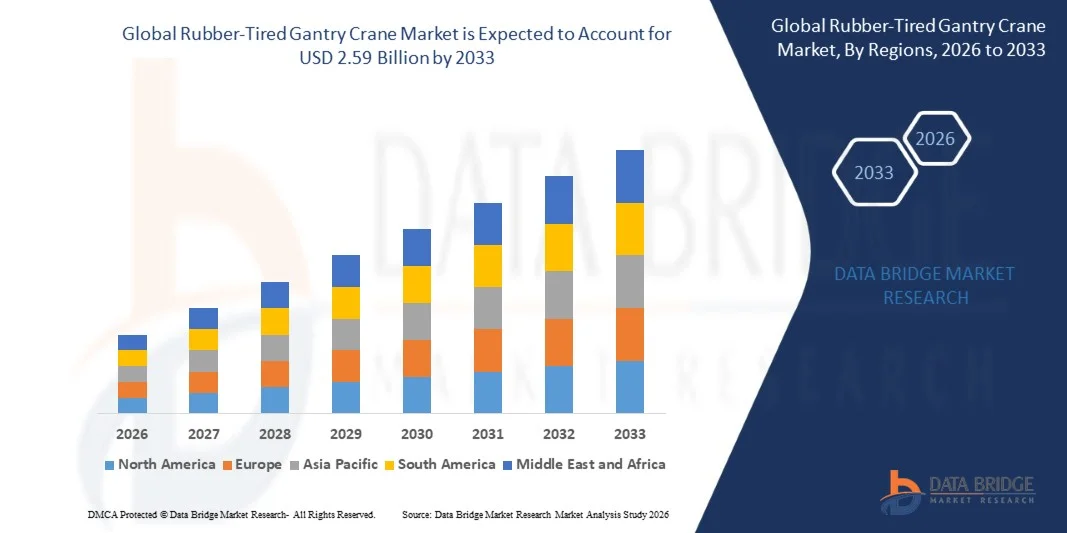
- As per Data Bridge Market Research analysis, the rubber-tired gantry crane market was valued at USD 1.70 billion in 2025 and is projected to reach USD 2.59 billion by 2033, growing at a CAGR of 5.40% from 2026 to 2033.
- The market is experiencing steady growth driven by rising container throughput, increasing investment in terminal capacity and yard modernization, and growing adoption of hybrid, electric, and automated crane technologies across seaports, inland container depots, dry ports, and rail terminals.
- The increasing emphasis on lower-emission cargo handling, labor safety, and higher stacking density, combined with growing integration of remote operation, automatic gantry steering, and fleet-monitoring systems, is supporting market adoption. Rubber-tired gantry cranes are being applied across container handling equipment fleets, intermodal rail yards, dry ports, and port automation projects, offering operators greater flexibility in stacking and transferring containers within terminal operations.
Market Size & Forecast
- Global Market Value (2025): USD 1.70 Billion
- Expected Market Value (2033): USD 2.59 Billion
- Forecast CAGR (2026–2033): 5.40%
- Leading Region in 2025: Asia-Pacific
- Fastest Growing Region: Middle East and Africa
What are the Major Takeaways of the Rubber-Tired Gantry Crane Market?
- Asia-Pacific dominated the rubber-tired gantry crane market with the largest revenue share of 46.85% in 2025, supported by large container ports, high transshipment volumes, and continuous terminal expansion and fleet modernization across China, Japan, India, and Southeast Asia.
- Middle East and Africa is expected to be the fastest-growing region at a CAGR of 7.35% from 2026 to 2033, fueled by new port and logistics-hub investments, rising transshipment activity, and adoption of hybrid and electric yard equipment.
- The hybrid segment led the power source category with a 43.80% share in 2025, driven by operators' need to cut fuel use and emissions while retaining operational flexibility.
- Electric is the fastest-growing power source, projected to register a CAGR of 8.20%, reflecting decarbonization targets and wider availability of busbar and battery systems.
- The up to 40 tons segment dominated the lifting capacity category with a 52.40% revenue share in 2025, led by its suitability for standard container handling and stacking.
- Container handling accounted for 68.90% of the market share in 2025, preferred by terminal operators seeking flexible yard stacking and efficient truck and rail transfers.
- The intermodal yard operations segment is the fastest-growing application category, with a CAGR of 6.60%, driven by expansion of rail-linked terminals, dry ports, and inland logistics hubs.
Report Scope and Rubber-Tired Gantry Crane Market Segmentation
|
Attributes |
Rubber-Tired Gantry Crane Key Market Insights |
|
Segments Covered |
|
|
Countries Covered |
North America
Europe
Asia-Pacific
Middle East and Africa
South America
|
|
Key Market Players |
|
|
Market Opportunities |
|
|
Value Added Data Infosets |
In addition to the market insights such as market value, growth rate, market segments, geographical coverage, market players, and market scenario, the market report curated by the Data Bridge Market Research team includes in-depth expert analysis, import/export analysis, pricing analysis, production consumption analysis, and pestle analysis. |
What is the Key Trend in the Rubber-Tired Gantry Crane Market?
- The container-yard crane fleet is shifting from conventional diesel drives toward hybrid and battery-electric rubber-tired gantry (RTG) cranes, as terminal operators look to cut fuel consumption, local emissions, and maintenance requirements while retaining the flexibility of a rubber-tired machine that can move between stacking blocks.
- For instance, in June 2025, according to Konecranes, the company launched its E-Hybrid RTG crane at the TOC Europe exhibition in Rotterdam, combining onboard batteries with busbar or cable-reel supply; the battery charging power requirement is 60 kW compared with up to 400 kW for RTGs powered directly by cable reel or busbar, and the underlying battery technology is already used in over 200 hybrid Konecranes RTGs globally
- Automation and remote operation are becoming standard options for new RTG fleets, with operators using automatic gantry steering, anti-sway, truck-detection, and remote-supervision functions to improve stacking productivity and safety while reducing dependence on cab-based operation.
- Battery-electric configurations are also moving from pilot projects to full-shift operation, supported by larger battery packs, opportunity charging along the yard, and integration with terminal energy-management systems.
- For instance, in March 2026, according to WorldCargo News, Konecranes won the first battery-electric RTG order in Europe from HHLA TK Estonia for the Port of Muuga, with the 1-over-5, six-lane cranes using a 296 kWh battery system that enables up to eight hours of independent operation and an integrated 25-metre busbar charging system
- As battery technology, remote-operation software, and yard-energy infrastructure continue to mature, RTG cranes are expected to evolve from diesel-dependent yard machines into connected, low-emission, and increasingly automated assets that support higher terminal throughput within a limited yard footprint.
What are the Key Drivers of the Rubber-Tired Gantry Crane Market?
- Rising container throughput, space constraints in terminals, and growing pressure to decarbonize cargo-handling operations are encouraging terminal operators to invest in new and replacement RTG fleets that stack containers higher and operate more efficiently.
- For instance, in July 2026, according to Container News, YILPORT Holding ordered 53 E-Hybrid RTG cranes from Konecranes for terminals in Portugal, El Salvador, and Ghana, comprising 20 automated and 33 manual units, with delivery in batches over the following two years.
- Port authorities and terminal operators are also prioritizing labor safety, predictable yard productivity, and lower total cost of ownership, which favors cranes with automatic gantry steering, remote supervision, and lower fuel and maintenance requirements than conventional diesel units.
- For instance, in September 2025, according to Konecranes, a major Colombian container terminal ordered 25 RTGs together with 10 retrofits for remote supervision, with the cranes to be delivered in five batches between the fourth quarter of 2026 and the first quarter of 2028 and integrated with the terminal's existing IT and operational technology infrastructure, including remote operating stations.
- Expanding inland container depots, dry ports, and rail-linked terminals, along with replacement demand for ageing diesel fleets, are further supporting steady procurement of RTG cranes across developed and emerging markets.
What Factors Are Challenging the Growth of the Rubber-Tired Gantry Crane Market?
- Rubber-tired gantry cranes involve high upfront capital cost, and electric and hybrid variants additionally require charging infrastructure, grid connections, and energy-management systems, which can lengthen payback periods for smaller terminals.
- For instance, in June 2025, according to Konecranes, even short one- or two-second blackouts cause emergency stops, brake issues, and maintenance problems on electrified RTGs, while longer outages halt operations completely, highlighting the dependence of electric yard equipment on reliable power supply.
- Trade-policy uncertainty and supply concentration in crane manufacturing can raise procurement costs and complicate delivery planning, particularly for public port authorities that purchase equipment through long-term capital programs.
- In addition, the transition from manual to automated and remote-operated RTG operation requires investment in networks, yard-control software, cybersecurity, and operator training, and can raise workforce and labor-relations considerations in some ports.
- For instance, in October 2025, according to Supply Chain Dive, the U.S. Trade Representative announced 100% tariffs on ship-to-shore cranes and cargo-handling equipment linked to China, effective November 9, and was considering tariffs of up to 150% on imported rubber-tired gantry cranes, rail-mounted gantry cranes, automatic stacking cranes, and related terminal equipment, creating cost and sourcing uncertainty for terminal operators.
- Longer lead times, specialized maintenance requirements, and the need to integrate cranes from different manufacturers into a single terminal operating system can further constrain adoption among cost-sensitive operators, particularly where existing diesel fleets still meet basic productivity needs.
How is the Rubber-Tired Gantry Crane Market Segmented?
The rubber-tired gantry crane market is segmented on the basis of power source, lifting capacity, application, and end user.
- By Power Source
On the basis of power source, the rubber-tired gantry crane market is segmented into diesel, hybrid, and electric. The hybrid segment dominated the market with 43.80% share in 2025, supported by terminal operators' need to cut fuel consumption and emissions without depending entirely on a fixed electrical supply. Hybrid cranes use onboard batteries and a smaller generator or supplementary power source, which reduces diesel use during stacking and idle periods. They can be deployed in yards with limited grid capacity and later converted to fully electric operation. Lower noise, reduced maintenance, and compatibility with existing yard layouts are further strengthening demand.
The electric segment is projected to register the fastest growth at a CAGR of 8.20% from 2026 to 2033, driven by decarbonization targets and the availability of busbar, cable-reel, and large-battery power systems. Electric cranes eliminate tailpipe emissions and reduce engine servicing requirements, which lowers lifetime operating costs. Terminals with reliable grid connections and renewable energy sourcing are increasingly specifying battery-electric and busbar-fed machines for new yards. Improvements in battery capacity, fast charging, and energy-management software are widening the range of terminals where full electrification is practical. Government incentives and customer sustainability requirements are also supporting adoption.
- By Lifting Capacity
On the basis of lifting capacity, the rubber-tired gantry crane market is segmented into up to 40 tons, 41–50 tons, and above 50 tons. The up to 40 tons segment dominated the market with 52.40% share in 2025, supported by its suitability for standard 20-foot, 40-foot, and 45-foot container handling and for stacking containers several tiers high. Cranes in this class balance lifting performance, wheel loads, and acquisition cost, making them the preferred choice for most seaport and inland terminals. Their compatibility with common yard pavements and widespread availability of spare parts and service support further strengthen demand.
The above 50 tons segment is projected to register the fastest growth at a CAGR of 6.80% from 2026 to 2033, driven by the need to handle heavier loaded containers, twin-lift operations, project cargo, and larger stacking blocks. Terminals serving heavy industrial and bulk-container flows are specifying higher-capacity cranes with reinforced structures and stronger spreaders. Higher capacity also supports greater stack height and wider spans, improving yard-space utilization at congested ports. Advances in structural design, drive systems, and load-monitoring technology are helping manufacturers deliver heavier-duty machines without proportionately higher energy use.
- By Application
On the basis of application, the rubber-tired gantry crane market is segmented into container handling, intermodal yard operations, and others. The container handling segment dominated the application category with 68.90% share in 2025, supported by rising container throughput and the central role of yard cranes in stacking, retrieving, and loading containers onto trucks. Rubber-tired gantry cranes allow terminals to reconfigure stacking blocks as traffic patterns change, which is valuable in multi-user and transshipment terminals. Operators are also adding automatic steering, anti-sway, and truck-detection features to improve productivity and safety during container handling.
The intermodal yard operations segment is projected to register the fastest growth at a CAGR of 6.60% from 2026 to 2033, driven by the expansion of rail-linked terminals, dry ports, and inland logistics hubs. Rubber-tired gantry cranes can serve both trucks and rail wagons and can be redeployed between yards without fixed rail infrastructure. Growing modal shift from road to rail is increasing demand for flexible transfer equipment at intermodal facilities. Integration with terminal operating systems, remote-supervision tools, and yard-planning software is further improving the efficiency of container transfers between modes.
- By End User
On the basis of end user, the rubber-tired gantry crane market is segmented into seaports, inland container depots and dry ports, rail terminals, and others. The seaports segment dominated the end-user category with 71.30% share in 2025, supported by continuous expansion of container terminal capacity and replacement of ageing yard fleets. Port operators are investing in cranes that raise stacking density, reduce emissions, and enable remote or automated operation. Large terminal groups often place multi-unit orders, which supports sustained demand for new crane deliveries and long-term service agreements.
The inland container depots and dry ports segment is projected to register the fastest growth at a CAGR of 7.10% from 2026 to 2033, driven by efforts to decongest coastal ports and move container processing closer to industrial and consumption centers. New dry ports and inland terminals are being developed with rail and road connectivity, creating demand for flexible yard cranes. Government logistics programs and private investment in inland infrastructure are supporting new equipment procurement. Lower-cost configurations and hybrid drives are particularly attractive for these facilities.
Which Region Holds the Largest Share of the Rubber-Tired Gantry Crane Market?
- Asia-Pacific dominated the rubber-tired gantry crane market with the largest revenue share of 46.85% in 2025, supported by the concentration of the world's busiest container ports, strong transshipment activity, and continuous investment in terminal expansion and equipment replacement.
- The region also benefits from the presence of leading crane manufacturers, large terminal operating groups, and government-backed port and logistics programs, along with growing adoption of hybrid, electric, and remote-operated yard equipment. Increasing container volumes, inland terminal development, and sustainability targets continue to strengthen Asia-Pacific's position in the global market.
China Rubber-Tired Gantry Crane Market Insight
The China rubber-tired gantry crane market is witnessing strong growth due to the country's large container port network, high export volumes, and continuous terminal expansion and automation. Domestic crane manufacturers and terminal operators are supplying and deploying hybrid, electric, and remote-operated RTG fleets at coastal and inland terminals. In addition, government support for green port development, shore-power use, and smart-port initiatives is accelerating the replacement of diesel yard equipment and strengthening China's position as both a major demand center and an export base for yard cranes.
Middle East and Africa Rubber-Tired Gantry Crane Market Insight
The Middle East and Africa rubber-tired gantry crane market is expected to witness rapid growth, driven by new port and logistics-hub investments, rising transshipment activity, and efforts to expand container-handling capacity along major shipping lanes. Terminal operators are deploying hybrid and automated RTG fleets to improve yard productivity and reduce emissions. In addition, government diversification programs, free-zone development, and growing intra-regional and Africa-bound trade are supporting equipment procurement across countries such as Saudi Arabia, the U.A.E., and South Africa.
U.A.E. Rubber-Tired Gantry Crane Market Insight
The U.A.E. rubber-tired gantry crane market is experiencing strong growth, supported by its role as a global transshipment and re-export hub with large, technologically advanced container terminals. Terminal operators are investing in higher-capacity, automated, and lower-emission yard equipment to handle rising volumes and shorten vessel and truck turnaround times. Furthermore, national logistics and sustainability strategies, together with continued capacity expansion at major ports and free zones, are encouraging adoption of hybrid and electric RTG fleets.
Saudi Arabia Rubber-Tired Gantry Crane Market Insight
The Saudi Arabia rubber-tired gantry crane market is growing rapidly, driven by Vision 2030 logistics programs, expansion of Red Sea and Gulf port capacity, and development of dry ports and logistics zones. Terminal operators are procuring modern yard cranes to support rising container volumes and improve operational efficiency. In addition, investments in rail-linked inland terminals and national logistics corridors are creating demand for flexible RTG equipment, while a focus on automation and sustainability is influencing technology choices.
Netherlands Rubber-Tired Gantry Crane Market Insight
The Netherlands rubber-tired gantry crane market is expanding steadily, supported by the country's role as a leading European container gateway and its extensive inland terminal and barge network. Terminal operators are investing in electric, hybrid, and automated yard equipment to meet strict emission and noise requirements. Moreover, strong digital infrastructure, port-community systems, and ongoing terminal modernization are encouraging adoption of remote-supervision and automation technologies on rubber-tired gantry cranes.
Germany Rubber-Tired Gantry Crane Market Insight
The Germany rubber-tired gantry crane market is witnessing consistent growth due to the country's strong port and intermodal terminal network, advanced engineering base, and focus on decarbonization. Seaport and inland terminal operators are modernizing yard fleets with electric, hybrid, and automated cranes to improve efficiency and meet climate targets. Furthermore, emphasis on rail–road intermodal transport, workplace safety, and energy-efficient equipment is supporting demand for modern RTG solutions across German terminals.
Which are the Top Companies in Rubber-Tired Gantry Crane Market?
The rubber-tired gantry crane industry is primarily led by well-established companies, including:
- Konecranes Plc (Finland)
- Kalmar Corporation (Finland)
- Shanghai Zhenhua Heavy Industries Co., Ltd. (China)
- Liebherr-International AG (Switzerland)
- SANY Heavy Industry Co., Ltd. (China)
- Mitsui E&S Co., Ltd. (Japan)
- Kuenz GmbH (Austria)
- Mi-Jack Products, Inc. (U.S.)
- Anupam Industries Limited (India)
- Cavotec SA (Switzerland)
- Conductix-Wampfler GmbH (Germany)
- ABB Ltd. (Switzerland)
- Siemens AG (Germany)
- Schneider Electric SE (France)
- Vahle GmbH & Co. KG (Germany)
- Cummins Inc. (U.S.)
- Volvo Penta (Sweden)
- Caterpillar Inc. (U.S.)
- TTS Group ASA (Norway)
- Gottwald Port Technology GmbH (Germany)
What are Latest Developments in Rubber-Tired Gantry Crane Market?
- In September 2026, DP World and Asian Terminals Inc. commissioned six hybrid rubber-tyred gantry cranes manufactured by ZPMC at Manila South Harbour; the cranes can stack containers six high, bring the terminal's RTG fleet to 29 units, and are designed for future conversion to fully electric operation.
- In July 2026, Hutchison Ports TIMSA took delivery of two electric rubber-tired gantry cranes from ZPMC for its operation at the Port of Manzanillo, Mexico; the busbar-powered cranes can stack containers 1-over-7 and form part of an investment exceeding 70 million pesos.
- In July 2026, Kalmar announced a major order from Patrick Terminals for hybrid and automated straddle carriers, with the hybrid machines to operate at the Melbourne terminal and the automated machines at the Sydney AutoStrad terminal, reflecting the parallel shift toward hybrid and automated yard equipment.
- In June 2026, Hutchison Ports Sohar signed an agreement with ZPMC for 12 automated electric rubber-tyred gantry cranes powered by grid-connected electricity, with delivery scheduled for the second quarter of 2027.
- In December 2025, six new electric rubber-tyred gantry cranes arrived at the PSA Genova Pra terminal in Italy as part of PSA's multi-year equipment renewal plan.

- Interactive Data Analysis Dashboard
- Company Analysis Dashboard for high growth potential opportunities
- Research Analyst Access for customization & queries
- Competitor Analysis with Interactive dashboard
- Latest News, Updates & Trend analysis
- Harness the Power of Benchmark Analysis for Comprehensive Competitor Tracking
Data collection and base year analysis are done using data collection modules with large sample sizes. The stage includes obtaining market information or related data through various sources and strategies. It includes examining and planning all the data acquired from the past in advance. It likewise envelops the examination of information inconsistencies seen across different information sources. The market data is analysed and estimated using market statistical and coherent models. Also, market share analysis and key trend analysis are the major success factors in the market report. To know more, please request an analyst call or drop down your inquiry.
The key research methodology used by DBMR research team is data triangulation which involves data mining, analysis of the impact of data variables on the market and primary (industry expert) validation. Data models include Vendor Positioning Grid, Market Time Line Analysis, Market Overview and Guide, Company Positioning Grid, Patent Analysis, Pricing Analysis, Company Market Share Analysis, Standards of Measurement, Global versus Regional and Vendor Share Analysis. To know more about the research methodology, drop in an inquiry to speak to our industry experts.
Data Bridge Market Research is a leader in advanced formative research. We take pride in servicing our existing and new customers with data and analysis that match and suits their goal. The report can be customized to include price trend analysis of target brands understanding the market for additional countries (ask for the list of countries), clinical trial results data, literature review, refurbished market and product base analysis. Market analysis of target competitors can be analyzed from technology-based analysis to market portfolio strategies. We can add as many competitors that you require data about in the format and data style you are looking for. Our team of analysts can also provide you data in crude raw excel files pivot tables (Fact book) or can assist you in creating presentations from the data sets available in the report.













