What is the Ruminants Feed Enzymes Market Size and Growth Rate?
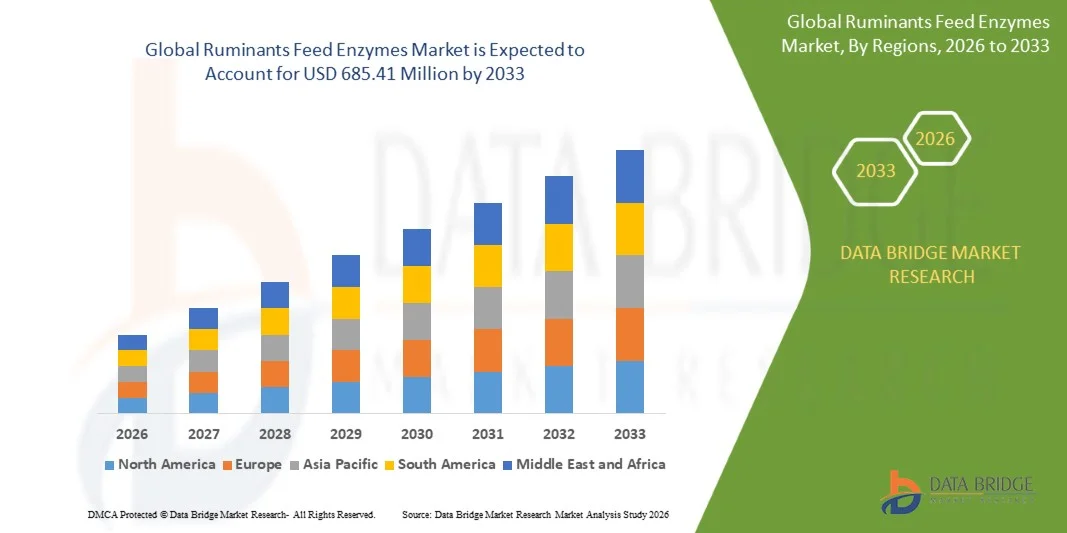
- As per Data Bridge Market Research analysis, the ruminants feed enzymes market was valued at USD 365.00 million in 2025 and is projected to reach USD 685.41 million by 2033, growing at a CAGR of 8.20% from 2026 to 2033.
- The market is experiencing steady growth driven by rising global demand for dairy and beef products, growing emphasis on feed conversion efficiency to reduce production costs, and increasing adoption of enzyme-based feed additives as sustainable alternatives to conventional growth promoters.
- The growing scrutiny of livestock methane emissions and environmental impact, combined with rising feed-ingredient costs, is compelling commercial dairy and beef producers to adopt fibrolytic and other feed enzymes that improve fiber digestibility and nutrient utilization from lower-cost roughage sources. Rising awareness of the role enzymes play in optimizing rumen function is reinforcing their position as a standard component of modern ruminant nutrition programs.
- Continued advancement in multi-enzyme blend formulations tailored to specific forage compositions and production stages is enabling feed manufacturers and commercial producers to achieve more precise, farm-specific nutritional outcomes compared to single-enzyme products.
Market Size & Forecast
- Global Market Value (2025): USD 365.00 Million
- Expected Market Value (2033): USD 685.41 Million
- Forecast CAGR (2026–2033): 8.20%
- Leading Region in 2025: North America
- Fastest Growing Region: Asia-Pacific
What are the Major Takeaways of the Ruminants Feed Enzymes Market?
- North America dominated the global ruminants feed enzymes market with the largest revenue share of 34.72% in 2025, supported by large-scale commercial dairy and beef operations and well-established feed-additive regulatory frameworks.
- Asia-Pacific is expected to be the fastest-growing region at a CAGR of 9.8% from 2026 to 2033, fueled by expanding commercial dairy farming and rising demand for feed-efficiency solutions in China and India.
- The carbohydrase enzyme type segment led the market with a 42.63% share in 2025, driven by its critical role in improving fiber and starch digestibility across forage-based ruminant diets.
- The microbial source segment is the fastest-growing source category, projected to register a CAGR of 9.3%, reflecting rising adoption of fermentation-derived enzymes offering consistent quality and scalable production.
- The dairy cattle livestock type segment dominated the livestock category with a 48.36% revenue share in 2025, led by sustained global demand for milk production efficiency and feed-cost optimization.
- The compound feed application segment accounted for 56.84% of the market share in 2025, preferred for its integration with standardized commercial feed manufacturing processes.
- The multi-enzyme/enzyme blends formulation segment is the fastest-growing formulation category, with a CAGR of 9.6%, driven by rising demand for tailored enzyme combinations addressing multiple digestibility challenges simultaneously.
Report Scope and Ruminants Feed Enzymes Market Segmentation
|
Attributes |
Ruminants Feed Enzymes Key Market Insights |
|
Segments Covered |
|
|
Countries Covered |
North America
Europe
Asia-Pacific
Middle East and Africa
South America
|
|
Key Market Players |
|
|
Market Opportunities |
|
|
Value Added Data Infosets |
In addition to the insights on market scenarios such as market value, growth rate, segmentation, geographical coverage, and major players, the market reports curated by the Data Bridge Market Research also include import export analysis, production capacity overview, production consumption analysis, price trend analysis, climate change scenario, supply chain analysis, value chain analysis, raw material/consumables overview, vendor selection criteria, PESTLE Analysis, Porter Analysis, and regulatory framework. |
What is the Key Trend in the Ruminants Feed Enzymes Market?
- Feed additive manufacturers are increasingly developing multi-enzyme blend formulations tailored to specific forage compositions, enabling more precise, farm-specific nutritional outcomes for commercial dairy and beef operations.
- For instance, in April 2025, Novonesis expanded its ruminant enzyme portfolio with a new fibrolytic enzyme blend designed to improve fiber digestibility in high-roughage dairy diets across European markets.
- Rising interest in enzyme-based feed additives as a tool for reducing enteric methane emissions is enabling livestock producers to address sustainability goals while simultaneously improving feed efficiency.
- Manufacturers are increasingly investing in thermostable and pelleting-resistant enzyme formulations that maintain activity through commercial feed-processing conditions, improving product reliability for large-scale feed manufacturers.
- For instance, in January 2025, Kemin Industries introduced an upgraded heat-stable protease enzyme product designed to withstand high-temperature pelleting processes used in commercial compound feed manufacturing.
- As livestock producers and feed manufacturers continue to prioritize feed efficiency, sustainability, and cost optimization, the adoption of advanced enzyme-based feed additives is expected to accelerate, reinforcing their role as a standard component of modern ruminant nutrition programs.
What are the Key Drivers of the Ruminants Feed Enzymes Market?
- Rising global demand for dairy and beef products, combined with increasing feed-ingredient costs, has significantly increased demand for enzyme-based additives capable of improving feed conversion efficiency and reducing overall production costs.
- For instance, in March 2025, Adisseo expanded its ruminant enzyme production capacity in Europe to meet rising demand from commercial dairy operations seeking improved feed-cost efficiency.
- Commercial livestock producers and feed manufacturers are increasingly incorporating enzyme additives into standard feed formulations to improve nutrient absorption, support animal health, and enhance overall production economics.
- For instance, in October 2024, Alltech announced an investment in additional enzyme production capacity to support rising orders from dairy and beef producers across North America and Latin America.
- With livestock producers increasingly relying on feed-efficiency improvements to manage rising input costs and sustainability expectations, ruminant feed enzymes will remain indispensable across commercial dairy, beef, and small-ruminant production systems worldwide.
- For instance, in June 2024, BASF expanded its animal nutrition enzyme portfolio to include additional ruminant-specific formulations, supporting growing demand from feed manufacturers seeking differentiated nutrition solutions.
- The ruminants feed enzymes market is driven by rising global demand for dairy and beef, escalating feed-ingredient costs, and the need to improve feed conversion efficiency. Producers increasingly adopt these enzymes to enhance nutrient absorption, support animal health, and lower production costs, prompting major industry investments by companies like Adisseo, Alltech, and BASF.
Which Factors are Challenging the Growth of the Ruminants Feed Enzymes Market?
- Enzyme efficacy in ruminant diets can be unpredictable due to the complex fermentation environment of the rumen, where variable pH levels, microbial interactions, and feed-processing conditions hinder a clear return on investment.
- Concerns regarding performance variability restrict widespread adoption, particularly among cost-conscious producers who require transparent and consistent efficacy data before committing to additive programs.
- For instance, in September 2024, Dairy Farmers of America (DFA) member networks across regional processing divisions temporarily deferred broader trials of targeted exogenous feed enzymes, citing variable performance outcomes across mixed forage-quality conditions.
- Performance inconsistencies disproportionately impact smaller-scale livestock operations lacking the resources for independent on-farm optimization, ultimately slowing broader commercial penetration in price-sensitive segments.
How is the Ruminants Feed Enzymes Market Segmented?
The ruminants feed enzymes market is segmented on the basis of enzyme type, source, form, livestock type, function, application, formulation, farm size, distribution channel and end user.
- By Enzyme Type
On the basis of enzyme type, the market is segmented into phytase, carbohydrase (amylase, cellulase, xylanase), protease, lipase, and others. The carbohydrase segment dominated the market with a 42.63% share in 2025, owing to its critical role in improving fiber and starch digestibility across forage-based ruminant diets. These enzymes break down complex plant-based carbohydrates into more digestible forms, making them the foundational enzyme category for ruminant nutrition programs.
The protease segment is projected to register the fastest growth at a CAGR of 9.1% from 2026 to 2033, driven by rising demand for improved protein utilization efficiency in high-performance dairy and beef production systems. Advances in protease stability and rumen-targeted delivery technology, combined with growing focus on protein-cost optimization, are accelerating segment expansion.
- By Source
On the basis of source, the market is segmented into microbial (bacteria, fungi), plant-based, and animal-based. The microbial segment led the market with a 68.94% share in 2025, supported by its scalable fermentation-based production, consistent enzyme quality, and broad enzyme-activity range compared to plant- and animal-derived alternatives.
The microbial segment is also expected to experience the fastest growth at a CAGR of 9.3% from 2026 to 2033, driven by continued advancements in fermentation technology and strain optimization that improve enzyme yield and cost efficiency.
- By Form
On the basis of form, the market is segmented into dry/powder and liquid. The dry/powder segment dominated the market with a share of 71.28% in 2025 due to its widespread compatibility with commercial compound-feed manufacturing processes, extended shelf stability, and ease of transport and storage. The widespread integration of powdered enzyme premixes into standardized feed-manufacturing workflows is driving strong demand for this form category.
The liquid segment is expected to witness the fastest CAGR of 8.9% from 2026 to 2033, driven by the rising need for precise, on-farm application flexibility in silage treatment and direct-feed applications. Manufacturers are increasingly developing liquid enzyme formulations optimized for spray-application methods. Additionally, the growing emphasis on farm-level customization of enzyme dosing is further accelerating adoption of this form category.
- By Livestock Type
On the basis of livestock type, the market is segmented into dairy cattle, beef cattle, sheep & goats, buffalo, and others. The dairy cattle segment dominated the market with a share of 48.36% in 2025 due to its critical role in supporting milk-production efficiency, increasing demand for feed-cost optimization in commercial dairy operations, and growing integration with precision-nutrition management programs. Additionally, rising focus on maximizing milk yield per unit of feed input further supports the strong adoption of enzyme additives in dairy cattle nutrition.
The buffalo segment is anticipated to witness the fastest CAGR of 9.4% from 2026 to 2033, driven by the increasing commercialization of buffalo dairy and meat production across South Asian markets. Producers are adopting enzyme-based feed additives to conduct cost-effective, scalable improvement of feed-conversion efficiency in buffalo production systems. Additionally, the integration of enzyme technology into expanding commercial buffalo operations is enhancing production economics, further driving segment growth.
- By Function
On the basis of function, the market is segmented into digestibility enhancement, nutrient absorption, feed conversion efficiency, and gut health improvement. The digestibility enhancement segment dominated the market with a share of 39.72% in 2025 due to its widespread use in breaking down complex fiber and starch components in forage-based ruminant diets, increasing demand for improved nutrient release from lower-cost feed ingredients, and growing integration with precision-feeding programs. Additionally, rising focus on maximizing nutritional value extraction from available feed resources further supports the strong adoption of digestibility-enhancement enzymes.
The feed conversion efficiency segment is expected to witness the fastest CAGR of 9.2% from 2026 to 2033, driven by the rising need for measurable, economically justifiable feed-efficiency improvements amid increasing input costs. Producers are increasingly adopting enzyme programs with quantifiable feed-conversion-ratio benefits. Additionally, the growing emphasis on production-cost accountability in commercial livestock operations is further accelerating adoption of this functional category.
- By Application
On the basis of application, the market is segmented into compound feed, feed premix, and fodder/silage treatment. The compound feed segment dominated the market with a share of 56.84% in 2025 due to its widespread integration with standardized commercial feed manufacturing processes, increasing demand for consistent, quality-controlled feed formulations, and growing integration with large-scale feed-mill operations. High adoption is driven by the increasing need for scalable enzyme-incorporation methods, integration with automated feed-manufacturing systems, and enhanced production consistency. Additionally, growing investment by feed manufacturers to improve product differentiation is reinforcing the leading position of this segment in the market.
The fodder/silage treatment segment is expected to witness the fastest CAGR of 9.0% from 2026 to 2033, driven by increasing farm-level adoption of enzyme treatments applied directly to silage and fodder to improve fermentation quality and nutrient preservation. Growing awareness among commercial producers regarding on-farm forage-quality optimization is further accelerating market expansion in this segment.
- By Formulation
On the basis of formulation, the market is segmented into single-enzyme and multi-enzyme/enzyme blends. The multi-enzyme/enzyme blends segment dominated the market with a share of 63.75% in 2025 due to its widespread adoption in addressing multiple digestibility and nutrient-utilization challenges simultaneously within a single product. High adoption is supported by feed manufacturers and commercial producers that rely on blended formulations to ensure comprehensive nutritional support, simplified inventory management, and measurable production outcomes. Additionally, increasing integration with farm-specific nutrition programs enhances formulation customization and reinforces the dominance of the multi-enzyme/enzyme blends segment.
The single-enzyme segment is expected to witness the fastest CAGR of 7.8% from 2026 to 2033, driven by the increasing demand for targeted enzyme solutions addressing specific, well-characterized digestibility challenges in research-supported nutrition programs. By offering precise, single-mechanism functionality, this formulation type enhances research clarity, dosing precision, and outcome predictability, making single-enzyme products attractive for specialized nutrition applications and research-oriented producers.
- By Farm Size
On the basis of farm size, the market is segmented into large-scale commercial farms and small & medium farms. The large-scale commercial farms segment dominated the market with a share of 66.83% in 2025 due to its preference among operations with sufficient production scale to justify enzyme-program investment and realize measurable return on investment through improved feed efficiency. Additionally, established feed-procurement infrastructure, broad supplier relationships, and extensive production-scale requirements are facilitating continued adoption of enzyme programs among large commercial operations, while strong vendor support networks are improving accessibility, reliability, and trust, further reinforcing this segment's leading market position.
The small & medium farms segment is expected to witness the fastest CAGR of 9.5% from 2026 to 2033, driven by the increasing availability of cost-optimized, simplified enzyme products designed for smaller-scale operations with limited technical support access. Manufacturers are leveraging simplified dosing formats and expanded distribution networks to enhance affordability, enable broader market access, and support smaller producers seeking feed-efficiency improvements, thereby accelerating adoption across small and medium-sized farm operations.
- By Distribution Channel
On the basis of distribution channel, the market is segmented into direct/B2B sales, feed mills/compounders, veterinary & farm supply stores, and online retail. The feed mills/compounders segment dominated the market with a share of 48.62% in 2025 due to its critical role in incorporating enzyme additives into commercial compound feed formulations at scale. Additionally, established long-term supply agreements, regional distribution infrastructure, and integrated formulation support are facilitating continued adoption of enzyme products among feed mills, while strong technical support networks are improving accessibility, reliability, and trust, further reinforcing this segment's leading market position.
The online retail segment is expected to witness the fastest CAGR of 10.2% from 2026 to 2033, driven by the increasing demand from small and medium-sized producers for accessible, standardized enzyme-product purchasing through e-commerce and agricultural supply platforms. These platforms offer scalable, cost-effective sourcing solutions for individual farmers and smaller operations, while providing product information, dosing guidance, and seamless integration with buyers' procurement routines, enhancing overall sourcing efficiency and flexibility.
- By End User
On the basis of end user, the market is segmented into commercial livestock producers, feed manufacturers, and individual farmers. The commercial livestock producers segment dominated the market with a share of 52.94% in 2025 due to its preference among large-scale dairy and beef operations with the production volume and technical capacity to implement and monitor enzyme-additive programs. Additionally, established herd-management infrastructure, broad access to nutrition consulting services, and extensive production-tracking capabilities are facilitating continued adoption of enzyme programs among commercial producers, while strong supplier relationships are improving accessibility, reliability, and trust, further reinforcing this segment's leading market position.
The feed manufacturers segment is expected to witness the fastest CAGR of 8.9% from 2026 to 2033, driven by the increasing incorporation of enzyme additives into differentiated, value-added commercial feed product lines. Feed manufacturers are leveraging enzyme technology to enhance product differentiation, enable improved customer feed-conversion outcomes, and support competitive positioning in the commercial feed market, thereby accelerating adoption across the feed-manufacturing sector.
Which Region Holds the Largest Share of the Ruminants Feed Enzymes Market?
- North America dominated the ruminants feed enzymes market and accounted for the largest revenue share of 34.72% in 2025, supported by large-scale commercial dairy and beef operations, well-established feed-additive regulatory frameworks, and the presence of established animal-nutrition companies.
- The region also benefits from advanced precision-nutrition management practices, high adoption of feed-efficiency-focused production systems, and growing use of enzyme additives across dairy, beef, and small-ruminant production applications. Increasing focus on sustainability and methane-reduction initiatives continues to strengthen North America's leadership position in the global market.
U.S. Ruminants Feed Enzymes Market Insight
The U.S. ruminants feed enzymes market is growing steadily, driven by large-scale commercial dairy and beef production, rising feed-ingredient costs prompting efficiency-focused nutrition strategies, and increasing adoption of precision-livestock-management practices. Growing adoption of multi-enzyme blend formulations across commercial dairy operations is significantly boosting market demand. In addition, rising investments in animal-nutrition research and development, increasing collaboration between enzyme manufacturers and feed companies, and rapid product innovation are positioning the United States as the leading global market for ruminant feed enzymes.
Canada Ruminants Feed Enzymes Market Insight
Canada ruminants feed enzymes market is witnessing steady growth due to the rigorous sustainability regulations and a push for improved feed efficiency, Canadian dairy and beef operators are rapidly adopting specialized enzyme blends. Small-grain dairies are increasingly using fiber-degrading complexes to optimize home-grown forages and boost milk yields, while beef feedlots rely on starch-specific enzymes to accelerate weight gain. This rapid adoption positions the ruminant sector to challenge traditional poultry market dominance.
Asia-Pacific Ruminants Feed Enzymes Market Insight
The Asia-Pacific ruminants feed enzymes market is expanding as livestock producers seek improved feed efficiency, nutrient digestibility, and animal performance. Rising dairy and meat consumption, growing commercial cattle farming, and increasing awareness of sustainable livestock production are supporting demand. Enzymes such as cellulase, xylanase, and protease are gaining attention for enhancing fiber and protein utilization. India, China, Japan, and Southeast Asian countries offer significant growth opportunities, supported by expanding livestock populations, technological advancements, and increasing adoption of value-added feed additives.
China Ruminants Feed Enzymes Market Insight
China ruminants feed enzymes market is expanding rapidly, supported by growing commercial dairy farming expansion, rising domestic milk-consumption demand, and increasing investment in modern livestock-production infrastructure. Dairy and beef producers are increasingly integrating enzyme additives into standardized feed formulations to improve production efficiency. Continuous expansion of domestic feed-manufacturing infrastructure and rising government support for livestock-industry modernization are further driving market growth in China.
India Ruminants Feed Enzymes Market Insight
India ruminants feed enzymes market is expanding steadily, supported by the country's large dairy and buffalo production base, growing commercialization of dairy farming, and increasing awareness of feed-efficiency benefits among progressive producers. Dairy cooperatives and commercial producers are increasingly integrating enzyme additives into feed formulations to improve milk-production economics. Continuous advancements in cost-optimized enzyme products, along with strong domestic dairy-sector growth, are further driving market growth in India.
Which are the Top Companies in Ruminants Feed Enzymes Market?
The ruminants feed enzymes industry is primarily led by well-established companies, including:
- BASF SE (Germany)
- Novonesis (Denmark)
- Koninklijke DSM N.V. (Netherlands)
- Associated British Foods plc (AB Vista) (U.K.)
- Adisseo France SAS (France)
- Kemin Industries, Inc. (U.S.)
- Alltech, Inc. (U.S.)
- Cargill, Incorporated (U.S.)
- International Flavors & Fragrances Inc. (U.S.)
- Evonik Industries AG (Germany)
- Elanco Animal Health Incorporated (U.S.)
- Phibro Animal Health Corporation (U.S.)
- Advanced Enzyme Technologies Ltd. (India)
- Sunson Industry Group Co., Ltd. (China)
- Jiangsu Boli Bioproducts Co., Ltd. (China)
- Zhejiang NHU Company Ltd. (China)
- Biocatalysts Ltd. (U.K.)
- AB Enzymes GmbH (Germany)
- Dyadic International, Inc. (U.S.)
- Lesaffre (France)
- Aum Enzymes (India)
- Beijing Smistyle Technology Co., Ltd. (China)
What are Latest Developments in Ruminants Feed Enzymes Market?
- In September 2025, Novonesis launched an expanded fibrolytic enzyme product line for commercial dairy operations in North America, targeting improved forage digestibility and feed-cost efficiency.
- In February 2025, Kemin Industries expanded its ruminant enzyme manufacturing capacity in Asia to support growing demand from commercial dairy and beef producers across the region.
- In November 2025, Adisseo introduced an upgraded thermostable multi-enzyme blend designed to maintain activity through high-temperature commercial feed-pelleting processes, improving product reliability for large-scale feed manufacturers. This development strengthens Adisseo's position in the compound-feed enzyme market by offering manufacturers a more processing-resilient product option.
- In October 2024, BASF expanded its animal nutrition enzyme portfolio in Europe to include additional ruminant-specific protease formulations tailored for high-performance dairy production systems.
- In June 2023, Alltech partnered with a regional feed manufacturer to co-develop customized multi-enzyme blend products for commercial dairy operations, combining its enzyme-technology expertise with the partner's regional feed-formulation and distribution capabilities to support broader producer access.
- In March 2023, Advanced Enzyme Technologies received manufacturing certification for an expanded fermentation-based enzyme production facility in India, enabling the company to serve growing demand from domestic dairy cooperatives and feed manufacturers seeking cost-optimized ruminant enzyme solutions.

- Interactive Data Analysis Dashboard
- Company Analysis Dashboard for high growth potential opportunities
- Research Analyst Access for customization & queries
- Competitor Analysis with Interactive dashboard
- Latest News, Updates & Trend analysis
- Harness the Power of Benchmark Analysis for Comprehensive Competitor Tracking
Data collection and base year analysis are done using data collection modules with large sample sizes. The stage includes obtaining market information or related data through various sources and strategies. It includes examining and planning all the data acquired from the past in advance. It likewise envelops the examination of information inconsistencies seen across different information sources. The market data is analysed and estimated using market statistical and coherent models. Also, market share analysis and key trend analysis are the major success factors in the market report. To know more, please request an analyst call or drop down your inquiry.
The key research methodology used by DBMR research team is data triangulation which involves data mining, analysis of the impact of data variables on the market and primary (industry expert) validation. Data models include Vendor Positioning Grid, Market Time Line Analysis, Market Overview and Guide, Company Positioning Grid, Patent Analysis, Pricing Analysis, Company Market Share Analysis, Standards of Measurement, Global versus Regional and Vendor Share Analysis. To know more about the research methodology, drop in an inquiry to speak to our industry experts.
Data Bridge Market Research is a leader in advanced formative research. We take pride in servicing our existing and new customers with data and analysis that match and suits their goal. The report can be customized to include price trend analysis of target brands understanding the market for additional countries (ask for the list of countries), clinical trial results data, literature review, refurbished market and product base analysis. Market analysis of target competitors can be analyzed from technology-based analysis to market portfolio strategies. We can add as many competitors that you require data about in the format and data style you are looking for. Our team of analysts can also provide you data in crude raw excel files pivot tables (Fact book) or can assist you in creating presentations from the data sets available in the report.