


Salivary Gland Cancer Treatment Market Size
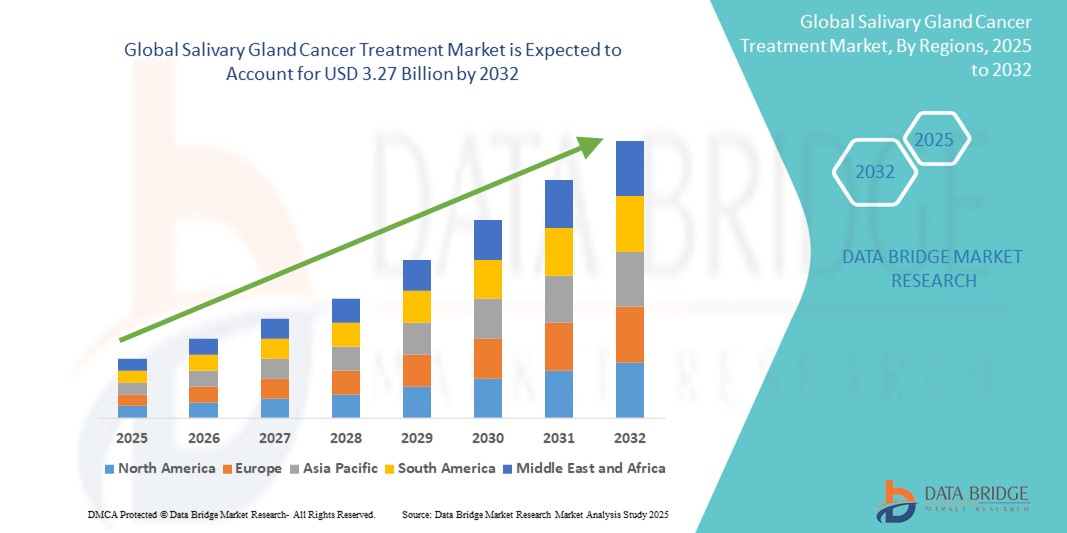
- The global salivary gland cancer treatment market size was valued at USD 1.78 billion in 2024 and is expected to reach USD 3.27 billion by 2032, at a CAGR of 7.90% during the forecast period
- The market growth is largely fueled by the increasing incidence of head and neck cancers, coupled with rising awareness and early detection of rare malignancies such as salivary gland cancer. Advancements in diagnostic imaging and biopsy techniques have improved the accuracy of cancer identification, allowing for timely and targeted intervention, particularly in developed healthcare systems. These factors are propelling demand for innovative and effective treatment solutions globally
- Furthermore, rising investment in oncology research and development, including the development of novel chemotherapy, targeted therapy, and immunotherapy agents, is establishing advanced therapeutics as the cornerstone of salivary gland cancer treatment. These converging factors are accelerating the uptake of salivary gland cancer treatment solutions, thereby significantly boosting the industry's growth. Additionally, the adoption of multidisciplinary care approaches—combining surgery, radiation, and systemic therapies—is driving improved patient outcomes and expanding treatment access across emerging economies
Salivary Gland Cancer Treatment Market Analysis
- The demand for salivary gland cancer treatment is increasing due to the rising incidence of head and neck cancers, improved diagnostic modalities, and the growing awareness of early detection. The introduction of targeted therapies and immunotherapy options has significantly advanced treatment outcomes for rare salivary gland malignancies
- The global salivary gland cancer Treatment market is further fueled by increasing healthcare investments, rising availability of cancer screening programs, and ongoing clinical trials exploring new treatment regimens. Surgical resection remains a mainstay of therapy, often supplemented with radiation or chemotherapy, particularly in advanced-stage cases
- North America dominated the salivary gland cancer treatment market with the largest revenue share of 41.3% in 2024, driven by robust healthcare infrastructure, high per capita healthcare spending, and early access to advanced oncology treatments. The U.S. in particular leads in clinical research, FDA-approved drug pipelines, and the presence of top-tier cancer treatment centers
- Asia-Pacific is expected to witness the fastest growth in the salivary gland cancer treatment market at a CAGR of 7.8% during the forecast period, fueled by increasing cancer incidence, rising awareness, expanding healthcare access in countries such as China and India, and growing adoption of radiotherapy and immunotherapy options
- The mucoepidermoid carcinoma segment dominated the salivary gland cancer treatment market with a market share of 34.2% in 2024, owing to its higher prevalence and favorable treatment outcomes. Early diagnosis and responsiveness to surgical and radiation therapies make it the most commonly managed subtype among salivary gland malignancies
Report Scope and Salivary Gland Cancer Treatment Market Segmentation
|
Attributes |
Salivary Gland Cancer Treatment Key Market Insights |
|
Segments Covered |
|
|
Countries Covered |
North America
Europe
Asia-Pacific
Middle East and Africa
South America
|
|
Key Market Players |
|
|
Market Opportunities |
|
|
Value Added Data Infosets |
In addition to the insights on market scenarios such as market value, growth rate, segmentation, geographical coverage, and major players, the market reports curated by the Data Bridge Market Research also include in-depth expert analysis, pricing analysis, brand share analysis, consumer survey, demography analysis, supply chain analysis, value chain analysis, raw material/consumables overview, vendor selection criteria, PESTLE Analysis, Porter Analysis, and regulatory framework. |
Salivary Gland Cancer Treatment Market Trends
“Rising Demand Due to Growing Cancer Incidence and Advancements in Treatment Modalities”
- A significant and accelerating trend in the global salivary gland cancer treatment market is the increasing incidence of head and neck cancers, including rare malignancies such as salivary gland carcinoma. The growing awareness of early diagnosis and better survival outcomes with timely intervention is driving demand for advanced therapeutic options
- For instance, in recent years, hospitals and cancer centers have strengthened multidisciplinary treatment programs involving surgical oncology, radiation therapy, and chemotherapy, particularly for rare salivary gland tumors, enabling more personalized and effective care pathways for patients
- Technological advancements in diagnostic imaging, such as high-resolution MRI, PET-CT scans, and endoscopy, are facilitating earlier and more accurate detection of tumors, contributing significantly to improved prognosis and treatment planning
- Furthermore, innovations in radiation therapy—including intensity-modulated radiation therapy (IMRT) and proton therapy—are offering greater precision in targeting cancerous tissues while minimizing damage to surrounding healthy structures such as nerves and glands, making them ideal for sensitive regions such as the head and neck
- The shift toward minimally invasive surgical techniques, improved post-surgical care, and reconstructive options is also enhancing quality of life for patients undergoing salivary gland tumor resections
- The demand for comprehensive cancer care across hospital networks, specialized clinics, and ambulatory surgical centers is expanding, with many health systems investing in oncology infrastructure and specialized care teams to handle complex head and neck cancers
Salivary Gland Cancer Treatment Market Dynamics
Driver
“Growing Need Due to Rising Cancer Incidence and Advancements in Targeted Therapy”
- The increasing incidence of salivary gland cancer worldwide, coupled with growing awareness and improved diagnostic capabilities, is significantly driving demand for advanced treatment options
- For instance, in April 2024, Bristol-Myers Squibb announced promising clinical data on immune checkpoint inhibitors for head and neck cancers, including rare salivary gland tumors. Such developments by key players are expected to bolster the growth of the Salivary Gland Cancer Treatment market during the forecast period
- As patients and providers seek more personalized and less invasive treatment approaches, therapies such as immunotherapy, precision radiotherapy, and targeted drug delivery systems are gaining traction over traditional chemoradiation methods
- Furthermore, the rising adoption of genomic profiling and molecular diagnostics is enabling oncologists to select optimal therapies tailored to individual tumor biology, significantly enhancing treatment outcomes
- The convenience of targeted therapies with fewer systemic side effects, outpatient-based regimens, and supportive care advancements are also key factors propelling the adoption of novel treatment strategies across hospitals, oncology centers, and research institutes. The shift towards multidisciplinary, precision medicine approaches is further accelerating innovation in the salivary gland cancer care space
Restraint/Challenge
“High Treatment Costs and Limited Awareness in Low-Resource Settings”
- The high cost of advanced cancer therapies, including immunotherapies and radiotherapy devices, remains a major barrier to widespread adoption, particularly in developing countries where healthcare budgets are constrained
- For instance, while proton beam therapy has demonstrated benefits in salivary gland cancers with reduced toxicity, its cost-intensive infrastructure limits its accessibility to only a few advanced centers worldwide
- Moreover, a lack of awareness about early symptoms, delayed diagnosis, and insufficient screening programs in rural or underserved areas results in many cases being detected at advanced stages, limiting curative treatment potential
- Addressing these challenges requires global efforts to improve early detection through awareness campaigns, implement cost-effective screening tools, and expand access to newer therapies via public-private partnerships and value-based pricing models
- In addition, strengthening cancer registries, improving referral systems, and training healthcare professionals in rare cancer management will be essential to expanding reach and improving survival rates. Overcoming these hurdles will be critical to unlocking the full growth potential of the Salivary Gland Cancer Treatment market in the years ahead
Salivary Gland Cancer Treatment Market Scope
The market is segmented on the basis of type, treatment, diagnosis, end-users, and distribution channel.
- By Type
On the basis of type, the salivary gland cancer treatment market is segmented into mucoepidermoid carcinoma, adenoid cystic carcinoma, adenocarcinomas, malignant mixed tumors, and others. The mucoepidermoid carcinoma segment held the largest market revenue share of 34.2% in 2024, owing to its higher prevalence and favorable treatment outcomes.
The adenoid cystic carcinoma segment is expected to register the fastest CAGR of 8.6% from 2025 to 2032, due to increased research and treatment efforts.
- By Treatment
On the basis of treatment, the gland cancer treatment market is segmented into surgery, radiation therapy, and chemotherapy. The surgery segment accounted for the largest revenue share of 47.5% in 2024, as it remains the first-line treatment for most salivary gland cancers.
The radiation therapy segment is projected to grow at the highest CAGR of 9.3% during the forecast period, driven by increased application in advanced-stage and recurrent cases.
- By Diagnosis
On the basis of diagnosis, the gland cancer treatment market is segmented into MRI, CT Scan, PET scan, endoscopy, and biopsy. The MRI segment held the dominant market share of 29.6% in 2024, due to its accuracy in soft tissue visualization.
The PET Scan segment is anticipated to grow at a fastest CAGR of 10.1% during 2025–2032, due to growing use in cancer staging and recurrence detection.
- By End User
On the basis of end-users, the gland cancer treatment market is segmented into clinic, hospital, and others. The hospital segment captured the largest market share of 62.8% in 2024, driven by comprehensive care capabilities and specialized oncology services.
The clinic segment is expected to grow at the fastest CAGR of 7.7% during 2025–2032, supported by the shift toward outpatient care and day surgeries.
- By Distribution Channel
On the basis of distribution channel, the gland cancer treatment market is segmented into hospital pharmacy, retail pharmacy, and online pharmacy. The hospital pharmacy segment led with a revenue share of 53.4% in 2024, due to high patient inflow and post-treatment medication dispensing.
The Online Pharmacy segment is forecasted to grow at the highest CAGR of 11.2% during 2025–2032, owing to growing digital adoption, ease of access, and home delivery services.
Salivary Gland Cancer Treatment Market Regional Analysis
- North America dominated the salivary gland cancer treatment market with the largest revenue share of 41.3% in 2024, driven by the presence of advanced healthcare infrastructure, increasing incidence of salivary gland cancers, and growing awareness of early diagnosis and treatment options
- The region benefits from strong government funding for cancer research and access to cutting-edge therapies, including proton therapy and targeted radiation
- The availability of skilled professionals and early adoption of new technologies such as image-guided surgery and precision diagnostics continue to support market dominance
U.S. Salivary Gland Cancer Treatment Market Insight
The U.S. accounted for the largest share of 83% of the North American market in 2024, propelled by a high burden of head and neck cancers, advanced diagnostic imaging technologies (MRI, CT, PET), and a favorable reimbursement landscape. Major pharmaceutical players and clinical research organizations are actively developing novel chemotherapy and immunotherapy regimens, strengthening the country’s leadership. The increasing prevalence of salivary gland tumors among the aging population and a strong pipeline of FDA-approved oncology drugs further accelerate growth.
Europe Salivary Gland Cancer Treatment Market Insight
The Europe salivary gland cancer treatment market is projected to expand at a robust CAGR during the forecast period, driven by rising cancer awareness campaigns, universal healthcare access, and strong government support for oncology initiatives. Innovations in radiotherapy systems and the adoption of minimally invasive surgical techniques are improving patient outcomes. Countries such as Germany, France, and the U.K. are witnessing high demand for targeted therapies and diagnostic advancements.
U.K. Salivary Gland Cancer Treatment Market Insight
The U.K. market is anticipated to grow at a notable CAGR from 2025 to 2032, supported by enhanced cancer screening programs, collaborative research funding, and rising public health initiatives. The National Health Service (NHS) plays a pivotal role in providing equitable access to diagnostics and therapies. Technological integration with AI-based cancer detection tools is expected to shape the future landscape of cancer care.
Germany Salivary Gland Cancer Treatment Market Insight
Germany is expected to grow at a considerable CAGR during the forecast period, due to its advanced hospital infrastructure, high diagnostic precision, and a strong emphasis on medical innovation and sustainability. German oncology centers are increasingly incorporating robotic-assisted surgery and proton beam therapy for complex head and neck cancer cases. Rising investments in biotechnology and personalized medicine are driving the development of effective treatments for rare cancers such as those of the salivary gland.
Asia-Pacific Salivary Gland Cancer Treatment Market Insight
The Asia-Pacific market is poised to grow at the fastest CAGR of 7.8% during the forecast period (2025–2032), driven by rapid urbanization, improved healthcare infrastructure, and rising awareness in countries such as China, Japan, and India. Government initiatives for cancer prevention and early detection, along with increasing medical tourism, are boosting regional demand. Local production of generic chemotherapy drugs and surgical tools also enhances market accessibility.
Japan Salivary Gland Cancer Treatment Market Insight
The Japan market is gaining momentum due to an aging population, high incidence of head and neck cancers, and a robust healthcare system. Emphasis on early diagnosis through advanced imaging and AI-based systems is aiding timely treatment. Integration of personalized therapy options and high investment in cancer research are further contributing to market growth.
China Salivary Gland Cancer Treatment Market Insight
China accounted for the largest revenue share in the Asia-Pacific region in 2024, owing to its large patient pool, rapid growth in healthcare spending, and the government's "Healthy China 2030" initiative. Expansion of oncology centers and increased adoption of advanced imaging technologies such as PET-CT are improving diagnostic capabilities. Domestic pharmaceutical companies are investing heavily in R&D and clinical trials to meet rising demand for effective cancer therapies.
Salivary Gland Cancer Treatment Market Share
The salivary gland cancer treatment industry is primarily led by well-established companies, including:
- Varian Medical Systems, Inc. (U.S.)
- Siemens (Germany)
- Accuray Incorporated (U.S.)
- Koninklijke Philips N.V. (Netherlands)
- Elekta (Sweden)
- General Electric Company (U.S.)
- Bristol-Myers Squibb Company (U.S.)
- LGM Pharma (U.S.)
- Pfizer Inc. (U.S.)
- Bedford Laboratories (U.S.)
- Baxter (U.S.)
- Sanofi (U.S.)
- Pierre Fabre Laboratories (France)
- CMS Group Ltd (U.S.)
- Sandoz Group AG (U.S.)
Latest Developments in Global Salivary Gland Cancer Treatment Market
- In July 2024, Memorial Sloan Kettering Cancer Center (MSKCC) expanded its personalized approach to salivary gland cancer treatment by emphasizing precision medicine, including surgery, radiation, and systemic therapies tailored to tumor type and stage. With multidisciplinary care teams and advanced diagnostic tools, MSKCC continues to lead in delivering individualized treatment strategies aimed at improving patient outcomes for both early-stage and metastatic salivary gland cancers
- In July 2024, findings published in ESMO Open revealed significant advancements in biomarker-driven therapies for recurrent and metastatic salivary gland cancers. The study emphasized the importance of genomic profiling in identifying actionable mutations and optimizing therapy selection. These insights are expected to guide clinical decision-making and enhance the effectiveness of targeted treatment regimens
- In July 2024, during the ESMO Congress 2024, new clinical data were presented supporting the integration of personalized medicine into the treatment of recurrent and metastatic salivary gland cancers. The results suggest that incorporating genetic and molecular markers can significantly improve therapeutic outcomes and pave the way for more effective and patient-specific treatment plans in rare head and neck tumors

- Interactive Data Analysis Dashboard
- Company Analysis Dashboard for high growth potential opportunities
- Research Analyst Access for customization & queries
- Competitor Analysis with Interactive dashboard
- Latest News, Updates & Trend analysis
- Harness the Power of Benchmark Analysis for Comprehensive Competitor Tracking
Data collection and base year analysis are done using data collection modules with large sample sizes. The stage includes obtaining market information or related data through various sources and strategies. It includes examining and planning all the data acquired from the past in advance. It likewise envelops the examination of information inconsistencies seen across different information sources. The market data is analysed and estimated using market statistical and coherent models. Also, market share analysis and key trend analysis are the major success factors in the market report. To know more, please request an analyst call or drop down your inquiry.
The key research methodology used by DBMR research team is data triangulation which involves data mining, analysis of the impact of data variables on the market and primary (industry expert) validation. Data models include Vendor Positioning Grid, Market Time Line Analysis, Market Overview and Guide, Company Positioning Grid, Patent Analysis, Pricing Analysis, Company Market Share Analysis, Standards of Measurement, Global versus Regional and Vendor Share Analysis. To know more about the research methodology, drop in an inquiry to speak to our industry experts.
Data Bridge Market Research is a leader in advanced formative research. We take pride in servicing our existing and new customers with data and analysis that match and suits their goal. The report can be customized to include price trend analysis of target brands understanding the market for additional countries (ask for the list of countries), clinical trial results data, literature review, refurbished market and product base analysis. Market analysis of target competitors can be analyzed from technology-based analysis to market portfolio strategies. We can add as many competitors that you require data about in the format and data style you are looking for. Our team of analysts can also provide you data in crude raw excel files pivot tables (Fact book) or can assist you in creating presentations from the data sets available in the report.













