


Salt Substitute Market Overview
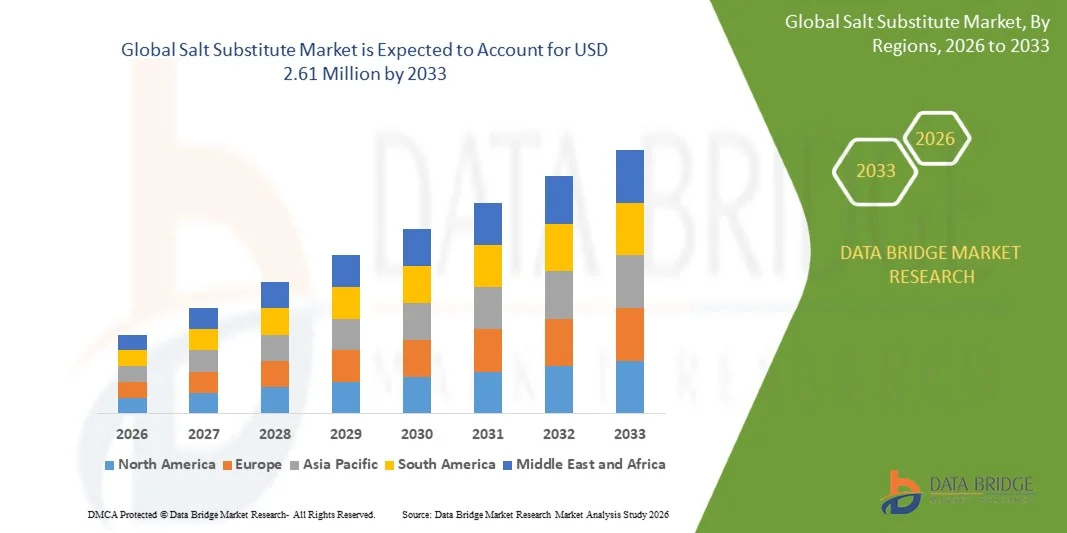
As per Data Bridge Market Research analysis the Salt Substitute Market was valued at USD 1.4 Billion in 2025 and is projected to reach USD 2.61 Billion by 2033, growing at a CAGR of 8.10% from 2026 to 2033. The market is experiencing consistent growth driven by rising health awareness regarding excessive sodium consumption, increasing prevalence of hypertension and cardiovascular diseases, and growing demand for low-sodium processed and packaged foods. Expanding adoption of mineral-based salt replacers, amino acid-based substitutes, and yeast-derived flavor enhancers across food manufacturing industries is further supporting market expansion globally.
The increasing global shift toward preventive healthcare and clean-label food consumption, combined with stricter regulatory guidelines on sodium reduction in processed foods, is encouraging food manufacturers to reformulate products using salt substitute ingredients. Growing innovation in taste modulation technologies and flavor enhancement systems is enabling manufacturers to maintain taste profiles while reducing sodium content, thereby accelerating adoption across snacks, sauces, bakery, and ready-to-eat food categories.
Key Market Trends & Insights
- Asia-Pacific dominated the Salt Substitute Market with the largest revenue share of 36.1% in 2025, supported by high consumption of processed and packaged foods, rising health awareness regarding sodium intake, and strong expansion of food manufacturing industries
- The mineral salt segment led the market with a 39.8% share in 2025, driven by widespread use of potassium chloride based formulations as primary sodium reduction agents across processed food applications
- North America is expected to be the fastest-growing region at a CAGR of 5.1% from 2026 to 2033, fueled by rising demand for healthier food formulations, increasing prevalence of lifestyle diseases, and strong innovation in food ingredient technologies
- Snacks are the fastest-growing application type, projected to register a CAGR of 13.4% from 2026 to 2033, supported by rising demand for healthier snacking alternatives with reduced sodium content
- The Sauces & Dressings segment dominated the application category with a 34.6% revenue share in 2025, led by high sodium content reformulation needs in condiments and flavor intensive products
- The Yeast Extracts segment is the fastest-growing type category, with a CAGR of 12.7% from 2026 to 2033, driven by increasing demand for natural flavor enhancers in low sodium food products
Market Size & Forecast
- Global Market Value (2025): USD 1.4 Billion
- Expected Market Value (2033): USD 2.61 Billion
- Forecast CAGR (2026–2033): 8.10%
- Leading Region in 2025: Asia-Pacific
- Fastest Growing Region: North America
Report Scope and Salt Substitute Market Segmentation
|
Attributes |
Salt Substitute Key Market Insights |
|
Segments Covered |
|
|
Countries Covered |
North America · U.S. · Canada · Mexico Europe · Germany · France · U.K. · Netherlands · Switzerland · Belgium · Russia · Italy · Spain · Turkey · Rest of Europe Asia-Pacific · China · Japan · India · South Korea · Singapore · Malaysia · Australia · Thailand · Indonesia · Philippines · Rest of Asia-Pacific Middle East and Africa · Saudi Arabia · U.A.E. · South Africa · Egypt · Israel · Rest of Middle East and Africa South America · Brazil · Argentina · Rest of South America |
|
Key Market Players |
· DuPont (U.S.) · ADM (U.S.) · Tate & Lyle (U.K.) · Ingredion Incorporated (U.S.) · Cargill Incorporated (U.S.) · Roquette Frères (France) · PureCircle Ltd (U.S.) · MacAndrews & Forbes Holdings Inc. (U.S.) · JK Sucralose Inc. (China) · Ajinomoto Co. (Japan) · Südzucker AG (Germany) · Guilin Layn Natural Ingredients Corp. (China) · Zhucheng Haotian Pharm Co., Ltd. (China) · HSWT France SAS (France) |
|
Market Opportunities |
· Expansion in Processed and Packaged Food Industry Adoption · Growth in Functional and Health-Oriented Food Product Development · Rising Opportunities in Plant-Based and Natural Flavor Enhancement Systems |
|
Value Added Data Infosets |
In addition to the insights on market scenarios such as market value, growth rate, segmentation, geographical coverage, and major players, the market reports curated by the Data Bridge Market Research also include in-depth expert analysis, pricing analysis, brand share analysis, consumer survey, demography analysis, supply chain analysis, value chain analysis, raw material/consumables overview, vendor selection criteria, PESTLE Analysis, Porter Analysis, and regulatory framework. |
Salt Substitute Market Trends
Trend: Rising Demand for Clean Label and Low Sodium Food Reformulation
The Salt Substitute Market is witnessing strong momentum due to increasing consumer preference for clean-label, low-sodium, and health-oriented food products. Food manufacturers are actively reformulating processed foods using potassium-based mineral salts, yeast extracts, and amino acid-based substitutes to address rising health concerns linked to excessive sodium intake. This trend is further supported by growing awareness of cardiovascular risks and hypertension across developed and emerging economies, pushing both retail and foodservice sectors toward sodium reduction initiatives.
Companies such as Nestlé are actively reformulating product portfolios, including reduced-sodium variants in packaged foods and seasoning systems, to align with global nutrition and health guidelines promoting lower salt consumption.
Salt Substitute Market Dynamics
Key Market Driver: Increasing Prevalence of Hypertension Driving Sodium Reduction Initiatives
The rising global burden of hypertension and cardiovascular diseases is a major driver accelerating demand for salt substitutes across food applications. Public health organizations such as the World Health Organization (WHO) have consistently recommended reducing sodium intake to below 5 grams per day, prompting governments and food regulators to enforce sodium reduction targets in processed foods. This has significantly increased adoption of salt replacement ingredients in snacks, bakery, sauces, and ready-to-eat meals.
Companies such as World Health Organization continue to support global sodium reduction strategies, while food manufacturers including Unilever are reformulating product lines such as soups, dressings, and seasonings to reduce sodium content while maintaining taste quality.
Key Restraint/Challenge: Taste Masking Complexity and Consumer Acceptance Limitations
A major challenge in the salt substitute market is maintaining taste integrity, as sodium reduction often leads to bitterness, metallic aftertaste, or reduced flavor intensity in food products. Achieving consumer-acceptable sensory profiles requires advanced formulation techniques, blending multiple substitute ingredients, and flavor modulation systems, which increases complexity for manufacturers. Consumer resistance to taste changes in familiar food products further limits large-scale adoption in certain categories.
Companies such as Kerry Group are addressing these challenges by developing proprietary flavor masking and sodium reduction technologies that help food manufacturers maintain taste while lowering sodium content across processed food applications.
Key Market Opportunity: Growth in Functional and Health-Oriented Food Product Development
The expanding demand for functional foods and health-focused dietary products is creating significant growth opportunities for salt substitutes globally. Increasing consumer interest in heart-health, weight management, and preventive nutrition is driving innovation in low-sodium formulations across bakery, dairy, snacks, and nutraceutical applications. Food manufacturers are increasingly integrating natural flavor enhancers and mineral salt systems to align with wellness-driven consumption patterns.
Companies such as Cargill Incorporated are investing in advanced sodium reduction technologies and functional ingredient solutions that support healthier food formulations while preserving taste and texture in processed food products.
Salt Substitute Market Scope
The salt substitute market is segmented on the basis of type and application.
- By Type
On the basis of type, the Salt Substitute Market is segmented into Mineral Salts, Amino Acids, Yeast Extracts, Hydrolyzed Vegetable Protein, and Others. The Mineral Salts segment dominated the market with the largest share of 39.8% in 2025, driven by widespread use of potassium chloride based formulations as primary sodium reduction agents across processed food applications. Strong adoption in clean label and reduced sodium product formulations supports its leadership position. Food manufacturers prefer mineral salts due to cost efficiency and ease of formulation compatibility in large scale production. Rising health concerns linked to hypertension and cardiovascular disorders further reinforce sustained demand across global food industries.
The Yeast Extracts segment is projected to register the fastest growth at a CAGR of 12.7% from 2026 to 2033, driven by increasing demand for natural flavor enhancers in low sodium food products. Expanding preference for umami rich taste profiles in processed foods is accelerating adoption across multiple food categories. Advances in fermentation technologies are improving flavor intensity while maintaining clean label positioning. Growing application in ready to eat meals and premium health focused products is significantly supporting segment expansion.
- By Application
On the basis of application, the Salt Substitute Market is segmented into Bakery & Confectionery, Snacks, Meat & Poultry, Beverages, Soups, Salads, Sauces & Dressings, and Others. The Sauces & Dressings segment dominated the market with a share of 34.6% in 2025, driven by high sodium content reformulation needs in condiments and flavor intensive products. Manufacturers are actively reducing salt levels while maintaining taste stability through advanced blending of mineral salts and flavor modulators. Strong consumption of packaged sauces in urban diets further supports segment leadership. Regulatory pressure for sodium reduction in processed foods reinforces continuous reformulation across major global brands.
The Snacks segment is projected to register the fastest growth at a CAGR of 13.4% from 2026 to 2033, driven by rising demand for healthier snacking alternatives with reduced sodium content. Increasing consumer awareness of diet related health risks is pushing manufacturers to reformulate chips, extruded snacks, and savory products. Innovations in seasoning systems and salt replacement blends are enabling improved taste retention in low sodium snack formulations. Expanding retail penetration of health focused snack brands is accelerating adoption across developed and emerging markets.
Salt Substitute Market Regional Analysis
Asia-Pacific dominated the salt substitute market and accounted for the largest revenue share of 36.1% in 2025, supported by high consumption of processed and packaged foods, rising health awareness regarding sodium intake, and strong expansion of food manufacturing industries. The region benefits from rapid urbanization, increasing demand for low sodium convenience foods, and growing government initiatives promoting dietary salt reduction to address hypertension risks. Expanding retail penetration of health-focused food products and strong presence of regional food processing companies are further accelerating market growth across major economies.
China Salt Substitute Market Insight
China held the largest share in the Asia-Pacific Salt Substitute market in 2025, driven by its massive processed food industry and increasing consumer shift toward healthier dietary habits. Strong adoption of potassium-based mineral salt substitutes across sauces, snacks, and ready-to-eat meals is supporting large-scale usage. The country also benefits from rising government-led nutrition awareness campaigns targeting sodium reduction in daily diets. In addition, expansion of domestic food manufacturing and growing export demand for reformulated low sodium products are reinforcing China’s leadership in the regional market.
India Salt Substitute Market Insight
India is witnessing the fastest growth in the Asia-Pacific region at a CAGR of 13.2% from 2026 to 2033, driven by rising cases of hypertension, increasing awareness of heart health, and expanding demand for packaged and convenience foods. Growing adoption of salt substitutes in snacks, sauces, and home cooking applications is further supporting market expansion. The country is also benefiting from rising penetration of health-focused FMCG brands and increasing availability of low sodium products through modern retail and e-commerce channels. In addition, growing urbanization and dietary diversification are accelerating long-term market growth.
Europe Salt Substitute Market Insight
The Europe Salt Substitute market is expanding steadily, supported by strong regulatory pressure on sodium reduction in processed foods and increasing consumer preference for clean-label and health-oriented diets. Rising demand for functional ingredients in bakery, meat processing, and ready meals is driving adoption of mineral salts and natural flavor enhancers. The region also benefits from strong presence of premium food manufacturers focusing on reformulation strategies. In addition, growing awareness of cardiovascular health risks is reinforcing long-term market penetration across European countries.
Germany Salt Substitute Market Insight
Germany accounted for the largest share in the Europe Salt Substitute market in 2025, driven by high consumption of processed bakery, meat, and packaged food products requiring sodium reduction solutions. Strong food processing infrastructure and advanced product reformulation capabilities are supporting widespread adoption of mineral salt substitutes. Increasing consumer preference for healthier and organic food formulations is further strengthening demand. In addition, robust retail distribution networks and growing focus on functional food innovation are reinforcing Germany’s leadership in the regional market.
U.K. Salt Substitute Market Insight
The U.K. market is supported by rising health awareness, increasing incidence of hypertension, and strong demand for reduced sodium processed foods. Food manufacturers are actively reformulating sauces, snacks, and ready meals using potassium-based and amino acid-based salt substitutes. Growing consumer preference for clean-label and natural ingredient products is further boosting adoption across retail and foodservice sectors. In addition, expansion of health-focused product lines and increasing availability through supermarkets and online grocery platforms are supporting steady market growth.
North America Salt Substitute Market Insight
North America is projected to grow at the fastest CAGR of 5.1% from 2026 to 2033, driven by rising demand for healthier food formulations, increasing prevalence of lifestyle diseases, and strong innovation in food ingredient technologies. Growing adoption of salt substitutes in processed foods, snacks, and nutraceutical products is accelerating regional expansion. Strong consumer preference for low sodium and clean-label products is further supporting market penetration. In addition, regulatory encouragement for sodium reduction in packaged foods is significantly boosting demand across the region.
U.S. Salt Substitute Market Insight
The U.S. accounted for the largest share in the North America Salt Substitute market in 2025, supported by strong demand from processed food, snack, and beverage industries. High consumer awareness regarding cardiovascular health and dietary sodium intake is driving widespread adoption of salt replacement solutions. The country also benefits from advanced food processing technologies and strong presence of major FMCG manufacturers focusing on product reformulation. In addition, increasing availability of low sodium packaged foods across supermarkets and e-commerce platforms is reinforcing the U.S. leadership position in the regional market.
Salt Substitute Market Share
The salt substitute industry is primarily led by well-established companies, including:
- DuPont (U.S.)
- ADM (U.S.)
- Tate & Lyle (U.K.)
- Ingredion Incorporated (U.S.)
- Cargill Incorporated (U.S.)
- Roquette Frères (France)
- PureCircle Ltd (U.S.)
- MacAndrews & Forbes Holdings Inc. (U.S.)
- JK Sucralose Inc. (China)
- Ajinomoto Co. (Japan)
- Südzucker AG (Germany)
- Guilin Layn Natural Ingredients Corp. (China)
- Zhucheng Haotian Pharm Co., Ltd. (China)
- HSWT France SAS (France)
Latest Developments in Salt Substitute Market
- In December 2024, Revye entered into a strategic distribution partnership with Lallemand Bio-Ingredients for the North American market, appointing Lallemand as the exclusive distributor across the U.S., Canada, and Mexico. The agreement also includes a raw material supply arrangement, strengthening integrated supply chain efficiency for salt substitute and flavor modulation ingredients. This development is expected to enhance market penetration of sodium reduction solutions by improving availability and distribution reach across key food manufacturing hubs in North America
- In November 2024, Corbion enhanced its AI-based Listeria control model by integrating dynamic temperature modeling and deep-chill simulation capabilities. This upgrade improves predictive food safety performance and supports manufacturers in optimizing formulation and processing conditions for reduced sodium food products. The advancement indirectly strengthens salt substitute adoption by enabling safer and more efficient reformulation processes in processed food categories, particularly in ready-to-eat and packaged foods
- In October 2024, Lesaffre acquired a controlling stake in Biorigin, a subsidiary of Zilor specializing in yeast derivative production. The acquisition expands Lesaffre’s capacity in yeast-based ingredients widely used in savory flavor systems and salt reduction applications. This move is expected to accelerate innovation in natural flavor enhancers, supporting broader adoption of yeast-derived salt substitutes across processed food and seasoning industries
- In September 2024, Kerry Group launched a new range of sodium reduction flavor systems designed to maintain taste intensity while significantly lowering salt content in processed foods. The solution integrates mineral salt blends and taste modulation technologies to support reformulation in snacks, sauces, and ready meals. This development is expected to strengthen market growth by helping food manufacturers meet regulatory sodium reduction targets without compromising sensory profiles
- In August 2024, Ingredion Incorporated expanded its clean-label ingredient portfolio with enhanced potassium-based salt replacement systems for bakery and savory applications. The innovation focuses on improving taste masking and formulation stability in low-sodium products. This advancement is expected to support wider commercialization of salt substitutes by enabling easier integration into large-scale food production systems while meeting rising consumer demand for healthier food options

- Interactive Data Analysis Dashboard
- Company Analysis Dashboard for high growth potential opportunities
- Research Analyst Access for customization & queries
- Competitor Analysis with Interactive dashboard
- Latest News, Updates & Trend analysis
- Harness the Power of Benchmark Analysis for Comprehensive Competitor Tracking
Global Salt Substitute Market, Supply Chain Analysis and Ecosystem Framework
To support market growth and help clients navigate the impact of geopolitical shifts, DBMR has integrated in-depth supply chain analysis into its Global Salt Substitute Market research reports. This addition empowers clients to respond effectively to global changes affecting their industries. The supply chain analysis section includes detailed insights such as Global Salt Substitute Market consumption and production by country, price trend analysis, the impact of tariffs and geopolitical developments, and import and export trends by country and HSN code. It also highlights major suppliers with data on production capacity and company profiles, as well as key importers and exporters. In addition to research, DBMR offers specialized supply chain consulting services backed by over a decade of experience, providing solutions like supplier discovery, supplier risk assessment, price trend analysis, impact evaluation of inflation and trade route changes, and comprehensive market trend analysis.
Data collection and base year analysis are done using data collection modules with large sample sizes. The stage includes obtaining market information or related data through various sources and strategies. It includes examining and planning all the data acquired from the past in advance. It likewise envelops the examination of information inconsistencies seen across different information sources. The market data is analysed and estimated using market statistical and coherent models. Also, market share analysis and key trend analysis are the major success factors in the market report. To know more, please request an analyst call or drop down your inquiry.
The key research methodology used by DBMR research team is data triangulation which involves data mining, analysis of the impact of data variables on the market and primary (industry expert) validation. Data models include Vendor Positioning Grid, Market Time Line Analysis, Market Overview and Guide, Company Positioning Grid, Patent Analysis, Pricing Analysis, Company Market Share Analysis, Standards of Measurement, Global versus Regional and Vendor Share Analysis. To know more about the research methodology, drop in an inquiry to speak to our industry experts.
Data Bridge Market Research is a leader in advanced formative research. We take pride in servicing our existing and new customers with data and analysis that match and suits their goal. The report can be customized to include price trend analysis of target brands understanding the market for additional countries (ask for the list of countries), clinical trial results data, literature review, refurbished market and product base analysis. Market analysis of target competitors can be analyzed from technology-based analysis to market portfolio strategies. We can add as many competitors that you require data about in the format and data style you are looking for. Our team of analysts can also provide you data in crude raw excel files pivot tables (Fact book) or can assist you in creating presentations from the data sets available in the report.













