


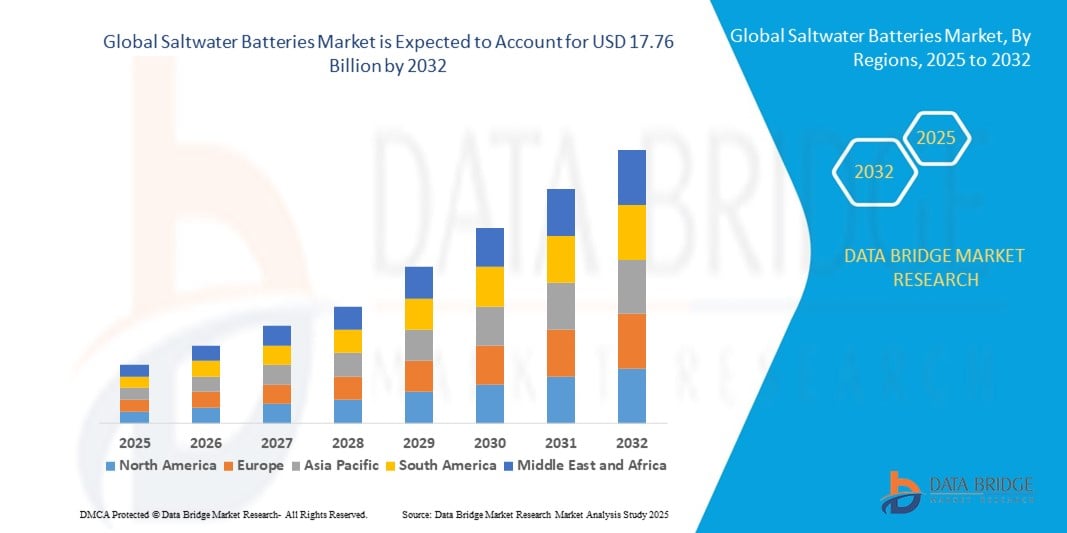
What is the Global Saltwater Batteries Market Size and Growth Rate?
- The global saltwater batteries market size was valued at USD 1.67 billion in 2024 and is expected to reach USD 17.76 billion by 2032, at a CAGR of 34.30% during the forecast period
- The saltwater batteries market encompasses the production, distribution, and consumption of batteries utilizing saltwater electrolytes for energy storage. These batteries typically employ sodium-ion or magnesium-based technologies, offering a sustainable and environmentally friendly alternative to traditional lithium-ion batteries
- Market players include manufacturers, suppliers, and distributors worldwide, catering to various industries such as renewable energy, grid storage, and marine applications. Key factors driving market growth include increasing demand for clean energy solutions, government initiatives promoting sustainable technologies, and advancements in saltwater battery technology
What are the Major Takeaways of Saltwater Batteries Market?
- Saltwater batteries are increasingly valued for their storage capacity, supporting the integration of solar and wind energy by providing reliable backup power during periods of low generation. This addresses the intermittent nature of renewable sources, bolstering their viability in the energy mix
- With a focus on environmental sustainability, saltwater batteries emerge as an eco-friendly alternative to conventional lithium-ion counterparts. This meets the needs of a growing population of environmentally conscious consumers, contributing to the shift towards greener energy solutions
- Asia-Pacific dominated the saltwater batteries market with the largest revenue share of 40.5% in 2024, supported by rapid urbanization, expanding middle-class population, and strong government initiatives toward sustainable energy adoption
- North America saltwater batteries market is projected to grow at the fastest CAGR of 6.5% during 2025–2032, driven by rising adoption of renewable energy storage solutions, eco-conscious consumer preferences, and supportive clean energy policies in the U.S. and Canada
- The Sodium-Ion Battery segment dominated the saltwater batteries market with the largest revenue share of 46.5% in 2024, driven by rising demand for sustainable, cost-effective, and high-cycle life energy storage solutions
Report Scope and Saltwater Batteries Market Segmentation
|
Attributes |
Saltwater Batteries Key Market Insights |
|
Segments Covered |
|
|
Countries Covered |
North America
Europe
Asia-Pacific
Middle East and Africa
South America
|
|
Key Market Players |
|
|
Market Opportunities |
|
|
Value Added Data Infosets |
In addition to the insights on market scenarios such as market value, growth rate, segmentation, geographical coverage, and major players, the market reports curated by the Data Bridge Market Research also include in-depth expert analysis, pricing analysis, brand share analysis, consumer survey, demography analysis, supply chain analysis, value chain analysis, raw material/consumables overview, vendor selection criteria, PESTLE Analysis, Porter Analysis, and regulatory framework. |
What is the Key Trend in the Saltwater Batteries Market?
Sustainable and Eco-Friendly Energy Storage Solutions
- A major trend in the global saltwater batteries market is the growing shift towards eco-friendly, safe, and sustainable alternatives to traditional lithium-ion and lead-acid batteries. Saltwater batteries are gaining traction as they are non-toxic, non-flammable, and fully recyclable, addressing environmental and safety concerns
- For instance, Aquion Energy’s Aqueous Hybrid Ion (AHI) technology has been adopted in residential and commercial energy storage projects due to its sustainable chemistry and ability to withstand deep discharge cycles without performance degradation
- Saltwater batteries also support the integration of renewable energy sources such as solar and wind, enabling decentralized energy storage and reliable backup power for off-grid and rural applications. Their ability to function in diverse climatic conditions makes them highly versatile for global deployment
- The growing emphasis on green energy policies, carbon neutrality targets, and circular economy practices is driving companies to innovate in saltwater battery technologies for scalable applications in residential, commercial, and grid-level storage
- This trend towards safe, durable, and eco-friendly energy storage is reshaping the energy storage ecosystem, positioning saltwater batteries as a sustainable solution in the global clean energy transition
What are the Key Drivers of Saltwater Batteries Market?
- The increasing global focus on renewable energy integration and the need for safe, long-duration storage solutions is a major driver for saltwater batteries. Their non-toxic and non-flammable properties make them suitable for residential, industrial, and off-grid energy storage applications
- For instance, in January 2024, Altech Batteries Ltd (Australia) announced advancements in its saltwater-based energy storage systems to support renewable integration, particularly in solar and wind projects. Such initiatives are fueling market growth
- Rising concerns about safety and environmental sustainability compared to lithium-ion batteries are boosting adoption. Saltwater batteries eliminate risks of thermal runaway, fire hazards, and toxic waste, making them attractive for eco-conscious consumers and governments
- The growing electrification of remote areas, demand for backup power, and energy storage mandates from policymakers further support the adoption of saltwater batteries in both developed and emerging markets
- The convenience of low maintenance, long cycle life, and recyclability are additional factors driving demand, as consumers and industries seek durable and cost-effective energy storage alternatives
Which Factor is Challenging the Growth of the Saltwater Batteries Market?
- Despite advantages, limited energy density and scalability challenges hinder the widespread adoption of saltwater batteries compared to lithium-ion solutions. They are bulkier, offer lower voltage output, and are less suitable for applications requiring high energy density
- For instance, while Aquion Energy introduced commercial saltwater-based batteries, scalability issues and higher upfront costs compared to conventional options limited broader adoption across competitive energy storage markets
- Another challenge is the relatively high cost of production and limited commercial availability, as only a few companies are actively manufacturing at scale. This restricts saltwater batteries from achieving economies of scale similar to lithium-ion batteries
- In addition, consumer awareness about saltwater battery benefits remains low, with many buyers still perceiving lithium-ion as the dominant solution. This slows adoption, particularly in price-sensitive and developing markets
- Addressing these challenges through technological innovations, cost reduction strategies, and strategic partnerships will be essential for saltwater batteries to become a mainstream solution in the global energy storage landscape
How is the Saltwater Batteries Market Segmented?
The market is segmented on the basis of type, battery capacity, application, and end-use.
- By Type
On the basis of type, the saltwater batteries market is segmented into Sodium-Nickel-Chloride Battery, Sodium-Sulfur Battery, and Sodium-Ion Battery. The Sodium-Ion Battery segment dominated the saltwater batteries market with the largest revenue share of 46.5% in 2024, driven by rising demand for sustainable, cost-effective, and high-cycle life energy storage solutions. These batteries are increasingly being adopted for renewable energy integration and stationary storage applications due to their abundant raw material availability and lower environmental impact.
The Sodium-Sulfur Battery segment is anticipated to witness the fastest growth rate of 20.4% from 2025 to 2032, owing to their higher energy density and growing deployment in grid-scale storage projects, particularly in countries focusing on renewable energy transition.
- By Battery Capacity
On the basis of battery capacity, the saltwater batteries market is segmented into Low-Capacity Sodium Salt Batteries (Less than 5 kWh), Medium-Capacity Sodium Salt Batteries (5 kWh to 100 kWh), and High-Capacity Sodium Salt Batteries (Over 100 kWh). The Medium-Capacity Sodium Salt Batteries segment held the largest market share of 41.2% in 2024, driven by their versatility for residential and commercial applications including backup power, microgrids, and small-scale renewable storage.
Meanwhile, the High-Capacity segment is expected to record the fastest CAGR during the forecast period, driven by the increasing demand for utility-scale storage projects and EV charging infrastructure.
- By Application
On the basis of application, the saltwater batteries market is segmented into Energy Storage System, Electric Vehicles, Consumer Electronics, and Others. The Energy Storage System segment dominated the market with a revenue share of 49.8% in 2024, owing to the global shift towards renewable energy and the need for stable grid integration solutions. Rising solar and wind installations across regions are fueling adoption of saltwater batteries for peak load management and backup power.
The Electric Vehicles segment is projected to witness the fastest CAGR from 2025 to 2032, driven by advancements in sodium-ion technology offering safer and more affordable alternatives to lithium-ion batteries.
- By End Use
On the basis of end-use, the saltwater batteries market is segmented into Residential, Industrial and Commercial, Utilities, Transportation, Electronics, and Others. The Utilities segment accounted for the largest market share of 37.6% in 2024, supported by growing investments in renewable energy storage infrastructure and smart grid projects. Utilities are increasingly adopting saltwater batteries for their safety, scalability, and long lifecycle advantages.
The Residential segment is expected to see the fastest growth rate, driven by increasing adoption of solar rooftops, home backup storage, and eco-friendly energy storage solutions.
Which Region Holds the Largest Share of the Saltwater Batteries Market?
- Asia-Pacific dominated the saltwater batteries market with the largest revenue share of 40.5% in 2024, supported by rapid urbanization, expanding middle-class population, and strong government initiatives toward sustainable energy adoption
- Consumers in the region are increasingly adopting eco-friendly and affordable energy storage solutions, with saltwater batteries being favored for their safety, low maintenance, and environmental benefits
- The presence of major manufacturing hubs in China, Japan, and India, coupled with ongoing investments in renewable energy and smart grid infrastructure, has further fueled market adoption
China Saltwater Batteries Market Insight
China saltwater batteries market accounted for the largest share within Asia-Pacific in 2024, driven by its fast-growing renewable energy sector and government-backed sustainability programs. With the country’s strong push toward smart cities and clean energy storage solutions, saltwater batteries are being increasingly deployed across residential, commercial, and industrial applications. Domestic players and competitive pricing further enhance market penetration.
Japan Saltwater Batteries Market Insight
Japan saltwater batteries market is expanding steadily, propelled by technological innovation, energy security concerns, and demand for sustainable alternatives to traditional batteries. Japan’s aging population and rising smart home adoption are fueling demand for safer, user-friendly storage systems. Integration of saltwater batteries with IoT and renewable systems is further strengthening the market outlook.
India Saltwater Batteries Market Insight
India saltwater batteries market is growing at a notable pace, supported by government initiatives such as “Make in India” and renewable energy targets. With rising energy needs and increasing solar adoption in rural and semi-urban areas, saltwater batteries are emerging as a cost-effective, eco-friendly storage solution. Local manufacturing and favorable policy frameworks are expected to further boost adoption.
Which Region is the Fastest Growing Region in the Saltwater Batteries Market?
North America saltwater batteries market is projected to grow at the fastest CAGR of 6.5% during 2025–2032, driven by rising adoption of renewable energy storage solutions, eco-conscious consumer preferences, and supportive clean energy policies in the U.S. and Canada. Government initiatives promoting clean energy and reducing dependence on fossil fuels further contribute to market growth. The presence of key market players and favorable policies also bolster the region's growth.
U.S. Saltwater Batteries Market Insight
U.S. saltwater batteries market captured the largest revenue share in North America in 2024, propelled by growing demand for sustainable and safe energy storage in residential and commercial sectors. Increasing adoption of solar-plus-storage solutions, combined with incentives for clean energy integration, continues to fuel growth. Tech-savvy consumers and strong R&D presence make the U.S. a frontrunner in innovation.
Canada Saltwater Batteries Market Insight
Canada saltwater batteries market is witnessing solid growth, supported by federal and provincial initiatives to promote clean and renewable energy storage solutions. With increasing deployment of solar and wind power, saltwater batteries are gaining popularity for their non-toxic, fire-safe, and recyclable properties, aligning with Canada’s sustainability goals.
Mexico Saltwater Batteries Market Insight
Mexico saltwater batteries market is gradually emerging, driven by expanding renewable energy projects and decentralized energy storage demand. With rising electricity consumption and infrastructure investments, saltwater batteries are being considered as cost-effective and reliable solutions to reduce grid dependency.
Which are the Top Companies in Saltwater Batteries Market?
The saltwater batteries industry is primarily led by well-established companies, including:
- GE Energy (U.S.)
- NGK INSULATORS, LTD. (Japan)
- Altech Batteries Ltd (Australia)
- Faradion (U.K.)
- CATL (Contemporary Amperex Technology Co., Limited) (China)
- HiNa Battery Technology Co., Ltd (China)
- Altris (U.K.)
- Aquion Energy (U.S.)
- AMTE Power (U.K.)
- TIAMAT Energy (U.S.)
What are the Recent Developments in Global Saltwater Batteries Market?
- In September 2024, Leclanché SA (Switzerland) introduced the XN50, the world’s first lithium-ion battery cell incorporating Echion Technologies’ XNO, a niobium-based anode material. The XN50 delivers a remarkable cycle life of over 10,000 cycles, making it highly suitable for heavy-duty applications across the rail, marine, and mining sectors. This breakthrough is expected to set new benchmarks for battery durability and performance in industries requiring long-lasting energy storage solutions
- In August 2024, Corvus Energy (Canada) partnered with Wärtsilä (Finland) to design the world’s largest battery electric ship, a 130-meter ferry capable of carrying 2,100 passengers and crew along with 225 cars. The vessel will operate on a massive 40 MWh battery system, with delivery planned for the end of 2024. This collaboration underscores the marine industry’s transition toward large-scale electrification and reduced carbon emissions
- In March 2024, Corvus Energy (Canada) secured a contract to provide its Orca Energy Storage system for the Magellan Discoverer, the first hybrid diesel-electric vessel to be constructed in South America. Integrated into ABB’s comprehensive power plant delivery, the system will enable zero-emission operations while enhancing the ship’s efficiency. This project marks a pivotal step toward sustainable hybridization in South American marine fleets
- In January 2024, Furukawa Electric Co., Ltd. (Japan) entered into a share subscription agreement involving an investment of approximately 10 million pounds in Tokamak Energy Ltd. (U.K.). The partnership is aimed at accelerating the development of commercial fusion energy. This initiative highlights Japan’s strategic commitment to supporting next-generation clean energy advancements
- In November 2023, Shift (Canada) and Garden Reach Shipbuilders & Engineers Ltd. (India, Kolkata) collaborated with Seatech Solutions International (Singapore) and the American Bureau of Shipping (ABS) to develop the E-VOLT 50, a 50-ton bollard pull electric tug. Designed to significantly cut carbon emissions while improving operational performance, this vessel will advance sustainable practices in marine operations

- Interactive Data Analysis Dashboard
- Company Analysis Dashboard for high growth potential opportunities
- Research Analyst Access for customization & queries
- Competitor Analysis with Interactive dashboard
- Latest News, Updates & Trend analysis
- Harness the Power of Benchmark Analysis for Comprehensive Competitor Tracking
Global Saltwater Batteries Market, Supply Chain Analysis and Ecosystem Framework
To support market growth and help clients navigate the impact of geopolitical shifts, DBMR has integrated in-depth supply chain analysis into its Global Saltwater Batteries Market research reports. This addition empowers clients to respond effectively to global changes affecting their industries. The supply chain analysis section includes detailed insights such as Global Saltwater Batteries Market consumption and production by country, price trend analysis, the impact of tariffs and geopolitical developments, and import and export trends by country and HSN code. It also highlights major suppliers with data on production capacity and company profiles, as well as key importers and exporters. In addition to research, DBMR offers specialized supply chain consulting services backed by over a decade of experience, providing solutions like supplier discovery, supplier risk assessment, price trend analysis, impact evaluation of inflation and trade route changes, and comprehensive market trend analysis.
Data collection and base year analysis are done using data collection modules with large sample sizes. The stage includes obtaining market information or related data through various sources and strategies. It includes examining and planning all the data acquired from the past in advance. It likewise envelops the examination of information inconsistencies seen across different information sources. The market data is analysed and estimated using market statistical and coherent models. Also, market share analysis and key trend analysis are the major success factors in the market report. To know more, please request an analyst call or drop down your inquiry.
The key research methodology used by DBMR research team is data triangulation which involves data mining, analysis of the impact of data variables on the market and primary (industry expert) validation. Data models include Vendor Positioning Grid, Market Time Line Analysis, Market Overview and Guide, Company Positioning Grid, Patent Analysis, Pricing Analysis, Company Market Share Analysis, Standards of Measurement, Global versus Regional and Vendor Share Analysis. To know more about the research methodology, drop in an inquiry to speak to our industry experts.
Data Bridge Market Research is a leader in advanced formative research. We take pride in servicing our existing and new customers with data and analysis that match and suits their goal. The report can be customized to include price trend analysis of target brands understanding the market for additional countries (ask for the list of countries), clinical trial results data, literature review, refurbished market and product base analysis. Market analysis of target competitors can be analyzed from technology-based analysis to market portfolio strategies. We can add as many competitors that you require data about in the format and data style you are looking for. Our team of analysts can also provide you data in crude raw excel files pivot tables (Fact book) or can assist you in creating presentations from the data sets available in the report.













