


What is the Sanitary Food and Beverage Market Size and Growth Rate?
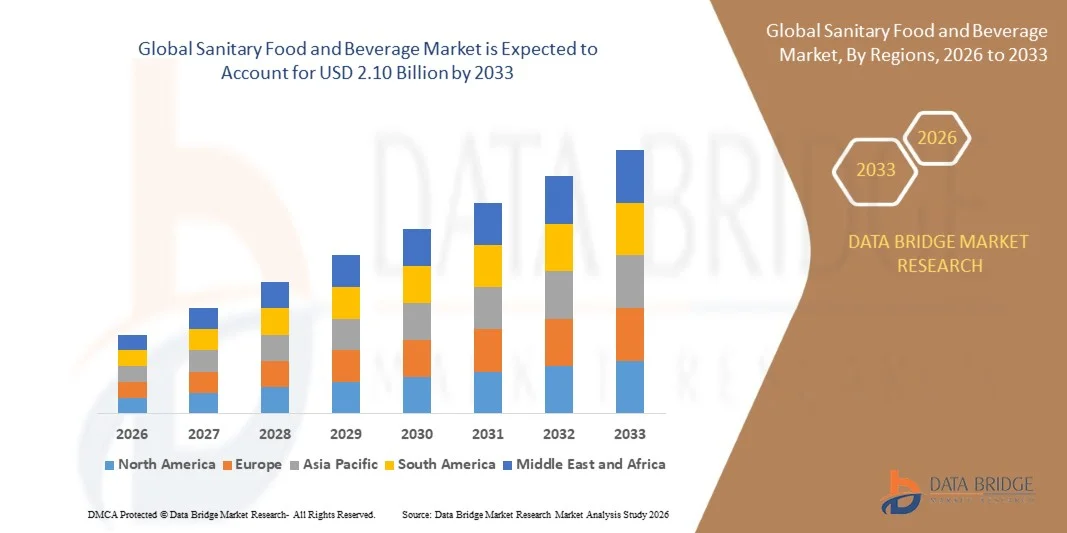
- As per Data Bridge Market Research Analysis the global sanitary food and beverage market size was valued at USD 1.31 billion in 2025 and is expected to reach USD 2.10 billion by 2033, at a CAGR of 6.1% during the forecast period
- The market growth is largely fueled by the rising demand for hygienic, contamination-free, and safe packaging solutions across food and beverage applications, driven by increasing consumer awareness regarding food safety and quality assurance. The expansion of packaged and processed food consumption, along with strict regulatory standards for food contact materials, is further strengthening the adoption of sanitary packaging formats across global supply chains
- Furthermore, rapid urbanization, changing consumer lifestyles, and growing preference for convenience food and ready-to-drink beverages are increasing the need for secure and durable sanitary packaging solutions. These converging factors are accelerating the shift toward advanced packaging materials such as flexible plastics, paperboard, and aseptic cartons, thereby significantly boosting the industry's growth
Market Size & Forecast
Global Market Value (2025): USD 1.31 billion
Expected Market Value (2033): USD 2.10 billion
Forecast CAGR (2026–2033): 6.1%
What are the Major Takeaways of Sanitary Food and Beverage Market ?
- Sanitary food and beverage packaging solutions, designed to ensure hygiene, prevent contamination, and maintain product integrity throughout storage and distribution, are increasingly essential across dairy, beverage, bakery, and ready-meal applications due to their ability to extend shelf life and preserve freshness
- The escalating demand for sanitary packaging is primarily fueled by stringent food safety regulations, increasing consumption of packaged food products, and rising adoption of sustainable and high-barrier packaging materials that ensure both hygiene compliance and operational efficiency across the global food supply chain
- North America dominated the sanitary food and beverage market with a share of 32.9% in 2025, due to strong demand for hygienic packaged food products and advanced food safety regulations across the region
- Asia-Pacific is expected to be the fastest growing region in the sanitary food and beverage market during the forecast period due to rapid urbanization, rising disposable incomes, and expanding food processing industries in countries such as China, India, and Japan
- Cups and liquid tight containers segment dominated the market with a market share of 41.8% in 2025, due to widespread use in foodservice outlets, quick-service restaurants, and beverage delivery systems. These containers provide strong leak resistance and hygiene assurance, making them essential for ready-to-consume products. Their compatibility with hot and cold beverages further increases their adoption across diverse consumption channels
Report Scope and Sanitary Food and Beverage Market Segmentation
|
Attributes |
Sanitary Food and Beverage Key Market Insights |
|
Segments Covered |
|
|
Countries Covered |
North America · U.S. · Canada · Mexico Europe · Germany · France · U.K. · Netherlands · Switzerland · Belgium · Russia · Italy · Spain · Turkey · Rest of Europe Asia-Pacific · China · Japan · India · South Korea · Singapore · Malaysia · Australia · Thailand · Indonesia · Philippines · Rest of Asia-Pacific Middle East and Africa · Saudi Arabia · U.A.E. · South Africa · Egypt · Israel · Rest of Middle East and Africa South America · Brazil · Argentina · Rest of South America |
|
Key Market Players |
· CHUO KAGAKU CO., LTD. (Japan) · FP Corporation. (Japan) · Crown Equipment Corporation (U.S.) · BALL CORPORATION (U.S.) · Kaira Can Company Limited (India) · Silgan Containers LLC (U.S.) · International Paper (U.S.) · Mondi (U.K.) · Sealed Air (U.S.) · Smurfit Kappa (Ireland) · Stora Enso AB (Finland) · Amcor plc (Switzerland) · Coveris (U.K.) · DS Smith (U.K.) · Graphic Packaging International, LLC (U.S.) |
|
Market Opportunities |
· Expansion of Smart Sanitation Systems in Food Plants · Rising Use of Automated Cleaning Solutions in Beverage Units |
|
Value Added Data Infosets |
In addition to the insights on market scenarios such as market value, growth rate, segmentation, geographical coverage, and major players, the market reports curated by the Data Bridge Market Research also include import export analysis, production capacity overview, production consumption analysis, price trend analysis, climate change scenario, supply chain analysis, value chain analysis, raw material/consumables overview, vendor selection criteria, PESTLE Analysis, Porter Analysis, and regulatory framework. |
What is the Key Trend in the Sanitary Food and Beverage Market ?
“Rising Adoption of Advanced Food Hygiene Technologies”
- A significant trend in the sanitary food and beverage market is the increasing deployment of advanced hygiene and sanitation technologies across food and beverage processing facilities to ensure contamination-free production environments and improved product safety standards. This trend is strengthening operational cleanliness protocols and supporting compliance with global food safety regulations across large-scale manufacturing units
- For instance, Ecolab provides integrated cleaning and sanitation solutions widely used in food processing plants such as those operated by Nestlé and PepsiCo, helping maintain strict hygiene standards and reduce microbial risks in production lines
- The integration of automated cleaning-in-place systems is expanding rapidly in beverage and dairy processing units where continuous sanitation is required without disrupting production cycles. This is improving efficiency while ensuring consistent hygiene levels across high-volume manufacturing operations
- Food manufacturers are increasingly adopting smart monitoring systems for real-time hygiene tracking and contamination detection in processing environments. This is enhancing traceability and enabling quicker response to potential safety risks in production facilities
- The demand for sustainable and chemical-optimized sanitation solutions is also rising as companies focus on reducing environmental impact while maintaining high hygiene standards. This is driving innovation in eco-friendly cleaning agents and water-efficient sanitation technologies
- The market is witnessing growing adoption of advanced sanitation infrastructure across global food processing industries where hygiene consistency is becoming a core operational requirement. This trend is reinforcing the shift toward technology-driven cleanliness management systems in sanitary food and beverage production environments
Sanitary Food and Beverage Market Dynamics
Driver
“Growing Demand for Safe and Hygienic Food Products”
- The increasing consumer awareness regarding food safety and hygiene is driving strong demand for sanitary food and beverage solutions across processing and packaging industries as end users prioritize health and quality assurance in their consumption choices. This is encouraging manufacturers to invest in advanced sanitation systems to meet rising expectations for contamination-free products
- For instance, Tetra Pak works with global dairy and beverage producers such as Danone to implement hygienic processing and aseptic packaging solutions that ensure product safety and extended shelf life
- The expansion of packaged and processed food consumption is further supporting the need for strict hygiene control systems in manufacturing environments. This is increasing the adoption of sanitary equipment and cleaning technologies across food production lines
- Regulatory bodies such as the U.S. FDA and the European Food Safety Authority are enforcing stringent hygiene standards that require manufacturers to maintain high sanitation levels. This is pushing companies to upgrade their sanitation infrastructure and compliance systems
- The continuous focus on public health and foodborne disease prevention is reinforcing investments in advanced sanitation technologies across the food and beverage industry. This sustained demand is positioning hygiene-focused solutions as a core driver of market growth
Restraint/Challenge
“High Compliance Costs of Food Safety Regulations”
- The sanitary food and beverage market faces challenges due to the high costs associated with compliance to strict food safety regulations, which require continuous investment in upgraded sanitation systems, certifications, and monitoring processes. This is increasing operational expenses for manufacturers, particularly small and mid-sized food processing companies
- For instance, companies such as Tyson Foods invest heavily in USDA and HACCP compliance systems to meet stringent food safety requirements across their meat processing facilities, increasing overall production and operational costs
- Frequent regulatory updates and evolving hygiene standards require constant system upgrades and staff training, which adds to long-term compliance expenditure. This creates financial pressure on manufacturers to maintain continuous regulatory alignment
- The need for advanced sanitation infrastructure such as automated cleaning systems and contamination control technologies increases capital investment requirements. This is making it difficult for smaller producers to adopt high-end hygiene solutions
- The ongoing requirement to meet diverse international food safety standards across export markets continues to elevate compliance costs for manufacturers. This is constraining profitability and acting as a key challenge for market expansion efforts
How is the Sanitary Food and Beverage Market Segmented?
The market is segmented on the basis of packaging type and product type.
- By Packaging Type
On the basis of packaging type, the sanitary food and beverage market is segmented into paperboard, rigid plastic, glass, flexible plastic, metal, and other packaging types. The flexible plastic segment dominated the market with the largest revenue share in 2025, driven by its high barrier properties, lightweight structure, and cost efficiency in large-scale food and beverage applications. Manufacturers prefer flexible plastic due to its ability to preserve hygiene, extend shelf life, and reduce transportation costs across supply chains. Its compatibility with high-speed filling and sealing systems further strengthens its adoption in sanitary packaging environments. Growing demand from quick-service restaurants and packaged beverage producers continues to reinforce its leading position in the market.
The paperboard segment is anticipated to witness the fastest growth rate from 2026 to 2033, driven by increasing regulatory pressure on single-use plastics and rising consumer preference for sustainable packaging solutions. Paperboard offers strong recyclability and biodegradability, making it suitable for environmentally conscious food and beverage brands. For instance companies such as Tetra Pak have expanded paperboard-based carton solutions to meet demand for eco-friendly dairy and juice packaging. Its ability to maintain product hygiene while supporting branding through high-quality printing enhances its adoption. The shift toward circular economy practices is expected to further accelerate paperboard packaging growth in sanitary applications.
- By Product Type
On the basis of product type, the sanitary food and beverage market is segmented into milk and other beverage cartons, cups and liquid tight containers, folding food containers, boards and trays, and other product types. The cups and liquid tight containers segment dominated the market with the largest revenue share of 41.8% in 2025, driven by widespread use in foodservice outlets, quick-service restaurants, and beverage delivery systems. These containers provide strong leak resistance and hygiene assurance, making them essential for ready-to-consume products. Their compatibility with hot and cold beverages further increases their adoption across diverse consumption channels. Expanding urban food delivery networks continue to support strong demand for this segment,
The boards and trays segment is expected to witness the fastest growth rate from 2026 to 2033, fueled by rising demand for sustainable and convenience-oriented food packaging formats. These products offer strong structural integrity while supporting hygienic handling of packaged meals in retail and foodservice applications. For instance companies such as Huhtamaki have introduced molded fiber and recyclable tray solutions to replace plastic-based formats. Increasing adoption in ready meal packaging and institutional catering services is driving segment expansion. The shift toward eco-friendly disposable packaging solutions is further strengthening the growth outlook for boards and trays in sanitary food and beverage applications.
Which Region Holds the Largest Share of the Sanitary Food and Beverage Market ?
- North America dominated the sanitary food and beverage market with the largest revenue share of 32.9% in 2025, driven by strong demand for hygienic packaged food products and advanced food safety regulations across the region
- Consumers in the region prioritize high-quality sanitary packaging solutions that ensure product integrity, extended shelf life, and contamination-free handling across retail and foodservice channels
- This strong adoption is further supported by high disposable incomes, well-established food processing industries, and increasing consumption of ready-to-eat and packaged beverages, reinforcing the dominance of sanitary packaging solutions in both residential and commercial applications
U.S. Sanitary Food and Beverage Market Insight
The U.S. sanitary food and beverage market captured the largest revenue share in 2025 within North America, driven by rapid expansion of packaged food consumption and stringent FDA food safety standards. Consumers are increasingly shifting toward convenient, hygienically packaged meals and beverages, supported by the growth of supermarkets, convenience stores, and online food delivery platforms. The rising adoption of sustainable and recyclable packaging materials is also contributing to market expansion. Furthermore, continuous innovation in packaging technologies focused on contamination prevention and freshness retention is strengthening market growth across the country.
Europe Sanitary Food and Beverage Market Insight
The Europe sanitary food and beverage market is projected to expand at a substantial CAGR throughout the forecast period, primarily driven by strict regulatory frameworks for food safety and strong emphasis on sustainable packaging solutions. The region’s growing preference for eco-friendly and recyclable materials is accelerating the adoption of paperboard and biodegradable packaging formats. Increasing urbanization and demand for convenience food products are further supporting market expansion. In addition, strong presence of organized retail chains and premium food brands is reinforcing the need for high-quality sanitary packaging systems.
U.K. Sanitary Food and Beverage Market Insight
The U.K. sanitary food and beverage market is anticipated to grow at a noteworthy CAGR during the forecast period, driven by rising consumption of ready-to-eat meals and increasing demand for safe and hygienic food packaging. Concerns regarding food contamination and strict regulatory standards are encouraging the use of advanced sanitary packaging solutions. The expansion of online grocery delivery services and takeaway food culture is further supporting market growth. Moreover, increasing consumer preference for sustainable packaging is influencing manufacturers to adopt recyclable and compostable materials.
Germany Sanitary Food and Beverage Market Insight
The Germany sanitary food and beverage market is expected to expand at a considerable CAGR during the forecast period, fueled by strong environmental regulations and high consumer awareness regarding food safety standards. The country’s focus on sustainable industrial practices is driving demand for recyclable and low-waste packaging solutions. Growing consumption of packaged dairy, bakery, and convenience food products is also supporting market expansion. In addition, technological advancements in food packaging machinery are enhancing efficiency and hygiene standards across the supply chain.
Asia-Pacific Sanitary Food and Beverage Market Insight
The Asia-Pacific sanitary food and beverage market is poised to grow at the fastest CAGR during the forecast period of 2026 to 2033, driven by rapid urbanization, rising disposable incomes, and expanding food processing industries in countries such as China, India, and Japan. Increasing demand for packaged and ready-to-eat food products is significantly boosting adoption of sanitary packaging solutions. Government initiatives promoting food safety standards and modern retail infrastructure are further accelerating market growth. In addition, the region’s strong manufacturing base for packaging materials is improving affordability and accessibility across emerging economies.
Japan Sanitary Food and Beverage Market Insight
The Japan sanitary food and beverage market is gaining momentum due to its high focus on food safety, hygiene standards, and convenience-oriented consumption patterns. The country’s aging population is increasing demand for easy-to-handle packaged food and beverages with secure sealing and contamination-free packaging. Strong technological integration in packaging systems is enhancing product freshness and safety. Moreover, the widespread use of compact and portion-controlled packaging formats is supporting growth across retail and foodservice sectors.
China Sanitary Food and Beverage Market Insight
The China sanitary food and beverage market accounted for the largest market revenue share in Asia Pacific in 2025, attributed to rapid urbanization, expanding middle-class population, and strong growth in packaged food consumption. Increasing demand for hygienic food packaging in retail, delivery, and convenience food sectors is driving market expansion. Government-led food safety regulations and smart manufacturing initiatives are further supporting adoption of advanced packaging solutions. In addition, strong domestic manufacturing capabilities and cost-efficient production are making sanitary packaging widely accessible across the country.
Which are the Top Companies in Sanitary Food and Beverage Market ?
The sanitary food and beverage industry is primarily led by well-established companies, including:
- CHUO KAGAKU CO., LTD. (Japan)
- FP Corporation. (Japan)
- Crown Equipment Corporation (U.S.)
- BALL CORPORATION (U.S.)
- Kaira Can Company Limited (India)
- Silgan Containers LLC (U.S.)
- International Paper. (U.S.)
- Mondi (U.K.), Sealed Air (U.S.)
- Smurfit Kappa (Ireland)
- Stora Enso AB (Finland)
- Amcor plc (Switzerland), Coveris (U.K.)
- DS Smith (U.K.)
- Graphic Packaging International, LLC (U.S.)
What are Latest Developments in Sanitary Food and Beverage Market ?
- In January 2025, SIG introduced aluminum-layer-free aseptic carton technology, which has strengthened the sanitary food and beverage market by improving recyclability while maintaining full barrier protection for liquid products. This development reduces environmental impact by lowering carbon emissions and supports regulatory compliance for sustainable packaging. It also enhances market competitiveness by enabling manufacturers to adopt eco-friendly cartons without modifying existing filling infrastructure, thereby accelerating adoption across beverage packaging applications
- In March 2025, Tetra Pak launched packaging with certified recycled polymers in India, significantly impacting the sanitary food and beverage market by advancing circular economy practices in emerging economies. This initiative enhances food safety compliance while integrating recycled materials without compromising hygiene standards, supporting growing demand for sustainable dairy and beverage packaging. It also strengthens brand positioning among environmentally conscious consumers and encourages wider adoption of recycled-content packaging across the region
- In February 2025, Tetra Pak advanced paper-based barrier packaging technology, reshaping the sanitary food and beverage market by reducing dependence on aluminum layers in aseptic cartons while maintaining product protection and shelf life. This innovation improves sustainability performance and supports the shift toward fully renewable packaging materials. It also creates new opportunities for dairy and juice manufacturers to adopt high-barrier, recyclable solutions that align with global environmental regulations
- In April 2025, Amcor completed its acquisition of Berry Global alongside Constantia Flexibles acquiring Aluflexpack, impacting the sanitary food and beverage packaging market by consolidating global production capabilities and strengthening supply chain efficiency. These strategic acquisitions expand product portfolios in flexible and rigid sanitary packaging formats while enhancing innovation capacity in sustainable materials. The consolidation is expected to increase competitiveness and accelerate development of advanced hygienic packaging solutions across global food and beverage industries
- In May 2025, Mondi expanded its European paper packaging production capacity through a new high-capacity machine installation, influencing the sanitary food and beverage market by increasing availability of recyclable, food-grade packaging materials. This expansion supports rising demand for sustainable alternatives in dairy, bakery, and ready-meal packaging segments. It also improves supply reliability and strengthens the shift toward fiber-based sanitary packaging solutions across the food and beverage industry

- Interactive Data Analysis Dashboard
- Company Analysis Dashboard for high growth potential opportunities
- Research Analyst Access for customization & queries
- Competitor Analysis with Interactive dashboard
- Latest News, Updates & Trend analysis
- Harness the Power of Benchmark Analysis for Comprehensive Competitor Tracking
Global Sanitary Food And Beverage Market, Supply Chain Analysis and Ecosystem Framework
To support market growth and help clients navigate the impact of geopolitical shifts, DBMR has integrated in-depth supply chain analysis into its Global Sanitary Food And Beverage Market research reports. This addition empowers clients to respond effectively to global changes affecting their industries. The supply chain analysis section includes detailed insights such as Global Sanitary Food And Beverage Market consumption and production by country, price trend analysis, the impact of tariffs and geopolitical developments, and import and export trends by country and HSN code. It also highlights major suppliers with data on production capacity and company profiles, as well as key importers and exporters. In addition to research, DBMR offers specialized supply chain consulting services backed by over a decade of experience, providing solutions like supplier discovery, supplier risk assessment, price trend analysis, impact evaluation of inflation and trade route changes, and comprehensive market trend analysis.
Data collection and base year analysis are done using data collection modules with large sample sizes. The stage includes obtaining market information or related data through various sources and strategies. It includes examining and planning all the data acquired from the past in advance. It likewise envelops the examination of information inconsistencies seen across different information sources. The market data is analysed and estimated using market statistical and coherent models. Also, market share analysis and key trend analysis are the major success factors in the market report. To know more, please request an analyst call or drop down your inquiry.
The key research methodology used by DBMR research team is data triangulation which involves data mining, analysis of the impact of data variables on the market and primary (industry expert) validation. Data models include Vendor Positioning Grid, Market Time Line Analysis, Market Overview and Guide, Company Positioning Grid, Patent Analysis, Pricing Analysis, Company Market Share Analysis, Standards of Measurement, Global versus Regional and Vendor Share Analysis. To know more about the research methodology, drop in an inquiry to speak to our industry experts.
Data Bridge Market Research is a leader in advanced formative research. We take pride in servicing our existing and new customers with data and analysis that match and suits their goal. The report can be customized to include price trend analysis of target brands understanding the market for additional countries (ask for the list of countries), clinical trial results data, literature review, refurbished market and product base analysis. Market analysis of target competitors can be analyzed from technology-based analysis to market portfolio strategies. We can add as many competitors that you require data about in the format and data style you are looking for. Our team of analysts can also provide you data in crude raw excel files pivot tables (Fact book) or can assist you in creating presentations from the data sets available in the report.













