Sanitary Ware Market Size
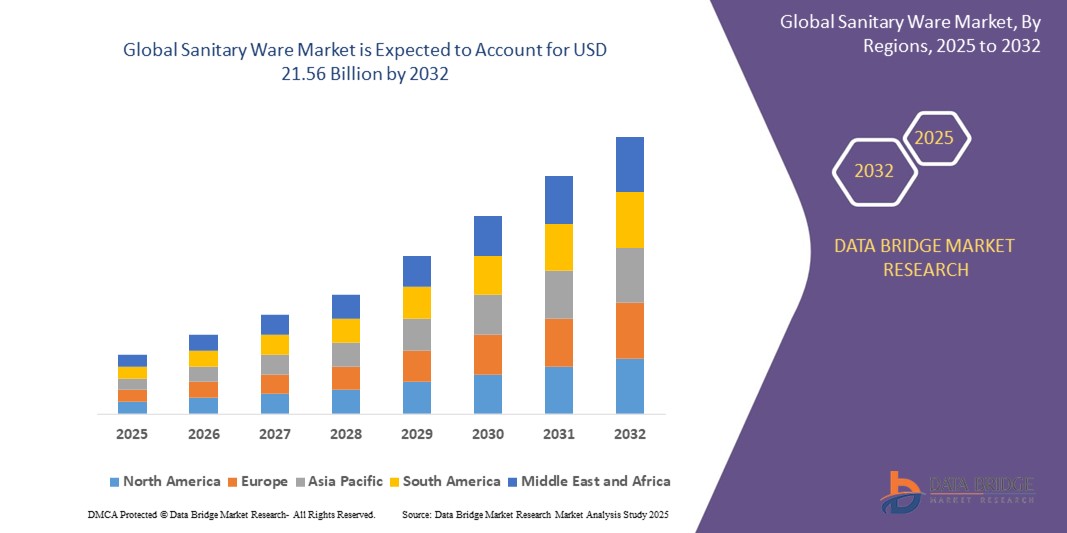
- The global sanitary ware market size was valued at USD 13.68 billion in 2024 and is expected to reach USD 21.56 billion by 2032, at a CAGR of 5.85% during the forecast period
- The market growth is largely fuelled by the increasing demand for modern bathrooms, rising urbanization, and growing awareness of hygiene standards across residential and commercial sectors
- The market is also supported by advancements in design and material technologies, such as water-efficient fixtures and smart sanitary products, which appeal to environmentally conscious consumers and premium real estate developments
Sanitary Ware Market Analysis
- The sanitary ware market is witnessing steady growth due to rising consumer preference for stylish and functional bathroom solutions that blend aesthetics with utility. Premium ceramic fittings and sleek designs are gaining popularity in residential and hospitality projects
- Increasing renovation activities and smart home trends are boosting demand for modern sanitary products with advanced features. Touchless faucets and water-saving toilets are now key choices in new home constructions and commercial upgrades
- North America dominates the sanitary ware market with the largest revenue share of 23% in 2024, driven by increasing home renovation projects and strong consumer preference for modern bathroom aesthetics
- Asia-Pacific region is expected to witness the highest growth rate in the global sanitary ware market, driven by rapid urbanization, expanding middle-class populations, and increasing government investments in sanitation infrastructure across countries such as India, China, and Indonesia.
- The toilet seats segment dominated the market with the largest revenue share of 26.4% in 2024, driven by rapid urbanization and rising sanitation standards globally. Increased construction activities in the residential sector further support segment growth
Report Scope and Sanitary Ware Market Segmentation
|
Attributes |
Sanitary Ware Key Market Insights |
|
Segments Covered |
|
|
Countries Covered |
North America
Europe
Asia-Pacific
Middle East and Africa
South America
|
|
Key Market Players |
|
|
Market Opportunities |
|
|
Value Added Data Infosets |
In addition to the insights on market scenarios such as market value, growth rate, segmentation, geographical coverage, and major players, the market reports curated by the Data Bridge Market Research also include in-depth expert analysis, pricing analysis, brand share analysis, consumer survey, demography analysis, supply chain analysis, value chain analysis, raw material/consumables overview, vendor selection criteria, PESTLE Analysis, Porter Analysis, and regulatory framework. |
Sanitary Ware Market Trends
“Rising Demand for Eco-Friendly and Water-Efficient Sanitary Products”
- The sanitary ware market is experiencing a strong shift toward eco-friendly and water-efficient products, driven by growing environmental awareness and regulatory pressures
- Consumers are becoming increasingly conscious of water conservation, leading to a rise in demand for sanitary solutions that reduce water usage without compromising performance
- Manufacturers are responding by developing products such as low-flow toilets, dual-flush systems, and waterless urinals to meet sustainability goals and appeal to cost-conscious users
- The trend is particularly visible in green building projects and LEED-certified developments, where sustainable bathroom fixtures are a core component
- For instance, the Bullitt Center in Seattle uses advanced water-efficient sanitary ware to minimize environmental impact
- Governments and city planners are incentivizing water-saving technologies through rebates and building codes, encouraging sanitary ware brands to expand their eco-friendly product lines to maintain competitive differentiation
Sanitary Ware Market Dynamics
Driver
“Increasing demand for modern, hygienic, and eco-friendly bathroom solutions”
- The sanitary ware market is driven by growing demand for modern and hygienic bathroom solutions across residential, commercial, and hospitality sectors
- Rising urbanization and higher disposable incomes encourage consumers to upgrade bathroom fixtures that blend aesthetics with functionality
- Increased awareness of hygiene and health, especially post-pandemic, has accelerated the adoption of touchless and easy-to-clean sanitary ware products
- Innovations such as sensor-operated faucets, smart toilets, and water-saving devices attract environmentally conscious users seeking convenience
- For instance, Kohler introduced smart toilets with features such as automatic flushing and heated seats, which have seen strong acceptance in North America
- Rapid construction and renovation activities worldwide, especially in emerging economies, boost demand for new and replacement sanitary products, creating growth opportunities for manufacturers
Restraint/Challenge
“High costs and limited awareness hindering widespread adoption of advanced sanitary products”
- The sanitary ware market faces challenges due to the high cost of advanced products such as smart and eco-friendly fixtures, limiting adoption among price-sensitive consumers in developing regions
- Price volatility of raw materials such as ceramics and metals, caused by supply chain disruptions during the COVID-19 pandemic, increased production costs and impacted pricing strategies globally
- Limited awareness and resistance to adopting modern sanitary solutions in rural and underdeveloped areas slow market growth
- Maintenance needs and technical knowledge required for some advanced sanitary products pose barriers to wider acceptance
- For instance, some users reported difficulty operating Toto’s Washlet smart toilets without proper training in parts of Southeast Asia
- Strict environmental regulations, such as the European Union’s water efficiency standards for sanitary products, increase compliance costs for manufacturers, adding to market challenges
Sanitary Ware Market Scope
The global sanitary ware market is segmented on the basis of type, material, operating mode, shape, colour, and end-user.
- By Type
On the basis of type, the sanitary ware market is segmented into toilet seats, wash basins, urinals, faucets, cisterns, showers, bathtubs, bathroom accessories, and others. The toilet seats segment dominated the market with the largest revenue share of 26.4% in 2024, driven by rapid urbanization and rising sanitation standards globally. Increased construction activities in the residential sector further support segment growth.
The wash basins segment is expected to witness the fastest growth rate from 2025 to 2032, propelled by rising consumer demand for stylish, space-saving, and hygiene-oriented fixtures. Expanding applications across hospitality and commercial spaces also drive this growth.
- By Material
On the basis of material, the sanitary ware market is segmented into ceramic, metal, glass, and others. The ceramic segment held the largest market revenue share of 61.3% in 2024 due to its durability, cost-effectiveness, and ease of cleaning. Ceramic products are preferred for their long life and aesthetic appeal in various applications.
The metal segment is expected to witness the fastest growth rate from 2025 to 2032, primarily due to its rising adoption in commercial and industrial facilities for its robustness and corrosion resistance. Stainless steel products with antibacterial properties are gaining significant traction.
- By Operating Mode
On the basis of operating mode, the sanitary ware market is segmented into manual and automated. The manual segment accounted for the largest market share of 71.8% in 2024, as traditional products remain dominant in price-sensitive regions and are widely available.
The automated segment is expected to witness the fastest growth rate from 2025 to 2032, fuelled by rising demand for touchless and sensor-based fixtures, especially in the wake of hygiene awareness post-pandemic. Automation also improves user convenience in high-traffic environments.
- By Shape
On the basis of shape, the sanitary ware market is segmented into curved, rectangle, circle, domed top, square, and others. The curved segment held the highest market share of 29.7% in 2024, supported by its ergonomic design, modern aesthetics, and easy integration into various bathroom layouts.
The rectangle segment is expected to witness the fastest growth rate from 2025 to 2032, favoured for its sleek, contemporary look and better space utilization in compact bathrooms. Rectangular shapes are increasingly preferred in urban housing and hotel projects.
- By Colour
On the basis of colour, the sanitary ware market is segmented into white, black, and others. The white segment dominated the global market revenue share 83.5% in 2024, owing to its traditional appeal, neutral compatibility with interiors, and widespread consumer preference.
The black segment is expected to witness the fastest growth rate from 2025 to 2032, driven by increasing demand for premium and designer sanitary ware. Black finishes are becoming popular in luxury residential and commercial settings due to their sophisticated appearance.
- By End-User
On the basis of end-user, the sanitary ware market is segmented into residential, commercial, institutional, and others. The residential segment held the largest market share of 58.2% in 2024, driven by growing housing projects, increased renovation activities, and rising consumer spending on home improvement.
The commercial segment is expected to witness the fastest growth rate from 2025 to 2032, during the forecast period, backed by expanding hospitality, healthcare, and retail infrastructure globally. The need for durable, low-maintenance, and visually appealing sanitary ware supports its adoption in these sectors.
Sanitary Ware Market Regional Analysis
- North America dominates the sanitary ware market with the largest revenue share of 23% in 2024, driven by increasing home renovation projects and strong consumer preference for modern bathroom aesthetics
- Consumers are increasingly drawn to sleek, efficient sanitary fixtures that complement smart home upgrades. The region benefits from high disposable income, widespread urbanization, and a robust construction sector
- Leading manufacturers offer a variety of premium and eco-friendly solutions catering to both residential and commercial applications
- Demand is particularly strong in urban centers where style, hygiene, and efficiency are key purchasing factors
U.S. Sanitary Ware Market Insight
The U.S. sanitary ware market held the largest revenue share in North America in 2024, fuelled by rising consumer spending on home improvement and interior upgrades. Consumers favour durable and water-efficient fixtures that align with sustainability goals. The growing trend of luxury bathroom remodelling and the proliferation of DIY renovation culture are driving demand. In addition, the availability of a wide product range through online and offline channels supports continued market expansion. Developers and homeowners alike prioritize quality sanitary ware in new construction and remodelling projects.
Asia-Pacific Sanitary Ware Market Insight
The Asia-Pacific sanitary ware market is expected to witness the fastest growth rate from 2025 to 2032, fuelled by urban development, rising middle-class income, and increased housing demand. Governments across the region are investing in infrastructure and sanitation, boosting market demand. Consumers in countries such as India, China, and Indonesia are shifting toward branded, hygienic bathroom solutions. The market also benefits from rapid industrialization and expanding hospitality and commercial sectors. Growth is further supported by the region’s strong manufacturing capabilities and competitive product pricing.
China Sanitary Ware Market Insight
The China accounted for the largest market revenue share in Asia-Pacific in 2024, driven by extensive urbanization and an expanding real estate sector. As the world's largest construction market, China sees steady demand for quality bathroom fixtures across residential and commercial spaces. The country’s push for smart cities and sustainable building practices promotes the adoption of eco-friendly and advanced sanitary ware products. Domestic manufacturers lead the market, offering affordable yet innovative solutions tailored to evolving consumer expectations and design preferences.
Japan Sanitary Ware Market Insight
The Japan sanitary ware market is expected to witness the fastest growth rate from 2025 to 2032, supported by strong consumer emphasis on hygiene, technology, and minimalist design. Japanese consumers favour smart bathroom fixtures that offer comfort, cleanliness, and energy efficiency. The market is influenced by a high-tech culture and aging population, driving demand for touchless and easy-to-use sanitary products. Compact, multifunctional solutions such as bidet-integrated toilets and wall-mounted basins are popular in space-constrained urban housing. Renovation trends in older properties and an increase in wellness-focused home design also support market expansion.
Europe Sanitary Ware Market Insight
The Europe sanitary ware market is expected to witness the fastest growth rate from 2025 to 2032, during the forecast period, fuelled by sustainability initiatives and evolving design trends. Consumers are increasingly opting for energy-efficient and water-saving bathroom solutions, aligning with the region’s stringent environmental standards. Renovation of historical buildings and new residential developments contribute to rising product demand. Smart sanitary ware integrated with digital features is also gaining traction. The market sees strong activity in Western Europe, especially in countries with advanced construction and design industries.
Germany Sanitary Ware Market Insight
The Germany sanitary ware market is expected to witness the fastest growth rate from 2025 to 2032, driven by high investments in eco-conscious construction and premium bathroom renovations. Consumers prefer sanitary fixtures that combine aesthetics with functionality and long-term durability. The market is supported by the country’s advanced manufacturing sector and emphasis on design innovation. Green building certifications and sustainability guidelines further promote demand for water-saving and recyclable sanitary ware products. German consumers are highly quality-conscious, often choosing products from leading local and global brands.
U.K. Sanitary Ware Market Insight
The U.K. sanitary ware market is expected to witness the fastest growth rate from 2025 to 2032, supported by increased home renovations and rising consumer focus on contemporary bathroom interiors. Compact and space-efficient sanitary ware is in demand, especially in urban settings. The market benefits from a mix of traditional and modern design preferences, with consumers seeking both visual appeal and functionality. The housing sector’s recovery and rising adoption of eco-friendly building materials also support market growth. Builders and homeowners prioritize water-saving features and stylish, easy-to-clean finishes in sanitary products.
Sanitary Ware Market Share
The Sanitary Ware industry is primarily led by well-established companies, including:
- LIXIL Corporation (Japan)
- Zurn Water, LLC. (U.S.)
- Masco Corporation (U.S.)
- Bella Group (U.S.)
- Kohler Co. (U.S.)
- Jaquar India (India)
- VITRA INTERNATIONAL AG. (Switzerland)
- Kerovit (India)
- CERA (India)
- Wenzhou Liangsha Sanitary Ware Co., Ltd. (China)
- BRIZO KITCHEN & BATH COMPANY (India)
- Oras Ltd. (Finland)
- TOTO LTD. (India)
- Roca Sanitario, S.A.U (Spain)
- Boch AG (Germany)
Latest Developments in Global Sanitary Ware Market
- In January 2022, Villeroy & Boch AG diversified its product lineup by introducing a versatile collection of washbasins designed for multiple installation preferences. This launch was aimed at addressing evolving consumer demands for both style and functionality in bathroom fixtures. By expanding its offerings, the company sought to enhance its competitive edge and appeal to a broader customer base. The new range supports market growth by catering to varied installation needs across residential and commercial projects
- In February 2022, Kohler Co. took significant steps toward innovation and capacity expansion with two key developments. The company collaborated with artist Daniel Arsham to design a unique 3D sink, targeting design-conscious consumers seeking exclusive bathroom products. In addition, Kohler announced the establishment of a new manufacturing facility, which is expected to increase production capabilities. These initiatives indicate Kohler’s preparation for rising demand and its focus on product differentiation in the sanitary ware market
- In June 2023, Toto Ltd. introduced the NEOREST WX, a state-of-the-art wall-hung toilet model emphasizing comfort, relaxation, and technological sophistication. This product reflects the growing consumer preference for luxury and advanced features in bathroom fixtures. By launching NEOREST WX, Toto aims to capture a larger share of the premium sanitary ware market. The innovation helps the company maintain its leadership in delivering high-end, user-centric bathroom solutions

- Interactive Data Analysis Dashboard
- Company Analysis Dashboard for high growth potential opportunities
- Research Analyst Access for customization & queries
- Competitor Analysis with Interactive dashboard
- Latest News, Updates & Trend analysis
- Harness the Power of Benchmark Analysis for Comprehensive Competitor Tracking
Data collection and base year analysis are done using data collection modules with large sample sizes. The stage includes obtaining market information or related data through various sources and strategies. It includes examining and planning all the data acquired from the past in advance. It likewise envelops the examination of information inconsistencies seen across different information sources. The market data is analysed and estimated using market statistical and coherent models. Also, market share analysis and key trend analysis are the major success factors in the market report. To know more, please request an analyst call or drop down your inquiry.
The key research methodology used by DBMR research team is data triangulation which involves data mining, analysis of the impact of data variables on the market and primary (industry expert) validation. Data models include Vendor Positioning Grid, Market Time Line Analysis, Market Overview and Guide, Company Positioning Grid, Patent Analysis, Pricing Analysis, Company Market Share Analysis, Standards of Measurement, Global versus Regional and Vendor Share Analysis. To know more about the research methodology, drop in an inquiry to speak to our industry experts.
Data Bridge Market Research is a leader in advanced formative research. We take pride in servicing our existing and new customers with data and analysis that match and suits their goal. The report can be customized to include price trend analysis of target brands understanding the market for additional countries (ask for the list of countries), clinical trial results data, literature review, refurbished market and product base analysis. Market analysis of target competitors can be analyzed from technology-based analysis to market portfolio strategies. We can add as many competitors that you require data about in the format and data style you are looking for. Our team of analysts can also provide you data in crude raw excel files pivot tables (Fact book) or can assist you in creating presentations from the data sets available in the report.