


What is the Sapphire Camera Market Size and Overview?
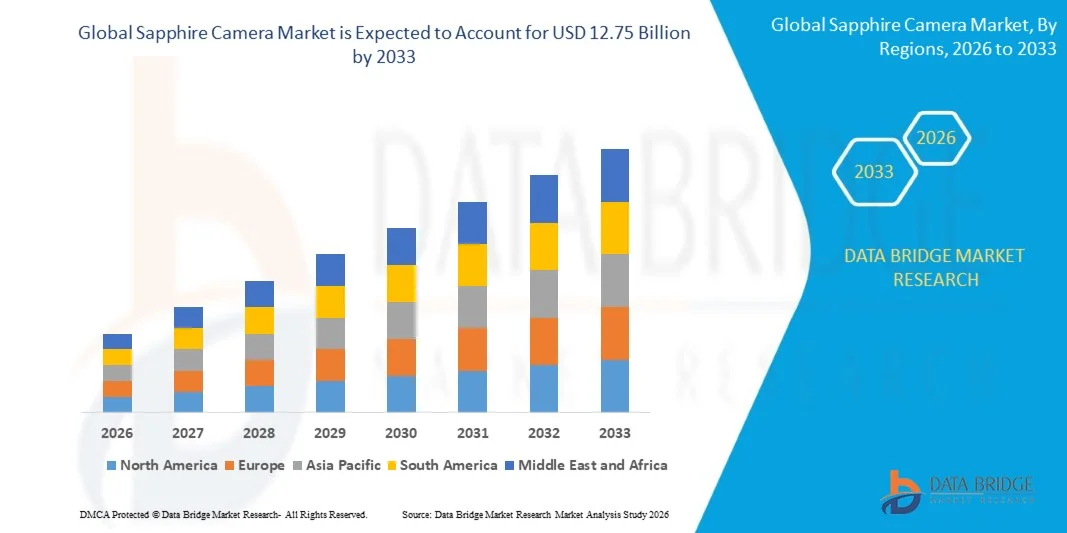
As per Data Bridge Market Research Analysis the Sapphire Camera Market was valued at USD 8.00 billion in 2025 and is projected to reach USD 12.75 billion by 2033, growing at a CAGR of 6.00% from 2026 to 2033. The Sapphire Camera Market is experiencing consistent growth driven by rising demand for high-durability camera protection solutions, increasing adoption of sapphire glass in smartphone cameras, surveillance systems, automotive imaging, and aerospace applications, and rapid advancements in optical materials and precision manufacturing technologies. Sapphire, known for its exceptional hardness, scratch resistance, and optical clarity, is increasingly being used as a protective cover material for camera lenses to enhance durability and long-term performance in harsh environments.
The growing penetration of premium smartphones with multi-lens camera systems, combined with rising consumer demand for high-quality imaging and enhanced device longevity, is accelerating the adoption of sapphire-based camera covers. In addition, increasing deployment of advanced surveillance systems, automotive ADAS cameras, and industrial imaging equipment is further driving demand for scratch-resistant and high-strength optical components. Manufacturers are focusing on cost-efficient sapphire production techniques and thin-wafer processing technologies to expand applications across consumer electronics and high-performance imaging systems.
Key Market Trends & Insights
- North America dominated the Sapphire Camera Market with the largest revenue share of 34.12% in 2025, supported by advanced surveillance infrastructure, strong defense modernization programs, and high adoption of infrared imaging technologies across industrial and government applications.
- The uncooled detectors segment dominated the market with an estimated 58.64% share in 2025, driven by lower cost, compact design, and reduced maintenance requirements .
- Asia-Pacific is expected to be the fastest-growing region at a CAGR of 7.6% from 2026 to 2033, fueled by rapid urbanization, increasing smart surveillance deployments, rising defense budgets in China and India, and expanding industrial automation adoption.
- PTZ (Pan-Tilt-Zoom) sapphire cameras are the fastest-growing product type, projected to register a CAGR of 7.4%, reflecting rising demand for flexible, wide-area monitoring solutions in smart cities, traffic management, and border security applications.
- The government and defence segment dominates the application category with a 38.65% revenue share in 2025, led by increasing deployment of advanced infrared sapphire cameras for surveillance, threat detection, reconnaissance, and border monitoring systems.
Market Size & Forecast
- Global Market Value (2025): USD 8.00 Billion
- Expected Market Value (2033): USD 12.75 Billion
- Forecast CAGR (2026–2033): 6.00%
- Leading Region in 2025: North America
- Fastest Growing Region: Asia-Pacific
Report Scope and Sapphire Camera Market Segmentation
|
Attributes |
Sapphire Camera Key Market Insights |
|
Segments Covered |
|
|
Countries Covered |
North America · U.S. · Canada · Mexico Europe · Germany · France · U.K. · Netherlands · Switzerland · Belgium · Russia · Italy · Spain · Turkey · Rest of Europe Asia-Pacific · China · Japan · India · South Korea · Singapore · Malaysia · Australia · Thailand · Indonesia · Philippines · Rest of Asia-Pacific Middle East and Africa · Saudi Arabia · U.A.E. · South Africa · Egypt · Israel · Rest of Middle East and Africa South America · Brazil · Argentina · Rest of South America |
|
Key Market Players |
• Samsung Electronics Co., Ltd. (South Korea) |
|
Market Opportunities |
· Growing Demand from Premium Smartphones and Consumer Electronics · Expansion in Automotive ADAS and Autonomous Vehicle Cameras · Increasing Adoption in Surveillance, Defense, and Industrial Imaging |
|
Value Added Data Infosets |
In addition to the insights on market scenarios such as market value, growth rate, segmentation, geographical coverage, and major players, the market reports curated by the Data Bridge Market Research also include in-depth expert analysis, geographically represented company-wise production and capacity, network layouts of distributors and partners, detailed and updated price trend analysis and deficit analysis of supply chain and demand. |
What is the Key Trend in the Sapphire Camera Market?
Trend: Growth in Smart Surveillance, Industrial Automation & Defense Imaging
The sapphire camera market is witnessing strong adoption across smart surveillance systems, industrial automation, and defense-grade imaging applications. Sapphire-based infrared cameras are increasingly deployed for high-durability, high-temperature, and harsh-environment monitoring where conventional optical systems fail. The integration of AI-powered image analytics and real-time edge processing is enabling faster object detection, anomaly identification, and predictive monitoring in mission-critical environments. For instance, in 2024, several defense modernization programs in the U.S. and Europe expanded procurement of long-wave infrared (LWIR) imaging systems for border surveillance and night vision enhancement, reflecting growing reliance on advanced thermal imaging solutions. Industrial operators in semiconductor manufacturing and metallurgy are also adopting sapphire lens-based cameras for high-precision thermal inspection and quality control under extreme conditions.
Sapphire Camera Market Dynamics
Key Market Driver: Rising Demand for Advanced Thermal Imaging in Defense, Automotive & Industrial Applications
The rapid expansion of defense modernization programs, smart city surveillance infrastructure, and industrial automation is significantly driving demand for Sapphire Camera systems. These cameras offer exceptional hardness, thermal resistance, and optical clarity, making them ideal for harsh environments such as aerospace monitoring, battlefield surveillance, and high-temperature industrial processes. Automotive OEMs and Tier-1 suppliers are increasingly integrating infrared sapphire imaging systems into ADAS development, enabling improved object detection in low-light and adverse weather conditions. According to industry deployment trends, adoption of thermal imaging cameras in intelligent transportation systems has increased steadily due to rising road safety initiatives and autonomous vehicle testing programs. In addition, governments in Asia-Pacific and the Middle East are investing heavily in smart surveillance networks, further accelerating market growth.
Key Restraint/Challenge: High Cost of Advanced Infrared Imaging Systems and Complex Integration Requirements
A major challenge in the Sapphire Camera Market is the high cost associated with advanced cooled and high-resolution infrared imaging systems. These cameras require precision manufacturing, specialized sapphire optics, and advanced sensor calibration, significantly increasing procurement and maintenance costs. Integration complexity with existing surveillance, defense, and industrial monitoring infrastructure further limits adoption among small and mid-scale enterprises. In addition, the need for skilled personnel for system calibration, thermal image interpretation, and AI-based analytics integration increases operational costs. In developing regions, budget constraints in public safety and industrial automation projects further slowdown large-scale deployment of high-end sapphire camera systems. The reliance on high-end cooling systems in MWIR and LWIR variants also contributes to higher total cost of ownership.
Key Market Opportunity: Integration of AI-Based Thermal Analytics and Autonomous Monitoring Platforms
The integration of artificial intelligence with Sapphire Camera systems presents a significant growth opportunity in the global market. AI-enabled thermal imaging platforms can automatically detect anomalies, classify objects, and predict equipment failures in real time, enhancing operational efficiency across defense, industrial, and transportation sectors. The development of autonomous surveillance systems and smart border monitoring solutions is further expanding the application scope of sapphire-based imaging technologies. Cloud-connected thermal imaging networks are being increasingly deployed in smart cities for real-time monitoring of traffic congestion, fire detection, and perimeter security. In addition, the rise of Industry 4.0 is driving adoption of predictive maintenance systems powered by thermal imaging analytics in manufacturing plants, oil & gas facilities, and power utilities. Emerging markets in Asia-Pacific and Latin America are expected to present strong growth opportunities due to increasing investments in smart infrastructure and public safety modernization programs.
How is the Sapphire Camera Market Segmented?
The sapphire camera market is segmented on the basis of simulation type, vehicle type, training application, end user, hardware components, software components, training mode, integration & connectivity, deployment and support & services.
By Product
On the basis of product, the Sapphire Camera Market is segmented into fixed cameras, handheld cameras, and pan-tilt-zoom (PTZ) cameras. The fixed cameras segment dominated the market with an estimated 42.18% share in 2025, owing to their widespread deployment in automotive testing rigs, defence surveillance systems, and industrial monitoring applications. These systems offer stable imaging performance, high durability, and cost efficiency, making them highly preferred in long-duration monitoring environments. Fixed cameras are extensively used in autonomous vehicle testing and simulation environments where consistent data capture is critical. Government agencies and OEM testing facilities increasingly rely on fixed configurations for precision-based validation workflows. Strong integration with AI-based analytics further strengthens adoption across industrial use cases. The segment benefits from lower maintenance requirements compared to movable systems. Rising deployment in smart infrastructure and connected mobility ecosystems also supports growth. However, limited flexibility compared to PTZ systems remains a constraint.
The Pan-Tilt-Zoom (PTZ) Cameras segment is projected to register the fastest growth at a CAGR of 7.3% from 2026 to 2033, driven by rising demand for flexible surveillance and adaptive imaging in dynamic environments. PTZ cameras are increasingly deployed in smart cities, traffic monitoring systems, and advanced automotive testing facilities. Their ability to remotely adjust zoom and orientation makes them highly suitable for real-time tracking applications. Integration with AI-based object detection and autonomous systems enhances operational efficiency. Defence and security sectors are rapidly adopting PTZ systems for situational awareness and border monitoring. In automotive simulation environments, PTZ cameras enable multi-angle behavioral analysis of drivers and vehicles. Continuous improvements in optical zoom and sensor resolution are expanding application scope. Cloud-based control systems are further accelerating adoption. Increasing investments in intelligent surveillance infrastructure across Asia-Pacific are boosting demand. The segment is also benefiting from reduced hardware costs and improved connectivity standards.
By Detector
On the basis of detector type, the Sapphire Camera Market is segmented into cooled and uncooled detectors. The Uncooled Detectors segment dominated the market with an estimated 58.64% share in 2025, driven by lower cost, compact design, and reduced maintenance requirements. These detectors are widely used in commercial surveillance, automotive ADAS testing, and industrial inspection systems. Their ease of integration into portable and embedded systems makes them highly attractive for mass deployment. Uncooled technology has significantly improved in sensitivity and resolution over recent years. Automotive OEMs prefer these detectors for real-time thermal imaging in safety systems. Government and industrial applications also rely on uncooled systems for cost-effective monitoring. Growing adoption in consumer-grade thermal imaging devices is further strengthening demand. However, performance limitations in extreme environments remain a challenge.
The cooled detectors segment is expected to witness the fastest growth at a CAGR of 7.8% from 2026 to 2033, driven by demand for high-precision imaging in defence, aerospace, and scientific applications. These detectors offer superior sensitivity and accuracy, making them ideal for long-range surveillance and missile tracking systems. Their ability to operate in extreme temperature conditions enhances reliability in mission-critical environments. Defence modernization programs across North America and Europe are driving large-scale adoption. In automotive testing, cooled detectors are used for advanced thermal diagnostics and ADAS validation. Continuous innovation in cryogenic cooling systems is improving efficiency and reducing operational complexity. High investment costs remain a barrier for smaller organizations. However, increasing use in space exploration and research applications is expanding the market base. Integration with AI-powered imaging systems is further enhancing analytical capabilities.
By Wavelength
On the basis of wavelength, the Sapphire Camera Market is segmented into near infrared, short-wave infrared (SWIR), mid-wave infrared (MWIR), and long-wave infrared (LWIR). The Long-Wave Infrared (LWIR) segment dominated the market with an estimated 45.27% share in 2025, due to its strong capability in thermal imaging under low-visibility conditions. LWIR systems are widely used in defence surveillance, automotive night vision systems, and industrial monitoring applications. Their ability to detect heat signatures without external illumination makes them highly reliable. Government and military sectors are major adopters of LWIR-based Sapphire Cameras. Automotive OEMs increasingly integrate LWIR sensors into ADAS systems for pedestrian detection. Industrial safety monitoring applications also rely heavily on LWIR imaging. The technology is well-established and cost-efficient compared to MWIR and SWIR systems. However, resolution limitations compared to shorter wavelengths remain a challenge.
The Short-Wave Infrared (SWIR) segment is projected to register the fastest growth at a CAGR of 7.6% from 2026 to 2033, driven by rising adoption in semiconductor inspection, aerospace, and advanced automotive testing. SWIR cameras provide superior imaging through smoke, fog, and dust, making them suitable for complex environments. Their ability to capture both reflected and thermal radiation enhances analytical precision. Defence and surveillance applications are increasingly shifting toward SWIR technology. In automotive R&D, SWIR is used for material classification and sensor validation. Growing adoption in BFSI security systems for document verification is expanding use cases. Continuous improvements in sensor miniaturization are reducing system costs. Integration with AI-based imaging platforms is accelerating demand. Increasing demand for high-resolution industrial inspection systems is a key growth driver.
By Application
On the basis of application, the Sapphire Camera Market is segmented into automotive, BFSI, commercial, government and defence, healthcare, industrial, and residential. The Government and Defence segment dominated the market with an estimated 34.92% share in 2025, driven by extensive use in surveillance, border security, and intelligence operations. Sapphire Cameras are critical for night vision and thermal imaging in mission-critical environments. Defence modernization programs across major economies are significantly boosting demand. These systems are widely deployed in UAVs, military vehicles, and perimeter security networks. Increasing geopolitical tensions have accelerated procurement of advanced imaging systems. Integration with AI-based threat detection systems enhances operational efficiency. Government agencies also use these cameras for disaster management and search-and-rescue operations. High reliability and durability make them suitable for harsh environments. Continuous upgrades in infrared technology are strengthening adoption.
The Automotive segment is expected to witness the fastest growth at a CAGR of 7.4% from 2026 to 2033, driven by rising integration of thermal imaging systems in ADAS and autonomous vehicles. Sapphire Cameras are increasingly used for pedestrian detection, night driving assistance, and driver monitoring systems. Automotive OEMs are investing heavily in sensor fusion technologies combining LiDAR, radar, and infrared imaging. Regulatory emphasis on vehicle safety standards is accelerating adoption. Electric vehicle manufacturers are integrating advanced imaging systems for battery thermal management. Rising demand for autonomous mobility solutions is further boosting growth. Continuous cost reduction in infrared sensors is improving scalability. Expansion of smart transportation infrastructure is creating new opportunities. Increasing adoption in motorsport testing and vehicle simulation is also supporting growth. The segment benefits from strong collaboration between automotive and semiconductor industries.
Which Region Holds the Largest Share of the Sapphire Camera Market?
North America dominated the Sapphire Camera Market and accounted for the largest revenue share of 34.12% in 2025, supported by advanced surveillance infrastructure, strong defense modernization programs, and high adoption of infrared imaging technologies across industrial and government applications. The region benefits from extensive deployment of high-performance imaging systems in security monitoring, aerospace, defense, and industrial inspection applications. Increasing investments in smart surveillance networks, AI-enabled imaging solutions, and next-generation optical systems are further strengthening market growth across the region.
U.S. Sapphire Camera Market Insight
The U.S. sapphire camera market is witnessing strong growth due to rising demand for advanced surveillance systems, defense imaging technologies, and high-precision industrial cameras. The country’s strong defense sector, coupled with rapid adoption of AI-based security solutions and infrared imaging systems, is driving deployment across military, homeland security, and commercial applications. In addition, increasing use of sapphire-based protective lenses in high-end imaging devices is supporting long-term market expansion.
Europe Sapphire Camera Market Insight
The Europe sapphire camera market remains a major contributor to global revenue, driven by stringent security regulations, increasing investment in public surveillance systems, and growing adoption of advanced imaging technologies. The region’s strong industrial base and focus on technological innovation are supporting the use of sapphire cameras in defense, automotive, and industrial monitoring applications. Rising emphasis on infrastructure security and smart city development is further enhancing market growth across Europe.
U.K. Sapphire Camera Market Insight
The U.K. sapphire camera market is experiencing steady growth, supported by expanding surveillance infrastructure, increasing defense modernization programs, and rising adoption of high-performance imaging systems. Government initiatives focused on public safety and security monitoring are driving demand for advanced camera technologies. In addition, growing integration of AI-powered analytics with imaging systems is improving surveillance efficiency and supporting market expansion.
Germany Sapphire Camera Market Insight
The Germany sapphire camera market is expanding steadily due to strong industrial automation, advanced manufacturing capabilities, and increasing adoption of high-precision imaging systems. German industries are integrating sapphire-based cameras in quality inspection, automotive testing, and security applications. Continuous innovation in optical technologies and strong focus on industrial efficiency are further driving market growth in the country.
Asia-Pacific Sapphire Camera Market Insight
The Asia-Pacific sapphire camera market is expected to be the fastest-growing region at a CAGR of 7.6% from 2026 to 2033, fueled by rapid urbanization, increasing smart surveillance deployments, rising defense budgets in China and India, and expanding industrial automation adoption. The region benefits from large-scale infrastructure development, growing demand for advanced security systems, and rapid technological advancements in imaging solutions. In addition, increasing investment in smart city projects and industrial digitalization is accelerating market expansion across Asia-Pacific.
Japan Sapphire Camera Market Insight
The Japan sapphire camera market is witnessing consistent growth due to strong demand for high-precision imaging systems, advanced industrial automation, and increasing adoption of security and surveillance technologies. The country’s focus on technological innovation and manufacturing excellence is driving integration of sapphire-based cameras in robotics, automotive testing, and industrial inspection applications.
China Sapphire Camera Market Insight
The China sapphire camera market is growing rapidly, driven by expanding smart city infrastructure, increasing defense modernization programs, and rapid adoption of advanced surveillance technologies. Strong government investment in public safety systems, industrial automation, and AI-based monitoring solutions is significantly boosting demand. In addition, rising deployment of high-performance imaging systems across commercial, defense, and industrial sectors is positioning China as one of the fastest-growing markets globally.
Which are the Top Companies in Sapphire Camera Market?
The Sapphire Camera industry is primarily led by well-established companies, including:
- Samsung Electronics Co., Ltd. (South Korea)
- Sony Group Corporation (Japan)
- Canon Inc. (Japan)
- Nikon Corporation (Japan)
- Leica Camera AG (Germany)
- Panasonic Holdings Corporation (Japan)
- Apple Inc. (U.S.)
- Huawei Technologies Co., Ltd. (China)
- Xiaomi Corporation (China)
- OPPO (Guangdong OPPO Mobile Telecommunications Corp., Ltd.) (China)
- Vivo (Vivo Communication Technology Co., Ltd.) (China)
- LG Electronics Inc. (South Korea)
- GoPro, Inc. (U.S.)
- STMicroelectronics N.V. (Switzerland)
- ams OSRAM AG (Austria)
- Teledyne Technologies Incorporated (U.S.)
- FLIR Systems (Teledyne FLIR) (U.S.)
- Canon Medical Systems Corporation (Japan)
- Zhejiang Dahua Technology Co., Ltd. (China)
- Hangzhou Hikvision Digital Technology Co., Ltd. (China)
- Omnivision Technologies, Inc. (U.S.)
- Sunny Optical Technology (Group) Company Limited (China)
- Largan Precision Co., Ltd. (Taiwan)
- AGC Inc. (Japan)
- SCHOTT AG (Germany)
- Corning Incorporated (U.S.)
- Ricoh Company, Ltd. (Japan)
- Blackmagic Design Pty Ltd. (Australia)
What are Latest Developments in Sapphire Camera Market?
- In July 2025, Allied Vision Technologies announced the launch of its new Goldeye Pro SWIR camera series, designed for advanced short-wave infrared imaging applications across industrial inspection, semiconductor manufacturing, scientific imaging, and machine vision markets. The new 5GigE-enabled cameras integrate Sony InGaAs SenSWIR global shutter sensors, offering high-resolution imaging, high-speed data transfer, and sensitivity across the 400–1700 nm wavelength range. The launch strengthens the adoption of Sapphire Camera technologies in precision inspection and automated industrial processes by enabling improved defect detection and real-time imaging performance
- In September 2025, Exosens announced the launch of its Crius XP and MicroCube XP series of long-wave infrared (LWIR) cameras, expanding its thermal imaging portfolio for defence and industrial applications. The new camera platforms were developed to provide enhanced image clarity, reliability, and operational flexibility in challenging environments such as smoke, fog, and low-contrast conditions. The introduction highlights the growing demand for advanced infrared Sapphire Camera solutions in surveillance, security, and mission-critical imaging applications
- In October 2025, FLIR announced the launch of its M460 and M560 AI-powered multispectral maritime camera systems, combining thermal imaging with visible-light imaging, laser rangefinding, and AI-based target tracking capabilities. The new systems were designed for commercial vessels, first responders, and professional maritime applications requiring enhanced situational awareness. This development reflects the increasing integration of artificial intelligence and multispectral imaging technologies within Sapphire Camera solutions for advanced monitoring and detection application
- In November 2025, FOTRIC announced the launch of its TK6 professional thermal camera, introducing a more accessible thermal imaging solution with a 384×288 infrared detector, ceramic-packaged sensor technology, and manual focus capability. The camera was developed to support industrial diagnostics, maintenance inspection, and professional thermal analysis applications. The launch demonstrates the market trend toward affordable high-performance Sapphire Camera technologies with improved resolution, accuracy, and field usability
- In September 2024, researchers at Oak Ridge National Laboratory published developments related to advanced infrared imaging sensors using sapphire substrates, demonstrating the material’s potential for improving infrared imaging system durability and performance. The research highlighted sapphire-based structures as robust alternatives for infrared sensor applications due to their transparency properties, thermal stability, and resistance to harsh operating conditions. This advancement supports future innovation in Sapphire Camera technologies for scientific, industrial, and defence imaging applications

- Interactive Data Analysis Dashboard
- Company Analysis Dashboard for high growth potential opportunities
- Research Analyst Access for customization & queries
- Competitor Analysis with Interactive dashboard
- Latest News, Updates & Trend analysis
- Harness the Power of Benchmark Analysis for Comprehensive Competitor Tracking
Global Sapphire Camera Market, Supply Chain Analysis and Ecosystem Framework
To support market growth and help clients navigate the impact of geopolitical shifts, DBMR has integrated in-depth supply chain analysis into its Global Sapphire Camera Market research reports. This addition empowers clients to respond effectively to global changes affecting their industries. The supply chain analysis section includes detailed insights such as Global Sapphire Camera Market consumption and production by country, price trend analysis, the impact of tariffs and geopolitical developments, and import and export trends by country and HSN code. It also highlights major suppliers with data on production capacity and company profiles, as well as key importers and exporters. In addition to research, DBMR offers specialized supply chain consulting services backed by over a decade of experience, providing solutions like supplier discovery, supplier risk assessment, price trend analysis, impact evaluation of inflation and trade route changes, and comprehensive market trend analysis.
Data collection and base year analysis are done using data collection modules with large sample sizes. The stage includes obtaining market information or related data through various sources and strategies. It includes examining and planning all the data acquired from the past in advance. It likewise envelops the examination of information inconsistencies seen across different information sources. The market data is analysed and estimated using market statistical and coherent models. Also, market share analysis and key trend analysis are the major success factors in the market report. To know more, please request an analyst call or drop down your inquiry.
The key research methodology used by DBMR research team is data triangulation which involves data mining, analysis of the impact of data variables on the market and primary (industry expert) validation. Data models include Vendor Positioning Grid, Market Time Line Analysis, Market Overview and Guide, Company Positioning Grid, Patent Analysis, Pricing Analysis, Company Market Share Analysis, Standards of Measurement, Global versus Regional and Vendor Share Analysis. To know more about the research methodology, drop in an inquiry to speak to our industry experts.
Data Bridge Market Research is a leader in advanced formative research. We take pride in servicing our existing and new customers with data and analysis that match and suits their goal. The report can be customized to include price trend analysis of target brands understanding the market for additional countries (ask for the list of countries), clinical trial results data, literature review, refurbished market and product base analysis. Market analysis of target competitors can be analyzed from technology-based analysis to market portfolio strategies. We can add as many competitors that you require data about in the format and data style you are looking for. Our team of analysts can also provide you data in crude raw excel files pivot tables (Fact book) or can assist you in creating presentations from the data sets available in the report.













