


What is the Satcom On The Move Market Size and Overview?
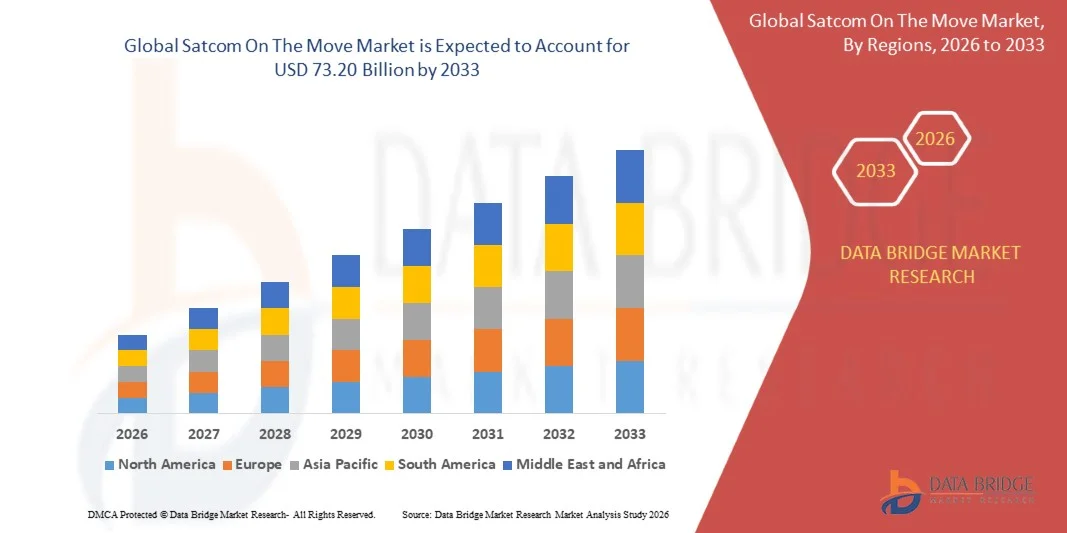
As per Data Bridge Market Research Analysis the Satcom On The Move Market was valued at USD 37.56 billion in 2025 and is projected to reach USD 73.20 billion by 2033, growing at a CAGR of 8.70% from 2026 to 2033. The market is witnessing strong growth driven by increasing demand for uninterrupted high-speed connectivity in moving platforms, rapid expansion of defense communication networks, and rising adoption of satellite-based broadband services across commercial transportation and maritime sectors.
The growing need for real-time data transmission in defense operations, aviation, and naval fleets is significantly driving the adoption of satcom on the move solutions. In addition, increasing deployment of connected vehicles, autonomous systems, and IoT-enabled transportation platforms is further accelerating demand for reliable satellite communication systems capable of maintaining seamless connectivity in remote and mobile environments.
Market Size & Forecast
- Global Market Value (2025): USD 37.56 Billion
- Expected Market Value (2033): USD 73.20 Billion
- Forecast CAGR (2026–2033): 8.70%
- Leading Region in 2025: North America
- Fastest Growing Region: Asia-Pacific
What are the Major Takeaways of Satcom On The Move Market?
- North America dominated the satcom on the move market with the largest revenue share of 39.8% in 2025, supported by strong defense communication modernization programs, high adoption of advanced satellite mobility solutions, and extensive deployment across aviation, maritime, and land-based military platforms.
- Asia-Pacific satcom on the move market is expected to witness the fastest growth rate from 2026 to 2033, supported by rapid expansion of defense modernization programs, growing maritime trade activities, and increasing adoption of connected aviation systems in countries such as China, Japan, and India.
- The Land segment held the largest market revenue share of approximately 41.6% in 2025 driven by increasing deployment of satellite communication systems in military vehicles, commercial logistics fleets, and connected autonomous transport systems. Rising demand for real-time navigation, fleet coordination, and secure defense communication is further strengthening adoption across land-based mobility platforms. Growing integration of satcom terminals in armored vehicles, public transport systems, and long-haul trucking fleets is also supporting segment dominance. Increasing digitization of transportation networks and rising need for uninterrupted connectivity in remote terrains further boost demand.
- The Maritime segment is projected to register the fastest growth at a CAGR of 9.4% from 2026 to 2033, driven by expanding global shipping activities, increasing demand for real-time vessel monitoring, and rising adoption of connected shipping and autonomous maritime technologies. Growing reliance on satellite connectivity for route optimization, cargo tracking, and offshore operations is accelerating segment expansion. Increasing offshore oil & gas exploration activities and expansion of global trade routes are further enhancing adoption. Rising demand for crew welfare connectivity services and high-speed internet at sea is also contributing to growth.
- The Ku Band segment held the largest market revenue share of approximately 34.2% in 2025 driven by widespread usage in aviation connectivity, maritime communication, and broadcast satellite services due to its balanced performance and global availability. It offers reliable bandwidth efficiency and moderate weather resistance, making it suitable for mobile applications. Increasing adoption in in-flight entertainment systems and maritime broadband is further supporting dominance. Its mature infrastructure and cost-effectiveness also strengthen market penetration.
- The Ka Band segment is projected to register the fastest growth at a CAGR of 11.2% from 2026 to 2033, driven by increasing demand for high-throughput satellite communication services, particularly in broadband-intensive applications such as inflight connectivity and defense data transmission. Expansion of LEO and HTS satellite networks is further accelerating adoption. Growing need for ultra-high-speed data transfer in autonomous systems and real-time surveillance applications is also contributing to demand. Increasing investments in next-generation satellite constellations are strengthening long-term growth prospects.
- The Hardware segment held the largest market revenue share of approximately 56.9% in 2025 driven by strong demand for antennas, terminals, and satellite modems used across defense, aviation, and maritime mobility platforms. Increasing deployment of ruggedized and compact mobile terminals is further supporting growth. Continuous innovation in phased-array antenna systems is enhancing performance in moving platforms. Rising need for lightweight, high-efficiency communication hardware is also driving adoption.
- The Services segment is projected to register the fastest growth at a CAGR of 10.6% from 2026 to 2033, driven by increasing adoption of managed satellite communication services, network integration, and maintenance solutions across enterprise and government users. Organizations are increasingly outsourcing connectivity management to improve efficiency and reduce operational complexity. Rising demand for subscription-based connectivity models is further strengthening service revenues. Expansion of global satellite service providers is also accelerating segment growth.
- The Command & Control (C2) segment held the largest market revenue share of approximately 27.8% in 2025 driven by strong defense modernization programs and increasing need for secure battlefield communication systems. It enables real-time decision-making and coordination across distributed military units. Rising geopolitical tensions and defense digitization programs are further supporting demand. Increasing use of mobile command centers is also strengthening adoption.
- The Commercial Mobility & In-Transit Connectivity segment is projected to register the fastest growth at a CAGR of 10.9% from 2026 to 2033, driven by rising demand for broadband connectivity in aviation, maritime, and connected transport systems. Increasing passenger demand for uninterrupted internet access is a major growth factor. Expansion of smart logistics and fleet management systems is further supporting adoption. Growing reliance on cloud-based enterprise operations during transit is accelerating demand.
- The Government & Defense segment held the largest market revenue share of approximately 52.3% in 2025 driven by increasing defense modernization programs, battlefield communication upgrades, and secure mobile satellite network deployment. Strong budget allocations toward military communication infrastructure are further supporting growth. Increasing need for encrypted and resilient communication systems is also driving adoption. Integration of multi-domain operations across land, air, and sea platforms strengthens segment dominance.
- The Commercial Enterprises segment is projected to register the fastest growth at a CAGR of 9.8% from 2026 to 2033, driven by rising adoption of satellite connectivity in aviation, maritime logistics, and connected transportation ecosystems. Expanding digital transformation across industries is increasing reliance on continuous connectivity. Growth of IoT-enabled logistics and smart mobility solutions is further supporting demand. Increasing demand for global coverage in remote business operations is also accelerating adoption.
Report Scope and Satcom On The Move Market Segmentation
|
Attributes |
Satcom On The Move Key Market Insights |
|
Segments Covered |
· By Platform: Land, Airborne, and Maritime · By Frequency Band: Ku Band, Ka Band, X Band, L Band, C Band, and Others · By Component: Hardware, Software, and Services · By Application: Command & Control (C2), Intelligence, Surveillance & Reconnaissance (ISR), Situational Awareness & Navigation Support, Disaster Response, Remote Operations & Asset Monitoring, and Commercial Mobility & In-Transit Connectivity · By End User: Government & Defense, Commercial Enterprises, and Emergency Response Agencies |
|
Countries Covered |
North America
Europe
Asia-Pacific
Middle East and Africa
South America
|
|
Key Market Players |
|
|
Market Opportunities |
|
|
Value Added Data Infosets |
|
What is the Key Trend in the Satcom On The Move Market?
Trend: Growth In High-Speed Mobile Connectivity And Multi-Orbit Satellite Communication Systems
Increasing demand for uninterrupted broadband connectivity in moving platforms across defense, aviation, maritime, and land transportation sectors. Traditional communication systems face limitations in coverage, latency, and reliability, driving the shift toward advanced satcom on the move solutions that integrate GEO, MEO, and LEO satellite networks to ensure continuous real-time connectivity in remote and high-mobility environments.
In modern defense operations, armed forces are increasingly deploying satcom terminals in armored vehicles, naval vessels, and airborne platforms, for instance NATO and U.S. Department of Defense programs integrating multi-orbit satellite communication systems for battlefield connectivity, to enable secure command-and-control communication and real-time intelligence sharing across distributed units. In commercial aviation, airlines are expanding in-flight connectivity services to support passenger broadband demand and operational data exchange, improving flight efficiency and customer experience through continuous satellite links.
The rapid expansion of connected maritime fleets and autonomous shipping systems is also increasing demand for robust satellite communication systems capable of supporting navigation, cargo monitoring, and real-time fleet management across global shipping routes. In addition, emergency response services and disaster management agencies continue to rely on mobile satellite communication systems for uninterrupted connectivity in remote or infrastructure-damaged regions, such as during large-scale flooding and earthquake response operations across Asia-Pacific and North America. Growing industry validation through 2025 maritime trials integrating LEO-based satcom terminals has demonstrated latency reductions of nearly 40–60% compared to traditional GEO-only systems under open-sea operational conditions.
Satcom On The Move Market Dynamics
Key Market Driver: Rising Demand For Seamless Connectivity Across Defense, Aviation, And Maritime Mobility Networks
Industries and government agencies worldwide are facing increasing operational requirements for real-time communication in motion, driven by modernization of defense systems, expansion of global aviation networks, and growth in international maritime trade. High-speed, secure, and uninterrupted data transmission is becoming critical for mission-critical operations, fleet coordination, and passenger connectivity services.
Defense organizations are increasingly adopting advanced satellite communication systems to support mobile command centers, unmanned systems, and tactical vehicles. For instance, U.S. military modernization programs and similar initiatives in Europe are expanding the use of SATCOM terminals in battlefield environments to ensure resilient communication under contested conditions.
Similarly, the aviation sector is integrating satellite-based broadband solutions to enhance in-flight entertainment, operational monitoring, and predictive maintenance capabilities. Maritime industries are also deploying satcom systems for vessel tracking, route optimization, and real-time cargo monitoring, particularly across long-distance shipping lanes in the Atlantic and Pacific oceans, strengthening global demand for reliable mobile satellite connectivity.
Key Restraint/Challenge: High Deployment Costs And Signal Latency Limitations In Complex Environments
Satcom on the move systems require significant capital investment in satellite terminals, antenna systems, and subscription-based connectivity services, creating affordability challenges for small and mid-sized operators. High infrastructure costs and complex installation requirements limit adoption in cost-sensitive commercial transport and logistics segments.
In addition, signal disruption in dense urban environments, tunnels, and extreme weather conditions can impact connectivity reliability, particularly for high-speed mobile platforms. Latency issues in GEO-based systems also reduce performance for real-time applications such as autonomous navigation and high-frequency trading communications.
Market studies indicate that satcom terminal installation and integration costs can account for a substantial portion of total fleet communication expenses, particularly in aviation and defense applications, highlighting the need for cost optimization and next-generation low-latency satellite constellations.
Key Market Opportunity: Expansion Of LEO Constellations And Connected Mobility Ecosystems
Modern transportation systems, defense platforms, and industrial mobility networks increasingly require high-bandwidth, low-latency satellite communication solutions to support real-time data exchange and digital transformation initiatives. Traditional satellite systems are being complemented by rapidly expanding LEO constellations that significantly improve coverage and performance for mobile users.
Telecom and satellite operators are increasingly investing in LEO-based networks, for instance global constellations such as Starlink and OneWeb expanding coverage for maritime, aviation, and remote industrial operations, enabling high-speed connectivity in previously underserved regions. In commercial transportation, connected trucks and logistics fleets are adopting satcom solutions for route optimization, fleet tracking, and predictive maintenance.
In addition, advancements in phased-array antenna technology, AI-based network optimization, and hybrid terrestrial-satellite integration are improving system efficiency and reducing operational complexity. Large-scale 2025 deployment programs in maritime and aviation sectors across North America and Europe have reported connectivity availability improvements exceeding 95–99% across transoceanic routes using multi-orbit satellite architectures.
How is the Satcom On The Move Market Segmented?
The market is segmented on the basis of platform, frequency band, component, application, and end user
- ByPlatform
On the basis of platform, the satcom on the move market is segmented into Land, Airborne, and Maritime. The Land segment held the largest market revenue share of approximately 41.6% in 2025 driven by increasing deployment of satellite communication systems in military vehicles, commercial logistics fleets, and connected autonomous transport systems. Rising demand for real-time navigation, fleet coordination, and secure defense communication is further strengthening adoption across land-based mobility platforms. Growing integration of satcom terminals in armored vehicles, public transport systems, and long-haul trucking fleets is also supporting segment dominance. Increasing digitization of transportation networks and rising need for uninterrupted connectivity in remote terrains further boost demand.
The Maritime segment is projected to register the fastest growth at a CAGR of 9.4% from 2026 to 2033, driven by expanding global shipping activities, increasing demand for real-time vessel monitoring, and rising adoption of connected shipping and autonomous maritime technologies. Growing reliance on satellite connectivity for route optimization, cargo tracking, and offshore operations is accelerating segment expansion. Increasing offshore oil & gas exploration activities and expansion of global trade routes are further enhancing adoption. Rising demand for crew welfare connectivity services and high-speed internet at sea is also contributing to growth.
- By Frequency Band
On the basis of frequency band, the market is segmented into Ku Band, Ka Band, X Band, L Band, C Band, and Others. The Ku Band segment held the largest market revenue share of approximately 34.2% in 2025 driven by widespread usage in aviation connectivity, maritime communication, and broadcast satellite services due to its balanced performance and global availability. It offers reliable bandwidth efficiency and moderate weather resistance, making it suitable for mobile applications. Increasing adoption in in-flight entertainment systems and maritime broadband is further supporting dominance. Its mature infrastructure and cost-effectiveness also strengthen market penetration.
The Ka Band segment is projected to register the fastest growth at a CAGR of 11.2% from 2026 to 2033, driven by increasing demand for high-throughput satellite communication services, particularly in broadband-intensive applications such as inflight connectivity and defense data transmission. Expansion of LEO and HTS satellite networks is further accelerating adoption. Growing need for ultra-high-speed data transfer in autonomous systems and real-time surveillance applications is also contributing to demand. Increasing investments in next-generation satellite constellations are strengthening long-term growth prospects.
- By Component
On the basis of component, the market is segmented into Hardware, Software, and Services. The Hardware segment held the largest market revenue share of approximately 56.9% in 2025 driven by strong demand for antennas, terminals, and satellite modems used across defense, aviation, and maritime mobility platforms. Increasing deployment of ruggedized and compact mobile terminals is further supporting growth. Continuous innovation in phased-array antenna systems is enhancing performance in moving platforms. Rising need for lightweight, high-efficiency communication hardware is also driving adoption.
The Services segment is projected to register the fastest growth at a CAGR of 10.6% from 2026 to 2033, driven by increasing adoption of managed satellite communication services, network integration, and maintenance solutions across enterprise and government users. Organizations are increasingly outsourcing connectivity management to improve efficiency and reduce operational complexity. Rising demand for subscription-based connectivity models is further strengthening service revenues. Expansion of global satellite service providers is also accelerating segment growth.
- By Application
On the basis of application, the market is segmented into Command & Control (C2), Intelligence, Surveillance & Reconnaissance (ISR), Situational Awareness & Navigation Support, Disaster Response, Remote Operations & Asset Monitoring, and Commercial Mobility & In-Transit Connectivity. The Command & Control (C2) segment held the largest market revenue share of approximately 27.8% in 2025 driven by strong defense modernization programs and increasing need for secure battlefield communication systems. It enables real-time decision-making and coordination across distributed military units. Rising geopolitical tensions and defense digitization programs are further supporting demand. Increasing use of mobile command centers is also strengthening adoption.
The Commercial Mobility & In-Transit Connectivity segment is projected to register the fastest growth at a CAGR of 10.9% from 2026 to 2033, driven by rising demand for broadband connectivity in aviation, maritime, and connected transport systems. Increasing passenger demand for uninterrupted internet access is a major growth factor. Expansion of smart logistics and fleet management systems is further supporting adoption. Growing reliance on cloud-based enterprise operations during transit is accelerating demand.
- By End User
On the basis of end user, the market is segmented into Government & Defense, Commercial Enterprises, and Emergency Response Agencies. The Government & Defense segment held the largest market revenue share of approximately 52.3% in 2025 driven by increasing defense modernization programs, battlefield communication upgrades, and secure mobile satellite network deployment. Strong budget allocations toward military communication infrastructure are further supporting growth. Increasing need for encrypted and resilient communication systems is also driving adoption. Integration of multi-domain operations across land, air, and sea platforms strengthens segment dominance.
The Commercial Enterprises segment is projected to register the fastest growth at a CAGR of 9.8% from 2026 to 2033, driven by rising adoption of satellite connectivity in aviation, maritime logistics, and connected transportation ecosystems. Expanding digital transformation across industries is increasing reliance on continuous connectivity. Growth of IoT-enabled logistics and smart mobility solutions is further supporting demand. Increasing demand for global coverage in remote business operations is also accelerating adoption.
Which Region Holds the Largest Share of the Satcom On The Move Market?
North America Satcom On The Move Market Insight
North America dominated the satcom on the move market with the largest revenue share of 39.8% in 2025, supported by strong defense communication modernization programs, high adoption of advanced satellite mobility solutions, and extensive deployment across aviation, maritime, and land-based military platforms. The region benefits from early adoption of LEO satellite constellations, advanced communication infrastructure, and strong investments in secure mobile broadband systems. Increasing demand for real-time connectivity in defense operations, commercial aviation, and logistics fleets is further strengthening market growth across the U.S. and Canada.
U.S. Satcom On The Move Market Insight
The U.S. satcom on the move market captured the largest revenue share in 2025 within North America, driven by large-scale defense communication upgrades, rapid adoption of multi-orbit satellite networks, and strong integration of mobile satellite systems in military vehicles, aircraft, and naval fleets. Growing demand for secure battlefield communication, real-time ISR transmission, and connected defense platforms is further propelling market expansion. In addition, increasing deployment of in-flight connectivity services and connected maritime operations is strengthening the U.S. market position.
Europe Satcom On The Move Market Insight
The Europe satcom on the move market is expected to witness the fastest growth rate from 2026 to 2033, primarily driven by rising defense modernization initiatives, expansion of commercial aviation connectivity, and increasing investments in maritime communication infrastructure. The region is focusing on strengthening secure cross-border communication systems and enhancing satellite-based mobility solutions for transportation and emergency response applications. Growing adoption of LEO-based connectivity services and government-backed satellite programs is further accelerating market expansion.
U.K. Satcom On The Move Market Insight
The U.K. satcom on the move market is expected to witness strong growth from 2026 to 2033, driven by increasing defense communication upgrades, rising demand for in-flight connectivity, and expansion of maritime satellite communication systems. The country’s strong aerospace and defense sector is actively integrating advanced satcom solutions for secure and resilient mobile communications. In addition, growing adoption of connected transport systems and smart logistics networks is further supporting market growth.
Germany Satcom On The Move Market Insight
The Germany satcom on the move market is expected to witness steady growth from 2026 to 2033, supported by increasing investments in defense communication systems, industrial mobility solutions, and maritime connectivity applications. Strong emphasis on technological innovation and secure communication infrastructure is driving adoption across both government and commercial sectors. Growing use of satellite communication in logistics fleets and transportation networks is also contributing to market expansion.
Asia-Pacific Satcom On The Move Market Insight
The Asia-Pacific satcom on the move market is expected to witness the fastest growth rate from 2026 to 2033, supported by rapid expansion of defense modernization programs, growing maritime trade activities, and increasing adoption of connected aviation systems in countries such as China, Japan, and India. The region is witnessing strong demand for mobile satellite connectivity across transportation, logistics, and emergency response sectors. Government initiatives promoting digital connectivity and smart transportation infrastructure are further accelerating market growth.
Japan Satcom On The Move Market Insight
The Japan satcom on the move market is expected to witness strong growth from 2026 to 2033 due to increasing adoption of advanced communication technologies in defense systems, maritime operations, and commercial aviation. The country’s focus on high-tech mobility solutions and disaster-resilient communication infrastructure is driving demand for reliable satellite connectivity. Integration of satcom systems with autonomous transport and IoT-enabled platforms is further supporting market expansion.
China Satcom On The Move Market Insight
The China satcom on the move market accounted for the largest market revenue share in Asia-Pacific in 2025, attributed to rapid expansion of defense communication networks, strong growth in maritime logistics, and increasing deployment of satellite connectivity in commercial transportation systems. The country’s focus on building advanced satellite constellations and smart mobility infrastructure is significantly boosting market adoption. Rising demand for real-time communication in aviation, shipping, and defense applications is further strengthening China’s market position.
Which are the Top Companies in Satcom On The Move Market?
The Satcom On The Move industry is primarily led by well-established companies, including:
• Thales Group (France)
• L3Harris Technologies, Inc. (U.S.)
• Collins Aerospace – Raytheon Technologies (U.S.)
• Honeywell Aerospace (U.S.)
• Cobham Satcom (U.K.)
• SES S.A. (Luxembourg)
• Intelsat (U.S.)
• Eutelsat Group (France)
• Hughes Network Systems (U.S.)
• Inmarsat Global Limited (U.K.)
• Airbus Defence and Space (France)
• Gilat Satellite Networks (Israel)
• Kratos Defense & Security Solutions (U.S.)
• KVH Industries, Inc. (U.S.)
What are Latest Developments in Satcom On The Move Market?
- In October 2025, OneWeb introduced a lightweight 9kg man-portable satellite antenna terminal as a development aimed at strengthening tactical battlefield communications for defense forces. The solution is designed to provide high-speed, low-latency connectivity of up to 195 Mbps using its LEO satellite constellation. It is expected to enhance mobility, rapid deployment capability, and secure communication for military personnel operating in remote and hostile environments. The innovation strengthens the adoption of portable satcom solutions and increases competitive pressure in the defense communication market by advancing miniaturized LEO terminal technologies
- In September 2025, Orbit Communication Systems launched the MPT30Ka Satcom On-The-Move terminal as a product innovation designed for compact military vehicle and maritime deployment applications. The terminal supports multi-orbit connectivity across GEO, MEO, HEO, and LEO networks, enabling uninterrupted communication across diverse operational environments. It is expected to improve mission flexibility, enhance data reliability, and support real-time command-and-control operations. The development strengthens demand for interoperable multi-orbit satcom systems and accelerates modernization of defense mobility communication infrastructure
- In July 2025, Station Satcom entered into a strategic partnership with Eutelsat as a collaboration initiative to integrate OneWeb’s LEO satellite services into its maritime connectivity portfolio. This development is focused on delivering hybrid satellite communication solutions for global shipping and offshore operations. It is expected to enhance broadband coverage across ocean routes, improve vessel tracking efficiency, and support real-time fleet management systems. The partnership contributes to accelerating adoption of LEO-based maritime connectivity and strengthens hybrid satcom service offerings in the global market
- In July 2024, France’s defence procurement agency awarded a contract to Thales as a procurement initiative for 30 Syracuse IV SATCOM ground-based terminals under the Neptune program for armored vehicle deployment. The systems are intended to expand secure battlefield communication nodes for the French Army. The deployment is expected to enhance tactical coordination, improve real-time data sharing, and strengthen operational resilience in defense missions. This development reinforces demand for advanced military satcom infrastructure and supports modernization of European defense communication systems
- In May 2024, Airbus conducted a technology demonstration as a development initiative showcasing low-latency satellite communication using OneWeb’s LEO constellation on a moving vehicle in Finland. The trial validated stable connectivity for government and enterprise users operating in remote and infrastructure-limited regions. It is expected to improve confidence in LEO-based mobility solutions and support broader adoption in defense and emergency response applications. The demonstration strengthens market validation for next-generation satcom on the move technologies and accelerates integration of LEO networks into mobile communication ecosystems

- Interactive Data Analysis Dashboard
- Company Analysis Dashboard for high growth potential opportunities
- Research Analyst Access for customization & queries
- Competitor Analysis with Interactive dashboard
- Latest News, Updates & Trend analysis
- Harness the Power of Benchmark Analysis for Comprehensive Competitor Tracking
Global Satcom On The Move Market, Supply Chain Analysis and Ecosystem Framework
To support market growth and help clients navigate the impact of geopolitical shifts, DBMR has integrated in-depth supply chain analysis into its Global Satcom On The Move Market research reports. This addition empowers clients to respond effectively to global changes affecting their industries. The supply chain analysis section includes detailed insights such as Global Satcom On The Move Market consumption and production by country, price trend analysis, the impact of tariffs and geopolitical developments, and import and export trends by country and HSN code. It also highlights major suppliers with data on production capacity and company profiles, as well as key importers and exporters. In addition to research, DBMR offers specialized supply chain consulting services backed by over a decade of experience, providing solutions like supplier discovery, supplier risk assessment, price trend analysis, impact evaluation of inflation and trade route changes, and comprehensive market trend analysis.
Data collection and base year analysis are done using data collection modules with large sample sizes. The stage includes obtaining market information or related data through various sources and strategies. It includes examining and planning all the data acquired from the past in advance. It likewise envelops the examination of information inconsistencies seen across different information sources. The market data is analysed and estimated using market statistical and coherent models. Also, market share analysis and key trend analysis are the major success factors in the market report. To know more, please request an analyst call or drop down your inquiry.
The key research methodology used by DBMR research team is data triangulation which involves data mining, analysis of the impact of data variables on the market and primary (industry expert) validation. Data models include Vendor Positioning Grid, Market Time Line Analysis, Market Overview and Guide, Company Positioning Grid, Patent Analysis, Pricing Analysis, Company Market Share Analysis, Standards of Measurement, Global versus Regional and Vendor Share Analysis. To know more about the research methodology, drop in an inquiry to speak to our industry experts.
Data Bridge Market Research is a leader in advanced formative research. We take pride in servicing our existing and new customers with data and analysis that match and suits their goal. The report can be customized to include price trend analysis of target brands understanding the market for additional countries (ask for the list of countries), clinical trial results data, literature review, refurbished market and product base analysis. Market analysis of target competitors can be analyzed from technology-based analysis to market portfolio strategies. We can add as many competitors that you require data about in the format and data style you are looking for. Our team of analysts can also provide you data in crude raw excel files pivot tables (Fact book) or can assist you in creating presentations from the data sets available in the report.













