


What is the Satellite Based Augmentation Systems Market Size and Overview?
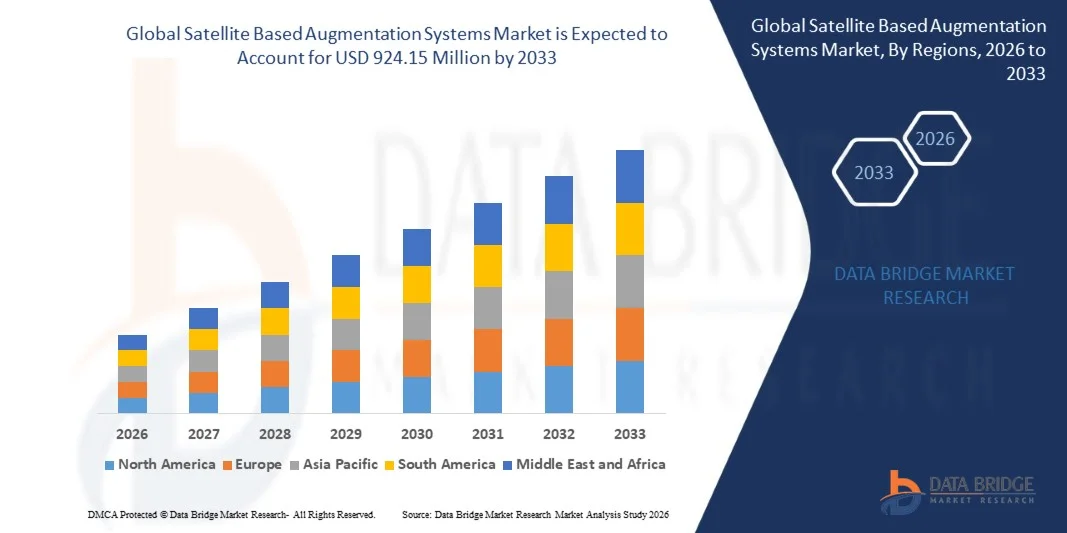
- As per Data Bridge Market Research Analysis the global Satellite Based Augmentation Systems size was valued at USD 635.11 million in 2025 and is expected to reach USD 924.15 million by 2033, at a CAGR of 4.80% during the forecast period
- The market growth is largely driven by the increasing demand for highly accurate and reliable satellite navigation systems in aviation, maritime, and transportation sectors, leading to broader adoption of advanced navigation infrastructure across global transportation networks
- Furthermore, the growing need for improved aircraft navigation safety, enhanced positioning accuracy, and efficient air traffic management systems is encouraging governments and aviation authorities to invest in satellite based augmentation technologies. These combined developments are accelerating the deployment of SBAS solutions worldwide and significantly supporting the expansion of the market
Market Size & Forecast
- Global Market Value (2025): USD 635.11 million
- Expected Market Value (2033): USD 924.15 million
- Forecast CAGR (2025–2033): 4.80%
Satellite Based Augmentation Systems Market Analysis
- Satellite Based Augmentation Systems, designed to enhance the accuracy, integrity, and reliability of Global Navigation Satellite Systems signals, are becoming critical components of modern aviation navigation and positioning infrastructure across multiple industries
- The increasing demand for SBAS solutions is primarily driven by rising air traffic volumes, modernization of aviation infrastructure, and growing dependence on satellite navigation technologies to support safe aircraft operations, precision landing procedures, and efficient navigation services across global airspace networks
- North America dominated the satellite based augmentation systems market in 2025, due to strong adoption of advanced satellite navigation technologies and significant investments in aviation infrastructure
- Asia-Pacific is expected to be the fastest growing region in the satellite based augmentation systems market during the forecast period due to rapid aviation expansion, increasing air passenger traffic, and government investments in satellite navigation infrastructure
- Aviation segment dominated the market with a market share of 56.1% in 2025, due to the critical need for highly accurate navigation, safety monitoring, and efficient air traffic management. Satellite based augmentation systems play a vital role in improving aircraft positioning accuracy and enabling precision approach and landing procedures. Aviation authorities increasingly rely on SBAS to support satellite-based navigation frameworks and reduce dependency on conventional ground-based navigation infrastructure
Report Scope and Satellite Based Augmentation Systems Market Segmentation
|
Attributes |
Satellite Based Augmentation Systems Key Market Insights |
|
Segments Covered |
|
|
Countries Covered |
North America
Europe
Asia-Pacific
Middle East and Africa
South America
|
|
Key Market Players |
|
|
Market Opportunities |
|
|
Value Added Data Infosets |
|
What is the Key Trend in the Satellite Based Augmentation Systems Market?
“Integration of Multi-Constellation GNSS with SBAS”
- A significant trend in the satellite based augmentation systems market is the increasing integration of SBAS with multi-constellation Global Navigation Satellite Systems to enhance positioning accuracy, reliability, and service continuity across critical navigation applications. This integration is strengthening the capability of satellite navigation infrastructure by allowing augmentation systems to support multiple navigation constellations
- For instance, Airbus SE is supporting the development of the third generation of the European Geostationary Navigation Overlay Service which is designed to enhance navigation accuracy by augmenting both Global Positioning System and Galileo signals. This development improves aviation navigation capabilities and enables wider augmentation services for maritime and land users across Europe
- The aviation industry is increasingly incorporating multi-constellation SBAS capabilities to support precision navigation and safe landing operations in complex airspace environments. This integration ensures better signal availability and enhances operational reliability for aircraft navigation systems across global aviation networks
- Government agencies and aviation authorities are also expanding investments in satellite navigation modernization programs to enable compatibility with multiple GNSS constellations. This shift is improving the resilience of navigation services and strengthening the overall reliability of SBAS infrastructure
- Growing adoption of advanced avionics systems that support multi-frequency and multi-constellation navigation signals is further encouraging the integration of SBAS technologies across modern aircraft fleets. This technological advancement is enabling more accurate positioning services and improving operational safety within global aviation operations
- The continued integration of SBAS with multiple GNSS constellations is reinforcing its role as a critical component of next-generation satellite navigation infrastructure. This development is expected to support enhanced navigation performance and accelerate the broader adoption of SBAS technologies across aviation and transportation sectors
Satellite Based Augmentation Systems Market Dynamics
Driver
“Growing Demand for High-Precision Aviation Navigation”
- The increasing demand for highly accurate aircraft navigation systems is a major factor driving the satellite based augmentation systems market, as aviation authorities require reliable positioning technologies to support safe flight operations and efficient air traffic management. SBAS technologies enhance the accuracy and integrity of GNSS signals, enabling aircraft to perform precision navigation and landing procedures with improved safety and operational efficiency
- For instance, Raytheon Technologies secured a contract from the Federal Aviation Administration to upgrade the Wide Area Augmentation System with Dual Frequency Operation capabilities. This modernization improves navigation accuracy and strengthens the reliability of satellite based aviation guidance systems across the United States
- Rising global air passenger traffic is encouraging aviation authorities to adopt advanced navigation technologies that support optimized flight paths and improved aircraft positioning accuracy. SBAS solutions enable more efficient airspace management while reducing operational limitations associated with conventional ground-based navigation systems
- Many airports are expanding their use of satellite based navigation procedures to enable precision approaches and safer landing operations, particularly in regions where traditional navigation infrastructure is limited. This capability enhances airport accessibility and strengthens aviation safety standards
- The continued expansion of aviation infrastructure and the need for improved navigation accuracy are reinforcing the importance of satellite based augmentation technologies. This sustained demand for high-precision aviation navigation is significantly contributing to the long-term growth of the SBAS market
Restraint/Challenge
“High Cost of SBAS Infrastructure Deployment”
- The satellite based augmentation systems market faces challenges due to the high costs associated with developing and deploying the complex infrastructure required for SBAS operations. Implementing these systems requires advanced satellite technology, ground reference stations, and specialized control centers, which demand substantial financial investments from governments and aviation authorities
- For instance, European Union Agency for the Space Programme awarded a contract to Thales Alenia Space for the development and deployment of upgrades to the European Geostationary Navigation Overlay Service system. Projects of this scale require significant funding and long development timelines, reflecting the substantial investment needed to maintain advanced satellite navigation infrastructure
- Developing SBAS systems involves launching geostationary satellites, establishing monitoring stations, and maintaining continuous operational support for navigation services. These complex infrastructure requirements contribute to higher development and operational costs across the SBAS ecosystem
- Many countries face financial constraints when attempting to implement large-scale satellite navigation augmentation programs, which can slow adoption in emerging aviation markets. The requirement for regulatory approvals, system certification, and integration with existing aviation infrastructure further increases implementation complexity
- The high cost of infrastructure development and maintenance remains a major barrier for widespread SBAS deployment. These financial challenges continue to influence market growth and require governments and organizations to carefully manage investments in satellite navigation technologies
Satellite Based Augmentation Systems Market Scope
The market is segmented on the basis of type, application, signal type, and level of service.
• By Type
On the basis of type, the Satellite Based Augmentation Systems market is segmented into Wide Area Augmentation System (WAAS), European Geostationary Navigation Overlay Service (EGNOS), MTSAT Satellite Based Augmentation Navigation System (MSAS), GPS-Aided GEO Augmented Navigation System (GAGAN), System for Differential Corrections and Monitoring (SDCM), and others. The Wide Area Augmentation System (WAAS) segment dominated the market with the largest market revenue share in 2025, supported by its extensive adoption in aviation navigation across the U.S. WAAS improves the accuracy, integrity, and reliability of GNSS signals, which is essential for safe aircraft navigation and landing operations. Aviation authorities and airlines widely deploy WAAS to enable precision navigation without the need for ground-based navigation infrastructure. The system is integrated into many commercial aircraft avionics and flight management systems, strengthening its widespread adoption.
The GPS-Aided GEO Augmented Navigation System (GAGAN) segment is anticipated to witness the fastest growth rate during the forecast period, driven by increasing aviation modernization initiatives across Asia. GAGAN significantly enhances navigation accuracy and safety for aircraft operating in the Indian airspace and surrounding regions. Growing air traffic volumes and airport modernization projects across Asia are encouraging aviation authorities to adopt advanced augmentation systems. In addition, regional governments are investing in satellite navigation infrastructure to reduce dependence on traditional ground-based navigation systems. The expanding aviation sector and rising demand for precise satellite-based navigation solutions are expected to accelerate the adoption of GAGAN in the coming years.
• By Application
On the basis of application, the Satellite Based Augmentation Systems market is segmented into aviation, maritime, road and rail, and others. The aviation segment dominated the market with the largest revenue share of 56.1% in 2025 due to the critical need for highly accurate navigation, safety monitoring, and efficient air traffic management. Satellite based augmentation systems play a vital role in improving aircraft positioning accuracy and enabling precision approach and landing procedures. Aviation authorities increasingly rely on SBAS to support satellite-based navigation frameworks and reduce dependency on conventional ground-based navigation infrastructure. Growing global air traffic and ongoing airport infrastructure modernization are further strengthening the demand for SBAS in aviation applications. The ability of SBAS to enhance safety, operational efficiency, and fuel optimization also contributes to its strong adoption within the aviation sector.
The road and rail segment is projected to witness the fastest growth during the forecast period, driven by increasing adoption of advanced navigation and positioning technologies in transportation networks. SBAS solutions improve location accuracy for vehicle navigation, traffic management systems, and railway signaling operations. Governments and transportation authorities are investing in satellite-based navigation technologies to enhance safety, operational efficiency, and route optimization in road and rail infrastructure. The integration of satellite navigation with intelligent transportation systems is further expanding the use of SBAS in land transportation. Growing demand for connected mobility solutions and autonomous transportation technologies is expected to accelerate the adoption of SBAS in road and rail applications.
• By Signal Type
On the basis of signal type, the Satellite Based Augmentation Systems market is segmented into Wide Area Differential (WAD), GNSS/Ground Integrity Channel (GIC), and GEO Ranging. The Wide Area Differential (WAD) segment dominated the market with the largest revenue share in 2025 owing to its essential role in correcting GNSS signal errors across large geographic areas. WAD signals enhance positioning accuracy by providing differential corrections that compensate for atmospheric disturbances, satellite clock errors, and orbital inaccuracies. This capability significantly improves navigation precision for aviation, maritime, and surveying applications. WAD is widely integrated into SBAS architectures as it ensures reliable and accurate positioning information for critical navigation operations. Continuous demand for improved GNSS accuracy and reliability is sustaining the strong dominance of WAD signals in the SBAS ecosystem.
The GEO Ranging segment is expected to witness the fastest growth during the forecast period, driven by its capability to provide additional ranging signals from geostationary satellites. GEO ranging enhances satellite geometry and improves positioning accuracy for navigation systems. This feature supports advanced navigation services and strengthens signal availability in challenging environments. Growing deployment of geostationary satellites and modernization of GNSS augmentation infrastructure are increasing the use of GEO ranging signals. Rising demand for high-precision navigation in aviation and emerging autonomous mobility technologies is expected to further accelerate the adoption of GEO ranging capabilities.
• By Level of Service
On the basis of level of service, the Satellite Based Augmentation Systems market is segmented into en-route, en-route terminal, initial approach, intermediate approach, non-precision approach (NPA), departure, approach operations with vertical guidance (APV-I), approach operations with vertical guidance (APV-II), and category I precision approach. The en-route segment dominated the market with the largest revenue share in 2025 due to the widespread use of SBAS navigation services during the main phase of flight operations. En-route navigation requires reliable positioning accuracy and integrity monitoring to ensure safe aircraft movement over long distances. SBAS provides enhanced navigation capabilities that support optimized flight paths and improved air traffic management efficiency. Aviation authorities increasingly rely on satellite-based navigation solutions to manage growing air traffic volumes and reduce operational constraints. The ability of SBAS to provide continuous navigation coverage during en-route operations contributes significantly to the segment’s dominance.
The Approach Operations with Vertical Guidance (APV-I) segment is projected to witness the fastest growth during the forecast period, supported by increasing demand for advanced approach procedures in modern aviation. APV-I enables aircraft to perform safe landing approaches with vertical guidance using satellite-based augmentation systems. This capability improves landing safety, particularly at airports that lack expensive ground-based precision landing infrastructure. Aviation authorities are expanding SBAS-enabled approach procedures to enhance operational efficiency and safety across regional and international airports. Growing emphasis on satellite-based precision navigation and airport modernization initiatives is expected to accelerate the adoption of APV-I services in the coming years.
Satellite Based Augmentation Systems Market Regional Analysis
- North America dominated the satellite based augmentation systems market with the largest revenue share in 2025, driven by strong adoption of advanced satellite navigation technologies and significant investments in aviation infrastructure
- The region benefits from the widespread implementation of augmentation systems that improve GPS accuracy, reliability, and safety for aviation operations
- Continuous modernization of air traffic management systems and the growing reliance on satellite-based navigation solutions for aircraft guidance further support market growth, establishing SBAS as a critical technology for aviation safety and navigation efficiency
U.S. Satellite Based Augmentation Systems Market Insight
The U.S. satellite based augmentation systems market captured the largest revenue share in 2025 within North America, supported by the large-scale deployment of the Wide Area Augmentation System (WAAS) for aviation navigation. The country’s strong aviation network and advanced aerospace infrastructure encourage the widespread use of satellite-based navigation technologies. Aviation authorities increasingly rely on SBAS to improve aircraft positioning accuracy and enable precision approach procedures. Continuous investments in air traffic modernization programs and satellite navigation infrastructure are further accelerating the growth of the SBAS market in the U.S.
Europe Satellite Based Augmentation Systems Market Insight
The Europe satellite based augmentation systems market is projected to expand at a substantial CAGR throughout the forecast period, driven by increasing adoption of advanced satellite navigation technologies across aviation and transportation sectors. European aviation authorities are actively integrating SBAS services to enhance aircraft navigation accuracy and operational safety. The region’s growing emphasis on modernizing aviation infrastructure and improving air traffic management efficiency is fostering the demand for SBAS technologies. Expansion of satellite navigation applications across maritime and land transportation sectors is also contributing to regional market growth.
U.K. Satellite Based Augmentation Systems Market Insight
The U.K. satellite based augmentation systems market is anticipated to grow at a noteworthy CAGR during the forecast period, supported by the country’s focus on strengthening aviation navigation systems and satellite-based technologies. Increasing air traffic and the need for precise navigation systems are encouraging aviation authorities to adopt SBAS-enabled solutions. The U.K.’s investments in aerospace innovation and navigation infrastructure are further contributing to the adoption of satellite augmentation technologies. Growing integration of satellite navigation in aviation and transportation applications is expected to continue driving market expansion.
Germany Satellite Based Augmentation Systems Market Insight
The Germany satellite based augmentation systems market is expected to expand at a considerable CAGR during the forecast period, driven by the country’s strong aerospace industry and focus on advanced navigation technologies. Germany is actively supporting the development and integration of satellite navigation solutions to improve aviation safety and operational efficiency. Increasing investments in satellite infrastructure and positioning technologies are strengthening SBAS adoption across aviation and transportation sectors. The country’s technological innovation and focus on high-precision navigation systems are contributing to the steady growth of the market.
Asia-Pacific Satellite Based Augmentation Systems Market Insight
The Asia-Pacific satellite based augmentation systems market is poised to grow at the fastest CAGR during the forecast period of 2026 to 2033, driven by rapid aviation expansion, increasing air passenger traffic, and government investments in satellite navigation infrastructure. Countries across the region are implementing SBAS technologies to enhance navigation accuracy and improve aviation safety standards. The growing number of airport modernization projects and airspace management initiatives is accelerating the adoption of satellite-based navigation systems. Rising demand for precise positioning solutions across aviation and transportation sectors is further supporting regional market growth.
Japan Satellite Based Augmentation Systems Market Insight
The Japan satellite based augmentation systems market is gaining momentum due to the country’s advanced aerospace capabilities and strong emphasis on satellite navigation technologies. Japan operates the MTSAT Satellite Based Augmentation Navigation System (MSAS) which enhances GPS accuracy for aviation operations. Increasing investments in satellite infrastructure and the expansion of advanced air navigation systems are encouraging the adoption of SBAS technologies. The country’s focus on improving aviation safety and navigation precision continues to support market growth.
China Satellite Based Augmentation Systems Market Insight
The China satellite based augmentation systems market accounted for the largest market revenue share in Asia Pacific in 2025, attributed to the rapid expansion of aviation infrastructure and strong government support for satellite navigation development. The country is investing heavily in advanced navigation systems to enhance air traffic management and aircraft navigation accuracy. Growing airport development projects and increasing air travel demand are driving the adoption of satellite augmentation technologies. Continuous advancements in satellite navigation infrastructure are strengthening China’s position in the regional SBAS market.
Which are the Top Companies in Satellite Based Augmentation Systems Market?
The satellite based augmentation systems industry is primarily led by well-established companies, including:
- Cisco Systems, Inc. (U.S.)
- IBM (U.S.)
- Raytheon Technologies Corporation (U.S.)
- Northrop Grumman (U.S.)
- Lockheed Martin Corporation (U.S.)
- Boeing (U.S.)
- General Dynamics Corporation (U.S.)
- BAE Systems (U.K.)
- Airbus (Netherlands)
- Leonardo S.p.A. (Italy)
- Honeywell International, Inc. (U.S.)
- Thales Group (France)
- Collins Aerospace (U.S.)
- L3Harris Technologies, Inc. (U.S.)
- BluVector (U.S.)
- Qualys, Inc. (U.S.)
- Mercury Systems, Inc. (U.S.)
Latest Developments in Global Satellite Based Augmentation Systems Market
- In December 2022, Airbus SE successfully passed the System Critical Design Review (CDR) for EGNOS V3, the next-generation European Geostationary Navigation Overlay Service. This milestone marked a significant step toward deploying the second generation of the system, designed to enhance safety-critical applications such as aircraft navigation and landing operations. EGNOS V3 will improve the performance of both Global Positioning System and Galileo while extending augmentation services to maritime and land users. The development strengthens the European satellite navigation ecosystem and contributes to the expansion of the Satellite Based Augmentation Systems market by enabling more advanced and reliable positioning services
- In September 2022, Raytheon Intelligence & Space secured a WAAS DFO-2 contract from the Federal Aviation Administration valued at up to USD 375 million over ten years. The contract focuses on technical refresh initiatives and the implementation of Dual Frequency Operation (DFO) upgrades for the Wide Area Augmentation System. These enhancements are expected to improve navigation accuracy, reliability, and signal integrity for aviation operations across the U.S. The agreement reinforces the long-term modernization of SBAS infrastructure and highlights continued government investment in satellite navigation technologies, supporting overall market growth
- In June 2022, Thales Alenia Space signed a contract with the European Union Agency for the Space Programme to develop, certify, and deploy a new version of the European Geostationary Navigation Overlay Service. The company also reached a milestone within the Galileo program by integrating an additional satellite into its Ground Mission Segment (GMS). This advancement enhances location services for more than 3.3 billion users worldwide, improving positioning accuracy and service reliability. The initiative strengthens Europe’s satellite navigation capabilities and accelerates the adoption of augmentation technologies across aviation, maritime, and land applications
- In April 2022, the Ministry of Civil Aviation announced that the Airports Authority of India successfully conducted trials using the country’s proprietary SBAS technology, GPS Aided GEO Augmented Navigation, at Kishangarh Airport. During the trial, InterGlobe Aviation Ltd. operated an aircraft using the Instrument Approach Procedure (IAP) with a Localizer Performance with Vertical Guidance (LPV) minimum of 250 feet. The successful demonstration validated the operational capability of GAGAN for precision approach procedures. This development highlights India’s progress in satellite navigation infrastructure and supports wider SBAS adoption across the aviation sector in the Asia-Pacific region
- In February 2021, the European GNSS Agency awarded a USD 121 million contract to Eutelsat for the development of next-generation satellites supporting the European Geostationary Navigation Overlay Service program. The project focuses on strengthening Europe’s satellite navigation infrastructure and improving the reliability and coverage of augmentation services. By investing in next-generation SBAS capabilities, the initiative supports the long-term modernization of navigation systems and expands the potential for high-precision positioning applications across aviation and other transportation sectors

- Interactive Data Analysis Dashboard
- Company Analysis Dashboard for high growth potential opportunities
- Research Analyst Access for customization & queries
- Competitor Analysis with Interactive dashboard
- Latest News, Updates & Trend analysis
- Harness the Power of Benchmark Analysis for Comprehensive Competitor Tracking
Data collection and base year analysis are done using data collection modules with large sample sizes. The stage includes obtaining market information or related data through various sources and strategies. It includes examining and planning all the data acquired from the past in advance. It likewise envelops the examination of information inconsistencies seen across different information sources. The market data is analysed and estimated using market statistical and coherent models. Also, market share analysis and key trend analysis are the major success factors in the market report. To know more, please request an analyst call or drop down your inquiry.
The key research methodology used by DBMR research team is data triangulation which involves data mining, analysis of the impact of data variables on the market and primary (industry expert) validation. Data models include Vendor Positioning Grid, Market Time Line Analysis, Market Overview and Guide, Company Positioning Grid, Patent Analysis, Pricing Analysis, Company Market Share Analysis, Standards of Measurement, Global versus Regional and Vendor Share Analysis. To know more about the research methodology, drop in an inquiry to speak to our industry experts.
Data Bridge Market Research is a leader in advanced formative research. We take pride in servicing our existing and new customers with data and analysis that match and suits their goal. The report can be customized to include price trend analysis of target brands understanding the market for additional countries (ask for the list of countries), clinical trial results data, literature review, refurbished market and product base analysis. Market analysis of target competitors can be analyzed from technology-based analysis to market portfolio strategies. We can add as many competitors that you require data about in the format and data style you are looking for. Our team of analysts can also provide you data in crude raw excel files pivot tables (Fact book) or can assist you in creating presentations from the data sets available in the report.













