


What is the Satellite Internet Market Size and Overview?
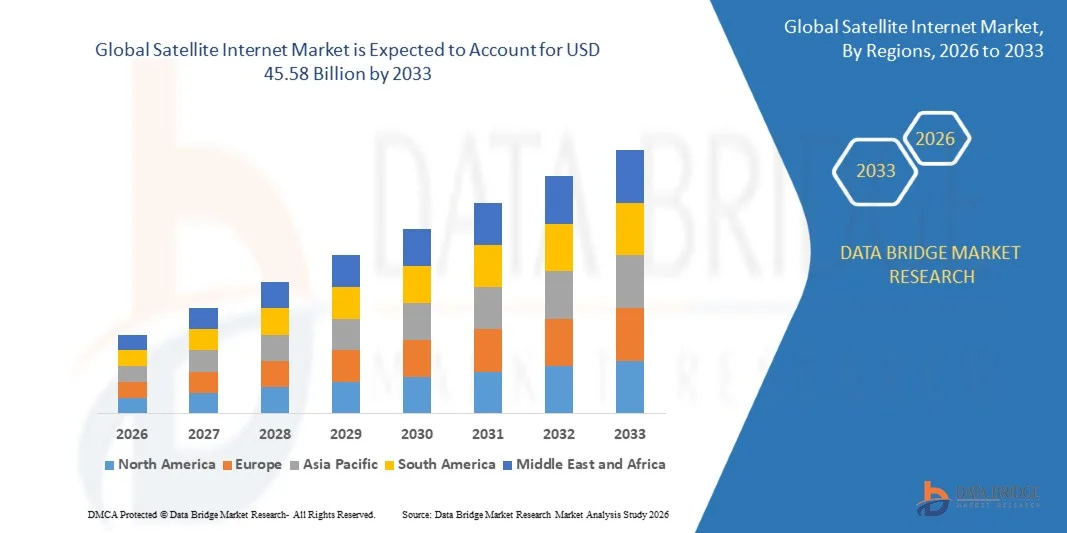
As per Data Bridge Market Research Analysis the Satellite Internet Market was valued at USD 13.16 billion in 2025 and is projected to reach USD 45.58 billion by 2033, growing at a CAGR of 16.80% from 2026 to 2033. The market is experiencing strong growth driven by increasing global demand for high-speed internet connectivity, expanding deployment of low earth orbit (LEO) satellite constellations, rising digital transformation initiatives, and growing need for broadband access in remote and underserved regions.
The increasing penetration of cloud computing, remote work infrastructure, online education, digital entertainment, and IoT-enabled connected devices is accelerating demand for reliable satellite-based communication networks. Governments, telecom operators, and private space technology companies are increasingly investing in next-generation satellite internet infrastructure to improve broadband accessibility and reduce the digital divide across rural and geographically isolated areas.
Key Market Trends & Insights
- North America dominated the Satellite Internet Market with the largest revenue share of 39.41% in 2025, supported by strong investments in space communication infrastructure and rapid deployment of LEO satellite constellations.
- Asia-Pacific is expected to be the fastest-growing region at a CAGR of 18.4% from 2026 to 2033, fueled by rising internet penetration initiatives and increasing investments in satellite communication infrastructure across India, China, Japan, and Southeast Asia
- The LEO Satellite Internet segment led the market with a 48.62% share in 2025, driven by increasing demand for low-latency and high-speed broadband connectivity services
- The Mobile Satellite Internet segment is projected to register the fastest CAGR of 17.8%, reflecting increasing demand for in-flight connectivity, connected vehicles, and maritime communication services.
- The Commercial segment dominated the end-user category with a 41.27% revenue share in 2025, led by growing adoption of satellite broadband solutions across aviation, maritime, energy, mining, and logistics industries.
- Governments are increasingly partnering with private satellite communication providers to expand broadband accessibility and strengthen digital infrastructure in remote regions.
- AI-enabled network optimization, software-defined satellites, and direct-to-device satellite connectivity are emerging as major innovation trends across the satellite internet ecosystem.
Market Size & Forecast
- Global Market Value (2025): USD 13.16 Billion
- Expected Market Value (2033): USD 45.58 Billion
- Forecast CAGR (2026–2033): 16.80%
- Leading Region in 2025: North America
- Fastest Growing Region: Asia-Pacific
Report Scope and Satellite Internet Market Segmentation
|
Attributes |
Satellite Internet Key Market Insights |
|
Segments Covered |
|
|
Countries Covered |
North America · U.S. · Canada · Mexico Europe · Germany · France · U.K. · Netherlands · Switzerland · Belgium · Russia · Italy · Spain · Turkey · Rest of Europe Asia-Pacific · China · Japan · India · South Korea · Singapore · Malaysia · Australia · Thailand · Indonesia · Philippines · Rest of Asia-Pacific Middle East and Africa · Saudi Arabia · U.A.E. · South Africa · Egypt · Israel · Rest of Middle East and Africa South America · Brazil · Argentina · Rest of South America |
|
Key Market Players |
· SpaceX (Starlink) (U.S.) · Eutelsat OneWeb (U.K.) · Viasat, Inc. (U.S.) · Hughes Network Systems, LLC (U.S.) · SES S.A. (Luxembourg) · Intelsat S.A. (Luxembourg) · Amazon Project Kuiper (U.S.) · Telesat Corporation (Canada) · Inmarsat Global Limited (U.K.) · Iridium Communications Inc. (U.S.) · EchoStar Corporation (U.S.) · Globalstar, Inc. (U.S.) · Thuraya Telecommunications Company (UAE) · Gilat Satellite Networks Ltd. (Israel) · Cobham Satcom (Denmark) · Speedcast International Limited (Australia) · KVH Industries, Inc. (U.S.) · Avanti Communications Group plc (U.K.) · Airbus Defence and Space (Netherlands) · NEC Corporation (Japan) |
|
Market Opportunities |
· Expansion of rural and remote broadband connectivity initiatives · Growing demand for connected mobility solutions · Increasing adoption of direct-to-device satellite communication technologies |
|
Value Added Data Infosets |
In addition to the market insights such as market value, growth rate, market segments, geographical coverage, market players, and market scenario, the market report curated by the Data Bridge Market Research team includes in-depth expert analysis, import/export analysis, pricing analysis, production consumption analysis, and pestle analysis. |
What is the Key Trend in the Satellite Internet Market?
Trend: Rapid Expansion of Low Earth Orbit (LEO) Satellite Constellations
The rapid deployment of low earth orbit satellite constellations is emerging as a major trend in the Satellite Internet Market. Companies are increasingly launching thousands of interconnected satellites to provide low-latency, high-speed internet connectivity across global markets. LEO satellite networks offer improved performance compared to traditional geostationary satellite systems, making them highly suitable for applications such as video streaming, online gaming, remote work, autonomous systems, and industrial IoT.
For instance,
In May 2026, Asia Tech x Singapore published an article in which it stated that global connectivity is entering a transformative phase with the rapid expansion of Low Earth Orbit (LEO) satellites. Unlike traditional geostationary satellites operating at approximately 36,000 kilometres altitude, LEO satellites orbit much closer to Earth—typically between 500 and 2,000 kilometres. This proximity dramatically reduces latency and enables faster data transmission, revolutionising broadband connectivity, remote communications, and enterprise applications worldwide
Additionally, advancements in phased-array antennas, reusable rocket technologies, AI-driven bandwidth optimization, and inter-satellite laser communication are significantly improving network efficiency and reducing operational costs across the satellite communication industry.
Satellite Internet Market Dynamics
Key Market Driver: Increasing Demand for Broadband Connectivity in Remote Regions
The increasing demand for reliable broadband connectivity across rural, remote, and underserved regions is significantly driving growth in the Satellite Internet Market. Governments and telecom providers are increasingly deploying satellite-based communication infrastructure to bridge the digital divide and improve access to online education, healthcare, financial services, and digital government platforms. Satellite internet technologies are enabling connectivity in areas where terrestrial fiber or cellular infrastructure deployment remains economically challenging.
Key Restraint/Challenge: High Infrastructure and Deployment Costs
A major challenge in the Satellite Internet Market is the high capital investment associated with satellite manufacturing, launch operations, ground station infrastructure, and spectrum licensing. Large-scale deployment of satellite constellations requires significant funding and ongoing maintenance expenditures. Additionally, regulatory complexities, orbital congestion concerns, and latency limitations in certain satellite systems continue to create operational challenges for service providers globally.
Key Market Opportunity: Growth of Connected Mobility and Defense Communication
The increasing demand for connected mobility solutions and secure communication networks across aviation, maritime, military, and transportation sectors presents significant growth opportunities for the satellite internet market. Satellite communication technologies are increasingly being integrated into aircraft, ships, autonomous vehicles, and defense systems to support uninterrupted connectivity, real-time monitoring, and mission-critical communication capabilities.
How is the Satellite Internet Market Segmented?
The satellite internet market is segmented on the basis of orbit type, end user, and service type.
- By Orbit Type
On the basis of orbit type, the Satellite Internet Market is segmented into LEO satellite internet, MEO satellite internet, and GEO satellite internet. The LEO satellite internet segment dominated the market with a share of 48.62% in 2025 due to increasing deployment of large-scale satellite constellations capable of delivering low-latency and high-speed internet connectivity. Growing investments by private space companies and telecom providers are significantly accelerating the adoption of LEO-based communication systems globally.
The MEO satellite internet segment is expected to witness the fastest CAGR of 17.2% from 2026 to 2033, driven by increasing demand for medium-latency communication services, expanding enterprise connectivity applications, and growing adoption across aviation and maritime sectors.
- By End User
On the basis of end user, the Satellite Internet Market is segmented into residential, commercial, and government & defense. The commercial segment dominated the market with a share of 41.27% in 2025 due to increasing adoption of satellite broadband services across aviation, maritime, energy, logistics, and mining industries. Businesses are increasingly utilizing satellite internet technologies to ensure reliable communication, real-time monitoring, and operational continuity in remote environments.
The residential segment is expected to witness the fastest CAGR of 17.5% from 2026 to 2033, driven by rising demand for high-speed internet connectivity in rural and underserved regions, increasing remote work adoption, and expansion of affordable satellite broadband subscription services globally.
- By Service Type
On the basis of service type, the Satellite Internet Market is segmented into fixed satellite internet, mobile satellite internet, and broadband & enterprise connectivity. The fixed satellite internet segment dominated the market with a share of 44.83% in 2025 due to increasing deployment of residential broadband connectivity services and government-supported rural internet expansion initiatives.
The mobile satellite internet segment is expected to witness the fastest CAGR of 17.8% from 2026 to 2033, driven by rising demand for connected mobility solutions, in-flight connectivity services, maritime broadband communication, and real-time connectivity across transportation and defense applications.
Which Region Holds the Largest Share of the Satellite Internet Market?
North America dominated the satellite internet market and accounted for the largest revenue share of 39.41% in 2025, supported by strong investments in space technology infrastructure, presence of major satellite communication companies, and rapid deployment of low earth orbit satellite constellations. Increasing demand for broadband connectivity and growing defense communication requirements are further driving regional market expansion.
U.S. Satellite Internet Market Insight
The U.S. satellite internet market is witnessing substantial growth due to increasing investments in commercial space technologies, expansion of satellite broadband infrastructure, and growing deployment of connected mobility applications. Major private space companies are accelerating satellite launches and expanding broadband coverage capabilities across rural and enterprise markets.
Europe Satellite Internet Market Insight
The Europe satellite internet market remains a significant contributor to global revenue, driven by increasing investments in digital connectivity infrastructure, government-supported broadband initiatives, and rising adoption of satellite communication technologies across commercial and defense sectors. The region is also witnessing increasing collaboration between telecom operators and satellite service providers.
U.K. Satellite Internet Market Insight
The U.K. satellite internet market is experiencing strong growth due to increasing demand for rural broadband connectivity, expansion of satellite communication infrastructure, and rising investments in next-generation space technologies. Enterprises are increasingly adopting satellite broadband services to support remote operations and connected enterprise applications.
Germany Satellite Internet Market Insight
The Germany satellite internet market is expanding steadily due to increasing digital infrastructure investments, growing adoption of connected industrial applications, and rising focus on advanced communication technologies. The country is also investing in satellite-enabled defense and mobility communication systems.
Asia-Pacific Satellite Internet Market Insight
The Asia-Pacific satellite internet market is expected to witness rapid growth, driven by increasing internet penetration initiatives, expansion of rural connectivity programs, and growing investments in digital infrastructure across China, India, Japan, and Southeast Asia. Rising adoption of connected mobility solutions and smart city projects is further supporting market expansion.
China Satellite Internet Market Insight
The China satellite internet market is growing rapidly due to strong government support for satellite communication infrastructure, increasing investments in domestic satellite constellation projects, and rising demand for digital connectivity services across remote and industrial regions.
India Satellite Internet Market Insight
The India satellite internet market is witnessing strong growth due to increasing government focus on digital inclusion, rising demand for broadband connectivity in rural regions, and the expansion of satellite-based communication services. Growing investments in education technology and remote enterprise connectivity are further supporting market growth.
Which are the Top Companies in Satellite Internet Market?
The satellite internet industry is primarily led by well-established companies, including:
- SpaceX (Starlink) (U.S.)
- Eutelsat OneWeb (U.K.)
- Viasat, Inc. (U.S.)
- Hughes Network Systems, LLC (U.S.)
- SES S.A. (Luxembourg)
- Intelsat S.A. (Luxembourg)
- Amazon Project Kuiper (U.S.)
- Telesat Corporation (Canada)
- Inmarsat Global Limited (U.K.)
- Iridium Communications Inc. (U.S.)
- EchoStar Corporation (U.S.)
- Globalstar, Inc. (U.S.)
- Thuraya Telecommunications Company (UAE)
- Gilat Satellite Networks Ltd. (Israel)
- Cobham Satcom (Denmark)
- Speedcast International Limited (Australia)
- KVH Industries, Inc. (U.S.)
- Avanti Communications Group plc (U.K.)
- Airbus Defence and Space (Netherlands)
- NEC Corporation (Japan)
What are Latest Developments in Satellite Internet Market?
- In February 2025, SpaceX expanded its Starlink satellite constellation with additional direct-to-cell communication capabilities designed to improve mobile connectivity services globally.
- In January 2025, Amazon accelerated the deployment of its Project Kuiper satellite internet infrastructure aimed at expanding high-speed broadband connectivity across underserved regions.
- In August 2025, Eutelsat partnered with Tata Group's Nelco to launch LEO satellite connectivity across India.
- In October 2024, Viasat officially unveiled the JetXP program for business aviation. This enhancement provides uncapped speeds, expanded capacity, and network prioritization to Jet ConneX customers.
- In 2024, SES successfully transitioned its second-generation Medium Earth Orbit (MEO) network, O3b mPOWER, into commercial service. These software-defined satellites feature thousands of dynamically steerable beams and adaptable power modules, allowing SES to intelligently route bandwidth in real-time to high-demand sectors like government, aviation, and maritime.

- Interactive Data Analysis Dashboard
- Company Analysis Dashboard for high growth potential opportunities
- Research Analyst Access for customization & queries
- Competitor Analysis with Interactive dashboard
- Latest News, Updates & Trend analysis
- Harness the Power of Benchmark Analysis for Comprehensive Competitor Tracking
Data collection and base year analysis are done using data collection modules with large sample sizes. The stage includes obtaining market information or related data through various sources and strategies. It includes examining and planning all the data acquired from the past in advance. It likewise envelops the examination of information inconsistencies seen across different information sources. The market data is analysed and estimated using market statistical and coherent models. Also, market share analysis and key trend analysis are the major success factors in the market report. To know more, please request an analyst call or drop down your inquiry.
The key research methodology used by DBMR research team is data triangulation which involves data mining, analysis of the impact of data variables on the market and primary (industry expert) validation. Data models include Vendor Positioning Grid, Market Time Line Analysis, Market Overview and Guide, Company Positioning Grid, Patent Analysis, Pricing Analysis, Company Market Share Analysis, Standards of Measurement, Global versus Regional and Vendor Share Analysis. To know more about the research methodology, drop in an inquiry to speak to our industry experts.
Data Bridge Market Research is a leader in advanced formative research. We take pride in servicing our existing and new customers with data and analysis that match and suits their goal. The report can be customized to include price trend analysis of target brands understanding the market for additional countries (ask for the list of countries), clinical trial results data, literature review, refurbished market and product base analysis. Market analysis of target competitors can be analyzed from technology-based analysis to market portfolio strategies. We can add as many competitors that you require data about in the format and data style you are looking for. Our team of analysts can also provide you data in crude raw excel files pivot tables (Fact book) or can assist you in creating presentations from the data sets available in the report.













