


Satellite Ocean Surveillance Market Overview
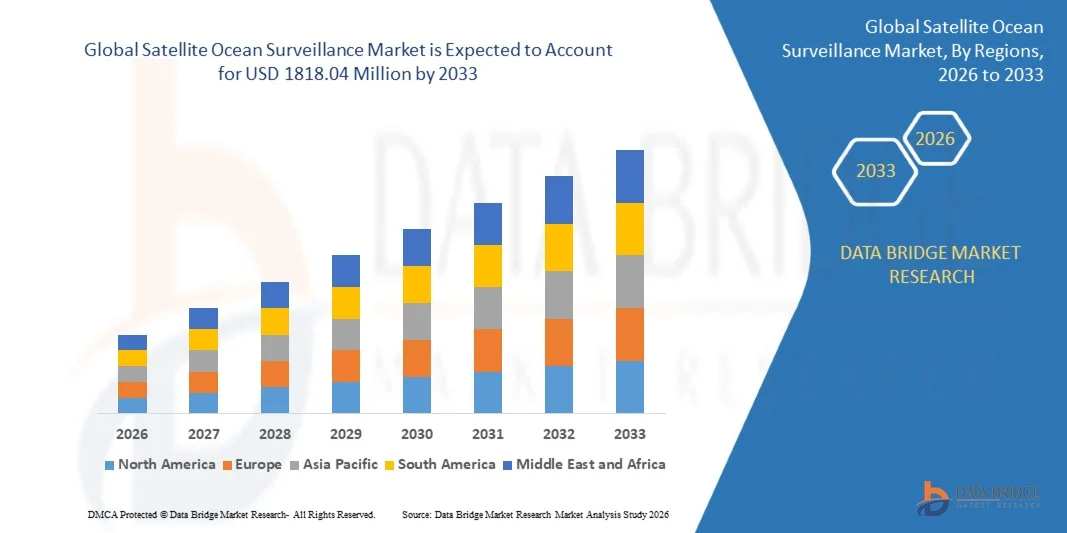
The Satellite Ocean Surveillance Market was valued at USD 503.80 million in 2025 and is projected to reach USD 1818.04 million by 2033, growing at a CAGR of 17.40% from 2026 to 2033. The market is experiencing significant growth driven by increasing maritime security concerns, rising illegal fishing activities, growing investments in naval intelligence systems, and expanding adoption of satellite-based monitoring technologies for environmental and commercial applications.
Governments, defense agencies, and maritime authorities are increasingly deploying satellite ocean surveillance systems to monitor vessel movement, detect unauthorized maritime activities, improve border security, and enhance disaster response capabilities. Advanced satellite technologies integrated with artificial intelligence, synthetic aperture radar (SAR), and real-time analytics are improving maritime domain awareness and enabling continuous monitoring of global ocean activities.
Key Market Trends & Insights
- North America dominated the Satellite Ocean Surveillance Market with the largest revenue share of 36.42% in 2025, supported by strong defense spending and advanced space surveillance infrastructure.
- Asia-Pacific is expected to be the fastest-growing region at a CAGR of 19.1% from 2026 to 2033, fueled by increasing maritime security investments and expanding satellite programs across China, India, Japan, and Southeast Asia
- The LEO Satellites segment led the market with a 44.16% share in 2025, driven by increasing deployment of low-latency and high-resolution earth observation systems.
- The Maritime Security & Defense segment dominated the application category with a 41.83% revenue share in 2025, reflecting rising naval surveillance and border protection initiatives globally.
- Government & Defense Agencies account for the largest end-user share due to increasing adoption of real-time maritime intelligence and national security monitoring systems.
- AI-powered vessel tracking, SAR imaging, and multi-satellite constellation deployment are emerging as key innovation areas across the market.
- Increasing investments in blue economy initiatives and climate observation programs are further supporting long-term market growth.
Market Size & Forecast
- Global Market Value (2025): USD 503.80 Million
- Expected Market Value (2033): USD 1818.04 Million
- Forecast CAGR (2026–2033): 17.40%
- Leading Region in 2025: North America
- Fastest Growing Region: Asia-Pacific
Report Scope and Satellite Ocean Surveillance Market Segmentation
|
Attributes |
Satellite Ocean Surveillance Key Market Insights |
|
Segments Covered |
|
|
Countries Covered |
North America · U.S. · Canada · Mexico Europe · Germany · France · U.K. · Netherlands · Switzerland · Belgium · Russia · Italy · Spain · Turkey · Rest of Europe Asia-Pacific · China · Japan · India · South Korea · Singapore · Malaysia · Australia · Thailand · Indonesia · Philippines · Rest of Asia-Pacific Middle East and Africa · Saudi Arabia · U.A.E. · South Africa · Egypt · Israel · Rest of Middle East and Africa South America · Brazil · Argentina · Rest of South America |
|
Key Market Players |
· Maxar Technologies Inc. (U.S.) · Airbus Defence and Space (Netherlands) · ICEYE Oy (Finland) · Capella Space Corp. (U.S.) · HawkEye 360 Inc. (U.S.) · Planet Labs PBC (U.S.) · L3Harris Technologies, Inc. (U.S.) · Northrop Grumman Corporation (U.S.) · Thales Group (France) · Lockheed Martin Corporation (U.S.) · RTX Corporation (U.S.) · Satellogic Inc. (Argentina) · Spire Global, Inc. (U.S.) · BlackSky Technology Inc. (U.S.) · Mitsubishi Electric Corporation (Japan) · NEC Corporation (Japan) · China Aerospace Science and Technology Corporation (China) · Saab AB (Sweden) · OHB SE (Germany) · Kongsberg Gruppen ASA (Norway) |
|
Market Opportunities |
· Expansion of AI-enabled maritime surveillance systems · Increasing deployment of small satellite constellations · Rising investments in climate monitoring and blue economy initiatives |
|
Value Added Data Infosets |
In addition to the market insights such as market value, growth rate, market segments, geographical coverage, market players, and market scenario, the market report curated by the Data Bridge Market Research team includes in-depth expert analysis, import/export analysis, pricing analysis, production consumption analysis, and pestle analysis. |
Satellite Ocean Surveillance Market Trends
Trend: Increasing Adoption of AI-Enabled Maritime Intelligence Systems
Artificial intelligence and advanced analytics are increasingly being integrated into satellite ocean surveillance systems to improve maritime intelligence capabilities and automate vessel tracking operations. AI-enabled surveillance platforms can analyze massive volumes of satellite imagery and maritime data in real time, enabling authorities to identify suspicious activities, detect illegal fishing operations, and monitor maritime traffic efficiently.
In addition, synthetic aperture radar (SAR) technologies and multi-satellite constellation architectures are enabling continuous ocean monitoring regardless of weather conditions or time of day. Governments and commercial operators are increasingly leveraging AI-powered surveillance systems to improve maritime situational awareness and operational decision-making.
Satellite Ocean Surveillance Market Dynamics
Key Market Driver: Rising Maritime Security and Border Surveillance Requirements
Increasing geopolitical tensions, illegal maritime activities, and growing concerns regarding border security are significantly driving demand for satellite ocean surveillance systems globally. Governments and defense organizations are increasingly investing in advanced maritime intelligence and monitoring platforms capable of tracking vessel movement, detecting unauthorized activities, and improving naval operational efficiency.
For instance,
On the third day of IMW 2025 (29 October, 2025), Prime Minister Narendra Modi dedicated a set of transformative maritime initiatives to the nation, marking a major milestone in India’s journey toward becoming a global maritime leader under the Maritime Amrit Kaal Vision (MAKV), 2047. “The announcements made by our Hon’ble Prime Minister Narendra Modi ji reflect the government’s commitment to expanding India’s maritime capacity, advancing sustainability, and driving indigenous innovation across the sector. As part of the initiatives launched by the PM, more than ₹2.2 Lakh Crores, the Shipping Corporation of India (SCI) announced plans to expand its fleet to 216 vessels by 2047 with an investment of ₹1 Lakh Crores, adding 10 million Gross Tonnage (GT) and strengthening India’s global maritime competitiveness.
The growing need for real-time maritime domain awareness and enhanced offshore infrastructure protection is further accelerating the adoption of satellite-based surveillance technologies across global defense and security sectors.
Key Restraint/Challenge: High Development and Deployment Costs
A major challenge in the Satellite Ocean Surveillance Market is the high cost associated with satellite manufacturing, launch operations, data processing infrastructure, and system integration. Advanced earth observation systems equipped with high-resolution imaging technologies and AI-enabled analytics require substantial capital investments and long development cycles.
Additionally, regulatory complexities, limited launch availability, and high maintenance costs create barriers for smaller commercial operators and developing nations seeking to expand satellite surveillance capabilities.
Key Market Opportunity: Expansion of Environmental and Climate Monitoring Programs
The increasing focus on environmental protection, ocean conservation, and climate monitoring presents significant opportunities for the satellite ocean surveillance market. Governments and research organizations are increasingly utilizing satellite imaging systems to monitor ocean pollution, track climate changes, assess marine biodiversity, and support disaster management operations.
For instance,
In April 2026, according to The Policy Edge, India is scaling ocean conservation under the Deep Ocean Mission, with new initiatives for marine monitoring and biodiversity mapping
The growing importance of sustainable marine resource management and global climate observation initiatives is expected to create strong long-term demand for advanced ocean surveillance technologies.
Satellite Ocean Surveillance Market Scope
The satellite ocean surveillance market is segmented on the basis of satellite type, application, and end user.
- By Satellite Type
On the basis of satellite type, the Satellite Ocean Surveillance Market is segmented into LEO satellites, GEO satellites, and MEO satellites. The LEO satellites segment dominated the market with a share of 44.16% in 2025 due to increasing deployment of low earth orbit satellite constellations offering high-resolution imaging, low latency communication, and real-time ocean monitoring capabilities. Governments and commercial operators are increasingly adopting LEO systems for maritime surveillance, vessel tracking, and environmental monitoring applications.
The MEO satellites segment is expected to witness the fastest CAGR of 18.2% from 2026 to 2033, driven by increasing investments in advanced navigation, communication, and regional surveillance systems capable of supporting broader maritime coverage and improved operational efficiency.
- By Application
On the basis of application, the Satellite Ocean Surveillance Market is segmented into maritime security & defense, environmental & climate monitoring, and fisheries & commercial operations. The maritime security & defense segment dominated the market with a share of 41.83% in 2025 due to rising investments in naval intelligence systems, border surveillance infrastructure, and anti-piracy operations. Governments are increasingly utilizing advanced satellite monitoring systems to improve maritime domain awareness and strengthen national security capabilities.
The environmental & climate monitoring segment is expected to witness the fastest CAGR of 17.9% from 2026 to 2033, driven by increasing global focus on climate observation, marine ecosystem monitoring, disaster response management, and ocean sustainability initiatives.
- By End User
On the basis of end user, the the Satellite Ocean Surveillance Market is segmented into government & defense agencies, commercial maritime operators, and research & environmental organizations. The government & defense agencies segment dominated the market with a share of 47.21% in 2025 due to increasing adoption of satellite-enabled maritime intelligence systems for national security, naval operations, and coastal monitoring activities.
The research & environmental organizations segment is expected to witness the fastest CAGR of 17.7% from 2026 to 2033, driven by increasing investments in climate monitoring projects, oceanographic research programs, and marine biodiversity assessment initiatives globally.
Satellite Ocean Surveillance Market Regional Analysis
North America dominated the satellite ocean surveillance market and accounted for the largest revenue share of 36.42% in 2025, supported by strong defense budgets, advanced aerospace capabilities, and increasing investments in maritime intelligence infrastructure. The region benefits from the strong presence of major satellite manufacturers and surveillance technology providers.
U.S. Satellite Ocean Surveillance Market Insight
The U.S. satellite ocean surveillance market is witnessing substantial growth due to increasing investments in naval intelligence systems, maritime border protection, and advanced space-based monitoring technologies. Government agencies and defense organizations are increasingly deploying AI-enabled satellite surveillance systems to improve real-time maritime domain awareness and operational efficiency.
Europe Satellite Ocean Surveillance Market Insight
The Europe satellite ocean surveillance market remains a significant contributor to global revenue, driven by increasing investments in maritime security programs, climate observation systems, and environmental sustainability initiatives. European governments are increasingly adopting advanced satellite imaging and vessel monitoring technologies to strengthen coastal security and marine resource management.
U.K. Satellite Ocean Surveillance Market Insight
The U.K. satellite ocean surveillance market is experiencing steady growth due to increasing adoption of maritime intelligence technologies, expansion of naval monitoring programs, and growing investments in satellite-based defense systems. The country is also witnessing rising deployment of AI-powered surveillance and ocean observation technologies.
Germany Satellite Ocean Surveillance Market Insight
The Germany satellite ocean surveillance market is expanding steadily due to strong investments in aerospace innovation, environmental monitoring programs, and advanced earth observation technologies. Increasing collaboration between defense agencies and research organizations is further supporting market development.
Asia-Pacific Satellite Ocean Surveillance Market Insight
The Asia-Pacific satellite ocean surveillance market is expected to witness rapid growth, driven by rising maritime security concerns, increasing naval modernization programs, and expanding investments in indigenous satellite infrastructure across China, India, Japan, and Southeast Asia. Growing focus on ocean resource management and disaster monitoring is further accelerating regional market growth.
China Satellite Ocean Surveillance Market Insight
The China satellite ocean surveillance market is growing rapidly due to large-scale investments in satellite constellations, maritime security programs, and advanced earth observation technologies. The country is increasingly expanding its ocean monitoring and naval intelligence capabilities to support strategic maritime initiatives.
India Satellite Ocean Surveillance Market Insight
The India satellite ocean surveillance market is witnessing strong growth due to increasing investments in coastal security infrastructure, maritime surveillance systems, and indigenous satellite development programs. Government initiatives focused on blue economy development and disaster monitoring are further supporting market expansion.
Satellite Ocean Surveillance Market Share
The satellite ocean surveillance industry is primarily led by well-established companies, including:
- Maxar Technologies Inc. (U.S.)
- Airbus Defence and Space (Netherlands)
- ICEYE Oy (Finland)
- Capella Space Corp. (U.S.)
- HawkEye 360 Inc. (U.S.)
- Planet Labs PBC (U.S.)
- L3Harris Technologies, Inc. (U.S.)
- Northrop Grumman Corporation (U.S.)
- Thales Group (France)
- Lockheed Martin Corporation (U.S.)
- RTX Corporation (U.S.)
- Satellogic Inc. (Argentina)
- Spire Global, Inc. (U.S.)
- BlackSky Technology Inc. (U.S.)
- Mitsubishi Electric Corporation (Japan)
- NEC Corporation (Japan)
- China Aerospace Science and Technology Corporation (China)
- Saab AB (Sweden)
- OHB SE (Germany)
- Kongsberg Gruppen ASA (Norway)
Latest Developments in Satellite Ocean Surveillance Market
- In September 2025, ICEYE, together with SATIM, the provider of state-of-the-art solutions for SAR data analytics, announced the launch of Detect & Classify – an AI-powered product that accelerates the transformation of satellite imagery into actionable intelligence. The product combines ICEYE’s high-resolution SAR imagery with SATIM’s advanced artificial intelligence to automatically detect and classify vessels, aircraft, and vehicles in ICEYE imagery with better than 90% accuracy.
- In November 2025, ICEY successfully launched and deployed five new SAR satellites into orbit. The satellites were integrated via Exolaunch and successfully lifted off on November 28, 2025, aboard the Transporter-15 rideshare mission with SpaceX from Vandenberg Space Force Base, California, USA.
- In September 2024, Capella Space introduced new high-resolution SAR imaging services aimed at improving coastal surveillance, naval intelligence, and disaster response applications.
- In June 2025, Maxar Intelligence launched a new monitoring product called Sentry, part of a broader effort to move beyond satellite imagery and become a provider of actionable geospatial intelligence.

- Interactive Data Analysis Dashboard
- Company Analysis Dashboard for high growth potential opportunities
- Research Analyst Access for customization & queries
- Competitor Analysis with Interactive dashboard
- Latest News, Updates & Trend analysis
- Harness the Power of Benchmark Analysis for Comprehensive Competitor Tracking
Data collection and base year analysis are done using data collection modules with large sample sizes. The stage includes obtaining market information or related data through various sources and strategies. It includes examining and planning all the data acquired from the past in advance. It likewise envelops the examination of information inconsistencies seen across different information sources. The market data is analysed and estimated using market statistical and coherent models. Also, market share analysis and key trend analysis are the major success factors in the market report. To know more, please request an analyst call or drop down your inquiry.
The key research methodology used by DBMR research team is data triangulation which involves data mining, analysis of the impact of data variables on the market and primary (industry expert) validation. Data models include Vendor Positioning Grid, Market Time Line Analysis, Market Overview and Guide, Company Positioning Grid, Patent Analysis, Pricing Analysis, Company Market Share Analysis, Standards of Measurement, Global versus Regional and Vendor Share Analysis. To know more about the research methodology, drop in an inquiry to speak to our industry experts.
Data Bridge Market Research is a leader in advanced formative research. We take pride in servicing our existing and new customers with data and analysis that match and suits their goal. The report can be customized to include price trend analysis of target brands understanding the market for additional countries (ask for the list of countries), clinical trial results data, literature review, refurbished market and product base analysis. Market analysis of target competitors can be analyzed from technology-based analysis to market portfolio strategies. We can add as many competitors that you require data about in the format and data style you are looking for. Our team of analysts can also provide you data in crude raw excel files pivot tables (Fact book) or can assist you in creating presentations from the data sets available in the report.













