


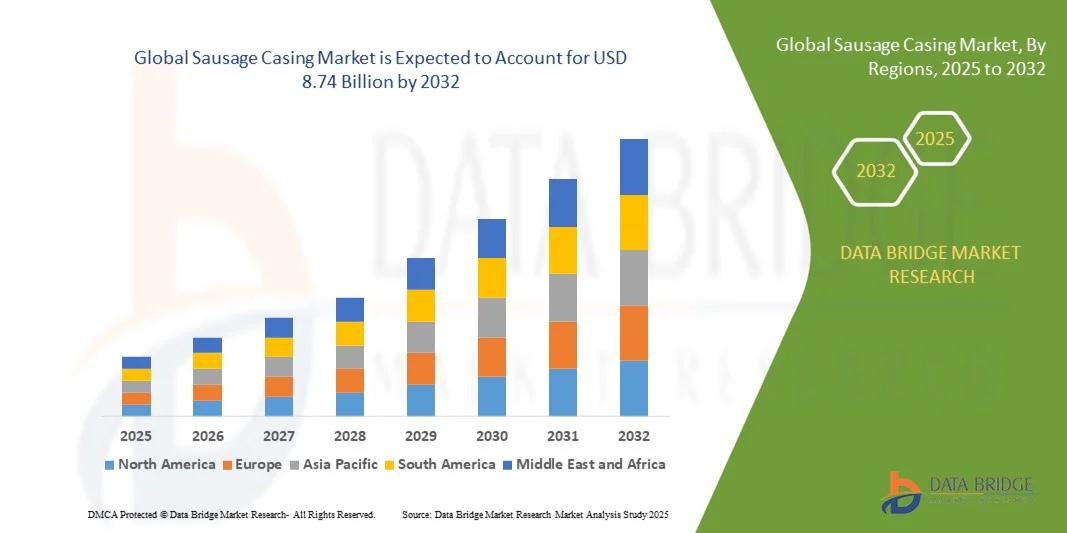
What is the Global Sausage Casing Market Size and Growth Rate?
- The global sausage casing market size was valued at USD 6.64 billion in 2024 and is expected to reach USD 8.74 billion by 2032, at a CAGR of 3.50% during the forecast period
- Population growth, combined with rising per capita disposable income, is expected to increase demand for sausage casing market and consumption of processed foods, boosting market growth over the forecast period. Increasing demand from the fast food outlets and chains and the continuous demand for the poultry products will further adds to the market growth
What are the Major Takeaways of Sausage Casing Market?
- The global sausage casings market is moderately fragmented, with many players present. At the same time, the market for sausage casings has a fierce competition landscape. To stay ahead of the competition, major enterprises in this market are executing a variety of strategic moves such as partnerships, mergers, acquisitions, collaborations, and new product launches
- Many of the world's leading manufacturers of sausage casings are pushing the boundaries of innovation in their products. As a result, they are redirecting cash inflows toward R&D activities. These efforts are expected to result in an upward growth curve for the global sausage casings market in the coming years
- Europe dominated the sausage casing market with the largest revenue share of 41.2% in 2024, driven by the region’s rich culinary heritage, high consumption of processed meat, and strong demand for premium sausage products
- The Asia-Pacific Sausage Casing market is anticipated to grow at the fastest CAGR of 9.6% during 2025–2032, driven by rapid urbanization, rising disposable incomes, and growing adoption of processed and ready-to-eat meat products
- The Natural Casings segment dominated the market with the largest revenue share of 56.3% in 2024, driven by growing consumer preference for authentic flavor, texture, and appearance in traditional sausages
Report Scope and Sausage Casing Market Segmentation
|
Attributes |
Sausage Casing Key Market Insights |
|
Segments Covered |
|
|
Countries Covered |
North America
Europe
Asia-Pacific
Middle East and Africa
South America
|
|
Key Market Players |
|
|
Market Opportunities |
|
|
Value Added Data Infosets |
In addition to the insights on market scenarios such as market value, growth rate, segmentation, geographical coverage, and major players, the market reports curated by the Data Bridge Market Research also include in-depth expert analysis, pricing analysis, brand share analysis, consumer survey, demography analysis, supply chain analysis, value chain analysis, raw material/consumables overview, vendor selection criteria, PESTLE Analysis, Porter Analysis, and regulatory framework. |
What is the Key Trend in the Sausage Casing Market?
Rising Popularity of Natural and Sustainable Casings
- A significant and accelerating trend in the global sausage casing market is the growing preference for natural and eco-friendly casings, driven by consumer demand for clean-label, organic, and sustainable meat products. Manufacturers are increasingly shifting from synthetic or plastic-based casings to collagen, cellulose, and natural gut casings derived from renewable sources
- For instance, Viscofan Group introduced a line of sustainable collagen casings developed from biodegradable materials to reduce environmental impact while maintaining product performance. Similarly, DAT-Schaub Group is investing in eco-conscious manufacturing processes to align with global sustainability goals
- The demand for transparent labeling and traceable sourcing is prompting producers to adopt more environmentally responsible practices, ensuring compliance with evolving food safety regulations and sustainability standards
- In addition, technological advancements are improving the quality and durability of natural casings, allowing for consistent texture, strength, and cooking performance. Innovations such as low-salt preservation and enhanced cleaning techniques are helping manufacturers reduce waste and extend shelf life
- This trend reflects the broader industry transition toward ethical production and circular economy models, positioning sustainable sausage casings as a key differentiator in premium and health-conscious markets
- As consumers continue to associate natural casings with higher quality and authentic taste, the adoption of eco-friendly casing materials is expected to accelerate globally, especially across Europe and North America
What are the Key Drivers of Sausage Casing Market?
- The increasing global consumption of processed meat and ready-to-eat food products is a major driver of the sausage casing market. Rising urbanization, changing dietary preferences, and higher disposable incomes are contributing to the growing demand for sausages across retail and foodservice sectors
- For instance, in March 2024, DAT-Schaub Group expanded its processing facility in Denmark to meet the surging demand for natural casings from premium sausage producers across Europe. Such expansions by leading players are driving market growth and supply reliability
- In addition, the rise in meat-based snack products and artisan sausages is encouraging small and medium manufacturers to invest in quality casings that improve texture and flavor retention
- Technological improvements in casing production, such as automated cleaning, sorting, and collagen extraction, are also driving efficiency and reducing labor dependency. These innovations help manufacturers meet growing global demand while maintaining food safety standards
- Furthermore, the increasing popularity of plant-based and hybrid sausages is creating new growth avenues for collagen and cellulose casing producers, who are developing adaptable materials for both meat and alternative protein formulations
- The combined impact of modernization, convenience foods, and premiumization trends is set to sustain strong market growth in the coming years
Which Factor is Challenging the Growth of the Sausage Casing Market?
- Despite its positive outlook, the sausage casing market faces challenges related to raw material supply fluctuations and high production costs, especially for natural casings derived from animal intestines. Supply chain disruptions and declining livestock populations in certain regions have resulted in inconsistent availability and rising prices
- For instance, in 2023, European sausage producers reported increased procurement costs due to limited hog supplies and stricter animal welfare regulations affecting raw casing sources
- In addition, synthetic casing disposal and environmental concerns present challenges, as cellulose and plastic casings contribute to waste generation when not properly managed. This has led to growing scrutiny from environmental agencies and consumers advocating for biodegradable alternatives
- Maintaining consistent quality and uniformity in natural casings also remains difficult, as variations in animal size and species can affect performance during automated sausage production
- Furthermore, cultural and dietary restrictions in certain regions—such as halal or kosher compliance—limit the use of specific casing materials, constraining market penetration
- Overcoming these challenges through supply chain diversification, innovation in alternative materials, and strategic partnerships with meat processors will be essential for ensuring steady and sustainable market expansion
How is the Sausage Casing Market Segmented?
The market is segmented on the basis of product type, distribution channel, and end-use.
- By Product Type
On the basis of product type, the sausage casing market is segmented into Natural Casings, Synthetic Casings, and Alternative Casings. The Natural Casings segment dominated the market with the largest revenue share of 56.3% in 2024, driven by growing consumer preference for authentic flavor, texture, and appearance in traditional sausages. These casings, primarily derived from animal intestines, are widely used in premium and artisanal meat products due to their superior cooking performance and natural bite.
The Alternative Casings segment is projected to witness the fastest growth rate from 2025 to 2032, fueled by rising demand for sustainable, plant-based, and halal-certified alternatives that align with modern dietary preferences and environmental goals. Manufacturers are investing in biodegradable and collagen-based casings to balance eco-friendliness with production efficiency. The ongoing shift toward clean-label and ethical food consumption is expected to further reinforce the dominance of natural casings while accelerating growth in the alternative segment.
- By End-Use
On the basis of end-use, the sausage casing market is segmented into Industrial and Household. The Industrial segment dominated the market with the largest share of 72.5% in 2024, attributed to its extensive utilization in large-scale sausage manufacturing and commercial meat processing. This dominance stems from high production volumes, standardized casing requirements, and long-standing partnerships with food processing companies. Industrial users prefer durable casings that ensure consistency, hygiene, and automated production compatibility.
The Household segment is expected to register the fastest CAGR from 2025 to 2032, driven by the rising popularity of home cooking, small-batch sausage making, and DIY food trends. Increasing accessibility of pre-cleaned natural and collagen casings through retail and online platforms further supports household adoption. Moreover, the growing number of culinary enthusiasts seeking authentic textures and flavors at home is expanding the consumer base. This segment’s growth highlights the shift from purely industrial applications to broader, consumer-driven demand for casing products.
- By Distribution Channel
On the basis of distribution channel, the sausage casing market is segmented into Direct Sales (B2B) and Indirect Sales (B2C). The Direct Sales (B2B) segment held the largest revenue share of 68.9% in 2024, primarily due to long-term supply contracts between casing manufacturers and meat processing firms, restaurant chains, and sausage producers. B2B transactions ensure bulk purchasing, stable pricing, and consistent quality, catering to large-scale operations. Companies such as Viscofan Group and DAT-Schaub Group rely heavily on B2B models to serve global meat processing industries efficiently.
Meanwhile, the Indirect Sales (B2C) segment is anticipated to record the fastest CAGR from 2025 to 2032, supported by e-commerce growth and retail expansion. Increasing consumer interest in gourmet cooking and the easy availability of casing kits through supermarkets and online stores are boosting B2C demand. The rise of digital platforms and home-delivery models is transforming market accessibility, bridging manufacturers directly with end consumers seeking premium casing options.
Which Region Holds the Largest Share of the Sausage Casing Market?
- Europe dominated the sausage casing market with the largest revenue share of 41.2% in 2024, driven by the region’s rich culinary heritage, high consumption of processed meat, and strong demand for premium sausage products
- Consumers across Europe, particularly in Germany, Spain, and Italy, exhibit a strong preference for traditional and natural sausage casings, which enhance flavor, texture, and cooking performance
- The region’s established meat processing industry, coupled with stringent quality and food safety regulations, fosters consistent demand for both natural and synthetic casings. In addition, the rise of clean-label and sustainable food trends supports the use of eco-friendly and plant-based casing materials
- Europe’s dominance is expected to continue as manufacturers invest in automation and sustainability initiatives, catering to evolving consumer preferences for high-quality, traceable, and ethically sourced sausage products
Germany Sausage Casing Market Insight
The Germany sausage casing market captured the largest revenue share of 36% in 2024 within Europe, owing to its strong meat-processing sector and deep-rooted sausage culture. The country’s long-standing tradition of producing varieties such as bratwurst and frankfurters sustains robust demand for natural and collagen casings. Moreover, technological innovations in meat production and increasing consumer preference for clean, authentic ingredients are supporting market growth. Germany’s strict food standards also encourage manufacturers to focus on hygienic production and traceability, further reinforcing its leadership position in the European market.
U.K. Sausage Casing Market Insight
The U.K. sausage casing market is projected to expand at a significant CAGR during the forecast period, driven by growing consumption of convenience foods and ready-to-cook meat products. The country’s evolving dietary trends, including demand for plant-based and low-fat sausages, are spurring innovation in alternative casing materials. In addition, the rise of artisanal sausage producers and premium meat brands is bolstering the demand for natural casings that deliver authentic texture and appearance. Increasing consumer preference for locally sourced ingredients and sustainability certifications is further influencing casing production and import patterns in the U.K.
Spain Sausage Casing Market Insight
The Spain sausage casing market is witnessing strong growth, supported by its vibrant processed meat industry and the popularity of traditional products such as chorizo and salchichón. Spanish manufacturers are focusing on enhancing casing quality through natural and collagen-based options that meet both domestic and export standards. The country’s robust meat export activity, particularly to Latin America and Europe, is further driving casing demand. Moreover, technological advancements in casing preservation and automation are improving production efficiency. The rise of gourmet sausage brands and the country’s emphasis on food authenticity are key factors contributing to sustained market expansion.
Which Region is the Fastest Growing in the Sausage Casing Market?
The Asia-Pacific sausage casing market is anticipated to grow at the fastest CAGR of 9.6% during 2025–2032, driven by rapid urbanization, rising disposable incomes, and growing adoption of processed and ready-to-eat meat products. The shift toward Western dietary patterns, coupled with increasing investments by global meat processing companies, is expanding casing demand across the region. Furthermore, technological developments in meat production and government initiatives promoting food processing modernization are fueling market growth. As Asia-Pacific emerges as both a manufacturing hub and a major consumer market, the accessibility and affordability of sausage casings continue to increase.
China Sausage Casing Market Insight
The China sausage casing market accounted for the largest revenue share in Asia-Pacific in 2024, owing to its vast processed meat industry and increasing demand for both natural and synthetic casings. Urbanization, changing dietary preferences, and the popularity of Western-style sausages are driving consumption. Domestic manufacturers are investing in advanced casing production technologies to meet export standards while catering to local preferences. In addition, China’s growing focus on food safety, quality assurance, and sustainable sourcing is fostering a shift toward eco-friendly and traceable casing solutions.
Japan Sausage Casing Market Insight
The Japan sausage casing market is gaining momentum, driven by the country’s emphasis on high-quality, premium meat products and technological innovation in food processing. Japanese consumers value texture, flavor integrity, and presentation, making natural and collagen casings highly desirable. The increasing demand for convenience foods, along with the rise of ready-to-cook meat products, is expanding casing usage across both retail and foodservice channels. Moreover, Japan’s aging population and preference for health-oriented, low-sodium sausages are encouraging manufacturers to explore sustainable, alternative casings that balance quality with nutrition.
Which are the Top Companies in Sausage Casing Market?
The sausage casing industry is primarily led by well-established companies, including:
- Amjadi GmbH Deutschland (Germany)
- Viscofan Group (U.S.)
- Almol Casing Pty Ltd (Australia)
- World Casings Corporation (U.S.)
- Natural Casing Co. (U.S.)
- DAT-Schaub Group (Denmark)
- Oversea Casing Co (U.S.)
- PeterGelhard Naturdärme KG (Germany)
- HOLDIJK & HAAMBERG GmbH (Germany)
- Agrimares (Spain)
- APN NATURDARM GmbH (Germany)
- Carl Lipmann & Co. K.G. (GmbH & Co.) (Germany)
- Fortis Srl, Irish Casing Company (Ireland)
- MCJ Casings (U.K.)
- CDS Hackner GmbH (Germany)
What are the Recent Developments in Global Sausage Casing Market?
- In May 2023, DAT-Schaub, a subsidiary of Danish Crown, acquired a 70 percent stake in two SELO companies, SELO Verpakking and SELO Belgium, known for their expertise in the sale of artificial casings for sausage and food production, marking a strategic move to strengthen its presence in the Benelux region. This acquisition allows DAT-Schaub to leverage its comprehensive product portfolio to better serve customers and drive business growth, reinforcing its position in the global Sausage Casing market
- In December 2022, SARIA, a German food manufacturer, acquired Devro plc, a Scottish sausage casing producer, in a transaction valued at USD 698 million, aiming to expand its product range, particularly in collagen-based edible films and coatings for meat products. The combined operations are expected to create a more diversified and scalable business, promoting long-term sustainable growth and strengthening SARIA’s global footprint in the sausage casing industry
- In September 2022, Hofmann Sausage Company announced that Walmart expanded its distribution to Florida, making Hofmann Natural Casing German Brand Franks and Natural Casing Snappy Grillers available in 88 locations across the state, including Tampa/St. Petersburg and Orlando. This expansion highlights increasing accessibility and consumer reach for premium natural casing products in the U.S. market, supporting brand growth and market penetration

- Interactive Data Analysis Dashboard
- Company Analysis Dashboard for high growth potential opportunities
- Research Analyst Access for customization & queries
- Competitor Analysis with Interactive dashboard
- Latest News, Updates & Trend analysis
- Harness the Power of Benchmark Analysis for Comprehensive Competitor Tracking
Global Sausage Casing Market, Supply Chain Analysis and Ecosystem Framework
To support market growth and help clients navigate the impact of geopolitical shifts, DBMR has integrated in-depth supply chain analysis into its Global Sausage Casing Market research reports. This addition empowers clients to respond effectively to global changes affecting their industries. The supply chain analysis section includes detailed insights such as Global Sausage Casing Market consumption and production by country, price trend analysis, the impact of tariffs and geopolitical developments, and import and export trends by country and HSN code. It also highlights major suppliers with data on production capacity and company profiles, as well as key importers and exporters. In addition to research, DBMR offers specialized supply chain consulting services backed by over a decade of experience, providing solutions like supplier discovery, supplier risk assessment, price trend analysis, impact evaluation of inflation and trade route changes, and comprehensive market trend analysis.
Data collection and base year analysis are done using data collection modules with large sample sizes. The stage includes obtaining market information or related data through various sources and strategies. It includes examining and planning all the data acquired from the past in advance. It likewise envelops the examination of information inconsistencies seen across different information sources. The market data is analysed and estimated using market statistical and coherent models. Also, market share analysis and key trend analysis are the major success factors in the market report. To know more, please request an analyst call or drop down your inquiry.
The key research methodology used by DBMR research team is data triangulation which involves data mining, analysis of the impact of data variables on the market and primary (industry expert) validation. Data models include Vendor Positioning Grid, Market Time Line Analysis, Market Overview and Guide, Company Positioning Grid, Patent Analysis, Pricing Analysis, Company Market Share Analysis, Standards of Measurement, Global versus Regional and Vendor Share Analysis. To know more about the research methodology, drop in an inquiry to speak to our industry experts.
Data Bridge Market Research is a leader in advanced formative research. We take pride in servicing our existing and new customers with data and analysis that match and suits their goal. The report can be customized to include price trend analysis of target brands understanding the market for additional countries (ask for the list of countries), clinical trial results data, literature review, refurbished market and product base analysis. Market analysis of target competitors can be analyzed from technology-based analysis to market portfolio strategies. We can add as many competitors that you require data about in the format and data style you are looking for. Our team of analysts can also provide you data in crude raw excel files pivot tables (Fact book) or can assist you in creating presentations from the data sets available in the report.













