Global Scaffold Technology Market
Market Size in USD Billion
CAGR :
% 
 USD
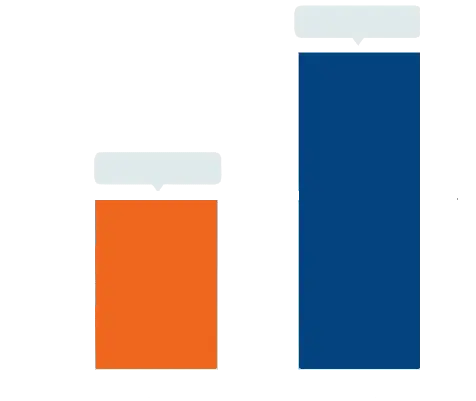
1.74 Billion
USD
3.43 Billion
2025
2033
USD
1.74 Billion
USD
3.43 Billion
2025
2033
 Forecast Period Forecast Period |
2026 –2033 |
 Market Size (Base Year) Market Size (Base Year) |
USD 1.74 Billion |
 Market Size (Forecast Year) Market Size (Forecast Year) |
USD 3.43 Billion |
 CAGR CAGR |
% |
| Major Markets Players |
|
Scaffold Technology Market Size
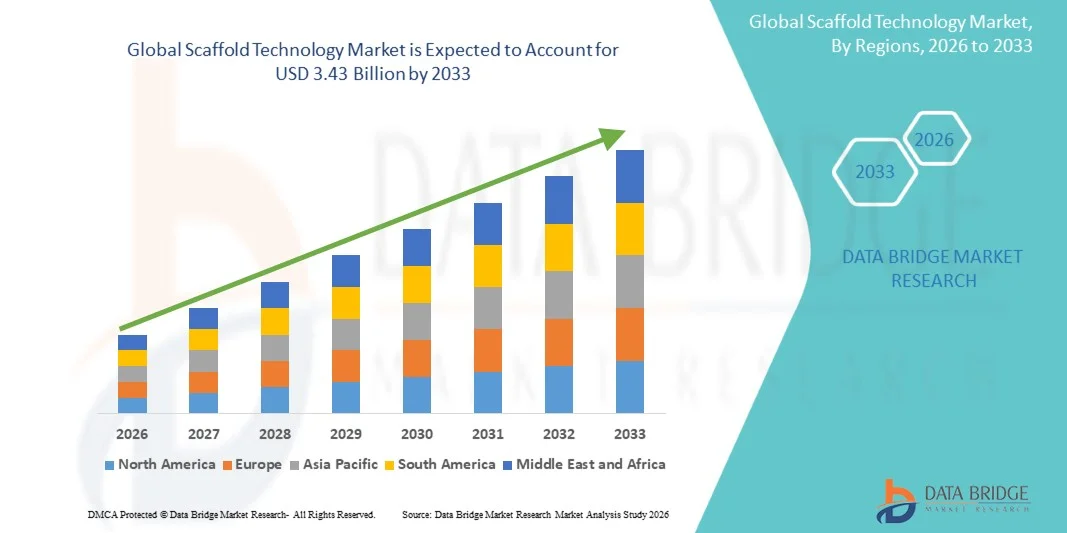
- The global scaffold technology market size was valued at USD 1.74 billion in 2025 and is expected to reach USD 3.43 billion by 2033, at a CAGR of 8.89% during the forecast period
- The market growth is largely fueled by increasing research and development activities in tissue engineering and regenerative medicine, along with continuous technological advancements in scaffold design and biomaterials, leading to improved clinical outcomes and broader adoption across research institutes and healthcare facilities
- Furthermore, rising demand for effective tissue regeneration solutions, growing prevalence of chronic diseases and injuries, and increased focus on personalized and regenerative therapies are establishing scaffold technology as a core component of modern biomedical and healthcare innovation. These converging factors are accelerating the uptake of Scaffold Technology solutions, thereby significantly boosting the industry’s growth
Scaffold Technology Market Analysis
- Scaffold technology, which provides three-dimensional structural support for cell attachment, proliferation, and tissue regeneration, has become a critical component of modern tissue engineering and regenerative medicine across both research and clinical settings due to its ability to closely mimic the natural extracellular matrix
- The escalating demand for scaffold technology is primarily driven by the rising prevalence of chronic diseases and traumatic injuries, increasing applications in stem cell research and regenerative therapies, and continuous advancements in biomaterials and fabrication techniques such as 3D bioprinting and nanotechnology
- North America dominated the Scaffold Technology market with the largest revenue share of approximately 38.5% in 2025, supported by strong funding for regenerative medicine research, early adoption of advanced biomedical technologies, and the presence of leading biotechnology and medical device companies, with the U.S. accounting for the majority of regional demand due to extensive clinical research and commercialization activities
- Asia-Pacific is expected to be the fastest-growing region in the Scaffold Technology market during the forecast period, driven by expanding healthcare infrastructure, rising investments in biotechnology and regenerative medicine, increasing research activities, and growing awareness of advanced tissue engineering solutions in countries such as China, Japan, and India
- Regenerative medicine and tissue engineering dominated the market with a revenue share of 48.9% in 2025, owing to extensive use of scaffolds in tissue repair and organ regeneration
Report Scope and Scaffold Technology Market Segmentation
|
Attributes |
Scaffold Technology Key Market Insights |
|
Segments Covered |
|
|
Countries Covered |
North America
Europe
Asia-Pacific
Middle East and Africa
South America
|
|
Key Market Players |
|
|
Market Opportunities |
|
|
Value Added Data Infosets |
In addition to the insights on market scenarios such as market value, growth rate, segmentation, geographical coverage, and major players, the market reports curated by the Data Bridge Market Research also include in-depth expert analysis, patient epidemiology, pipeline analysis, pricing analysis, and regulatory framework. |
Scaffold Technology Market Trends
“Advancements in Scaffold Design and Biomaterial Innovation”
- A significant and accelerating trend in the global scaffold technology market is the continuous advancement in biomaterial engineering, 3D fabrication techniques, and tissue-specific scaffold designs, which are enhancing structural support and cellular regeneration outcomes in tissue engineering and regenerative medicine applications
- For instance, in February 2023, Corning Incorporated expanded its portfolio of 3D cell culture scaffolds designed to improve cell growth and differentiation in regenerative medicine and drug discovery applications, reflecting the growing focus on advanced scaffold solutions
- Ongoing research into biodegradable, bioresorbable, and hybrid scaffolds is enabling improved cell adhesion, proliferation, and vascularization, which are critical for effective tissue regeneration
- The integration of advanced manufacturing techniques such as 3D bioprinting, electrospinning, and nanofabrication is allowing precise control over scaffold architecture, porosity, and mechanical strength
- This trend toward highly functional, application-specific scaffolds is reshaping expectations among researchers and clinicians, driving demand for customized solutions across orthopedic, cardiovascular, and soft tissue engineering fields
- As a result, academic institutions, biotechnology firms, and medical device manufacturers are increasingly investing in next-generation scaffold technologies to enhance clinical outcomes and research efficiency
Scaffold Technology Market Dynamics
Driver
“Rising Demand for Regenerative Medicine and Tissue Engineering Applications”
- The increasing focus on regenerative medicine, stem cell research, and tissue engineering therapies is a key driver propelling demand for scaffold technologies, as scaffolds play a critical role in supporting cell growth and tissue regeneration
- For instance, in June 2024, Thermo Fisher Scientific strengthened its regenerative medicine product portfolio by introducing advanced scaffold-based solutions to support stem cell expansion and tissue modeling applications
- Growth in chronic diseases, traumatic injuries, and age-related degenerative conditions is increasing the need for innovative tissue repair and replacement solutions, further boosting scaffold adoption
- Expanding investments in biomedical research, government-funded regenerative medicine programs, and clinical trials are accelerating the use of scaffold technologies in both research and therapeutic settings
- The rising adoption of personalized medicine and engineered tissues is encouraging the development and use of scaffolds tailored to specific cell types and clinical applications, supporting sustained market growth
Restraint/Challenge
“High Development Costs and Regulatory Complexity”
- One of the major challenges facing the scaffold technology market is the high cost associated with research, development, and manufacturing of advanced scaffold materials, particularly those intended for clinical and therapeutic use
- For instance, in October 2022, several early-stage biotechnology firms reported delays in commercializing scaffold-based regenerative therapies due to stringent regulatory approval requirements and high clinical validation costs
- In addition, complex regulatory frameworks and lengthy approval processes for scaffold-based medical products can slow market entry and limit commercialization, especially for smaller companies
- Technical challenges related to scalability, reproducibility, and long-term biocompatibility of scaffolds also pose barriers to widespread adoption
- Addressing these challenges through cost-effective manufacturing methods, standardized testing protocols, and clear regulatory pathways will be essential to support long-term growth and broader clinical adoption of scaffold technologies
Scaffold Technology Market Scope
The market is segmented on the basis of type, application, disease, and end use.
• By Type
On the basis of type, the Scaffold Technology market is segmented into Hydrogels, Wound Healing, 3D Bioprinting, and Immunomodulation. The hydrogels segment dominated the scaffold technology market with the largest revenue share of 42.6% in 2025, driven by their excellent biocompatibility, high water content, and ability to closely mimic the natural extracellular matrix. Hydrogels are extensively used in tissue engineering and regenerative medicine due to their flexibility in encapsulating cells and bioactive molecules. Their tunable mechanical properties support applications across cartilage, skin, and soft tissue regeneration. Strong adoption in academic research and clinical trials further strengthens demand. Hydrogels also enable controlled drug delivery and sustained cell release. Increasing investments in biomaterials research support market leadership. Their compatibility with stem cells boosts usage. Growing approvals for hydrogel-based scaffolds accelerate commercialization. High clinical success rates sustain preference. Ease of fabrication adds to adoption. Expanding regenerative medicine applications support revenue dominance. Continuous material innovation reinforces market leadership.
The 3D bioprinting segment is expected to witness the fastest growth, registering a CAGR of 21.8% from 2026 to 2033, driven by rapid advancements in biofabrication technologies. This segment enables precise, layer-by-layer construction of complex tissue structures. Increasing demand for patient-specific scaffolds significantly boosts adoption. Rising investments from biotech firms and research institutions accelerate innovation. Integration with stem cell therapy enhances growth potential. The technology supports faster prototyping and reduced development timelines. Growing applications in organ-on-chip and disease modeling expand scope. Government funding for advanced tissue engineering fuels adoption. Improved printer resolution and biomaterials improve outcomes. Increasing collaborations between academia and industry support scale-up. Regulatory progress encourages commercialization. These factors collectively drive strong CAGR growth.
• By Application
On the basis of application, the Scaffold Technology market is segmented into Stem Cell Therapy, Regenerative Medicine and Tissue Engineering, Drug Discovery, and Others. Regenerative medicine and tissue engineering dominated the market with a revenue share of 48.9% in 2025, owing to extensive use of scaffolds in tissue repair and organ regeneration. Scaffolds provide structural support essential for cell growth and differentiation. High prevalence of chronic diseases increases demand for regenerative solutions. Strong clinical pipeline activity supports sustained adoption. Hospitals and research centers widely use scaffolds for cartilage, bone, and skin regeneration. Favorable reimbursement policies in developed regions boost uptake. Technological advances improve scaffold performance. Rising aging population drives procedural volumes. Growing awareness of minimally invasive regenerative therapies supports demand. Increasing government funding accelerates research translation. High clinical success rates strengthen confidence. Expanding commercial availability sustains dominance.
The stem cell therapy segment is projected to grow at the fastest CAGR of 20.6% from 2026 to 2033, driven by increasing clinical trials and regenerative treatment approvals. Scaffolds play a critical role in improving stem cell survival and differentiation. Rising investment in cell-based therapies accelerates demand. Increasing prevalence of degenerative disorders boosts adoption. Strong academic–industry collaborations support innovation. Technological integration with biomaterials enhances therapeutic outcomes. Regulatory support for advanced therapies fuels growth. Growing patient awareness supports treatment uptake. Expansion of personalized medicine strengthens demand. Emerging markets contribute significantly to volume growth. Rapid progress in cell culture techniques enhances scalability. These factors collectively drive accelerated market expansion.
• By Disease
On the basis of disease, the Scaffold Technology market is segmented into Orthopedics, Musculoskeletal and Spine, Cancer, Skin and Integumentary, Dental, Cardiology and Vascular, Neurology, Urology, GI, Gynaecology, and Others. The orthopedics, musculoskeletal, and spine segment held the largest revenue share of 39.4% in 2025, driven by high demand for bone and cartilage regeneration solutions. Increasing incidence of fractures, osteoarthritis, and spinal disorders supports adoption. Scaffolds enable enhanced bone healing and structural support. Rising aging population increases orthopedic procedure volumes. Strong clinical evidence supports scaffold efficacy. Hospitals widely adopt scaffolds for joint reconstruction. Advancements in bioactive materials improve outcomes. Growing sports injuries contribute to demand. Favorable reimbursement frameworks support uptake. Continuous innovation strengthens surgeon preference. High procedural frequency sustains revenue leadership. Expanding orthopedic research pipelines reinforce dominance.
The cancer segment is anticipated to register the fastest CAGR of 22.3% from 2026 to 2033, driven by increasing use of scaffolds in tumor modeling and drug testing. Scaffolds enable realistic 3D cancer microenvironments. Rising oncology research funding accelerates adoption. Growing focus on personalized cancer therapies supports demand. Use in immuno-oncology research expands scope. Pharmaceutical companies increasingly adopt scaffold-based testing. Improved accuracy over 2D models boosts preference. Expanding cancer incidence globally drives research activity. Integration with bioprinting enhances growth. Regulatory support for advanced preclinical models aids expansion. Increasing collaborations drive innovation. These factors collectively fuel rapid growth.
• By End Use
On the basis of end use, the Scaffold Technology market is segmented into Biotechnology and Pharmaceutical Industries, Research Laboratories and Institutes, Hospitals and Diagnostic Centers, and Others. Research laboratories and institutes dominated the market with a revenue share of 44.7% in 2025, driven by extensive scaffold usage in tissue engineering and biomaterials research. Academic institutions are primary innovation hubs for scaffold development. High research funding supports procurement. Strong focus on regenerative medicine fuels demand. Laboratories use scaffolds for disease modeling and drug screening. Growing number of clinical research programs strengthens adoption. Collaboration with biotech firms increases volume. Availability of grants supports expansion. Continuous experimentation sustains repeat demand. Advanced infrastructure enables high utilization. Increasing publication output reinforces usage. Early-stage technology testing sustains dominance.
The biotechnology and pharmaceutical industries segment is expected to grow at the fastest CAGR of 21.1% from 2026 to 2033, driven by rising adoption of scaffolds in drug discovery and development. Scaffolds improve predictive accuracy of preclinical studies. Growing R&D investment fuels demand. Shift toward 3D cell culture accelerates uptake. Pharmaceutical firms seek cost-effective testing platforms. Regulatory pressure to reduce animal testing supports growth. Integration with organ-on-chip technologies boosts usage. Increasing biologics pipeline expands applications. Collaborations with scaffold developers drive innovation. Rapid commercialization of regenerative therapies supports adoption. Global expansion of biotech firms fuels volume growth. These factors drive strong CAGR expansion.
Scaffold Technology Market Regional Analysis
- North America dominated the scaffold technology market with the largest revenue share of approximately 38.5% in 2025, supported by strong funding for regenerative medicine research, early adoption of advanced biomedical technologies, and the presence of leading biotechnology and medical device companies
- The region benefits from a well-established research ecosystem, extensive clinical trials, and strong collaboration between academic institutions, hospitals, and industry players
- This leadership position is further reinforced by high healthcare expenditure, favorable reimbursement frameworks, and increasing demand for scaffold-based solutions in tissue engineering, stem cell research, and regenerative therapies
U.S. Scaffold Technology Market Insight
The U.S. scaffold technology market accounted for the majority of regional revenue in 2025, driven by extensive clinical research activities, robust commercialization efforts, and significant investments in regenerative medicine. The country hosts a large number of biotechnology firms, research universities, and medical device manufacturers actively developing advanced scaffold materials. Growing prevalence of chronic diseases, rising demand for tissue repair solutions, and strong government and private funding for biomedical research are further propelling market growth. In addition, the rapid translation of scaffold innovations from research to clinical applications continues to strengthen the U.S. market position.
Europe Scaffold Technology Market Insight
The Europe scaffold technology market is projected to expand at a steady CAGR during the forecast period, primarily driven by increasing emphasis on regenerative medicine, rising research funding, and supportive regulatory initiatives for advanced medical technologies. European countries are witnessing growing adoption of scaffold technologies in academic research, pharmaceutical development, and clinical applications. The region’s strong focus on innovation, coupled with collaborative research programs and public–private partnerships, is fostering the development and deployment of next-generation scaffold solutions across multiple therapeutic areas.
U.K. Scaffold Technology Market Insight
The U.K. scaffold technology market is anticipated to grow at a notable CAGR over the forecast period, supported by strong government backing for life sciences research and expanding investments in tissue engineering and regenerative medicine. The presence of leading academic institutions and research centers is accelerating innovation in scaffold design and biomaterials. Increasing clinical research activities and collaborations between universities and biotechnology companies are further contributing to market expansion in the U.K.
Germany Scaffold Technology Market Insight
The Germany scaffold technology market is expected to register considerable growth during the forecast period, driven by the country’s advanced healthcare infrastructure and strong emphasis on biomedical innovation. Germany’s well-established medical device and biotechnology sectors are actively investing in scaffold-based research and development. The rising adoption of tissue engineering solutions in orthopedic, cardiovascular, and reconstructive applications, along with a focus on high-quality and biocompatible materials, is supporting sustained market growth.
Asia-Pacific Scaffold Technology Market Insight
The Asia-Pacific scaffold technology market is expected to grow at the fastest CAGR during the forecast period, driven by expanding healthcare infrastructure, rising investments in biotechnology and regenerative medicine, and increasing research activities across the region. Countries such as China, Japan, and India are witnessing growing awareness of advanced tissue engineering solutions, supported by government initiatives and increasing funding for biomedical research. The region’s improving clinical capabilities and cost-effective manufacturing environment are further accelerating market expansion.
Japan Scaffold Technology Market Insight
The Japan scaffold technology market is gaining traction due to the country’s strong focus on advanced medical research, regenerative therapies, and innovation in biomaterials. Japan’s aging population is increasing demand for effective tissue repair and regeneration solutions, particularly in orthopedic and cardiovascular applications. Strong collaboration between academic institutions, research organizations, and biotechnology companies is driving continuous advancements in scaffold technologies within the country.
China Scaffold Technology Market Insight
China scaffold technology market accounted for the largest revenue share in the Asia-Pacific Scaffold Technology market in 2025, driven by rapid expansion of its biotechnology sector, increasing healthcare investments, and growing research activities in regenerative medicine. The country is witnessing rising adoption of scaffold technologies across academic research, pharmaceutical development, and clinical applications. Government support for biomedical innovation, along with the presence of strong domestic manufacturers and research institutions, is playing a crucial role in propelling the Scaffold Technology market in China.
Scaffold Technology Market Share
The Scaffold Technology industry is primarily led by well-established companies, including:
- Corning Incorporated (U.S.)
- Thermo Fisher Scientific (U.S.)
- Merck KGaA (Germany)
- B.D. (U.S.)
- 3D Biotek (U.S.)
- REPROCELL Inc. (Japan)
- Cellink (BICO Group) (Sweden)
- Advanced BioMatrix (U.S.)
- Tecan Group (Switzerland)
- Lonza Group (Switzerland)
- CollPlant Biotechnologies (Israel)
- NuVasive (U.S.)
- Stryker Corporation (U.S.)
- Zimmer Biomet (U.S.)
- Medtronic (Ireland)
- Organovo Holdings (U.S.)
- Matricel GmbH (Germany)
- DSM Biomedical (Netherlands)
- Integra LifeSciences (U.S.)
- Evonik Industries (Germany)
Latest Developments in Global Scaffold Technology Market
- In March 2023, Evonik and BellaSeno GmbH, a medical technology developer, advanced the commercialization of 3D-printed bioresorbable scaffolds for bone regeneration by using Evonik’s RESOMER polymers to treat large and complex bone defects. This partnership marked a significant step toward broader clinical use of additive-manufactured scaffold implants to improve bone healing and structural support in regenerative medicine
- In November 2022, Gelomics partnered with Rousselot Biomedical to create ready-to-use 3D cell culture kits based on ultra-pure X-Pure GelMA extracellular matrix, enabling researchers to more effectively grow physiologically relevant tissue models in 3D. This collaboration enhanced scaffold-related biomaterials for tissue engineering and preclinical research
- In March 2024, clinical case reports highlighted the use of BellaSeno’s custom-designed, 3D-printed resorbable bone scaffolds in reconstructive surgery, demonstrating successful bone integration and vascularization in a patient with a large segmental defect — marking real-world translation of scaffold technology into advanced surgical practice
- In April 2025, Northern Illinois University (NIU) launched an advanced biomaterials and tissue engineering laboratory, expanding research infrastructure dedicated to scaffold design, advanced hydrogels, and tissue fabrication techniques vital to regenerative medicine and personalized therapies
- In May 2025, industry reports noted groundbreaking innovations and expanding applications in scaffold technology, especially in regenerative medicine, tissue engineering, and drug discovery, with strategic partnerships and biomedical research fueling the next phase of market growth
SKU-
Get online access to the report on the World's First Market Intelligence Cloud

- Interactive Data Analysis Dashboard
- Company Analysis Dashboard for high growth potential opportunities
- Research Analyst Access for customization & queries
- Competitor Analysis with Interactive dashboard
- Latest News, Updates & Trend analysis
- Harness the Power of Benchmark Analysis for Comprehensive Competitor Tracking
Research Methodology
Data collection and base year analysis are done using data collection modules with large sample sizes. The stage includes obtaining market information or related data through various sources and strategies. It includes examining and planning all the data acquired from the past in advance. It likewise envelops the examination of information inconsistencies seen across different information sources. The market data is analysed and estimated using market statistical and coherent models. Also, market share analysis and key trend analysis are the major success factors in the market report. To know more, please request an analyst call or drop down your inquiry.
The key research methodology used by DBMR research team is data triangulation which involves data mining, analysis of the impact of data variables on the market and primary (industry expert) validation. Data models include Vendor Positioning Grid, Market Time Line Analysis, Market Overview and Guide, Company Positioning Grid, Patent Analysis, Pricing Analysis, Company Market Share Analysis, Standards of Measurement, Global versus Regional and Vendor Share Analysis. To know more about the research methodology, drop in an inquiry to speak to our industry experts.
Customization Available
Data Bridge Market Research is a leader in advanced formative research. We take pride in servicing our existing and new customers with data and analysis that match and suits their goal. The report can be customized to include price trend analysis of target brands understanding the market for additional countries (ask for the list of countries), clinical trial results data, literature review, refurbished market and product base analysis. Market analysis of target competitors can be analyzed from technology-based analysis to market portfolio strategies. We can add as many competitors that you require data about in the format and data style you are looking for. Our team of analysts can also provide you data in crude raw excel files pivot tables (Fact book) or can assist you in creating presentations from the data sets available in the report.