What is the Seaweed-Based Agricultural Biostimulants Market Size and Overview?
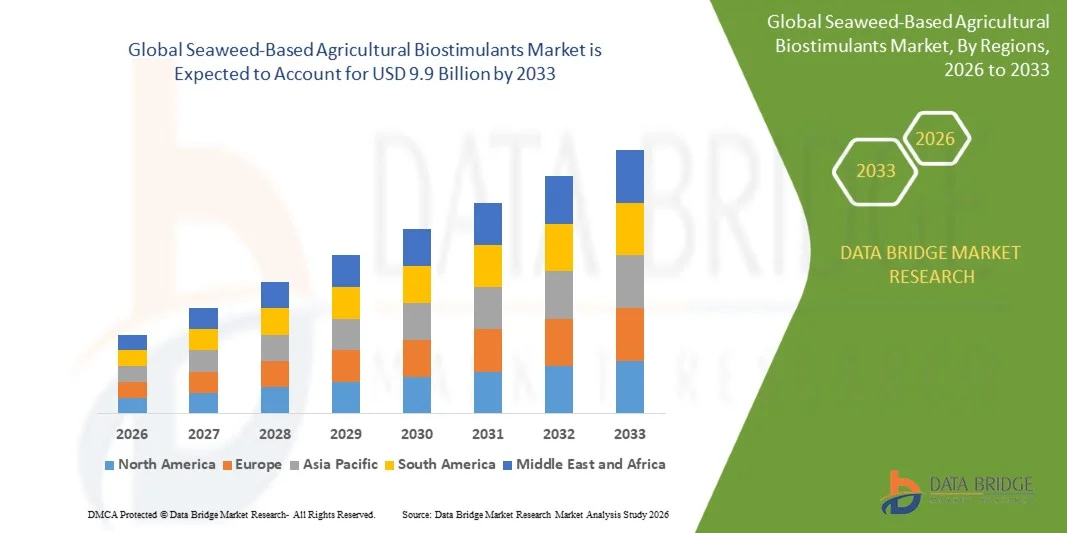
As per Data Bridge Market Research Analysis the seaweed-based agricultural biostimulants market was valued at USD 3.2 billion in 2025 and is projected to reach USD 9.9 billion by 2033, growing at a CAGR of 15.20% from 2026 to 2033. The market is witnessing steady growth driven by increasing demand for sustainable agricultural inputs, rising adoption of organic farming practices, and continuous advancements in plant biostimulant technologies. Growing concerns over soil degradation, declining crop productivity, and the need to improve resource-use efficiency, coupled with stricter regulations on chemical fertilizers and pesticides, are encouraging farmers and agricultural producers to adopt seaweed-based biostimulants across a wide range of crops.
Advanced formulations derived from brown, red, and green seaweed are increasingly being adopted as sustainable alternatives to conventional crop enhancement products by improving nutrient uptake, enhancing abiotic stress tolerance, stimulating plant growth, and increasing crop yield and quality while supporting environmentally sustainable farming practices.
Market Size & Forecast
- Global Market Value (2025): USD 3.2 Billion
- Expected Market Value (2033): USD 9.9 Billion
- Forecast CAGR (2026–2033): 15.20%
- Leading Region in 2025: Europe
- Fastest Growing Region: Asia-Pacific
What are the Major Takeaways of Seaweed-Based Agricultural Biostimulants Market?
-
Europe dominated the global seaweed-based agricultural biostimulants market with the largest revenue share of 37.84% in 2025, supported by stringent regulations on chemical fertilizers, widespread adoption of sustainable farming practices, and strong demand for organic crop inputs.
-
Asia-Pacific is expected to be the fastest-growing region at a CAGR of 16.4% from 2026 to 2033, fuelled by expanding agricultural production, increasing adoption of precision farming, growing awareness of sustainable crop nutrition, and rising government support for eco-friendly agricultural practices.
- The liquid seaweed biostimulants segment led the market with a 42.63% share in 2025, driven by ease of application, rapid nutrient absorption, high compatibility with foliar spray systems, and widespread adoption across commercial farming operations.
- The brown seaweed segment is projected to be the fastest-growing seaweed type, registering a CAGR of 17.1%, owing to its high concentration of bioactive compounds such as alginates, betaines, and natural plant hormones that enhance crop growth, nutrient uptake, and abiotic stress tolerance.
- The fruits & vegetables segment dominated the crop type category with a 39.76% revenue share in 2025, supported by increasing demand for high-value horticultural crops, rising adoption of organic cultivation practices, and the need to improve crop yield and quality.
- Commercial farms accounted for 48.91% of the market share in 2025, driven by increasing adoption of seaweed-based biostimulants to improve nutrient use efficiency, enhance crop resilience against abiotic stress, and maximize agricultural productivity.
- The organic farming segment is expected to be the fastest-growing farming type, registering a CAGR of 16.8%, driven by growing consumer demand for organic food products, stricter regulations on synthetic agrochemicals, and increasing adoption of sustainable crop management practices.
Report Scope and Seaweed-Based Agricultural Biostimulants Market Segmentation
|
Attributes |
Seaweed-Based Agricultural Biostimulants Market Key Segments |
|
Segments Covered |
|
|
Countries Covered |
North America
Europe
Asia-Pacific
Middle East and Africa
South America
|
|
Key Market Players |
|
|
Market Opportunities |
|
|
Value Added Data Infosets |
In addition to the insights on market scenarios such as market value, growth rate, segmentation, geographical coverage, and major players, the market reports curated by the Data Bridge Market Research also include import export analysis, production capacity overview, production consumption analysis, price trend analysis, climate change scenario, supply chain analysis, value chain analysis, raw material/consumables overview, vendor selection criteria, PESTLE Analysis, Porter Analysis, and regulatory framework. |
What is the Key Trend in the Seaweed-Based Agricultural Biostimulants Market?
Trend: Rising Adoption of Sustainable and Organic Crop Nutrition Solutions
Farmers are increasingly adopting seaweed-based agricultural biostimulants to enhance crop productivity, improve nutrient use efficiency, and strengthen plant resilience against abiotic stress while reducing dependence on synthetic agrochemicals. Advanced formulations derived from brown, red, and green seaweed are gaining widespread commercial acceptance due to their ability to stimulate plant growth, improve soil health, and enhance crop quality without adverse environmental impacts. In addition, precision agriculture technologies and sustainable farming practices are enabling growers to optimize biostimulant application, improve resource efficiency, and meet evolving environmental and regulatory requirements.
Seaweed-Based Agricultural Biostimulants Market Dynamics
Key Market Driver: Rising Demand for Sustainable Agriculture and Organic Farming Practices
Increasing concerns regarding soil degradation, excessive use of chemical fertilizers, and environmental sustainability are significantly driving demand for seaweed-based agricultural biostimulants. Governments, agricultural organizations, and farmers are increasingly promoting sustainable crop production practices that improve soil fertility and crop performance while minimizing environmental impact. Growing adoption of organic farming, supportive regulatory policies, and increasing awareness of bio-based crop inputs are accelerating the use of seaweed-derived biostimulants across a wide range of agricultural applications. These products not only enhance nutrient uptake and crop yield but also improve plant tolerance to drought, salinity, and other abiotic stresses.
Key Restraint/Challenge: High Production Costs and Variability in Raw Material Supply
The high production cost of seaweed-based biostimulants and fluctuations in the availability of high-quality seaweed remain major challenges for market growth. Seasonal harvesting patterns, geographic limitations, and increasing demand for sustainably sourced seaweed can affect raw material availability and production costs. In addition, limited farmer awareness and inconsistent regulatory frameworks across different countries continue to restrain widespread adoption, particularly in developing agricultural markets.
Key Market Opportunity: Expansion of Regenerative Agriculture and Bio-Based Crop Input Technologies
The rapid expansion of regenerative agriculture and increasing demand for bio-based crop enhancement solutions present significant opportunities for the seaweed-based agricultural biostimulants market. Rising investments in sustainable farming technologies, precision agriculture, and climate-resilient crop production are encouraging the adoption of innovative seaweed-derived formulations. Furthermore, increasing government support for environmentally friendly agricultural practices and growing demand for high-quality organic food products are expected to create substantial growth opportunities across Europe, Asia-Pacific, and Latin America during the forecast period.
How is the Seaweed-Based Agricultural Biostimulants Market Segmented?
The seaweed-based agricultural biostimulants market is segmented on the basis of product type, seaweed type, crop type, application method, formulation, function, farming type, distribution channel, end user, source, and support & services.
- By Product Type
On the basis of product type, the global seaweed-based agricultural biostimulants market is segmented into liquid seaweed biostimulants, dry/powder seaweed biostimulants, and granular seaweed biostimulants. The liquid seaweed biostimulants segment dominated the market with a 42.63% share in 2025 due to their ease of application, rapid absorption by plants, compatibility with foliar spray and fertigation systems, and widespread adoption across commercial farming operations. Their ability to enhance nutrient uptake, improve crop growth, and increase tolerance to abiotic stress has further strengthened the segment's leading position in the global market.
The dry/powder seaweed biostimulants segment is expected to witness the fastest CAGR of 16.4% from 2026 to 2033, driven by their longer shelf life, lower transportation costs, and increasing demand for concentrated formulations suitable for large-scale agriculture. Growing adoption in precision farming and organic cultivation practices is further accelerating the growth of this segment during the forecast period.
- By Seaweed Type
On the basis of seaweed type, the global seaweed-based agricultural biostimulants market is segmented into brown seaweed, red seaweed, and green seaweed. The brown seaweed segment dominated the market with a 51.28% share in 2025 due to its high concentration of bioactive compounds such as alginates, laminarin, fucoidan, betaines, and natural plant growth hormones that enhance nutrient uptake, improve plant growth, and increase tolerance to abiotic stress. The widespread commercial use of species such as Ascophyllum nodosum and Ecklonia maxima in agricultural biostimulant formulations has further strengthened the segment's leading position in the global market.
The red seaweed segment is expected to witness the fastest CAGR of 16.8% from 2026 to 2033, driven by increasing research on its bioactive compounds, expanding use in sustainable crop nutrition, and growing demand for natural biostimulants that improve crop quality, soil health, and resilience against environmental stress. Increasing commercialization of red seaweed extracts is further supporting the rapid growth of this segment during the forecast period.
- By Crop Type
On the basis of crop type, the global seaweed-based agricultural biostimulants market is segmented into cereals & grains, fruits & vegetables, oilseeds & pulses, turf & ornamentals, plantation crops, and other crops. The fruits & vegetables segment dominated the market with a 39.76% share in 2025 due to the increasing demand for high-quality produce, greater adoption of sustainable crop nutrition practices, and the widespread use of seaweed-based biostimulants to enhance fruit quality, yield, nutrient uptake, and resistance to abiotic stress. In addition, the growing organic horticulture industry and rising consumer preference for residue-free produce continue to strengthen the dominance of this segment.
The plantation crops segment is expected to witness the fastest CAGR of 16.6% from 2026 to 2033, driven by the increasing adoption of biostimulants in crops such as coffee, tea, cocoa, sugarcane, and oil palm to improve crop productivity, soil health, and climate resilience. Rising investments in sustainable plantation management and growing demand for eco-friendly agricultural inputs are further accelerating the growth of this segment during the forecast period.
- By Application Method
On the basis of application method, the global seaweed-based agricultural biostimulants market is segmented into foliar spray, soil treatment, seed treatment, and fertigation. The foliar spray segment dominated the market with a 46.82% share in 2025 due to its rapid nutrient absorption, ease of application, and ability to deliver bioactive compounds directly to plant leaves for improved growth, stress tolerance, and crop productivity. Its widespread adoption across horticultural crops, fruits, vegetables, and field crops has further strengthened the segment's leading position in the global market.
The fertigation segment is expected to witness the fastest CAGR of 16.9% from 2026 to 2033, driven by the increasing adoption of precision irrigation systems, rising demand for efficient nutrient management, and growing use of seaweed-based biostimulants in high-value crops. The expansion of modern irrigation infrastructure and sustainable farming practices is further accelerating the growth of this segment during the forecast period.
- By Formulation
On the basis of formulation, the global seaweed-based agricultural biostimulants market is segmented into liquid, powder, and granules. The liquid segment dominated the market with a 54.37% share in 2025 due to its ease of application, rapid plant absorption, excellent compatibility with foliar spraying and fertigation systems, and widespread use across commercial agriculture. Liquid formulations provide uniform distribution of bioactive compounds, enabling improved nutrient uptake, enhanced plant growth, and better tolerance to abiotic stress, thereby reinforcing the segment's leading position in the global market.
The powder segment is expected to witness the fastest CAGR of 16.5% from 2026 to 2033, driven by its extended shelf life, lower transportation and storage costs, and increasing demand for concentrated biostimulant formulations in large-scale farming. Growing adoption in sustainable agriculture and precision crop management is further supporting the rapid growth of this segment during the forecast period.
- By Function
On the basis of function, the global seaweed-based agricultural biostimulants market is segmented into plant growth promotion, abiotic stress tolerance, nutrient uptake enhancement, soil health improvement, and yield & quality enhancement. The plant growth promotion segment dominated the market with a 33.84% share in 2025 due to the increasing use of seaweed-derived biostimulants to stimulate root development, improve plant vigor, and enhance overall crop productivity. The presence of naturally occurring bioactive compounds such as cytokinins, auxins, and betaines further supports widespread adoption across a variety of agricultural crops, reinforcing the segment's leading position in the global market.
The abiotic stress tolerance segment is expected to witness the fastest CAGR of 17.2% from 2026 to 2033, driven by increasing climate variability, frequent drought and salinity stress, and rising demand for sustainable crop protection solutions. Growing adoption of seaweed-based biostimulants to improve plant resilience under adverse environmental conditions is expected to accelerate the growth of this segment during the forecast period.
- By Farming Type
On the basis of farming type, the global seaweed-based agricultural biostimulants market is segmented into conventional farming and organic farming. The conventional farming segment dominated the market with a 61.42% share in 2025 due to its extensive cultivation area, widespread adoption of biostimulants to improve crop productivity, and increasing integration of sustainable crop nutrition practices into conventional agricultural systems. Growing awareness regarding the benefits of seaweed-based biostimulants in enhancing nutrient use efficiency, crop quality, and stress tolerance has further strengthened the dominance of this segment.
The organic farming segment is expected to witness the fastest CAGR of 16.8% from 2026 to 2033, driven by rising consumer demand for organic food products, increasing government support for sustainable agriculture, and stricter regulations on the use of synthetic fertilizers and pesticides. The growing adoption of bio-based crop inputs and regenerative farming practices is further accelerating the demand for seaweed-based agricultural biostimulants in organic farming systems during the forecast period.
- . By Distribution Channel
On the basis of distribution channel, the global seaweed-based agricultural biostimulants market is segmented into direct sales, distributors & dealers, agricultural retail stores, and online sales. The direct sales segment dominated the market with a 44.58% share in 2025 due to strong partnerships between biostimulant manufacturers, agricultural cooperatives, and commercial farming enterprises. Direct sales enable customized agronomic support, technical consultation, and bulk product supply, making them the preferred distribution channel for large-scale agricultural operations and commercial growers.
The agricultural retail stores segment is expected to witness the fastest CAGR of 16.3% from 2026 to 2033, driven by expanding retail distribution networks, increasing availability of bio-based crop inputs, and rising awareness among farmers regarding the benefits of seaweed-based biostimulants. The growing presence of specialized agricultural input retailers and improved access to sustainable farming products are further accelerating the growth of this segment during the forecast period.
- By End User
On the basis of end user, the global seaweed-based agricultural biostimulants market is segmented into commercial farms, greenhouses, horticulture growers, agricultural cooperatives, and research institutions. The commercial farms segment dominated the market with a 48.91% share in 2025 due to the widespread adoption of seaweed-based biostimulants for improving crop productivity, nutrient use efficiency, and resilience against abiotic stress across large-scale farming operations. Increasing investments in sustainable agriculture, precision farming technologies, and bio-based crop inputs have further strengthened the dominance of this segment in the global market.
The greenhouses segment is expected to witness the fastest CAGR of 16.7% from 2026 to 2033, driven by the increasing adoption of controlled environment agriculture, growing demand for high-value horticultural crops, and the need to maximize crop yield and quality through efficient biostimulant application. Rising investments in greenhouse cultivation and protected farming practices are further accelerating the growth of this segment during the forecast period.
- By Source
On the basis of source, the global seaweed-based agricultural biostimulants market is segmented into ascophyllum nodosum, ecklonia maxima, kappaphycus spp., sargassum spp., and other seaweed species. The ascophyllum nodosum segment dominated the market with a 46.15% share in 2025 due to its rich concentration of natural bioactive compounds, including cytokinins, auxins, betaines, and polysaccharides, which enhance plant growth, nutrient uptake, and tolerance to abiotic stress. Its extensive scientific validation, widespread commercial availability, and broad application across cereals, horticultural crops, and plantation crops have further reinforced its leading position in the global market.
The kappaphycus spp. segment is expected to witness the fastest CAGR of 17.0% from 2026 to 2033, driven by increasing commercial cultivation, rising demand for sustainable bio-based agricultural inputs, and growing research on its effectiveness in improving crop productivity and soil health. Expanding use of kappaphycus-derived extracts in next-generation biostimulant formulations is further accelerating the growth of this segment during the forecast period.
- By Support & Services
On the basis of support & services, the global seaweed-based agricultural biostimulants market is segmented into technical consultation, agronomic advisory services, product demonstration & training, and after-sales technical support. The agronomic advisory services segment dominated the market with a 37.84% share in 2025 due to the increasing demand for expert guidance on crop-specific biostimulant application, nutrient management, and sustainable farming practices. Growing collaboration between biostimulant manufacturers, agronomists, and commercial growers has further strengthened the adoption of advisory services, helping farmers maximize crop yield, improve soil health, and enhance overall farm productivity.
The technical consultation segment is expected to witness the fastest CAGR of 16.4% from 2026 to 2033, driven by the rising adoption of precision agriculture, increasing demand for customized crop nutrition solutions, and growing awareness regarding the effective use of seaweed-based biostimulants. Continuous product innovation and expanding technical support programs are further accelerating the growth of this segment during the forecast period.
Seaweed-Based Agricultural Biostimulants Market Regional Analysis
Europe dominated the seaweed-based agricultural biostimulants market and accounted for the largest revenue share of 37.84% in 2025, supported by stringent regulations promoting sustainable agriculture, widespread adoption of organic farming practices, and increasing restrictions on chemical fertilizers and pesticides. The region also benefits from strong research and development activities, a well-established biostimulants industry, and the presence of leading manufacturers. Growing demand for environmentally friendly crop inputs and increasing focus on improving soil health and crop productivity continue to strengthen Europe's leadership position in the global market.
U.K. Seaweed-Based Agricultural Biostimulants Market Insight
The U.K. seaweed-based agricultural biostimulants market is witnessing steady growth due to increasing adoption of sustainable farming practices, rising demand for organic food production, and growing awareness of bio-based crop inputs. Farmers are increasingly utilizing seaweed-derived biostimulants to improve nutrient use efficiency, crop quality, and resilience against environmental stress. Furthermore, government initiatives supporting regenerative agriculture are accelerating market expansion across the country.
Germany Seaweed-Based Agricultural Biostimulants Market Insight
The Germany seaweed-based agricultural biostimulants market is expanding steadily due to the country's strong emphasis on sustainable agriculture, precision farming, and environmental protection. Agricultural producers are increasingly adopting seaweed-based biostimulants to enhance crop productivity, improve soil fertility, and reduce reliance on synthetic agrochemicals. In addition, continuous investments in agricultural innovation and bio-based crop technologies are further supporting market growth in Germany.
North America Seaweed-Based Agricultural Biostimulants Market
The North America seaweed-based agricultural biostimulants market is experiencing significant growth due to increasing adoption of precision agriculture, growing awareness regarding sustainable crop nutrition, and rising demand for high-value agricultural production. Farmers across the U.S. and Canada are increasingly incorporating seaweed-based biostimulants to improve nutrient efficiency, increase crop yields, and strengthen plant tolerance to abiotic stress. Growing investments in biological crop inputs are further supporting regional market expansion.
U.S. Seaweed-Based Agricultural Biostimulants Market Insight
The U.S. seaweed-based agricultural biostimulants market is witnessing strong growth due to increasing adoption of sustainable farming technologies, expanding organic farming acreage, and growing demand for environmentally friendly crop enhancement products. Increasing investment in precision agriculture, coupled with favorable regulatory developments for biological crop inputs, is accelerating the adoption of seaweed-derived biostimulants across commercial farming operations.
Asia-Pacific Seaweed-Based Agricultural Biostimulants Market
The Asia-Pacific seaweed-based agricultural biostimulants market is expected to witness the fastest growth during the forecast period, driven by expanding agricultural production, increasing adoption of sustainable crop management practices, and growing government support for eco-friendly farming. Countries such as China, India, Japan, Australia, and South Korea are investing in advanced biostimulant technologies to improve crop productivity and resource-use efficiency. Rising demand for organic food products and climate-resilient agriculture is further accelerating regional market growth.
Japan Seaweed-Based Agricultural Biostimulants Market Insight
The Japan seaweed-based agricultural biostimulants market is witnessing consistent growth due to the country's long-standing expertise in seaweed cultivation, increasing focus on sustainable agriculture, and rising demand for high-quality agricultural products. Growing research on seaweed-derived bioactive compounds and increasing adoption of precision farming practices are contributing to the expansion of the market in Japan.
China Seaweed-Based Agricultural Biostimulants Market Insight
The China seaweed-based agricultural biostimulants market is growing rapidly, driven by the country's large agricultural sector, increasing government initiatives promoting sustainable farming, and rising demand for biological crop inputs. Expanding production of seaweed-derived biostimulants, increasing awareness regarding soil health management, and continuous investments in agricultural biotechnology are positioning China as one of the fastest-growing markets for seaweed-based agricultural biostimulants globally.
Seaweed-Based Agricultural Biostimulants Market Share
The Seaweed-Based Agricultural Biostimulants industry is primarily led by well-established companies, including:
- Acadian Plant Health (Canada)
- Valagro S.p.A. (Italy)
- BioAtlantis Ltd. (Ireland)
- BASF SE (Germany)
- UPL Ltd. (India)
- Syngenta Crop Protection AG (Switzerland)
- FMC Corporation (U.S.)
- Corteva Agriscience LLC (U.S.)
- Bayer AG (Germany)
- Gowan Company, LLC (U.S.)
- Koppert B.V. (Netherlands)
- Tradecorp International S.A.U. (Spain)
- Biolchim S.p.A. (Italy)
- Italpollina S.p.A. (Italy)
- AlgaEnergy S.A. (Spain)
- COMPO EXPERT GmbH (Germany)
- Futureco Bioscience S.A. (Spain)
- Maxicrop USA, Inc. (U.S.)
- Kelpak (Pty) Ltd. (South Africa)
- ICL Group Ltd. (Israel)
- Haifa Group (Israel)
- Seasol International Pty Ltd. (Australia)
- OMEX Agriculture Ltd. (U.K.)
- Plant Response Biotech, S.L. (Spain)
- Suståne Natural Fertilizer, Inc. (U.S.)
Latest Developments in Seaweed-Based Agricultural Biostimulants Market
- In September 2025, Acadian Plant Health announced the expansion of its premium seaweed biostimulant portfolio with new crop-specific solutions designed to improve nutrient use efficiency, abiotic stress tolerance, and crop productivity. The new products strengthen the company's sustainable agriculture portfolio while supporting precision farming and regenerative agricultural practices across global markets.
- In June 2022, Valagro S.p.A. launched new-generation biostimulant solutions developed using its proprietary GeaPower® technology to improve plant growth, nutrient efficiency, and crop quality. The development strengthened the company's global leadership in specialty biostimulants and expanded its sustainable crop nutrition portfolio.
- In October 2023, BioAtlantis Ltd. introduced an advanced seaweed-derived biostimulant technology for improving crop tolerance to drought and other abiotic stresses. The innovation expands the company's climate-resilient agriculture portfolio and supports growers seeking sustainable alternatives to conventional crop enhancement products.
- In March 2024, UPL Ltd. expanded its bio-solutions portfolio through the launch of advanced seaweed-based biostimulant formulations under its Natural Plant Protection (NPP) platform. The new products are designed to enhance crop resilience, improve nutrient uptake, and support sustainable agricultural production, reinforcing UPL's position in the biological crop inputs market.
- In April 2021, AlgaEnergy S.A. expanded its international agricultural business through new commercial agreements for its algae- and seaweed-based biostimulant products across Europe and Latin America. The expansion increased the company's global market presence while supporting the adoption of sustainable and bio-based crop nutrition solutions.

- Interactive Data Analysis Dashboard
- Company Analysis Dashboard for high growth potential opportunities
- Research Analyst Access for customization & queries
- Competitor Analysis with Interactive dashboard
- Latest News, Updates & Trend analysis
- Harness the Power of Benchmark Analysis for Comprehensive Competitor Tracking
Data collection and base year analysis are done using data collection modules with large sample sizes. The stage includes obtaining market information or related data through various sources and strategies. It includes examining and planning all the data acquired from the past in advance. It likewise envelops the examination of information inconsistencies seen across different information sources. The market data is analysed and estimated using market statistical and coherent models. Also, market share analysis and key trend analysis are the major success factors in the market report. To know more, please request an analyst call or drop down your inquiry.
The key research methodology used by DBMR research team is data triangulation which involves data mining, analysis of the impact of data variables on the market and primary (industry expert) validation. Data models include Vendor Positioning Grid, Market Time Line Analysis, Market Overview and Guide, Company Positioning Grid, Patent Analysis, Pricing Analysis, Company Market Share Analysis, Standards of Measurement, Global versus Regional and Vendor Share Analysis. To know more about the research methodology, drop in an inquiry to speak to our industry experts.
Data Bridge Market Research is a leader in advanced formative research. We take pride in servicing our existing and new customers with data and analysis that match and suits their goal. The report can be customized to include price trend analysis of target brands understanding the market for additional countries (ask for the list of countries), clinical trial results data, literature review, refurbished market and product base analysis. Market analysis of target competitors can be analyzed from technology-based analysis to market portfolio strategies. We can add as many competitors that you require data about in the format and data style you are looking for. Our team of analysts can also provide you data in crude raw excel files pivot tables (Fact book) or can assist you in creating presentations from the data sets available in the report.