What is the Global Seaweed Cultivation Market Size and Growth Rate?
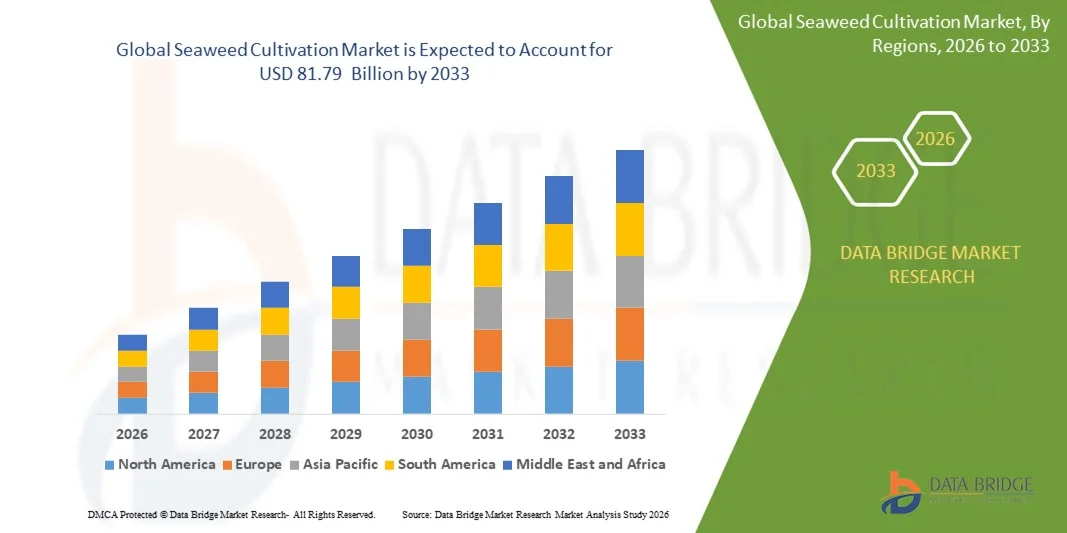
- As per Data Bridge Market Research analysis, the global seaweed cultivation market size was valued at USD 30.76 billion in 2025 and is expected to reach USD 81.79 billion by 2033, at a CAGR of 13.0% during the forecast period
- Increasing industrial, agricultural, and feed-related applications, growing number of seaweed farming practices propelled by global demand, increasing growth of the seaweed market across the globe, rising preferences towards the consumption of seaweed as a snack product, rising awareness about the nutritional content and advantages associated with seaweed consumption, rising application of seaweeds in agriculture, feed, medicine, and human food are some of the major as well as vital factors which will likely to augment the growth of the seaweed cultivation market
Market Size & Forecast
- Market Value (2025): USD 30.76 Billion
- Expected Market Value (2033): USD 81.79 Billion
- Forecast CAGR: 13.0%
What are the Major Takeaways of Seaweed Cultivation Market?
- Increasing number of technological developments along with increase in demand for aquaculture seaweeds as a raw material for the hydrocolloid industry which will further contribute by generating massive opportunities that will lead to the growth of the seaweed cultivation market in the above mentioned projected timeframe
- Increasing occurrences of natural calamities along with toxicity associated with the consumption of seaweeds which will likely to act as market restraints factor for the growth of the seaweed cultivation
- Asia-Pacific dominated the seaweed cultivation market with the largest revenue share of 39.5% in 2025, driven by abundant coastal resources, government initiatives supporting aquaculture, and rising demand for functional food, pharmaceuticals, and agricultural products across countries such as China, Japan, India, and South Korea
- North America is projected to witness the fastest growth rate of 9.7% during 2026–2033, driven by increasing applications in nutraceuticals, pharmaceuticals, and food additives
- The Harvesting segment dominated the market with the largest revenue share of 36.7% in 2025, driven by the increasing adoption of mechanized and semi-automated harvesting systems that enhance productivity and reduce labor dependency
Report Scope and Seaweed Cultivation Market Segmentation
|
Attributes |
Seaweed Cultivation Key Market Insights |
|
Segments Covered |
|
|
Countries Covered |
North America
Europe
Asia-Pacific
Middle East and Africa
South America
|
|
Key Market Players |
|
|
Market Opportunities |
|
|
Value Added Data Infosets |
In addition to the insights on market scenarios such as market value, growth rate, segmentation, geographical coverage, and major players, the market reports curated by the Data Bridge Market Research also include in-depth expert analysis, pricing analysis, brand share analysis, consumer survey, demography analysis, supply chain analysis, value chain analysis, raw material/consumables overview, vendor selection criteria, PESTLE Analysis, Porter Analysis, and regulatory framework. |
What is the Key Trend in the Seaweed Cultivation Market?
Rising Adoption of Seaweed in Sustainable Food, Pharmaceutical, and Cosmetic Applications
- The seaweed cultivation market is witnessing a significant shift toward sustainable and multifunctional applications across food, pharmaceutical, and cosmetic industries, driven by rising environmental awareness and the growing demand for plant-based ingredients. Manufacturers are investing in innovative cultivation and extraction technologies to enhance yield and bioactive compound retention
- For instance, Cargill, Incorporated and DuPont are expanding their seaweed-derived hydrocolloid product portfolios, offering eco-friendly and natural alternatives for thickening, stabilizing, and texturizing food formulations
- Increasing consumer preference for vegan, organic, and nutrient-rich products has accelerated the inclusion of seaweed in plant-based meat, dairy substitutes, and functional foods enriched with vitamins, antioxidants, and omega-3 fatty acids
- Growing demand for sustainable cosmetics and skincare formulations is driving the use of seaweed extracts for their moisturizing, anti-aging, and detoxifying properties, particularly among premium beauty brands
- Rising government support for ocean farming, along with investments in seaweed aquaculture projects across Asia-Pacific and Europe, is reinforcing market expansion
- As seaweed emerges as a renewable, carbon-absorbing biomass, its integration into global food and non-food industries is expected to remain the dominant trend shaping the Seaweed Cultivation market in the coming years
What are the Key Drivers of Seaweed Cultivation Market?
- Rising demand for sustainable and plant-based ingredients in food, pharmaceuticals, and cosmetics is the primary growth driver of the Seaweed Cultivation market
- For instance, in 2024, Groupe Roullier expanded its seaweed-based biostimulant portfolio in Europe, promoting soil health and sustainable agriculture practices
- Increasing adoption of seaweed in functional foods, nutraceuticals, and animal feed is boosting commercial cultivation due to its high nutritional content and cost-effectiveness
- Strong government initiatives in countries such as China, Indonesia, and India are supporting large-scale ocean farming through subsidies and public-private partnerships
- Technological advancements in offshore cultivation, processing automation, and cold-chain logistics are improving productivity and reducing post-harvest losses
- As seaweed continues to gain recognition as a sustainable raw material for diverse industries, the market is projected to grow steadily with expanded applications and regional diversification
Which Factor is Challenging the Growth of the Seaweed Cultivation Market?
- Environmental fluctuations such as ocean temperature changes, coastal pollution, and habitat degradation remain major challenges affecting seaweed yield and quality
- For instance, in 2024, prolonged heatwaves in Southeast Asia disrupted seaweed production in Indonesia and the Philippines, impacting global supply and raw material prices
- Limited infrastructure for large-scale cultivation and the lack of standardized quality control systems in developing regions hinder international trade and export potential
- High dependency on manual labor and traditional farming methods increases operational costs and reduces scalability
- Stringent regulations on seaweed harvesting and marine ecosystem preservation in regions such as the U.S. and Europe also restrict production expansion
- To mitigate these challenges, key players are focusing on technological innovation, integrated aquaculture systems, and sustainable harvesting practices to ensure long-term market stability and environmental balance
How is the Seaweed Cultivation Market Segmented?
The market is segmented on the basis of coffee type, beans type, and distribution channel.
- By Process
On the basis of process, the seaweed cultivation market is segmented into Seeding/Netting, Open Sea Transplanting, Harvesting, Drying, and Processing. The Harvesting segment dominated the market with the largest revenue share of 36.7% in 2025, driven by the increasing adoption of mechanized and semi-automated harvesting systems that enhance productivity and reduce labor dependency. The integration of IoT and AI-based monitoring systems is also improving yield quality and traceability.
The Processing segment is expected to register the fastest CAGR from 2026 to 2033, supported by technological advancements in extraction and preservation methods. These include cold-drying, biorefining, and value-added product processing for food, pharmaceutical, and cosmetic industries. As end-user industries seek high-purity seaweed derivatives, investments in efficient and sustainable post-harvest processing solutions are expected to drive future growth in this segment.
- By Type
On the basis of type, the seaweed cultivation market is segmented into Red Seaweeds, Brown Seaweeds, and Green Seaweeds. The Red Seaweeds segment dominated the market with the largest revenue share of 52.4% in 2025, owing to its extensive use in food-grade hydrocolloids such as agar, carrageenan, and alginates. Its nutritional richness and wide application in processed food, cosmetics, and pharmaceuticals further strengthen its market leadership.
The Brown Seaweeds segment is projected to exhibit the fastest CAGR from 2026 to 2033, driven by increasing demand for alginates and bioactive compounds in dietary supplements and agricultural biostimulants. Rising cultivation of brown species such as kelp in China, Japan, and South Korea is further enhancing supply chain stability. The growing focus on sustainable aquaculture is expected to reinforce the demand for brown seaweeds globally.
- By Method of Harvesting
On the basis of harvesting method, the seaweed cultivation market is segmented into Aquaculture/Industrial and Wild Harvesting/Traditional. The Aquaculture/Industrial segment dominated the market with the largest revenue share of 61.3% in 2025, supported by advancements in large-scale sea farming, automation, and sustainable cultivation practices. This method ensures consistent quality, controlled nutrient content, and higher yield output.
The Wild Harvesting/Traditional segment is anticipated to register the fastest CAGR from 2026 to 2033, driven by rising consumer interest in organic and naturally sourced seaweed. Governments and local cooperatives are promoting sustainable wild collection to preserve biodiversity while supporting coastal economies. The increasing focus on traceability and marine ecosystem protection is encouraging responsible wild harvesting initiatives worldwide.
- By Form
On the basis of form, the seaweed cultivation market is segmented into Liquid, Powder, Flakes, and Sheets. The Powder segment dominated the market with the largest revenue share of 43.9% in 2025, driven by its widespread use in food additives, nutraceuticals, cosmetics, and agriculture. Seaweed powder offers high stability, ease of formulation, and extended shelf life, making it suitable for global export.
The Liquid segment is expected to record the fastest CAGR from 2026 to 2033, supported by its growing adoption in biofertilizers, plant biostimulants, and functional beverages. Liquid extracts are gaining popularity in sustainable agriculture due to their eco-friendly properties and high nutrient concentration. The increasing use of liquid seaweed formulations in horticulture and organic farming is further fueling segment expansion.
- By Application
On the basis of application, the seaweed cultivation market is segmented into Food, Feed, Agriculture, Pharmaceuticals, and Other Applications. The Food segment dominated the market with the largest revenue share of 48.6% in 2025, attributed to the increasing consumption of seaweed as a functional ingredient in snacks, soups, and nutritional supplements. Its rich content of vitamins, minerals, and antioxidants supports global demand for healthy, plant-based food options.
The Pharmaceuticals segment is projected to witness the fastest CAGR from 2026 to 2033, driven by the expanding use of seaweed-derived compounds in drug formulations, wound healing, and nutraceutical products. The growing focus on marine bioactives for anti-inflammatory and antiviral applications is expected to propel strong growth in this segment in the coming years.
Which Region Holds the Largest Share of the Seaweed Cultivation Market?
- Asia-Pacific dominated the seaweed cultivation market with the largest revenue share of 39.5% in 2025, driven by abundant coastal resources, government initiatives supporting aquaculture, and rising demand for functional food, pharmaceuticals, and agricultural products across countries such as China, Japan, India, and South Korea. The region’s investment in large-scale seaweed farms, advanced cultivation technologies, and sustainable practices is fueling market expansion
- Local and international players are focusing on product innovation, value-added seaweed derivatives, and distribution expansion to meet diverse consumer and industrial needs
- Furthermore, the adoption of digital platforms, B2B e-commerce, and collaborations with research institutes are strengthening Asia-Pacific’s dominance in the global Seaweed Cultivation landscape
China Seaweed Cultivation Market Insight
China is the largest contributor in Asia-Pacific, supported by advanced aquaculture infrastructure, large-scale production of red and brown seaweeds, and strong government backing for the algae industry. Investments in extraction technologies and high-value seaweed products for food, nutraceuticals, and cosmetics are enhancing China’s regional leadership.
India Seaweed Cultivation Market Insight
India is witnessing robust growth due to coastal aquaculture development, rising adoption of seaweed-based fertilizers and functional foods, and government incentives promoting domestic production in regions such as Gujarat, Tamil Nadu, and Kerala. Expansion of export-oriented ventures and industrial-scale seaweed processing is further strengthening growth.
North America Seaweed Cultivation Market Insight
North America is projected to witness the fastest growth rate of 9.7% during 2026–2033, driven by increasing applications in nutraceuticals, pharmaceuticals, and food additives. The presence of advanced research, strong investment in sustainable cultivation practices, and growing consumer awareness regarding functional foods are key drivers.
U.S. Seaweed Cultivation Market Insight
The U.S. leads North America, supported by rising demand for organic and bioactive seaweed products, increased R&D in extraction and processing technologies, and growth in the functional food and dietary supplements sector. Companies are focusing on high-value derivatives for pharmaceuticals, cosmetics, and sustainable agriculture, strengthening market growth.
Canada Seaweed Cultivation Market Insight
Canada contributes steadily, with growing demand for high-quality red and brown seaweeds in nutraceuticals and functional foods. Investments in eco-friendly harvesting, industrial-scale processing, and collaborations with academic research institutions are supporting market expansion in the country.
Europe Seaweed Cultivation Market Insight
Europe is witnessing stable growth, driven by consumer preference for organic, sustainable, and value-added seaweed products. Countries such as Germany, France, and the U.K. are at the forefront of industrial seaweed cultivation and processing, with strong regulatory frameworks supporting sustainable aquaculture practices.
Germany Seaweed Cultivation Market Insight
Germany leads Europe’s market, propelled by high demand for functional food ingredients, nutraceuticals, and bioactive seaweed derivatives. Industrial-scale processing, eco-certifications, and sustainable sourcing are enhancing the country’s market position.
U.K. Seaweed Cultivation Market Insight
The U.K. market is expanding steadily, driven by growing interest in plant-based and functional foods, nutraceuticals, and sustainable agricultural solutions. Investments in R&D, industrial-scale processing, and eco-labeling initiatives are supporting consistent market growth.
Which are the Top Companies in Seaweed Cultivation Market?
The seaweed cultivation industry is primarily led by well-established companies, including:
- DuPont (U.S.)
- Cargill, Incorporated (U.S.)
- Groupe Roullier (France)
- CP Kelco U.S., Inc. (U.S.)
- Qingdao Gather Great Ocean Algae Industry Group CO., LTD (China)
- ASL (India)
- AtSeaNova (U.K.)
- The Seaweed Company (Denmark)
- Seaweed Solutions AS (Norway)
- ALGEA (Italy)
- Gelymar (Spain)
- Seasol (Australia)
- Ceamsa (Spain)
- COMPO EXPERT GmbH (Germany)
- ALGAIA (France)
- Irish Seaweeds (Ireland)
- Beijing Leili Agricultural Co., Ltd (China)
- Celtic Sea Spice Company Ltd (U.K.)
- AquAgri Processing Private Limited (India)
What are the Recent Developments in Global Seaweed Cultivation Market?
- In October 2024, BASF announced its partnership with Acadian Plant Health to expand its BioSolutions portfolio by introducing seaweed-based biostimulants. Leveraging Acadian's Ascophyllum nodosum seaweed technology, these products enhance crop resilience to climate stress. BASF plans to distribute them globally, supporting climate-smart agriculture and sustainable crop production, which is expected to strengthen its position in the bio-agriculture sector
- In October 2024, India, according to the Central Marine Fisheries Research Institute (CMFRI), has the potential to produce 9.7 million tonnes of seaweed across 342 locations. The Union Government introduced new guidelines to boost production using high-quality imported seed materials, ensuring environmental sustainability while economically benefiting coastal states, which is anticipated to enhance India’s seaweed cultivation capacity
- In March 2024, Irish firm Simply Blue Group received approval to build the world's first commercial seaweed farm in the North Sea. The project aims to scale sustainable seaweed production for food, feed, and bioactive applications, marking a significant milestone in Europe’s commercial seaweed farming industry

- Interactive Data Analysis Dashboard
- Company Analysis Dashboard for high growth potential opportunities
- Research Analyst Access for customization & queries
- Competitor Analysis with Interactive dashboard
- Latest News, Updates & Trend analysis
- Harness the Power of Benchmark Analysis for Comprehensive Competitor Tracking
Global Seaweed Cultivation Market, Supply Chain Analysis and Ecosystem Framework
To support market growth and help clients navigate the impact of geopolitical shifts, DBMR has integrated in-depth supply chain analysis into its Global Seaweed Cultivation Market research reports. This addition empowers clients to respond effectively to global changes affecting their industries. The supply chain analysis section includes detailed insights such as Global Seaweed Cultivation Market consumption and production by country, price trend analysis, the impact of tariffs and geopolitical developments, and import and export trends by country and HSN code. It also highlights major suppliers with data on production capacity and company profiles, as well as key importers and exporters. In addition to research, DBMR offers specialized supply chain consulting services backed by over a decade of experience, providing solutions like supplier discovery, supplier risk assessment, price trend analysis, impact evaluation of inflation and trade route changes, and comprehensive market trend analysis.
Data collection and base year analysis are done using data collection modules with large sample sizes. The stage includes obtaining market information or related data through various sources and strategies. It includes examining and planning all the data acquired from the past in advance. It likewise envelops the examination of information inconsistencies seen across different information sources. The market data is analysed and estimated using market statistical and coherent models. Also, market share analysis and key trend analysis are the major success factors in the market report. To know more, please request an analyst call or drop down your inquiry.
The key research methodology used by DBMR research team is data triangulation which involves data mining, analysis of the impact of data variables on the market and primary (industry expert) validation. Data models include Vendor Positioning Grid, Market Time Line Analysis, Market Overview and Guide, Company Positioning Grid, Patent Analysis, Pricing Analysis, Company Market Share Analysis, Standards of Measurement, Global versus Regional and Vendor Share Analysis. To know more about the research methodology, drop in an inquiry to speak to our industry experts.
Data Bridge Market Research is a leader in advanced formative research. We take pride in servicing our existing and new customers with data and analysis that match and suits their goal. The report can be customized to include price trend analysis of target brands understanding the market for additional countries (ask for the list of countries), clinical trial results data, literature review, refurbished market and product base analysis. Market analysis of target competitors can be analyzed from technology-based analysis to market portfolio strategies. We can add as many competitors that you require data about in the format and data style you are looking for. Our team of analysts can also provide you data in crude raw excel files pivot tables (Fact book) or can assist you in creating presentations from the data sets available in the report.