


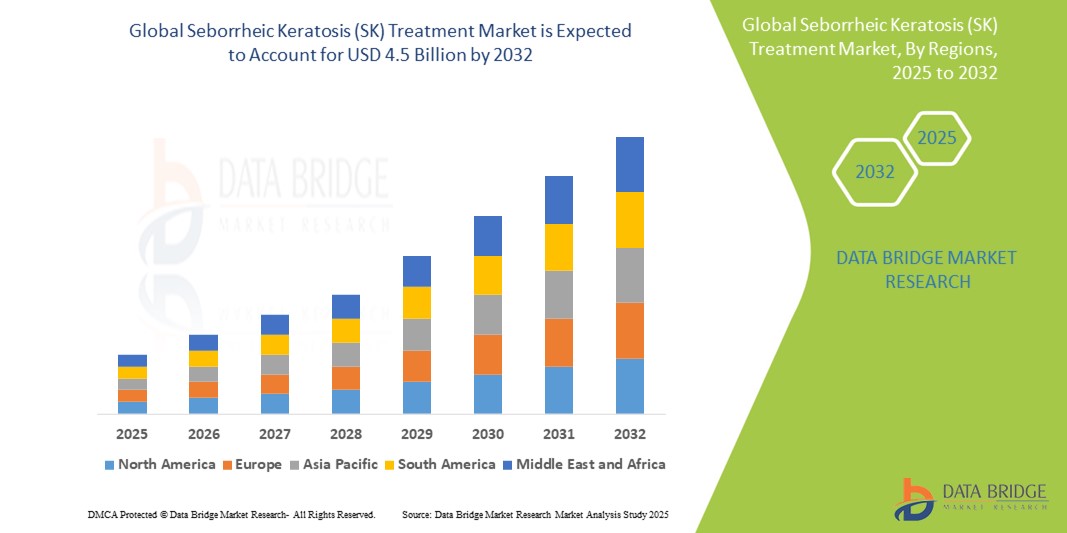
Seborrheic Keratosis (SK) Treatment Market Size
- The Global Seborrheic Keratosis (SK) Treatment Market size was valued at USD 2.5 billion in 2024 and is expected to reach USD 4.5 billion by 2032, at a CAGR of 5.8% during the forecast period
- The market growth is primarily driven by the rising prevalence of seborrheic keratosis among the aging population, along with increasing awareness regarding skin health and early diagnosis
- Furthermore, advancements in dermatological treatment methods—including cryotherapy, laser surgery, electrocautery, and topical medications—are contributing to improved patient outcomes and wider treatment adoption. The growing demand for minimally invasive aesthetic procedures across hospitals, specialty clinics, and home healthcare settings is further supporting market expansion. These converging trends are expected to sustain steady growth for the SK treatment industry over the coming years
Seborrheic Keratosis (SK) Treatment Market Analysis
- Seborrheic keratosis (SK), a common non-cancerous skin condition, is increasingly treated using advanced procedures such as cryotherapy, curettage or electrocautery, ablative laser surgery, shave biopsy, focal chemical peels, and topical medications. These methods offer effective removal, minimal discomfort, and improved cosmetic outcomes, thereby supporting their growing adoption across dermatology clinics and hospitals.
- The global demand for SK treatment is largely driven by the rising geriatric population, which is more prone to SK, alongside increased awareness of skin health, growing availability of dermatology services, and the influence of cosmetic dermatology trends encouraging the removal of benign lesions for aesthetic reasons.
- North America held the largest revenue share of 38.7% in 2024, owing to a high incidence of SK, early adoption of advanced treatment technologies, well-established dermatological infrastructure, and increased patient expenditure on skin-related procedures. The United States alone accounted for over USD 650 million in SK treatment revenue in 2024.
- Asia-Pacific is projected to be the fastest-growing region from 2025 to 2035, driven by a large underserved patient population, increasing urbanization, rising disposable incomes, and expanding dermatology clinics and aesthetic centers in countries like China, India, and South Korea.
- Cryotherapy is expected to dominate the treatment segment, accounting for approximately 34.5% of the global market share in 2025, due to its high effectiveness, affordability, and ease of application in both outpatient and homecare settings
Report Scope and Seborrheic Keratosis (SK) Treatment Market Segmentation
|
Attributes |
Seborrheic Keratosis (SK) Treatment Key Market Insights |
|
Segments Covered |
|
|
Countries Covered |
North America
Europe
Asia-Pacific
Middle East and Africa
South America
|
|
Key Market Players |
|
|
Market Opportunities |
|
|
Value Added Data Infosets |
In addition to the insights on market scenarios such as market value, growth rate, segmentation, geographical coverage, and major players, the market reports curated by the Data Bridge Market Research also include in-depth expert analysis, pricing analysis, brand share analysis, consumer survey, demography analysis, supply chain analysis, value chain analysis, raw material/consumables overview, vendor selection criteria, PESTLE Analysis, Porter Analysis, and regulatory framework. |
Seborrheic Keratosis (SK) Treatment Market Trends
“Rising Preference for Aesthetic Dermatology and Non-Invasive Treatment Modalities”
- A significant and accelerating trend in the seborrheic keratosis treatment market is the growing demand for aesthetic dermatological procedures that are minimally invasive, quick, and deliver superior cosmetic outcomes. Patients—especially older adults and professionals—are increasingly seeking removal of benign lesions from visible areas such as the face, neck, and hands for aesthetic purposes.
- For instance, Alma Lasers (Israel) launched the Harmony XL Pro, an advanced multi-technology platform that includes laser-based treatments for benign pigmented lesions like SK. The device is widely used in dermatology clinics across Europe and Asia for fast and scar-minimized removal.
- Similarly, Cutera (U.S.) has expanded the use of its excel V+ laser platform, which is FDA-cleared for treating superficial skin irregularities, including seborrheic keratosis. Dermatologists have reported improved patient outcomes, particularly in patients seeking cosmetic enhancements.
- The market is also witnessing a rise in portable, in-clinic devices that support walk-in procedures, allowing patients to receive treatment without prolonged downtime. Devices like CryoPen X+ are becoming popular among clinics for precise, non-contact cryotherapy for SK lesions.
- Additionally, Aclaris Therapeutics (U.S.) has been developing topical pharmacologic treatments under its AKARI Therapeutics pipeline, aimed at non-invasive, at-home management of non-malignant skin lesions, indicating a shift toward convenience-driven care models.
Seborrheic Keratosis (SK) Treatment Market Dynamics
Driver
“Increasing Prevalence Among Aging Population and Demand for Non-Cancerous Lesion Management”
- A primary driver of the SK treatment market is the growing geriatric population worldwide. As individuals age, the likelihood of developing seborrheic keratosis increases significantly due to cumulative sun exposure and age-related epidermal changes.
- For instance, a study published in the Journal of Clinical and Aesthetic Dermatology (2022) found that over 83% of individuals aged 60+ in the U.S. exhibited at least one SK lesion, many with multiple lesions requiring intervention.
- Furthermore, the American Academy of Dermatology (AAD) has noted a surge in dermatology visits related to benign skin lesions, particularly SK, emphasizing that patients are increasingly seeking removal not only for comfort but for cosmetic satisfaction and peace of mind.
- The wide availability of outpatient treatments such as liquid nitrogen cryotherapy and curettage or shave biopsy in dermatology clinics and specialty hospitals makes it feasible to treat large numbers of patients with minimal infrastructure.
Restraint/Challenge
“Limited Insurance Coverage and Cosmetic Classification of Treatment”
- A key challenge in market expansion is the limited insurance reimbursement for SK procedures. In many countries, treatments for seborrheic keratosis are considered cosmetic rather than medically necessary, especially when the lesions are asymptomatic.
- For instance, in the U.S., Medicare and most private insurers do not cover SK removal unless medically justified, such as in cases of recurrent irritation, bleeding, or diagnostic uncertainty with suspected melanoma. This leads to patients delaying or avoiding treatment due to high out-of-pocket expenses.
- A 2023 survey by the Skin Cancer Foundation found that nearly 48% of U.S. patients with multiple SK lesions opted out of removal procedures due to non-reimbursement and perceived high cost, especially among lower-income or elderly individuals without supplemental insurance.
- Moreover, the recurrence of lesions post-treatment and the need for multiple sessions—especially in patients with extensive skin involvement—can cause dissatisfaction and increase treatment costs, further discouraging uptake in certain markets.
- Addressing these challenges involves educating healthcare providers on the psychosocial burden of SK, developing cost-effective treatment devices, and pushing for reimbursement reforms, particularly in markets with aging populations and high SK prevalence.
Seborrheic Keratosis (SK) Treatment Market Scope
The market is segmented on the basis of diagnosis, treatment, end-users, and distribution channel.
- By Diagnosis
On the basis of diagnosis, the seborrheic keratosis treatment market is segmented into skin biopsy, skin test, and others. The skin biopsy segment held the largest market revenue share of 56.3% in 2024, driven by its widespread use in confirming diagnosis and ruling out malignancies such as melanoma or basal cell carcinoma. Dermatologists often rely on biopsy to differentiate SK from similar-looking lesions. The increasing availability of dermatoscopic tools and trained professionals in clinical settings further supports this segment’s dominance.
The skin test segment is projected to witness the fastest CAGR of 7.9% from 2025 to 2032, as non-invasive diagnostic techniques gain traction. Technological advancements in digital dermoscopy and AI-driven image analysis are making in-clinic skin assessments more accessible, helping to minimize the need for invasive biopsies in routine cases.
By Treatment
On the basis of treatment, the market is segmented into cryotherapy, curettage or electrocautery, ablative laser surgery, shave biopsy, focal chemical peel, medication, and others. Cryotherapy held the largest market revenue share in 2024, accounting for approximately 34.5% of the global market. This dominance is attributed to its cost-effectiveness, ease of application, and suitability for outpatient or homecare settings. For instance, devices like CryoPen X+ are widely used in dermatology practices for precise lesion removal with minimal discomfort.
The ablative laser surgery segment is expected to witness the fastest CAGR from 2025 to 2032, driven by growing demand for high-precision, cosmetic-focused treatments. Devices such as the Harmony XL Pro by Alma Lasers (Israel) and excel V+ by Cutera (U.S.) are gaining popularity due to their ability to target SK lesions with minimal scarring and downtime.
• By End-User
On the basis of end-users, the market is segmented into hospitals, specialty clinics, home healthcare, and others. Hospitals accounted for the largest market share in 2024, driven by the availability of advanced equipment, multidisciplinary teams, and insurance-covered treatment pathways in medically justified cases. Hospitals are often the first point of diagnosis for elderly patients presenting with multiple skin lesions.
The home healthcare segment is projected to grow at the fastest CAGR from 2025 to 2032, fueled by the rise in at-home treatment devices, teledermatology consultations, and elderly care services. Increasing availability of user-friendly cryotherapy pens and topical treatments enhances treatment access for immobile or elderly patients.
• By Distribution Channel
On the basis of distribution channel, the market is segmented into direct tender, hospital pharmacy, retail pharmacy, online pharmacy, and others. Hospital pharmacies held the dominant market revenue share in 2024, primarily due to the high volume of dermatological prescriptions and in-hospital procurement of SK treatment devices and topical medications.
The online pharmacy segment is anticipated to witness the fastest CAGR from 2025 to 2032. This is driven by growing e-commerce penetration in healthcare, increasing consumer preference for convenience, and the availability of prescription and OTC topical medications via digital platforms. Leading players like Netmeds and CVS Health have expanded their dermatology portfolios to include SK-focused therapies.
Seborrheic Keratosis (SK) Treatment Market Regional Analysis
- North America dominates the global seborrheic keratosis treatment market with the largest revenue share of 38.7% in 2024, driven by a high prevalence of SK among the aging population and strong access to dermatological care.
- Consumers in the region are highly proactive about skin health and aesthetics, often opting for SK treatment not just for medical necessity but also for cosmetic reasons. The presence of advanced healthcare infrastructure and a wide network of dermatologists further facilitates early diagnosis and effective treatment.
- This widespread treatment adoption is further supported by higher disposable incomes, greater awareness of non-cancerous skin conditions, and a well-established reimbursement landscape for dermatological evaluations in select cases. The region’s focus on aesthetic dermatology also fuels demand for laser-based and minimally invasive treatment modalities, positioning North America as the leading market for SK care across both medical and cosmetic segments.
North America Seborrheic Keratosis (SK) Treatment Market Insight
The North America seborrheic keratosis treatment market captured the largest revenue share of 38.7% in 2024, driven by a high prevalence of SK among the aging population and an advanced healthcare infrastructure. The region benefits from widespread dermatological awareness, early diagnosis, and access to both medical and cosmetic treatment options. Increasing demand for minimally invasive aesthetic procedures and the growing popularity of outpatient dermatology clinics further support market growth.
U.S. Seborrheic Keratosis (SK) Treatment Market Insight
The U.S. market accounted for over 81% of North America’s SK treatment revenue in 2024, fueled by a large aging demographic, a high rate of dermatology consultations, and strong consumer inclination toward aesthetic skin improvements. The presence of leading players such as Aclaris Therapeutics, Becton Dickinson, and Cutera supports innovation in cryotherapy, laser-based procedures, and pharmacological treatment options. Additionally, favorable reimbursement frameworks for medically indicated cases and the rise of teledermatology contribute to increased patient engagement.
Europe Seborrheic Keratosis (SK) Treatment Market Insight
The European SK treatment market is projected to grow at a significant CAGR throughout the forecast period, driven by rising awareness of skin health, a growing elderly population, and the expansion of dermatology services. Countries like Germany, France, and Italy are seeing increased demand for laser and cryo-based lesion removal procedures. Moreover, stringent healthcare quality regulations and access to public dermatology services in several EU countries ensure timely diagnosis and treatment.
U.K. Seborrheic Keratosis (SK) Treatment Market Insight
The U.K. SK treatment market is anticipated to grow at a healthy CAGR, supported by a combination of public healthcare accessibility through the NHS and rising private-sector dermatology services. A growing awareness of non-malignant skin conditions and their aesthetic impact is encouraging more patients to seek treatment. The availability of advanced diagnostic tools and increasing cosmetic dermatology procedures in private clinics also contribute to the market’s expansion.
Germany Seborrheic Keratosis (SK) Treatment Market Insight
The German SK treatment market is expected to expand at a considerable CAGR, underpinned by the country’s well-established healthcare infrastructure, aging population, and high demand for innovative dermatological procedures. The presence of technologically advanced treatment devices—such as laser systems from Alma Lasers and Quanta Systems—and a cultural emphasis on personal care and early diagnosis support sustained market growth across both clinical and aesthetic segments.
Asia-Pacific Seborrheic Keratosis (SK) Treatment Market Insight
The Asia-Pacific SK treatment market is poised to grow at the fastest CAGR of over 7.2% in 2025, driven by a rising middle class, increasing life expectancy, and expanding access to dermatological care in countries like China, Japan, India, and South Korea. The region’s rapid urbanization and growing interest in skin aesthetics are fueling demand for cost-effective and minimally invasive SK treatments. Additionally, increasing investments in healthcare infrastructure and digital dermatology platforms are expanding patient outreach.
Japan Seborrheic Keratosis (SK) Treatment Market Insight
The Japanese market is gaining momentum due to the country’s aging population and strong cultural emphasis on skin health and appearance. Japan is witnessing growing adoption of laser-based and non-invasive SK treatments, particularly in urban dermatology clinics. The integration of SK care with broader anti-aging and aesthetic skin solutions is driving demand, while advancements in AI-driven dermatology tools support early diagnosis and precision treatment.
China Seborrheic Keratosis (SK) Treatment Market Insight
The China SK treatment market accounted for the largest revenue share in Asia-Pacific in 2025, supported by a rapidly aging population, increasing awareness of dermatological health, and a surge in private skin clinics. China’s expanding middle class is seeking cosmetic improvements, leading to high demand for cryotherapy and laser ablation procedures. Additionally, local manufacturers are introducing affordable treatment devices, making SK procedures more accessible across tier 2 and tier 3 cities.
Seborrheic Keratosis (SK) Treatment Market Share
The Seborrheic Keratosis (SK) Treatment industry is primarily led by well-established companies, including:
- Aclaris Therapeutics, Inc. (U.S.)
- Coherent, Inc. (U.S.)
- Quanta Systems S.p.A. (Italy)
- BioLight Technologies LLC. (U.S.)
- Alma Lasers (Israel)
- AngioDynamics, Inc. (U.S.)
- Becton Dickinson and Company (U.S.)
- Cutera (U.S.)
- Erchonia Corporation (U.S.)
- IRIDEX Corp. (U.S.)
- Lumenis (Israel)
- Biolase Inc. (U.S.)

- Interactive Data Analysis Dashboard
- Company Analysis Dashboard for high growth potential opportunities
- Research Analyst Access for customization & queries
- Competitor Analysis with Interactive dashboard
- Latest News, Updates & Trend analysis
- Harness the Power of Benchmark Analysis for Comprehensive Competitor Tracking
Data collection and base year analysis are done using data collection modules with large sample sizes. The stage includes obtaining market information or related data through various sources and strategies. It includes examining and planning all the data acquired from the past in advance. It likewise envelops the examination of information inconsistencies seen across different information sources. The market data is analysed and estimated using market statistical and coherent models. Also, market share analysis and key trend analysis are the major success factors in the market report. To know more, please request an analyst call or drop down your inquiry.
The key research methodology used by DBMR research team is data triangulation which involves data mining, analysis of the impact of data variables on the market and primary (industry expert) validation. Data models include Vendor Positioning Grid, Market Time Line Analysis, Market Overview and Guide, Company Positioning Grid, Patent Analysis, Pricing Analysis, Company Market Share Analysis, Standards of Measurement, Global versus Regional and Vendor Share Analysis. To know more about the research methodology, drop in an inquiry to speak to our industry experts.
Data Bridge Market Research is a leader in advanced formative research. We take pride in servicing our existing and new customers with data and analysis that match and suits their goal. The report can be customized to include price trend analysis of target brands understanding the market for additional countries (ask for the list of countries), clinical trial results data, literature review, refurbished market and product base analysis. Market analysis of target competitors can be analyzed from technology-based analysis to market portfolio strategies. We can add as many competitors that you require data about in the format and data style you are looking for. Our team of analysts can also provide you data in crude raw excel files pivot tables (Fact book) or can assist you in creating presentations from the data sets available in the report.












