


Security Fencing Market Size
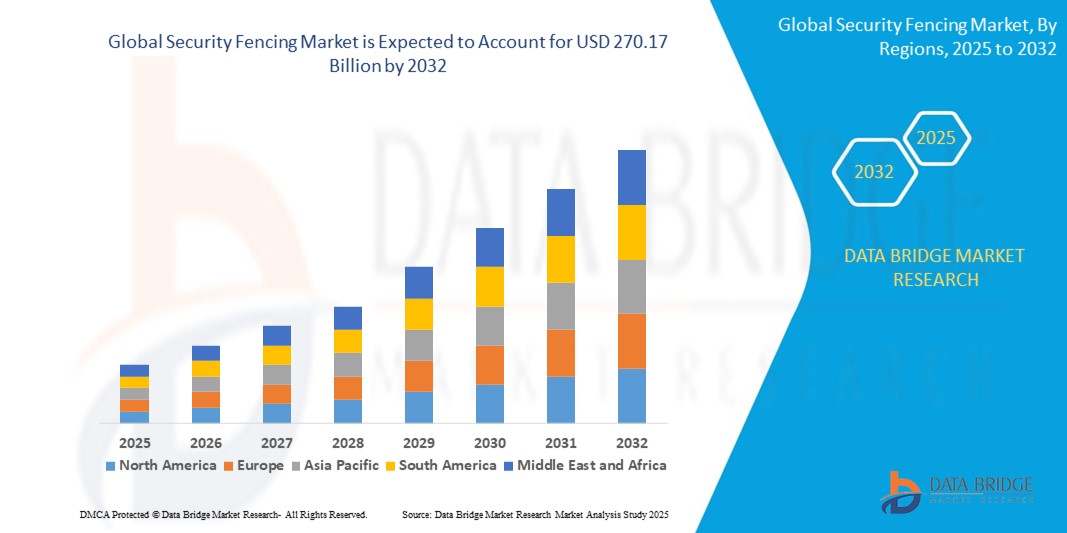
- The global security fencing market size was valued at USD 62.41 billion in 2024 and is expected to reach USD 270.17 billion by 2032, at a CAGR of 20.10% during the forecast period
- The market growth is primarily driven by rising security concerns across residential, commercial, industrial, and military sectors, prompting increased investment in perimeter protection and access control systems
- In addition, rapid urbanization, infrastructure development, and advancements in fencing materials such as electric, anti-climb, and smart perimeter technologies are contributing to the demand for durable and reliable security fencing solutions. These dynamics are propelling the market forward and enhancing global adoption
Security Fencing Market Analysis
- Security fencing, comprising barriers such as chain link, welded wire, and palisade systems, plays an essential role in protecting residential, commercial, industrial, and governmental assets by deterring unauthorized access and enhancing perimeter security through physical and sometimes electrified deterrents
- The growing demand for security fencing is primarily driven by increased concerns over property protection, rising geopolitical tensions, urban expansion, and greater investments in infrastructure and critical facility security
- North America dominated the security fencing market with the largest revenue share of 39% in 2024, supported by significant government and defense spending, widespread industrial infrastructure, and a strong presence of fencing system manufacturers, especially in the U.S., where smart and integrated fencing technologies are being adopted rapidly
- Asia-Pacific is expected to be the fastest growing region in the security fencing market during the forecast period due to increasing urbanization, expanding infrastructure projects, and rising security concerns in developing economies such as China and India
- Metal fencing segment dominated the security fencing market with a market share of 55.3% in 2024, owing to its high durability, resistance to tampering, and widespread use across military, industrial, and commercial applications
Report Scope and Security Fencing Market Segmentation
|
Attributes |
Security Fencing Key Market Insights |
|
Segments Covered |
|
|
Countries Covered |
North America
Europe
Asia-Pacific
Middle East and Africa
South America
|
|
Key Market Players |
|
|
Market Opportunities |
|
|
Value Added Data Infosets |
In addition to the insights on market scenarios such as market value, growth rate, segmentation, geographical coverage, and major players, the market reports curated by the Data Bridge Market Research also include in-depth expert analysis, pricing analysis, brand share analysis, consumer survey, demography analysis, supply chain analysis, value chain analysis, raw material/consumables overview, vendor selection criteria, PESTLE Analysis, Porter Analysis, and regulatory framework. |
Security Fencing Market Trends
Integration of Smart Surveillance and Perimeter Detection Systems
- A prominent and accelerating trend in the global security fencing market is the integration of traditional fencing solutions with smart surveillance and advanced perimeter detection technologies, transforming fences into proactive security systems rather than just passive barriers
- For instance, modern fencing solutions now incorporate motion sensors, thermal imaging cameras, and vibration detection systems that alert authorities or property owners to potential intrusions in real time. Companies such as Senstar and Gallagher offer integrated systems combining fencing with intrusion detection and monitoring software
- These smart solutions are increasingly adopted in high-security areas such as data centers, military installations, and industrial complexes, where layered security and rapid threat detection are crucial. For instance, electric fencing integrated with perimeter monitoring is being deployed in energy and utility sectors to enhance real-time response capabilities
- In addition, the growing use of AI and machine learning in video surveillance linked to fencing systems allows for intelligent threat classification and false alarm reduction, enabling more efficient resource allocation and incident response
- This convergence of fencing with smart security technologies is reshaping user expectations by offering not just physical protection but also active surveillance and control. As a result, vendors are developing modular and IoT-enabled fencing systems that allow easy integration with broader security networks
- The demand for such multifunctional fencing solutions is rapidly growing across sectors such as government, transportation, critical infrastructure, and high-value commercial assets, where real-time monitoring and deterrence are essential
Security Fencing Market Dynamics
Driver
Increasing Demand for Perimeter Protection Across Critical Sectors
- The growing need to secure critical infrastructure, industrial facilities, and residential areas is a primary driver of demand in the global security fencing market
- For instance, in February 2024, Betafence Group expanded its perimeter security portfolio by launching a new generation of welded mesh fencing systems integrated with intrusion detection and solar-powered surveillance, targeting military and utility applications. Such developments by leading players are fueling market growth
- As threats ranging from theft to terrorism become more sophisticated, governments and private enterprises are investing in robust perimeter security solutions, including high-security fencing systems that offer deterrence, delay, and detection
- Furthermore, urban expansion, rising crime rates, and increased awareness regarding physical security are encouraging adoption of fencing solutions in residential and commercial settings
- The affordability, durability, and customizability of modern fencing materials—along with ease of installation and integration with access control systems—are key factors supporting adoption in sectors such as logistics, oil & gas, power generation, and agriculture
Restraint/Challenge
Aesthetic Constraints and Regulatory Compliance Issues
- One of the primary challenges faced by the security fencing market is the aesthetic limitations and local zoning regulations that can restrict the installation of fencing solutions, particularly in urban and residential areas
- For instance, in several regions, strict building codes or homeowner association rules may limit the height, material, or appearance of perimeter fencing, impeding the deployment of high-security structures. In addition, historical sites and public areas often require specialized designs that balance security with visual harmony
- Further, security fencing systems particularly those with electrified or sensor-integrated components must comply with evolving safety and environmental regulations. Compliance-related costs and certification requirements can act as a barrier for small to mid-sized manufacturers and consumers
- Moreover, the high installation and maintenance costs associated with advanced fencing systems especially those used in industrial or high-risk environments—may limit adoption in price-sensitive markets
- To overcome these challenges, manufacturers are investing in modular, customizable, and visually appealing fencing solutions that meet both security and aesthetic needs while adhering to local and international regulations. Enhanced awareness and flexible financing options can also support broader adoption across sectors
Security Fencing Market Scope
The market is segmented on the basis of type and end user.
- By Type
On the basis of type, the global security fencing market is segmented into metal fencing, wood fencing, and others. The metal fencing segment dominated the market with the largest market revenue share of 55.3% in 2024, driven by its superior durability, resistance to tampering, and high demand across industrial, commercial, military, and infrastructure projects. Metal fencing—particularly chain link, palisade, and welded wire types is widely adopted due to its low maintenance, long lifespan, and compatibility with integrated security technologies such as motion sensors and electric deterrents.
The wood fencing segment is expected to register steady growth, primarily in residential and agricultural applications. Wood fencing appeals to homeowners for its aesthetic value and cost-effectiveness, especially in suburban and rural environments. However, its susceptibility to environmental wear limits its use in high-security settings.
- By End User
On the basis of end user, the global security fencing market is segmented into residential, agricultural, military and defense, government, petroleum and chemicals, mining, energy and power, warehouse, and others. The military and defense segment dominated the market with the largest revenue share of 24.3% in 2024, owing to growing global investments in border security, defense infrastructure modernization, and surveillance-integrated fencing systems. Military-grade fencing often includes features such as electrification, barbed wire, and intrusion detection technologies.
The residential segment is anticipated to experience robust growth through 2032 due to increasing concerns about property security and the adoption of aesthetically designed fences that complement smart home systems. Rapid urbanization, rising crime rates, and the DIY installation trend are propelling demand in this segment.
Security Fencing Market Regional Analysis
- North America dominated the security fencing market with the largest revenue share of 39% in 2024, supported by significant government and defense spending, widespread industrial infrastructure, and a strong presence of fencing system manufacturers, especially in the U.S., where smart and integrated fencing technologies are being adopted rapidly
- End users in the region prioritize durability, integration with advanced surveillance systems, and compliance with stringent safety regulations, which has accelerated the adoption of smart and high-security fencing solutions across both urban and rural areas
- This widespread usage is further supported by a mature construction sector, high-security awareness, and the presence of leading fencing system manufacturers, making North America a key market for both traditional and technology-enhanced fencing products
U.S. Security Fencing Market Insight
The U.S. security fencing market captured the largest revenue share of 79% in 2024 within North America, driven by heightened concerns over facility protection, infrastructure security, and border control. Strong demand across military bases, government buildings, and private enterprises has led to widespread adoption of high-security fencing solutions. The integration of advanced technologies such as sensor-based intrusion detection and electric deterrent systems further strengthens market expansion. Moreover, ongoing infrastructure modernization and investments in smart city projects are fostering continued growth in the commercial and residential fencing segments.
Europe Security Fencing Market Insight
The Europe security fencing market is projected to grow at a robust CAGR throughout the forecast period, primarily driven by rising security threats, increasing infrastructure investments, and strict regulatory standards for perimeter safety. The growing need for effective protection in critical sectors such as energy, transport, and public services is accelerating the demand for advanced fencing solutions. In addition, the region’s focus on sustainable and aesthetically pleasing fencing materials is prompting innovation across manufacturers, particularly for urban, residential, and governmental applications.
U.K. Security Fencing Market Insight
The U.K. security fencing market is expected to expand steadily during the forecast period, supported by increasing concerns about property and infrastructure security. Demand is particularly strong in sectors such as utilities, transportation, and public infrastructure, where regulatory compliance and high safety standards drive adoption. The rise of urban development and government emphasis on counter-terrorism and anti-intrusion measures are also contributing to market growth, with metal and electric fencing systems gaining traction in both new and retrofit installations.
Germany Security Fencing Market Insight
The Germany security fencing market is set to witness considerable growth over the forecast period, fueled by the country’s emphasis on securing critical infrastructure, industrial zones, and energy facilities. Germany's strong regulatory environment and investment in smart surveillance systems are driving the integration of fencing with real-time monitoring and intrusion detection technologies. In addition, the country's focus on sustainability and design efficiency has spurred demand for eco-friendly, long-lasting fencing materials for residential and public-sector applications.
Asia-Pacific Security Fencing Market Insight
The Asia-Pacific security fencing market is expected to register the fastest CAGR of 23.1% during the forecast period from 2025 to 2032, propelled by rapid industrialization, urban expansion, and infrastructure development in countries such as China, India, and Southeast Asian nations. Growing concerns over public safety, increased government spending on border and facility protection, and the expansion of commercial and industrial zones are key drivers. The availability of cost-effective fencing materials and the rise of domestic manufacturing in the region are making security fencing accessible to a broader customer base.
Japan Security Fencing Market Insight
The Japan security fencing market is gaining traction due to the nation’s strong emphasis on disaster preparedness, facility protection, and urban planning. Demand for fencing solutions in Japan is high in sectors such as public transport, commercial real estate, and energy. The integration of technology, such as seismic alert sensors and AI-driven surveillance systems with fencing structures, is shaping the future of perimeter protection in the country. Furthermore, Japan’s aging population is increasing the need for secure, yet unobtrusive fencing solutions in residential communities and healthcare facilities.
India Security Fencing Market Insight
The India security fencing market accounted for the largest revenue share in Asia-Pacific in 2024, driven by the growing need for infrastructure protection, urban safety, and border security. The rapid pace of urbanization, increasing investments in smart cities, and the demand for security across transportation hubs, warehouses, and industrial facilities are propelling the market. India’s robust domestic manufacturing ecosystem and government-backed security initiatives are also fostering widespread adoption of metal, electric, and mesh fencing solutions across both rural and urban areas.
Security Fencing Market Share
The Security Fencing industry is primarily led by well-established companies, including:
- Betafence NV (Belgium)
- Ameristar Perimeter Security USA Inc. (U.S.)
- Bekaert NV (Belgium)
- Zaun Limited (U.K.)
- Jacksons Fencing Limited (U.K.)
- Heritage Fence Company, Inc. (U.S.)
- Allied Tube & Conduit Corporation (U.S.)
- Long Fence Company, Inc. (U.S.)
- Associated Fence Corporation (U.S.)
- Gregory Industries, Inc. (U.S.)
- Guangdong Lianxin Security Technology Co., Ltd. (China)
- Clotan Steel (Pty) Ltd. (South Africa)
- Harper Chalice Group Limited (U.K.)
- Western Fence Co. (U.S.)
- Anchor Fence Inc. (U.S.)
- FenceWorks, Inc. (U.S.)
- Procter Contracts Ltd. (U.K.)
- Nucor Corporation (U.S.)
- Permaconn Pty Ltd (Australia)
- Yehuda Fences Ltd. (Israel)
What are the Recent Developments in Global Security Fencing Market?
- In April 2023, Betafence Group, a leading global provider of perimeter fencing and access control solutions, launched its new SecureGuard fencing system designed for critical infrastructure protection. The system features advanced anti-climb and anti-cut designs integrated with fiber-optic intrusion detection sensors. This innovation reinforces Betafence’s commitment to combining physical barriers with intelligent monitoring technologies, enhancing perimeter defense across military, utility, and high-risk industrial facilities globally
- In March 2023, Ameristar Perimeter Security, a U.S.-based manufacturer, introduced its Matrix High-Security Fence System aimed at government and data center applications. This fencing solution offers crash-rated protection and integrates seamlessly with surveillance and access control technologies. The product reflects Ameristar’s strategic focus on delivering premium perimeter protection to meet growing demands for layered and automated security systems in sensitive sectors
- In February 2023, Zaun Ltd., a prominent UK-based fencing systems manufacturer, completed the deployment of its PAS 68 crash-rated fencing solution for a high-profile airport project in Europe. The system incorporates vehicle mitigation barriers and smart surveillance interfaces, aimed at enhancing protection against vehicle-borne threats. This deployment underscores Zaun’s specialization in combining structural resilience with technological integration for critical infrastructure safety
- In February 2023, Jacksons Fencing, a UK manufacturer of security and garden fencing, launched its Smart Perimeter Integration Program which enables clients to integrate fencing with smart gate automation, CCTV systems, and alarm sensors. Targeted at schools, commercial properties, and local councils, the initiative reflects the growing market trend of converging physical and digital security into unified perimeter management solutions
- In January 2023, Bekaert, a global leader in steel wire transformation and coating technologies, introduced its next-generation Fortinet® Ultra fencing system optimized for energy and utility sectors. Engineered with high-tensile galvanized steel and designed for harsh environmental conditions, the system supports optional electrification and remote monitoring. This innovation highlights Bekaert’s focus on delivering robust, customizable fencing tailored to the evolving needs of mission-critical infrastructure

- Interactive Data Analysis Dashboard
- Company Analysis Dashboard for high growth potential opportunities
- Research Analyst Access for customization & queries
- Competitor Analysis with Interactive dashboard
- Latest News, Updates & Trend analysis
- Harness the Power of Benchmark Analysis for Comprehensive Competitor Tracking
Global Security Fencing Market, Supply Chain Analysis and Ecosystem Framework
To support market growth and help clients navigate the impact of geopolitical shifts, DBMR has integrated in-depth supply chain analysis into its Global Security Fencing Market research reports. This addition empowers clients to respond effectively to global changes affecting their industries. The supply chain analysis section includes detailed insights such as Global Security Fencing Market consumption and production by country, price trend analysis, the impact of tariffs and geopolitical developments, and import and export trends by country and HSN code. It also highlights major suppliers with data on production capacity and company profiles, as well as key importers and exporters. In addition to research, DBMR offers specialized supply chain consulting services backed by over a decade of experience, providing solutions like supplier discovery, supplier risk assessment, price trend analysis, impact evaluation of inflation and trade route changes, and comprehensive market trend analysis.
Data collection and base year analysis are done using data collection modules with large sample sizes. The stage includes obtaining market information or related data through various sources and strategies. It includes examining and planning all the data acquired from the past in advance. It likewise envelops the examination of information inconsistencies seen across different information sources. The market data is analysed and estimated using market statistical and coherent models. Also, market share analysis and key trend analysis are the major success factors in the market report. To know more, please request an analyst call or drop down your inquiry.
The key research methodology used by DBMR research team is data triangulation which involves data mining, analysis of the impact of data variables on the market and primary (industry expert) validation. Data models include Vendor Positioning Grid, Market Time Line Analysis, Market Overview and Guide, Company Positioning Grid, Patent Analysis, Pricing Analysis, Company Market Share Analysis, Standards of Measurement, Global versus Regional and Vendor Share Analysis. To know more about the research methodology, drop in an inquiry to speak to our industry experts.
Data Bridge Market Research is a leader in advanced formative research. We take pride in servicing our existing and new customers with data and analysis that match and suits their goal. The report can be customized to include price trend analysis of target brands understanding the market for additional countries (ask for the list of countries), clinical trial results data, literature review, refurbished market and product base analysis. Market analysis of target competitors can be analyzed from technology-based analysis to market portfolio strategies. We can add as many competitors that you require data about in the format and data style you are looking for. Our team of analysts can also provide you data in crude raw excel files pivot tables (Fact book) or can assist you in creating presentations from the data sets available in the report.













