Seed Coating Materials Market Overview
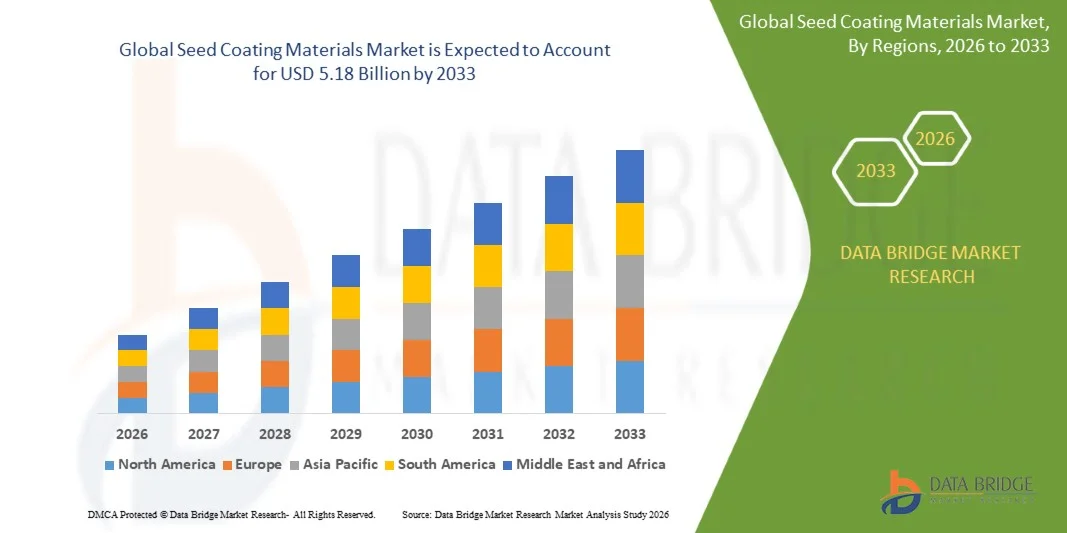
As per Data Bridge Market Research analysis, the seed coating materials market was valued at USD 2.60 billion in 2025 and is projected to reach USD 5.18 billion by 2033, growing at a CAGR of 9.01% from 2026 to 2033. The market growth is supported by rising demand for high-quality seeds, precision agriculture, improved crop establishment, sustainable farming, and advanced coatings that deliver protection, nutrients, biologicals, and other functional benefits directly to the seed.
Seed coating materials are used to form a uniform layer around seeds to improve handling, plantability, protection, germination, and early crop performance. Common materials include polymers, binders, colorants, fillers, and functional ingredients. Modern systems are designed to reduce dust-off, improve retention of seed-applied products, support mechanical planting, and help deliver active ingredients more precisely than broad field applications.
Market Size & Forecast
- Global Market Value (2025): USD 2.60 Billion
- Expected Market Value (2034): USD 5.18 Billion
- Forecast CAGR (2026-2034): 9.01%
- Leading Region: North America
- Fastest-Growing Region: Asia-Pacific
Key Market Trends & Insights
- North America emerged as the leading regional market, accounting for approximately 43.56% of global revenue in 2025. The region's dominance is attributed to the widespread adoption of precision agriculture, advanced seed treatment technologies, strong commercial seed production, and significant investments in agricultural research across the U.S. and Canada.
- Asia-Pacific is projected to be the fastest-growing regional market, expanding at a CAGR of approximately 11.4% during the forecast period. Growth is driven by increasing commercialization of agriculture, rising adoption of high-quality treated seeds, supportive government initiatives for food security, expanding protected cultivation, and growing demand for high-value crops across China, India, Japan, South Korea, and Southeast Asia.
- The polymers segment dominated the market in 2025, driven by their critical role in enhancing seed adhesion, durability, dust reduction, and uniform coating performance while improving seed handling and planting efficiency.
- The liquid segment accounted for the largest market share in 2025, owing to its ease of application, uniform distribution of active ingredients, compatibility with modern seed treatment equipment, and widespread adoption in commercial seed processing facilities.
- The film coating segment dominated the technology category in 2025, supported by its ability to provide precise application of crop protection products, improve seed appearance, minimize dust-off, and enhance germination performance without significantly increasing seed size.
Report Scope and Seed Coating Materials Market Segmentation
|
Attributes |
Seed Coating Materials Key Market Insights |
|
Segments Covered |
|
|
Countries Covered |
North America
Europe
Asia-Pacific
Middle East and Africa
South America
|
|
Key Market Players |
|
|
Market Opportunities |
|
|
Value Added Data Infosets |
In addition to the insights on market scenarios such as market value, growth rate, segmentation, geographical coverage, and major players, the market reports curated by the Data Bridge Market Research also include import export analysis, production capacity overview, production consumption analysis, price trend analysis, climate change scenario, supply chain analysis, value chain analysis, raw material/consumables overview, vendor selection criteria, PESTLE Analysis, Porter Analysis, and regulatory framework. |
Seed Coating Materials Market Trends
Trend: Growing Shift Toward Microplastic-Free, Biodegradable, and Bio-Based Seed Coating Materials
Sustainability regulations and increasing environmental awareness are accelerating the transition from conventional synthetic seed coating materials to biodegradable, bio-based, and microplastic-free alternatives. Modern seed coatings are expected not only to provide adhesion, dust reduction, color consistency, and improved seed flowability but also to minimize environmental impact after planting. Manufacturers are increasingly developing coating materials capable of delivering biologicals, micronutrients, biostimulants, and crop protection products while maintaining seed safety and germination performance.
Regulatory developments are significantly influencing product innovation. In October 2023, the European Commission adopted restrictions on intentionally added microplastics under the REACH Regulation, with specific transition periods established for seed coating applications. This regulatory framework has encouraged seed technology companies to accelerate the commercialization of sustainable coating materials. Supporting this trend, Incotec introduced Disco Red L-1140, a ready-to-use microplastic-free film coating designed for cereal seeds that provides low dust-off, strong adhesion, and compatibility with crop protection products while helping seed companies prepare for future European regulatory requirements. As sustainability standards continue to evolve globally, manufacturers are increasingly investing in biodegradable polymers and renewable raw materials that deliver comparable performance to conventional synthetic coatings.
Seed Coating Materials Market Dynamics
Key Market Driver: Rising Demand for High-Performance Seeds and Precision Agriculture
The growing adoption of precision agriculture and increasing demand for high-quality seeds are key factors driving the seed coating materials market. Farmers are seeking technologies that improve seed protection, enhance germination, optimize planting efficiency, and maximize crop yields while reducing input costs. Seed coating materials enable uniform application of crop protection chemicals, biologicals, micronutrients, and colorants, contributing to better seed handling, improved plant establishment, and enhanced field performance across cereals, oilseeds, vegetables, and horticultural crops.
Advancements in seed treatment technologies are further strengthening market growth. In 2023, BASF launched Flo Rite Pro 02, a next-generation plantability polymer designed to improve seed flow, singulation, and spacing during precision planting. The advanced polymer technology enhances planting accuracy while reducing dust generation and improving compatibility with modern seed treatment formulations. Similarly, leading seed companies continue to invest in precision seed treatment systems that require high-performance coating materials capable of maintaining treatment integrity throughout storage, transportation, and planting operations. As farm mechanization and precision planting technologies continue to expand worldwide, demand for advanced seed coating materials is expected to increase steadily.
Key Restraint/Challenge: Formulation Complexity and Transition to Sustainable Coating Technologies
Developing high-performance seed coating materials remains technically challenging due to the need to balance adhesion, flexibility, dust control, germination safety, storage stability, and compatibility with diverse crop protection products and biological ingredients. Seed surface characteristics vary considerably among crop species, requiring manufacturers to develop crop-specific formulations capable of maintaining consistent performance under different environmental and storage conditions. Climate variability, including drought, excessive rainfall, and temperature fluctuations, can further influence seed coating effectiveness during germination and crop establishment.
The ongoing transition away from conventional synthetic polymers presents additional technical and commercial challenges. Manufacturers must develop biodegradable alternatives that comply with emerging environmental regulations while preserving coating durability, treatment retention, and processing efficiency. Reflecting this industry-wide effort, Croda International Plc, Incotec, and Xampla announced a collaborative research project in 2023, supported by Innovate UK, to develop biodegradable, microplastic-free seed coating technologies using plant-based materials. Such innovations require extensive formulation development, compatibility testing, germination trials, and commercial validation, increasing research costs and extending product development timelines, particularly for smaller manufacturers.
Key Market Opportunity: Expanding Use of Biological Seed Treatments and Sustainable Precision Farming
The rapid growth of biological seed treatments presents significant opportunities for manufacturers of advanced seed coating materials. Modern coating systems are increasingly being designed to deliver beneficial microorganisms, biostimulants, micronutrients, and crop protection products directly onto seeds while preserving biological viability and ensuring controlled release during germination. This approach supports sustainable agriculture by improving nutrient-use efficiency, reducing chemical inputs, and enhancing early crop establishment.
Industry innovation continues to accelerate in this area. In October 2023, Indigo Ag introduced biotrinsic Nemora FP, an EPA-registered microbial soybean seed treatment formulated as a flowable powder for planter-box and commercial seed treatment applications. The product utilizes naturally occurring beneficial bacteria to promote root colonization and improve crop performance while demonstrating the growing convergence of biological technologies and advanced seed coating materials. As demand for biological crop inputs, regenerative agriculture, and precision farming continues to increase, manufacturers that develop coating systems compatible with microbial formulations, controlled-release technologies, and precision planting equipment are expected to secure substantial growth opportunities across both field crops and specialty horticultural markets.
Seed Coating Materials Market Scope
The seed coating materials market is segmented on the basis of additive, form, technology, and crop type.
-
By Additive
On the basis of additive, the global seed coating materials market is segmented into polymers, binders, colorants, and others. The polymers segment dominated the market in 2025, owing to their essential role in improving seed adhesion, coating durability, dust reduction, and compatibility with crop protection products and biological seed treatments. Their ability to enhance seed flowability and ensure uniform application makes them the preferred additive across commercial seed treatment operations.
The binders segment is projected to register the fastest growth during the forecast period from 2026 to 2033, driven by increasing demand for biodegradable and bio-based coating formulations. Growing regulatory emphasis on sustainable seed treatment materials and the development of advanced binder technologies are supporting the segment's rapid expansion.
-
By Form
On the basis of form, the global seed coating materials market is segmented into solid and liquid. The liquid segment dominated the market in 2025, owing to its ease of application, superior coating uniformity, compatibility with automated seed treatment equipment, and widespread use in commercial seed processing facilities. Liquid formulations also provide better dispersion of active ingredients while minimizing dust generation.
The solid segment is anticipated to witness the fastest growth during the forecast period from 2026 to 2033, supported by increasing demand for dry powder formulations used in biological seed treatments, improved storage stability, and ease of transportation, particularly in regions adopting sustainable agricultural practices.
-
By Technology
On the basis of technology, the global seed coating materials market is segmented into film coating, encrusting, and pelleting. The film coating segment dominated the market in 2025, owing to its ability to provide uniform application of crop protection products while preserving seed size, improving handling characteristics, and reducing dust-off during planting. The technology is widely adopted across cereals, oilseeds, vegetables, and other commercial crops.
The encrusting segment is projected to register the fastest growth during the forecast period from 2026 to 2033, driven by increasing demand for improved seed uniformity, enhanced precision planting, and the incorporation of biologicals, micronutrients, and controlled-release technologies into seed treatment formulations.
-
By Crop Type
On the basis of crop type, the global seed coating materials market is segmented into cereals and grains, oilseeds and pulses, vegetables, flowers and ornamentals, and others. The cereals and grains segment dominated the market in 2025, owing to the large-scale cultivation of crops such as corn, wheat, rice, and barley, along with the extensive adoption of seed treatment technologies to improve germination, crop establishment, and disease protection.
The vegetables segment is projected to register the fastest growth during the forecast period from 2026 to 2033, driven by increasing cultivation of high-value vegetable crops, growing adoption of precision farming practices, and rising demand for premium-quality treated seeds that enhance germination, seedling vigor, and overall crop productivity.
Seed Coating Materials Market Regional Analysis
North America dominated the seed coating materials market and accounted for approximately 43.56% of the global revenue in 2025, supported by the widespread adoption of precision agriculture, advanced seed treatment technologies, well-established commercial seed production systems, and significant investments in agricultural research across the U.S. and Canada. The region also benefits from high adoption of treated seeds, the presence of leading seed and crop protection companies, and increasing demand for high-performance seed technologies that improve germination, crop establishment, and yield potential.
U.S. Seed Coating Materials Market Insight
The U.S. seed coating materials market is experiencing steady growth, driven by the country's highly mechanized agricultural sector, strong commercial seed industry, and increasing adoption of precision farming practices. Seed companies are investing in advanced coating materials that enhance seed protection, improve planting efficiency, and support the delivery of biologicals and crop protection products. In addition, continuous innovation in sustainable coating technologies and increasing demand for high-quality treated seeds are strengthening the U.S. market.
Canada Seed Coating Materials Market Insight
The Canada seed coating materials market is expanding steadily due to growing adoption of treated seeds across cereals, oilseeds, and pulse crops. Increasing investments in agricultural innovation, precision planting technologies, and sustainable farming practices are supporting market growth. Rising demand for environmentally friendly seed coating formulations and improved crop productivity is further encouraging the adoption of advanced seed coating materials throughout the country.
Asia-Pacific Seed Coating Materials Market Insight
The Asia-Pacific seed coating materials market is projected to witness the fastest growth, registering a CAGR of approximately 11.4% during the forecast period. Growth is driven by increasing commercialization of agriculture, rising adoption of certified and high-quality treated seeds, expanding protected cultivation, supportive government initiatives for food security, and growing demand for high-value crops across China, India, Japan, South Korea, and Southeast Asia. Rapid modernization of farming practices and expanding seed treatment infrastructure are further supporting regional market expansion.
Japan Seed Coating Materials Market Insight
The Japan seed coating materials market is witnessing consistent growth due to increasing adoption of precision agriculture, high-quality vegetable and horticultural seed production, and growing emphasis on sustainable crop management practices. Seed companies are increasingly utilizing advanced coating materials to improve germination performance, seed handling, and compatibility with biological seed treatments. Continuous investments in agricultural research and innovative seed technologies are further supporting market development.
China Seed Coating Materials Market Insight
The China seed coating materials market is expanding rapidly, supported by increasing agricultural modernization, rising use of hybrid and genetically improved seeds, and growing government initiatives to improve food security and crop productivity. Expanding commercial farming activities, increasing adoption of precision agriculture, and growing investments in seed treatment technologies are accelerating demand for advanced seed coating materials. The country's expanding crop protection industry and increasing use of biological seed treatments are further contributing to market growth.
Seed Coating Materials Market Share
The seed coating materials industry is primarily led by well-established chemical companies:
- BASF SE (Germany)
- Croda International Plc (U.K.)
- Clariant AG (Switzerland)
- Syensqo SA (Belgium)
- Bayer AG (Germany)
- Sensient Technologies Corporation (U.S.)
- BrettYoung Seeds Limited (Canada)
- Precision Laboratories, LLC (U.S.)
- CR Minerals Company, LLC (U.S.)
- Universal Coating Systems, Inc. (U.S.)
- Germains Seed Technology Group (U.K.)
- Michelman, Inc. (U.S.)
- Milliken & Company (U.S.)
- Cistronics Technovations Pvt. Ltd. (India)
- Incotec Group B.V. (Netherlands)
Latest Developments in Seed Coating Materials Market
- In April 2024, Incotec introduced Disco Red L-1140, a ready-to-use microplastic-free film coating for cereal seeds. Developed to support compliance with upcoming European regulations on intentionally added microplastics, the product offers low dust-off, strong seed safety, excellent application performance, and compatibility with crop protection products, reinforcing the industry's transition toward sustainable seed coating technologies.
- In October 2023, Indigo Ag launched biotrinsic Nemora FP, an EPA-registered microbial soybean seed treatment formulated as a flowable powder. Designed for both planter-box application and the company's CLIPS delivery system, the product enables beneficial microorganisms to coat seeds and colonize developing root systems, highlighting the increasing integration of biological seed treatments with advanced seed coating technologies.
- In October 2024, Incotec unveiled Disco Blue L-1523, a microplastic-free film coating for sunflower seeds, during the Euroseeds Congress held in Copenhagen, Denmark. The coating was developed to deliver an intense blue appearance while maintaining high application efficiency, processing performance, and seed safety, demonstrating the company's continued focus on sustainable, high-performance seed coating solutions aligned with evolving environmental regulations.

- Interactive Data Analysis Dashboard
- Company Analysis Dashboard for high growth potential opportunities
- Research Analyst Access for customization & queries
- Competitor Analysis with Interactive dashboard
- Latest News, Updates & Trend analysis
- Harness the Power of Benchmark Analysis for Comprehensive Competitor Tracking
Data collection and base year analysis are done using data collection modules with large sample sizes. The stage includes obtaining market information or related data through various sources and strategies. It includes examining and planning all the data acquired from the past in advance. It likewise envelops the examination of information inconsistencies seen across different information sources. The market data is analysed and estimated using market statistical and coherent models. Also, market share analysis and key trend analysis are the major success factors in the market report. To know more, please request an analyst call or drop down your inquiry.
The key research methodology used by DBMR research team is data triangulation which involves data mining, analysis of the impact of data variables on the market and primary (industry expert) validation. Data models include Vendor Positioning Grid, Market Time Line Analysis, Market Overview and Guide, Company Positioning Grid, Patent Analysis, Pricing Analysis, Company Market Share Analysis, Standards of Measurement, Global versus Regional and Vendor Share Analysis. To know more about the research methodology, drop in an inquiry to speak to our industry experts.
Data Bridge Market Research is a leader in advanced formative research. We take pride in servicing our existing and new customers with data and analysis that match and suits their goal. The report can be customized to include price trend analysis of target brands understanding the market for additional countries (ask for the list of countries), clinical trial results data, literature review, refurbished market and product base analysis. Market analysis of target competitors can be analyzed from technology-based analysis to market portfolio strategies. We can add as many competitors that you require data about in the format and data style you are looking for. Our team of analysts can also provide you data in crude raw excel files pivot tables (Fact book) or can assist you in creating presentations from the data sets available in the report.