Global Seed Enhancement Products Market Size
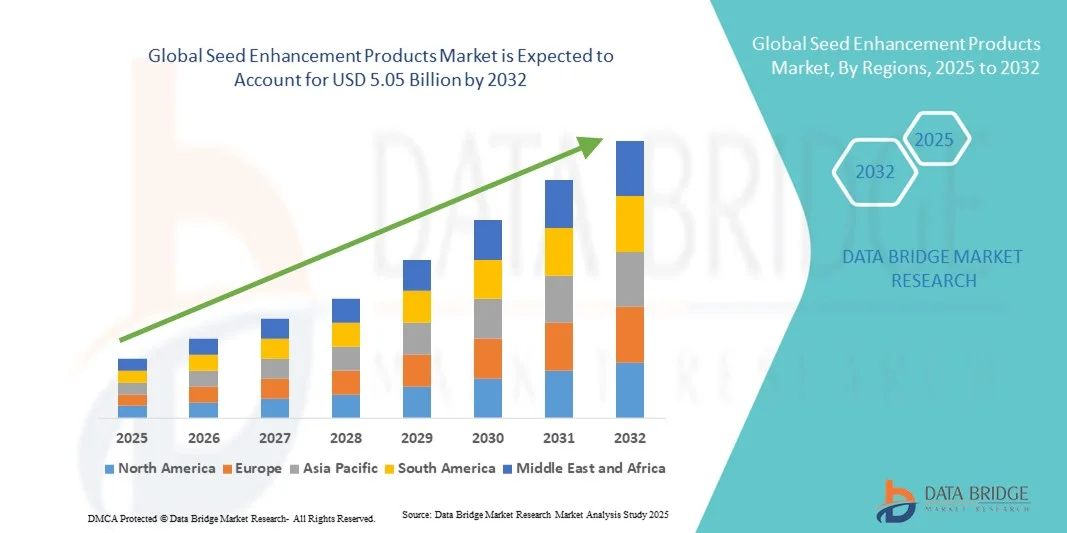
- The global Seed Enhancement Products Market size was valued at USD 2.14 billion in 2024 and is expected to reach USD 5.05 billion by 2032, at a CAGR of 11.30% during the forecast period
- The market growth is primarily driven by increasing demand for improved crop yields and sustainable agricultural practices, alongside advancements in seed treatment technologies that enhance seed performance and protection
- Additionally, growing awareness among farmers about the benefits of seed enhancement products such as coatings, inoculants, and priming solutions is fueling market adoption, while regulatory support for eco-friendly farming methods further propels industry expansion
Global Seed Enhancement Products Market Analysis
- Seed enhancement products, including coatings, priming agents, and biological inoculants, play a crucial role in improving seed performance, germination rates, and crop yields across diverse agricultural applications worldwide.
- The rising global demand for food security, sustainable farming practices, and climate-resilient crops is driving increased adoption of seed enhancement solutions among farmers and agribusinesses.
- North America dominated the global seed enhancement products market with the largest revenue share of 38.7% in 2024, driven by the widespread adoption of advanced agricultural practices, strong investments in agri-biotech, and the presence of leading market players. The U.S. led regional growth with significant demand from large-scale commercial farming operations, emphasizing yield improvement, crop resilience, and sustainability through the use of seed coatings, bio-stimulants, and microbial inoculants.
- Asia-Pacific is expected to be the fastest growing region in the seed enhancement products market during the forecast period, fueled by rapid agricultural modernization, rising awareness of crop productivity tools among smallholder farmers, and increased government initiatives aimed at improving food security and sustainable farming practices across emerging economies such as India and China.
- The bio-fertilizers segment dominated the market with the largest revenue share of 39.8% in 2024, driven by growing global emphasis on sustainable agriculture, soil health, and reduced reliance on chemical inputs.
Report Scope and Global Seed Enhancement Products Market Segmentation
|
Attributes |
Seed Enhancement Products Key Market Insights |
|
Segments Covered |
|
|
Countries Covered |
North America
Europe
Asia-Pacific
Middle East and Africa
South America
|
|
Key Market Players |
|
|
Market Opportunities |
|
|
Value Added Data Infosets |
In addition to the insights on market scenarios such as market value, growth rate, segmentation, geographical coverage, and major players, the market reports curated by the Data Bridge Market Research also include in-depth expert analysis, pricing analysis, brand share analysis, consumer survey, demography analysis, supply chain analysis, value chain analysis, raw material/consumables overview, vendor selection criteria, PESTLE Analysis, Porter Analysis, and regulatory framework. |
Global Seed Enhancement Products Market Trends
Enhanced Efficiency Through AI and Precision Agriculture Integration
- A significant and accelerating trend in the global Seed Enhancement Products Market is the growing integration with artificial intelligence (AI) and precision agriculture technologies, enabling more targeted and efficient seed treatment applications. This synergy is enhancing crop performance and resource management for farmers.
- For instance, AI-driven platforms analyze soil health, weather patterns, and seed genetics to recommend optimized seed enhancement treatments tailored to specific field conditions, improving germination and yield outcomes. Similarly, digital seed treatment systems allow precise application of coatings and inoculants, minimizing waste and environmental impact.
- AI integration in seed enhancement products enables predictive analytics for seed performance under varying conditions and can provide real-time alerts for potential issues like disease or pest risk. For instance, some advanced seed treatment technologies utilize machine learning to adapt formulations based on ongoing crop data, enhancing effectiveness season after season.
- The seamless integration of seed enhancement solutions with smart farm management platforms facilitates centralized monitoring and control of crop inputs, irrigation, and pest management, creating a unified and data-driven agricultural ecosystem.
- This trend toward more intelligent, precise, and adaptive seed enhancement solutions is fundamentally reshaping farmer expectations for crop productivity and sustainability. Consequently, companies such as Bayer and Syngenta are investing heavily in AI-enabled seed treatments that improve seed vigor while supporting eco-friendly farming practices.
- The demand for seed enhancement products with AI and precision agriculture integration is growing rapidly across global farming sectors, as producers increasingly prioritize yield optimization, sustainability, and cost efficiency.
Global Seed Enhancement Products Market Dynamics
Driver
Growing Need Due to Rising Food Security Demands and Sustainable Agriculture Adoption
-
The increasing global emphasis on food security, coupled with the rising adoption of sustainable and precision agriculture practices, is a major driver fueling demand for seed enhancement products.
- For instance, in May 2024, Syngenta announced the expansion of its biological seed treatment portfolio aimed at improving seedling vigor and early-stage disease resistance, particularly in climate-stressed regions. Such strategic moves by key players are expected to drive market growth in the forecast period.
- As farmers seek to improve crop yields and resilience while reducing dependency on synthetic agrochemicals, seed enhancement technologies offer a powerful solution—providing improved germination, nutrient delivery, and stress tolerance from the outset.
- Furthermore, growing awareness of the environmental impact of conventional farming is pushing both smallholders and large-scale agribusinesses toward adopting seed coatings, inoculants, and priming solutions that align with sustainable practices.
- The ability to enhance crop performance without expanding agricultural land, reduce replanting costs, and improve seed uniformity is making seed enhancement products a critical component of modern agriculture. Increased availability of user-friendly, ready-to-use treatments and growing access in emerging markets are further accelerating adoption.
Restraint/Challenge
Regulatory Hurdles and Cost Sensitivity Among Small-Scale Farmers
-
Regulatory complexity and approval delays for novel seed enhancement formulations—especially those involving biological agents—pose a significant challenge to broader market adoption. Varying regional regulations and safety evaluations can hinder the global commercialization of new solutions.
- For instance, the approval process for microbial inoculants in the EU remains stringent and time-consuming, limiting their rapid deployment compared to markets like the U.S. or Brazil. This fragmented regulatory environment can deter innovation and delay access to advanced products in key regions.
- Additionally, small and resource-limited farmers—particularly in developing economies—often face affordability issues, with some high-performance seed enhancement solutions priced beyond their immediate reach. While large agribusinesses readily invest in such technologies, price-sensitive segments remain underserved.
- Addressing these challenges will require harmonized regulatory frameworks, increased investment in education and outreach to farmers on long-term cost savings, and the development of affordable, scalable seed enhancement products tailored for smallholders and diverse crop types.
Global Seed Enhancement Products Market Scope
The global seed enhancement products market is segmented on the basis of product type and end uses.
- By Product Type
On the basis of product type, the seed enhancement products market is segmented into bio-fertilizers, micronutrients, plant growth regulators (PGRs), and others. The bio-fertilizers segment dominated the market with the largest revenue share of 39.8% in 2024, driven by growing global emphasis on sustainable agriculture, soil health, and reduced reliance on chemical inputs. Farmers increasingly adopt bio-fertilizers for their ability to enhance nutrient availability, stimulate plant growth, and support long-term soil fertility. In regions with organic farming initiatives, such as Europe and North America, bio-fertilizers are particularly preferred due to regulatory support and rising consumer demand for organic produce.
The plant growth regulators (PGRs) segment is projected to witness the fastest growth from 2025 to 2032, fueled by increasing usage in high-value crops to regulate flowering, improve stress resistance, and optimize yield. Advancements in precision agriculture and controlled application methods also support the rapid adoption of PGRs in commercial farming operations.
- By End Uses
On the basis of end uses, the seed enhancement products market is segmented into fruits and vegetables, cereals and grains, oilseeds and pulses, and other crop types. The cereals and grains segment held the largest market revenue share of 42.3% in 2024, owing to the global demand for staple crops like wheat, rice, and corn. These crops represent the largest portion of global agricultural land, and farmers are increasingly applying seed enhancement technologies to improve germination rates, early plant vigor, and resistance to abiotic stress, especially in regions prone to climate variability.
The fruits and vegetables segment is expected to witness the fastest CAGR from 2025 to 2032, driven by growing consumer demand for high-quality, nutrient-rich produce and increased investments in horticulture. Seed enhancement products help improve uniformity, shelf life, and overall quality in high-value crops, making them increasingly attractive to commercial growers seeking greater return on investment and consistent harvests.
Global Seed Enhancement Products Market Regional Analysis
- North America dominated the Global Seed Enhancement Products Market with the largest revenue share of 38.7% in 2024, driven by advanced agricultural practices, high awareness of sustainable farming, and strong investments in agri-biotechnology and seed technologies.
- Farmers in the region actively adopt seed enhancement products such as coatings, inoculants, and priming agents to improve crop performance, reduce input costs, and increase resilience against climate variability and pests.
- The widespread use of precision agriculture, favorable government support for sustainable farming, and strong presence of leading agritech companies further boost adoption. Additionally, high farm mechanization levels and a focus on productivity make seed enhancements a vital input for commercial-scale farming across the U.S. and Canada.
U.S. Global Seed Enhancement Products Market Insight
The U.S. Global Seed Enhancement Products Market captured the largest revenue share of 78% in 2024 within North America, driven by the country’s leadership in advanced agriculture, biotechnology innovation, and widespread use of high-yielding hybrid and GM seeds. U.S. farmers are early adopters of seed enhancement technologies, including biological inoculants, seed coatings, and priming agents, to improve germination, disease resistance, and yield performance. The growing focus on sustainable farming, climate resilience, and precision agriculture also supports this trend. Continued R&D investment and a strong regulatory framework for agri-inputs further position the U.S. as a key driver of global market growth.
Europe Global Seed Enhancement Products Market Insight
The Europe Global Seed Enhancement Products Market is projected to expand at a substantial CAGR throughout the forecast period, driven by the region’s stringent environmental regulations and a strong focus on sustainable agriculture. As EU policies increasingly promote eco-friendly and biological inputs, farmers are shifting towards seed enhancement products to reduce chemical dependency and improve crop productivity. The rise in organic farming, coupled with technological integration in seed treatment processes, is accelerating demand. Markets in countries like France, Germany, and the Netherlands are experiencing significant adoption across grains, oilseeds, and vegetable crops.
U.K. Global Seed Enhancement Products Market Insight
The U.K. Global Seed Enhancement Products Market is anticipated to grow at a noteworthy CAGR during the forecast period, fueled by the country’s emphasis on sustainable food production and precision agriculture. British farmers are adopting seed enhancements to improve crop resilience and reduce input costs amid changing climate conditions. The U.K.’s regulatory push towards reduced pesticide usage is also fostering the adoption of seed treatments such as biostimulants and protective coatings. Additionally, innovations in controlled environment agriculture and urban farming are opening new opportunities for enhanced seed usage across both conventional and alternative farming systems.
Germany Global Seed Enhancement Products Market Insight
The Germany Global Seed Enhancement Products Market is expected to expand at a considerable CAGR during the forecast period, supported by strong R&D infrastructure and a growing emphasis on innovation in sustainable agriculture. German farmers are increasingly adopting seed enhancement technologies to align with EU Green Deal targets, particularly those related to reduced chemical usage and improved biodiversity. Biological seed treatments and precision seed coatings are gaining traction as part of integrated crop management strategies. Germany’s high-value horticulture and cereals markets provide strong application potential for enhanced seeds across both conventional and organic farming sectors.
Asia-Pacific Global Seed Enhancement Products Market Insight
The Asia-Pacific Global Seed Enhancement Products Market is poised to grow at the fastest CAGR of 24% during the forecast period of 2025 to 2032, driven by rising food demand, agricultural modernization, and supportive government policies in countries like India, China, and Vietnam. Farmers in the region are increasingly turning to seed enhancement products to boost productivity, particularly in water-stressed and pest-prone regions. Ongoing investments in agri-tech, combined with improving awareness of seed quality, are expanding the market. As local manufacturers and multinationals increase their presence, access to affordable and high-quality seed enhancement solutions is rapidly improving.
Japan Global Seed Enhancement Products Market Insight
The Japan Global Seed Enhancement Products Market is gaining momentum due to the country’s advanced agricultural technology landscape and limited arable land, which necessitates maximizing crop performance. Japanese farmers prioritize seed quality and are adopting enhancement products to improve germination rates, disease resistance, and early plant vigor, especially in high-value crops such as vegetables and fruits. The market is also being influenced by demographic shifts, including an aging farming population, which is driving demand for labor-saving and efficient agricultural inputs such as ready-to-use enhanced seeds.
China Global Seed Enhancement Products Market Insight
The China Global Seed Enhancement Products Market accounted for the largest market revenue share in Asia Pacific in 2024, driven by the country’s vast agricultural output, modernization efforts, and rising food security concerns. Chinese farmers are increasingly adopting seed enhancement products to improve yields and reduce input costs amid climate variability and soil degradation challenges. Government-backed initiatives promoting high-quality seed usage and the expansion of agri-biotech zones are further accelerating adoption. The presence of both domestic and international seed companies is fostering innovation and improving accessibility to advanced seed enhancement technologies across the country.
Global Seed Enhancement Products Market Share
The seed enhancement products market is primarily led by well-established companies, including:
- BASF SE (Germany)
- Bayer AG (Germany)
- BIOBEST GROUP NV (Belgium)
- Certis USA L.L.C. (U.S.)
- Novozymes (Denmark)
- Marrone Bio Innovations (U.S.)
- Syngenta (Switzerland)
- Nufarm (Australia)
- Som Phytopharma India Ltd. (India)
- Valent BioSciences LLC (U.S.)
- BioWorks Inc. (United States)
- Camson Biotechnologies Ltd. (India)
- Andermatt Biocontrol AG (Switzerland)
- Kan Biosys Pvt. Ltd. (India)
- Futureco Bioscience S.A. (Spain)
- Kilpest India Ltd. (India)
- BioSafe Systems, LLC. (U.S.)
- Vestaron Corporation (U.S.)
- SDS Biotech K.K. (Japan)
- NEOGEN Corporation (U.S.)
- LANXESS (Germany)
What are the Recent Developments in Global Seed Enhancement Products Market?
- In April 2024, BASF SE launched a regional initiative in South Africa aimed at improving crop productivity and soil health through its advanced bio-fertilizer and seed treatment technologies. This initiative reflects BASF’s commitment to sustainable agriculture by tailoring its solutions to local soil conditions and climate challenges. By leveraging its global R&D capabilities and partnerships with local agronomists, BASF is not only addressing food security concerns in emerging markets but also reinforcing its leadership in the global seed enhancement sector.
- In March 2023, Novozymes A/S, a global leader in biological solutions, introduced its TagTeam® BioniQ™ biofertilizer in North America, targeting soybean and pulse growers. The product combines multiple microbial strains to enhance nutrient uptake and root development, enabling higher yields under diverse growing conditions. This launch demonstrates Novozymes’ focus on science-based innovation and its commitment to reducing the agricultural sector’s environmental footprint.
- In February 2023, Syngenta AG expanded its biological seed treatment production facility in Brazil to meet the rising demand for sustainable crop protection solutions in Latin America. The investment aims to increase production capacity for bio-based seed coatings and microbial inoculants, aligning with regional shifts toward regenerative agriculture. This move underscores Syngenta’s strategy to integrate sustainability into all aspects of its seed enhancement offerings.
- In January 2023, Corteva Agriscience partnered with Indian agri-tech startups to co-develop micronutrient seed coatings designed specifically for smallholder farmers. The collaboration focuses on boosting crop resilience in nutrient-deficient soils, especially for staple crops like rice and millet. This initiative demonstrates Corteva’s commitment to inclusive innovation and its mission to support food security in developing economies through accessible, science-driven technologies.
- In December 2022, UPL Limited launched a new range of plant growth regulators (PGRs) under the brand name “AdvantaBoost” across key Southeast Asian markets. Tailored for high-value horticultural crops, the product line enhances flowering, fruit set, and stress tolerance. This strategic expansion highlights UPL’s focus on delivering high-performance seed enhancement products that align with the region’s evolving agricultural needs and climate resilience goals.

- Interactive Data Analysis Dashboard
- Company Analysis Dashboard for high growth potential opportunities
- Research Analyst Access for customization & queries
- Competitor Analysis with Interactive dashboard
- Latest News, Updates & Trend analysis
- Harness the Power of Benchmark Analysis for Comprehensive Competitor Tracking
Data collection and base year analysis are done using data collection modules with large sample sizes. The stage includes obtaining market information or related data through various sources and strategies. It includes examining and planning all the data acquired from the past in advance. It likewise envelops the examination of information inconsistencies seen across different information sources. The market data is analysed and estimated using market statistical and coherent models. Also, market share analysis and key trend analysis are the major success factors in the market report. To know more, please request an analyst call or drop down your inquiry.
The key research methodology used by DBMR research team is data triangulation which involves data mining, analysis of the impact of data variables on the market and primary (industry expert) validation. Data models include Vendor Positioning Grid, Market Time Line Analysis, Market Overview and Guide, Company Positioning Grid, Patent Analysis, Pricing Analysis, Company Market Share Analysis, Standards of Measurement, Global versus Regional and Vendor Share Analysis. To know more about the research methodology, drop in an inquiry to speak to our industry experts.
Data Bridge Market Research is a leader in advanced formative research. We take pride in servicing our existing and new customers with data and analysis that match and suits their goal. The report can be customized to include price trend analysis of target brands understanding the market for additional countries (ask for the list of countries), clinical trial results data, literature review, refurbished market and product base analysis. Market analysis of target competitors can be analyzed from technology-based analysis to market portfolio strategies. We can add as many competitors that you require data about in the format and data style you are looking for. Our team of analysts can also provide you data in crude raw excel files pivot tables (Fact book) or can assist you in creating presentations from the data sets available in the report.