


Self Cleaning Coating Market Size
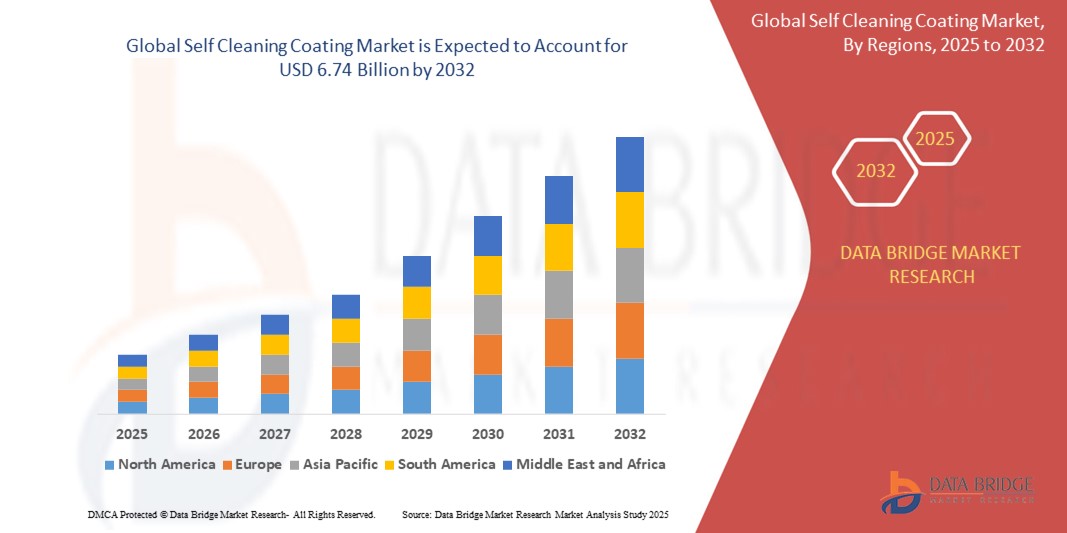
- The global self cleaning coating market size was valued at USD 4.43 billion in 2024 and is expected to reach USD 6.74 billion by 2032, at a CAGR of 5.40% during the forecast period
- The market growth is primarily driven by increasing demand for advanced materials in construction, automotive, and textile industries, coupled with technological advancements in nanotechnology and surface coatings
- Rising consumer preference for low-maintenance, eco-friendly, and durable coating solutions is further propelling the adoption of self cleaning coatings across various sectors, establishing them as a preferred choice for modern applications
Self Cleaning Coating Market Analysis
- Self cleaning coatings, leveraging hydrophobic or hydrophilic properties, are designed to repel dirt, water, or organic matter, ensuring surfaces remain clean with minimal maintenance. These coatings are increasingly integral to industries such as construction, automotive, and textiles due to their durability, environmental benefits, and cost-effective maintenance
- The demand for self cleaning coatings is fueled by growing awareness of sustainable building materials, increasing vehicle production with advanced surface protection, and the need for stain-resistant fabrics in apparel
- North America dominated the self cleaning coating market with the largest revenue share of 38.5% in 2024, driven by early adoption of advanced coating technologies, high investment in infrastructure, and a strong presence of key manufacturers
- Asia-Pacific is expected to be the fastest-growing region during the forecast period, propelled by rapid urbanization, increasing construction activities, and rising automotive production, particularly in countries such as China, Japan, and India
- The hydrophobic segment dominated the largest market revenue share of 62.5% in 2024, driven by their critical role in the automotive sector, where demand for water-repellent solutions is escalating
Report Scope and Self Cleaning Coating Market Segmentation
|
Attributes |
Self Cleaning Coating Key Market Insights |
|
Segments Covered |
|
|
Countries Covered |
North America
Europe
Asia-Pacific
Middle East and Africa
South America
|
|
Key Market Players |
|
|
Market Opportunities |
|
|
Value Added Data Infosets |
In addition to the insights on market scenarios such as market value, growth rate, segmentation, geographical coverage, and major players, the market reports curated by the Data Bridge Market Research also include import export analysis, production capacity overview, production consumption analysis, price trend analysis, climate change scenario, supply chain analysis, value chain analysis, raw material/consumables overview, vendor selection criteria, PESTLE Analysis, Porter Analysis, and regulatory framework. |
Self Cleaning Coating Market Trends
“Increasing Integration of Hydrophobic and Hydrophilic Technologies”
- The global self-cleaning coating market is experiencing a notable trend toward the integration of advanced hydrophobic and hydrophilic technologies
- These technologies enable enhanced surface properties, allowing coatings to repel water, dirt, and contaminants or break them down through photocatalytic processes, reducing maintenance needs
- Advanced hydrophobic coatings, inspired by natural phenomena such as the lotus effect, create surfaces that minimize water adhesion, enabling easy cleaning by allowing water to roll off and carry away debris
- Hydrophilic coatings, often utilizing titanium dioxide, leverage photocatalysis to decompose organic matter under light exposure, ensuring clean surfaces with minimal manual intervention
- For instance, companies are developing smart coatings that combine both technologies to offer tailored solutions for specific applications, such as self-cleaning glass in construction or water-repellent surfaces in automotive manufacturing
- This trend enhances the appeal of self-cleaning coatings for industries such as construction, automotive, and textiles by offering low-maintenance, eco-friendly solutions that align with sustainability goals
Self Cleaning Coating Market Dynamics
Driver
“Rising Demand for Low-Maintenance and Sustainable Solutions”
- The increasing consumer and industry demand for low-maintenance surfaces that reduce cleaning efforts and costs is a key driver for the global self-cleaning coating market
- Self-cleaning coatings enhance durability and aesthetics by repelling dirt, water, and contaminants or breaking them down, making them ideal for applications in construction, automotive, textile and apparel, and other industries
- Government initiatives promoting sustainable building practices, particularly in regions such as Europe and North America, are boosting the adoption of self-cleaning coatings to reduce water and chemical usage in cleaning processes
- The rise of smart cities and green building certifications, such as LEED, further drives demand for self-cleaning coatings in construction, especially for facades, windows, and solar panels
- Advancements in nanotechnology and material science are enabling more efficient and cost-effective coating solutions, making them accessible to a broader range of industries and consumers
Restraint/Challenge
“High Initial Costs and Regulatory Compliance Issues”
- The high upfront costs associated with the development, production, and application of self-cleaning coatings, particularly those incorporating advanced nanotechnology, pose a significant barrier to widespread adoption, especially in cost-sensitive markets such as Asia-Pacific and Latin America
- Integrating self-cleaning coatings into existing infrastructure or manufacturing processes can be complex and expensive, deterring smaller companies or industries with limited budgets
- Data security is not a concern for self-cleaning coatings, but compliance with stringent environmental regulations, such as REACH in Europe, can complicate production and increase costs due to the need for eco-friendly and non-toxic formulations
- The lack of technical awareness among end-users in emerging markets about the benefits and applications of self-cleaning coatings can further hinder market growth
- These factors may limit market expansion in regions with high cost sensitivity or where regulatory frameworks are not yet aligned with advanced coating technologies
Self Cleaning Coating market Scope
The market is segmented on the basis of type and end-user.
- By Type
On the basis of type, the self-cleaning coating market is segmented into hydrophobic and hydrophilic. The hydrophobic segment dominated the largest market revenue share of 62.5% in 2024, driven by their critical role in the automotive sector, where demand for water-repellent solutions is escalating. These coatings reduce surface energy, minimizing dust, liquid, and ice accumulation, making them ideal for vehicle manufacturing, offering improved visibility during precipitation and protection against environmental elements. Their widespread use in construction and electronics further bolsters their dominance.
The hydrophilic segment is anticipated to witness the fastest growth rate of 11.2% from 2025 to 2032, fueled by their increasing adoption in applications requiring photocatalytic decomposition, such as building exteriors and solar panels. Hydrophilic coatings utilize titanium dioxide to break down organic dirt, enhancing cleanliness and reducing maintenance costs, particularly in the construction and healthcare sectors.
- By End-User
On the basis of end-user, the self-cleaning coating market is segmented into construction, automotive, textile and apparel, and others. The construction segment is expected to hold the largest market revenue share in 2024, driven by the increasing demand for low-maintenance building facades, windows, and solar panels. Self-cleaning coatings in construction offer aesthetic benefits, reduce cleaning costs, and contribute to sustainable building practices.
The textile and apparel segment is anticipated to witness the fastest growth rate from 2025 to 2032. This growth is fueled by increasing consumer demand for easy-care, stain-resistant, and durable fabrics, coupled with advancements in nanotechnology that enable the integration of self-cleaning properties into textiles.
Self Cleaning Coating Market Regional Analysis
- North America dominated the self cleaning coating market with the largest revenue share of 38.5% in 2024, driven by early adoption of advanced coating technologies, high investment in infrastructure, and a strong presence of key manufacturers
- Consumers prioritize self-cleaning coatings for reducing maintenance costs, enhancing surface durability, and protecting against environmental elements, particularly in regions with varying climatic conditions
- Growth is supported by advancements in coating technologies, such as hydrophobic and photocatalytic films, alongside increasing adoption in both OEM and aftermarket applications across multiple industries
U.S. Self Cleaning Coating Market Insight
The U.S. self cleaning coating market captured the largest revenue share of 74.8% in 2024 within North America, fueled by strong aftermarket demand and growing awareness of the benefits of hydrophobic and hydrophilic coatings for UV protection and dirt repellency. The trend toward sustainable building materials and vehicle customization further drives market expansion. Automakers’ integration of self-cleaning coatings in factory-finished vehicles complements aftermarket sales, fostering a diverse product ecosystem.
Europe Self Cleaning Coating Market Insight
The European self-cleaning coating market is expected to exhibit significant growth, driven by stringent regulations promoting eco-friendly and energy-efficient materials. Consumers seek coatings that enhance surface cleanliness while providing thermal insulation. Growth is notable in both new construction projects and automotive applications, with countries such as Germany and France showing strong adoption due to environmental concerns and urban infrastructure development.
U.K. Self Cleaning Coating Market Insight
The U.K. market for self-cleaning coatings is projected to experience rapid growth, driven by demand for low-maintenance solutions in urban and suburban construction projects. Increased awareness of UV protection and stain resistance benefits encourages adoption in automotive and textile applications. Evolving regulations balancing environmental sustainability with performance standards further shape consumer preferences.
Germany Self Cleaning Coating Market Insight
Germany is expected to witness rapid growth in the self-cleaning coating market, attributed to its advanced automotive and construction industries, coupled with a strong focus on energy efficiency and sustainability. German consumers prefer technologically advanced coatings that reduce maintenance costs and contribute to environmental conservation. The integration of these coatings in premium vehicles and commercial buildings supports sustained market growth.
Asia-Pacific Self Cleaning Coating Market Insight
The Asia-Pacific region is expected to witness the fastest growth rate, driven by rapid industrialization, urbanization, and rising disposable incomes in countries such as China, India, and Japan. Growing awareness of self-cleaning coatings’ benefits, including heat rejection, UV protection, and aesthetic enhancement, boosts demand. Government initiatives promoting sustainable construction and vehicle safety further accelerate the adoption of advanced coatings.
Japan Self Cleaning Coating Market Insight
Japan’s self-cleaning coating market is projected to grow rapidly due to strong consumer demand for high-quality, technologically advanced coatings that enhance durability and reduce maintenance. The presence of major automotive manufacturers and the integration of self-cleaning coatings in OEM vehicles drive market penetration. Rising interest in aftermarket applications for construction and textiles also contributes to growth.
China Self Cleaning Coating Market Insight
China holds the largest share of the Asia-Pacific self-cleaning coating market, propelled by rapid urbanization, increasing vehicle ownership, and growing demand for low-maintenance solutions. The country’s expanding middle class and focus on sustainable infrastructure support the adoption of advanced hydrophobic and hydrophilic coatings. Strong domestic manufacturing capabilities and competitive pricing enhance market accessibility.
Self Cleaning Coating Market Share
The self cleaning coating industry is primarily led by well-established companies, including:
- AkzoNobel N.V. (Netherlands)
- Compagnie De Saint-Gobain S.A. (France)
- PPG Industries Inc. (U.S.)
- Shanghai Huzheng Nano Technology Co., Ltd. (China)
- Asahi India Glass Limited (India)
- Viridian Glass Pty Ltd (Australia)
- ATIS (France)
- Wuxi Yaopi Glass Engineering Co. Ltd (China)
- Polypane Glasindustrie NV (Belgium)
- Tuffx Glass (U.K.)
- Prefix Systems (UK) LTD (U.K.)
What are the Recent Developments in Global Self Cleaning Coating Market?
- In June 2025, Research and Markets reported a surge in demand for advanced functional paints—including dirt-repelling, self-healing, and self-cleaning formulations—driven by strong growth in the architectural paints and coatings sector. This trend reflects a broader industry shift toward smart coatings that offer enhanced durability, reduced maintenance, and eco-friendly benefits. Urbanization, infrastructure expansion, and sustainability goals are fueling innovation in coating technologies, with manufacturers increasingly investing in nanomaterials and responsive polymers to meet evolving performance standards. The market’s momentum signals a clear push toward intelligent surface solutions across residential, commercial, and industrial applications
- In June 2025, Fortune Business Insights highlighted the growing adoption of smart coatings in the architectural and agricultural sectors, with PPG Industries’ SunCleanglass coating standing out as a key innovation. SunCleanuses a photocatalytic titanium dioxide layer that activates under UV light to break down organic dirt, which is then rinsed away by rain or water. This self-cleaning functionality is especially beneficial for greenhouse applications, where maintaining clear glass improves light transmission and ultimately enhances crop yields. The product exemplifies a shift toward functional coatings that combine durability, sustainability, and performance
- In June 2025, Data Insights Market reported that leading companies such as Okitsumo Incorporated, Saint-Gobain, and Shin-Etsu Chemical are driving innovation in the automotive photocatalysis self-cleaning coatings segment through active research and development. These coatings, which typically use photocatalytic materials such as titanium dioxide, break down organic pollutants under UV light—reducing the need for manual cleaning and enhancing vehicle aesthetics. The push for eco-friendly, low-maintenance solutions is fueling continuous product enhancements, with advancements in nanotechnology, durability, and UV resistance shaping the future of smart automotive surfaces
- In April 2024, AZoBuild highlighted a major breakthrough in self-cleaning coatings for construction through the adoption of magnetron sputtering—a highly controlled physical vapor deposition technique. This method enables the precise fabrication of uniform multilayer structures at a commercial scale, which is crucial for enhancing the performance and reliability of self-cleaning surfaces in architectural applications. By allowing fine-tuned control over coating thickness, composition, and crystallinity, magnetron sputtering supports the development of durable, photocatalytic coatings that can break down organic contaminants and reduce maintenance needs for buildings and infrastructure
- In August 2021, a prominent automotive manufacturer introduced a new vehicle model equipped with self-cleaning coating technology as a standard feature, marking a pivotal moment in the mainstream adoption of advanced surface treatments. Although the brand wasn’t publicly disclosed, this integration highlights growing confidence in photocatalytic and hydrophobic coatings that repel dirt, water, and pollutants—reducing maintenance and enhancing vehicle aesthetics. The move reflects a broader industry trend toward smart, sustainable materials that improve user experience and support eco-friendly practices

- Interactive Data Analysis Dashboard
- Company Analysis Dashboard for high growth potential opportunities
- Research Analyst Access for customization & queries
- Competitor Analysis with Interactive dashboard
- Latest News, Updates & Trend analysis
- Harness the Power of Benchmark Analysis for Comprehensive Competitor Tracking
Global Self Cleaning Coating Market, Supply Chain Analysis and Ecosystem Framework
To support market growth and help clients navigate the impact of geopolitical shifts, DBMR has integrated in-depth supply chain analysis into its Global Self Cleaning Coating Market research reports. This addition empowers clients to respond effectively to global changes affecting their industries. The supply chain analysis section includes detailed insights such as Global Self Cleaning Coating Market consumption and production by country, price trend analysis, the impact of tariffs and geopolitical developments, and import and export trends by country and HSN code. It also highlights major suppliers with data on production capacity and company profiles, as well as key importers and exporters. In addition to research, DBMR offers specialized supply chain consulting services backed by over a decade of experience, providing solutions like supplier discovery, supplier risk assessment, price trend analysis, impact evaluation of inflation and trade route changes, and comprehensive market trend analysis.
Data collection and base year analysis are done using data collection modules with large sample sizes. The stage includes obtaining market information or related data through various sources and strategies. It includes examining and planning all the data acquired from the past in advance. It likewise envelops the examination of information inconsistencies seen across different information sources. The market data is analysed and estimated using market statistical and coherent models. Also, market share analysis and key trend analysis are the major success factors in the market report. To know more, please request an analyst call or drop down your inquiry.
The key research methodology used by DBMR research team is data triangulation which involves data mining, analysis of the impact of data variables on the market and primary (industry expert) validation. Data models include Vendor Positioning Grid, Market Time Line Analysis, Market Overview and Guide, Company Positioning Grid, Patent Analysis, Pricing Analysis, Company Market Share Analysis, Standards of Measurement, Global versus Regional and Vendor Share Analysis. To know more about the research methodology, drop in an inquiry to speak to our industry experts.
Data Bridge Market Research is a leader in advanced formative research. We take pride in servicing our existing and new customers with data and analysis that match and suits their goal. The report can be customized to include price trend analysis of target brands understanding the market for additional countries (ask for the list of countries), clinical trial results data, literature review, refurbished market and product base analysis. Market analysis of target competitors can be analyzed from technology-based analysis to market portfolio strategies. We can add as many competitors that you require data about in the format and data style you are looking for. Our team of analysts can also provide you data in crude raw excel files pivot tables (Fact book) or can assist you in creating presentations from the data sets available in the report.













