


What is the Self-Driving Truck Market Size and Growth Rate?
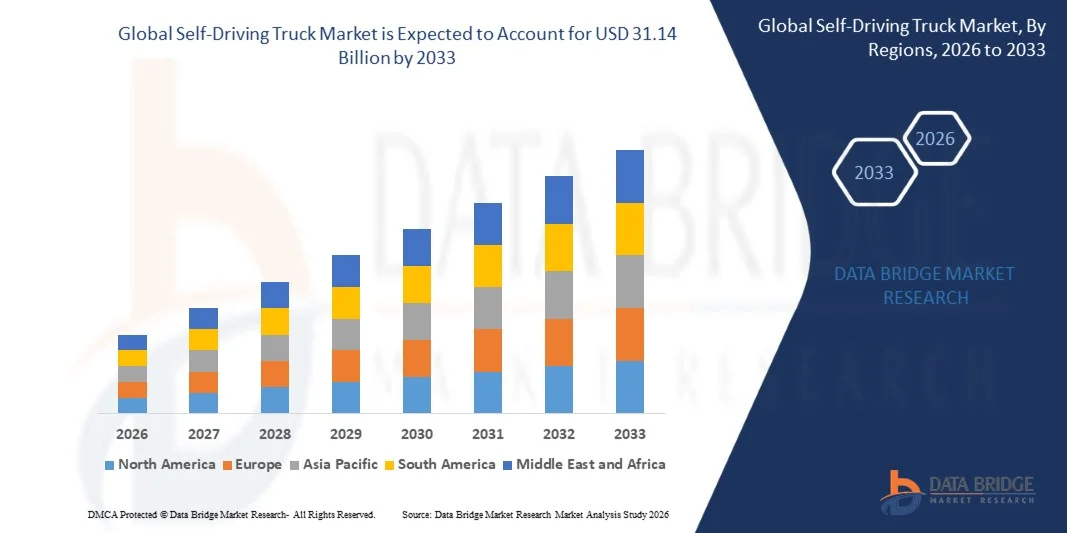
As per Data Bridge Market Research analysis the self-driving truck market was valued at USD 2.30 billion in 2025 and is projected to reach USD 31.14 billion by 2033, growing at a CAGR of 38.50% from 2026 to 2033. The market is experiencing rapid growth driven by increasing demand for autonomous freight transportation, advancements in artificial intelligence and sensor technologies, rising logistics efficiency requirements, and growing investments by automotive manufacturers and technology companies in autonomous trucking solutions.
The increasing shortage of truck drivers, rising operational costs in the logistics sector, and the need for safer and more efficient transportation systems are encouraging logistics companies and fleet operators to adopt self-driving trucks. Advanced technologies such as LiDAR, radar, computer vision, and machine learning are enabling autonomous trucks to improve route optimization, reduce human errors, and enhance fuel efficiency. In addition, the expansion of e-commerce, increasing freight transportation demand, and regulatory developments supporting autonomous vehicle testing are accelerating the adoption of self-driving trucks across commercial transportation networks.
Market Size & Forecast
- Market Value (2025): USD 2.30 Billion
- Expected Market Value (2033): USD 31.14 Billion
- Forecast CAGR (2026–2033): 38.50%
- Leading Region in 2025: North America
- Fastest Growing Region: Asia-Pacific
What are the Major Takeaways of Self-Driving Truck Market?
- North America dominated the self-driving truck market with the largest revenue share in 2025, supported by strong investments in autonomous vehicle technologies, advanced logistics infrastructure, and increasing demand for efficient freight transportation solutions.
- Asia-Pacific self-driving truck market is expected to witness the fastest growth rate from 2026 to 2033, supported by rapid industrialization, expanding logistics networks, increasing freight transportation demand, and rising investments in autonomous mobility technologies.
- The hardware segment held the largest market revenue share in 2025, driven by increasing integration of LiDAR sensors, radar systems, cameras, electronic control units, and advanced computing platforms in autonomous trucks. Hardware components are essential for perception, navigation, and real-time decision-making, making them a critical part of autonomous freight systems. Rising investments by truck manufacturers in autonomous-ready vehicle platforms are further supporting segment growth.
- The software segment is projected to register the fastest growth at a CAGR from 2026 to 2033, driven by increasing adoption of artificial intelligence, machine learning algorithms, autonomous driving platforms, and fleet management software. Continuous improvements in perception software, route optimization, and decision-making systems are accelerating the deployment of self-driving trucks across commercial transportation networks.
- The logistics and transportation segment held the largest market revenue share of approximately 48.7% in 2025, driven by rising freight volumes, increasing e-commerce activities, and growing demand for efficient long-haul transportation solutions. Autonomous trucks are increasingly being tested and deployed in logistics operations to improve delivery efficiency, reduce operational costs, and address driver shortages.
- The mining segment is projected to register the fastest growth at a CAGR from 2026 to 2033, driven by increasing adoption of autonomous haulage systems in mining operations. Mining companies are implementing self-driving trucks to improve worker safety, optimize productivity, and enable continuous material transportation in controlled environments.
Report Scope and Self-Driving Truck Market Segmentation
|
Attributes |
Self-Driving Truck Key Market Insights |
|
Segments Covered |
|
|
Countries Covered |
North America
Europe
Asia-Pacific
Middle East and Africa
South America
|
|
Key Market Players |
|
|
Market Opportunities |
|
|
Value Added Data Infosets |
In addition to the market insights such as market value, growth rate, market segments, geographical coverage, market players, and market scenario, the market report curated by the Data Bridge Market Research team includes in-depth expert analysis, import/export analysis, pricing analysis, production consumption analysis, and pestle analysis. |
What is the Key Trend in the Self-Driving Truck Market?
Trend: Increasing Deployment Of Autonomous Trucking Solutions For Freight Transportation
The growing demand for efficient freight transportation, increasing logistics costs, and ongoing driver shortages are accelerating the adoption of self-driving trucks across global supply chains. Logistics companies and fleet operators are increasingly exploring autonomous trucking solutions to improve delivery efficiency, enhance road safety, reduce operational costs, and optimize long-haul transportation. Advanced technologies such as artificial intelligence, LiDAR, radar sensors, and autonomous driving software are enabling trucks to perform complex driving functions while improving reliability and fleet productivity.
The rapid expansion of e-commerce, increasing freight movement, and investments from automotive and technology companies are creating sustained demand for autonomous trucks. According to the American Trucking Associations (ATA), trucks transported approximately 72.7% of domestic freight tonnage in the U.S. in 2023, highlighting the importance of trucking automation for future logistics operations.
For instance, in April 2025, Daimler Truck announced the delivery of its latest autonomous-ready Freightliner Cascadia truck platform to Torc Robotics for autonomous driving development. The platform includes redundant safety systems designed for SAE Level 4 autonomous trucking and supports Torc’s goal of commercializing autonomous trucks in the U.S. market by 2027. This development is expected to strengthen autonomous freight capabilities and accelerate the transition toward driverless transportation solutions.
The increasing focus on autonomous freight operations, rising investments in self-driving technologies, and growing demand for efficient logistics solutions are expected to support long-term growth of the self-driving truck market.
Self-Driving Truck Market Dynamics
Key Market Driver: Rising Demand For Autonomous Freight Efficiency And Driver Shortage Management
The global logistics sector is increasingly adopting automation technologies to address challenges related to driver availability, increasing transportation costs, and the need for faster delivery operations. Self-driving trucks provide opportunities to enhance fleet utilization, reduce human-error-related accidents, and enable continuous freight movement. These benefits are encouraging transportation companies and technology providers to accelerate autonomous trucking development and commercialization.
The growing requirement for reliable long-distance freight transportation is further supporting market expansion. Autonomous trucks are particularly gaining attention for highway freight applications, where predictable routes and structured environments enable safer deployment of autonomous driving systems.
For instance, in December 2024, Volvo Autonomous Solutions and DHL Supply Chain launched autonomous truck operations in the U.S. using the Volvo VNL Autonomous truck powered by the Aurora Driver technology. The initiative began freight transportation on routes between Dallas-Houston and Fort Worth-El Paso to validate autonomous operations and improve supply chain efficiency. This collaboration demonstrates increasing industry adoption of autonomous trucks for commercial logistics applications.
As logistics providers continue investing in automation and autonomous freight solutions, demand for self-driving trucks is expected to increase, driven by operational efficiency improvements and transportation workforce challenges.
Key Restraint/Challenge: High Technology Costs And Regulatory Uncertainty
The self-driving truck market faces challenges due to high development costs, complex testing requirements, cybersecurity risks, and evolving regulatory frameworks. Autonomous trucks require advanced hardware components, including sensors, computing systems, and artificial intelligence platforms, which significantly increase vehicle development and deployment costs. In addition, manufacturers must complete extensive safety validation before achieving large-scale commercial adoption.
Regulatory differences across countries and regions also create uncertainty for autonomous truck deployment. Governments and transportation authorities continue developing guidelines related to autonomous vehicle testing, safety standards, and commercial operations, which may influence market expansion timelines.
For instance, the National Highway Traffic Safety Administration (NHTSA) continues to develop safety frameworks and reporting requirements for automated driving systems to improve transparency and establish guidelines for autonomous vehicle deployment. These evolving regulatory requirements create additional compliance considerations for self-driving truck manufacturers and technology providers.
Despite strong growth potential, high research and development costs, regulatory challenges, and safety validation requirements are expected to remain significant restraints affecting the pace of self-driving truck commercialization.
Key Market Opportunity: Expansion Of Commercial Autonomous Freight Networks
The increasing development of autonomous freight corridors, smart logistics infrastructure, and partnerships between truck manufacturers, technology companies, and logistics providers is creating significant growth opportunities for the self-driving truck market. Autonomous trucks can improve freight capacity, reduce transportation delays, and support more efficient supply chain operations by enabling continuous and optimized vehicle movement.
The growing adoption of autonomous logistics solutions is encouraging companies to conduct real-world commercial testing and expand autonomous freight networks. These developments are expected to create opportunities for truck manufacturers, autonomous technology providers, and fleet operators.
For instance, in May 2025, Aurora Innovation announced the expansion of its autonomous trucking operations, with commercial driverless truck deployment activities involving freight routes in Texas. The company’s Aurora Driver technology is designed to support autonomous Class 8 trucks and enable scalable freight transportation solutions through partnerships with logistics and transportation companies.
As autonomous freight networks expand and commercial deployment progresses, increasing adoption of self-driving trucks is expected to create substantial growth opportunities across logistics, transportation, and fleet management industries.
How is the Self-Driving Truck Market Segmented?
The market is segmented on the basis of component, application, level of automation, and propulsion type.
- By Component
On the basis of component, the self-driving truck market is segmented into hardware, software, and services. The hardware segment held the largest market revenue share in 2025, driven by increasing integration of LiDAR sensors, radar systems, cameras, electronic control units, and advanced computing platforms in autonomous trucks. Hardware components are essential for perception, navigation, and real-time decision-making, making them a critical part of autonomous freight systems. Rising investments by truck manufacturers in autonomous-ready vehicle platforms are further supporting segment growth.
The software segment is projected to register the fastest growth at a CAGR from 2026 to 2033, driven by increasing adoption of artificial intelligence, machine learning algorithms, autonomous driving platforms, and fleet management software. Continuous improvements in perception software, route optimization, and decision-making systems are accelerating the deployment of self-driving trucks across commercial transportation networks.
- By Application
On the basis of application, the self-driving truck market is segmented into logistics and transportation, construction and manufacturing, mining, port, and others. The logistics and transportation segment held the largest market revenue share of approximately 48.7% in 2025, driven by rising freight volumes, increasing e-commerce activities, and growing demand for efficient long-haul transportation solutions. Autonomous trucks are increasingly being tested and deployed in logistics operations to improve delivery efficiency, reduce operational costs, and address driver shortages.
The mining segment is projected to register the fastest growth at a CAGR from 2026 to 2033, driven by increasing adoption of autonomous haulage systems in mining operations. Mining companies are implementing self-driving trucks to improve worker safety, optimize productivity, and enable continuous material transportation in controlled environments.
- By Level of Automation
On the basis of level of automation, the self-driving truck market is segmented into Level 1, Level 2, Level 3, Level 4, and Level 5. The Level 4 segment held the largest market revenue share in 2025, driven by increasing commercial testing and deployment of highly automated trucks capable of operating without human intervention under specific conditions. Level 4 autonomous trucks are gaining adoption in freight corridors and logistics hubs due to their ability to improve efficiency while maintaining operational safety.
The Level 5 segment is projected to register the fastest growth at a CAGR from 2026 to 2033, driven by long-term industry efforts toward fully autonomous transportation systems. Advancements in artificial intelligence, sensor technologies, and autonomous decision-making capabilities are supporting future development of fully driverless trucks for widespread commercial applications.
- By Propulsion Type
On the basis of propulsion type, the self-driving truck market is segmented into internal combustion, hybrid transmission, and electric transmission. The internal combustion segment held the largest market revenue share of approximately 62.3% in 2025, driven by the widespread availability of diesel-powered commercial trucks and established freight transportation infrastructure. Internal combustion autonomous trucks continue to dominate early deployments due to their long-range capabilities and compatibility with existing logistics operations.
The electric transmission segment is projected to register the fastest growth at a CAGR from 2026 to 2033, driven by increasing investments in zero-emission transportation, battery technology advancements, and integration of autonomous driving systems with electric truck platforms. Growing government initiatives supporting clean mobility and sustainability are accelerating the adoption of electric autonomous trucks across logistics and commercial transportation sectors.
Self-Driving Truck Market Regional Analysis
North America Self-Driving Truck Market Insight
North America dominated the self-driving truck market with the largest revenue share in 2025, supported by strong investments in autonomous vehicle technologies, advanced logistics infrastructure, and increasing demand for efficient freight transportation solutions. The region benefits from the presence of leading autonomous trucking companies, technology providers, and commercial vehicle manufacturers actively developing and testing self-driving trucks. The growing shortage of truck drivers, rising transportation costs, and increasing adoption of artificial intelligence and sensor-based technologies are accelerating the deployment of autonomous trucks across logistics and freight networks.
U.S. Self-Driving Truck Market Insight
The U.S. self-driving truck market captured the largest revenue share in North America in 2025, driven by significant investments in autonomous trucking development, extensive freight transportation networks, and favorable testing environments for advanced vehicle technologies. Companies are increasingly deploying autonomous trucks for long-haul freight operations to improve efficiency, reduce operational costs, and address driver shortages. The presence of major technology developers and partnerships between truck manufacturers, logistics providers, and autonomous technology companies is further contributing to market expansion.
Europe Self-Driving Truck Market Insight
The Europe self-driving truck market is expected to witness significant growth from 2026 to 2033, driven by increasing focus on sustainable transportation, rising logistics automation, and supportive government initiatives for autonomous mobility. European countries are investing in connected transportation infrastructure and advanced driver assistance technologies to improve freight efficiency and reduce emissions. The growing adoption of electric and autonomous commercial vehicles, combined with increasing demand for safer logistics operations, is supporting market development across the region.
Germany Self-Driving Truck Market Insight
The Germany self-driving truck market is expected to experience strong growth from 2026 to 2033, supported by the country’s advanced automotive manufacturing ecosystem, technological expertise, and focus on intelligent transportation solutions. Germany’s leading position in commercial vehicle manufacturing is encouraging the development and adoption of autonomous truck technologies. Increasing investments in artificial intelligence, vehicle automation, and electric mobility are promoting the integration of self-driving systems into freight transportation applications.
U.K. Self-Driving Truck Market Insight
The U.K. self-driving truck market is expected to grow from 2026 to 2033, driven by increasing demand for logistics automation, rising e-commerce activities, and government support for autonomous vehicle testing. The country’s focus on improving freight efficiency and reducing transportation emissions is encouraging investments in autonomous trucking technologies. Furthermore, collaborations between logistics companies, technology providers, and vehicle manufacturers are supporting the adoption of self-driving trucks for commercial transportation applications.
Asia-Pacific Self-Driving Truck Market Insight
The Asia-Pacific self-driving truck market is expected to witness the fastest growth rate from 2026 to 2033, supported by rapid industrialization, expanding logistics networks, increasing freight transportation demand, and rising investments in autonomous mobility technologies. Countries such as China, Japan, and South Korea are actively developing autonomous vehicle ecosystems through advancements in artificial intelligence, connectivity, and smart transportation infrastructure. The region’s growing e-commerce sector and increasing need for efficient supply chain management are further accelerating the adoption of self-driving trucks.
China Self-Driving Truck Market Insight
The China self-driving truck market accounted for the largest revenue share in Asia-Pacific in 2025, attributed to the country’s strong automotive manufacturing capabilities, expanding logistics industry, and significant investments in autonomous driving technologies. China has become a major hub for autonomous truck testing and development, with companies focusing on improving freight efficiency through artificial intelligence, 5G connectivity, and advanced sensor technologies. Government initiatives supporting smart transportation and intelligent vehicle development are further driving market growth.
Japan Self-Driving Truck Market Insight
The Japan self-driving truck market is expected to grow from 2026 to 2033, driven by advanced automotive technology capabilities, increasing demand for logistics automation, and challenges associated with driver shortages. Japanese companies are focusing on autonomous transportation solutions to improve freight efficiency and address workforce limitations in the logistics sector. The integration of robotics, artificial intelligence, and connected vehicle technologies is supporting the development of safer and more efficient self-driving truck systems across commercial transportation applications.
Self-Driving Truck Market Share
The self-driving truck industry is primarily led by well-established companies, including:
- Aurora Innovation, Inc. (U.S.)
- Torc Robotics (U.S.)
- PlusAI, Inc. (U.S.)
- Einride AB (Sweden)
- Waabi Innovation Inc. (Canada)
- Kodiak Robotics, Inc. (U.S.)
- Gatik AI Inc. (U.S.)
- Stack AV (U.S.)
- Outrider Technologies, Inc. (U.S.)
- TuSimple Holdings Inc. (U.S.)
- Daimler Truck AG (Germany)
- Volvo Autonomous Solutions (Sweden)
- PACCAR Inc. (U.S.)
- NVIDIA Corporation (U.S.)
- Waymo LLC (U.S.)
Latest Developments in Self-Driving Truck Market
- In June 2023, Einride AB (Sweden) announced a strategic partnership with PostNord to implement digital, electric, and autonomous freight transportation solutions in Norway. The collaboration aimed to deploy advanced autonomous logistics technology to improve transportation efficiency, reduce carbon emissions, and support regional sustainability targets. This development strengthened Einride’s position in the autonomous trucking market and demonstrated the growing adoption of zero-emission autonomous freight solutions.
- In April 2023, Aurora Innovation, Inc. (U.S.) and Continental AG (Germany) entered into a strategic partnership to develop a commercially scalable autonomous trucking system based on Aurora’s Aurora Driver platform. The companies planned to combine Aurora’s autonomous driving software with Continental’s automotive hardware and engineering expertise to support large-scale deployment of self-driving trucks. This collaboration is expected to accelerate commercialization of autonomous freight solutions and improve reliability across trucking operations.
- In March 2023, Inceptio Technology (China) and Nestlé expanded their collaboration to integrate autonomous driving technology into line-haul logistics operations. The initiative focused on improving transportation safety, increasing logistics efficiency, and reducing operating costs through the adoption of autonomous trucks. This partnership highlighted the increasing interest among global supply chain companies in using autonomous technology to optimize freight transportation.
- In March 2023, Cavnue and Robotic Research (U.S.) announced a collaboration to advance connected and automated vehicle technologies across the U.S. transportation ecosystem. The partnership focused on supporting commercial advanced driver assistance systems (ADAS) and autonomous mobility solutions by combining smart infrastructure capabilities with autonomous vehicle technologies. This initiative contributed to the development of future-ready transportation networks supporting autonomous freight applications.
- In June 2023, TuSimple Holdings Inc. (U.S./China) successfully completed an autonomous truck demonstration on an open public road in China, covering approximately 62.76 kilometers without a human driver or external intervention. The trial demonstrated the capability of autonomous trucking technology to navigate real-world traffic conditions safely. This milestone supported the advancement of driverless freight operations and increased confidence in the commercial deployment potential of autonomous trucks.

- Interactive Data Analysis Dashboard
- Company Analysis Dashboard for high growth potential opportunities
- Research Analyst Access for customization & queries
- Competitor Analysis with Interactive dashboard
- Latest News, Updates & Trend analysis
- Harness the Power of Benchmark Analysis for Comprehensive Competitor Tracking
Data collection and base year analysis are done using data collection modules with large sample sizes. The stage includes obtaining market information or related data through various sources and strategies. It includes examining and planning all the data acquired from the past in advance. It likewise envelops the examination of information inconsistencies seen across different information sources. The market data is analysed and estimated using market statistical and coherent models. Also, market share analysis and key trend analysis are the major success factors in the market report. To know more, please request an analyst call or drop down your inquiry.
The key research methodology used by DBMR research team is data triangulation which involves data mining, analysis of the impact of data variables on the market and primary (industry expert) validation. Data models include Vendor Positioning Grid, Market Time Line Analysis, Market Overview and Guide, Company Positioning Grid, Patent Analysis, Pricing Analysis, Company Market Share Analysis, Standards of Measurement, Global versus Regional and Vendor Share Analysis. To know more about the research methodology, drop in an inquiry to speak to our industry experts.
Data Bridge Market Research is a leader in advanced formative research. We take pride in servicing our existing and new customers with data and analysis that match and suits their goal. The report can be customized to include price trend analysis of target brands understanding the market for additional countries (ask for the list of countries), clinical trial results data, literature review, refurbished market and product base analysis. Market analysis of target competitors can be analyzed from technology-based analysis to market portfolio strategies. We can add as many competitors that you require data about in the format and data style you are looking for. Our team of analysts can also provide you data in crude raw excel files pivot tables (Fact book) or can assist you in creating presentations from the data sets available in the report.













