


What is the Self-Healing Coatings Size and Growth Rate?
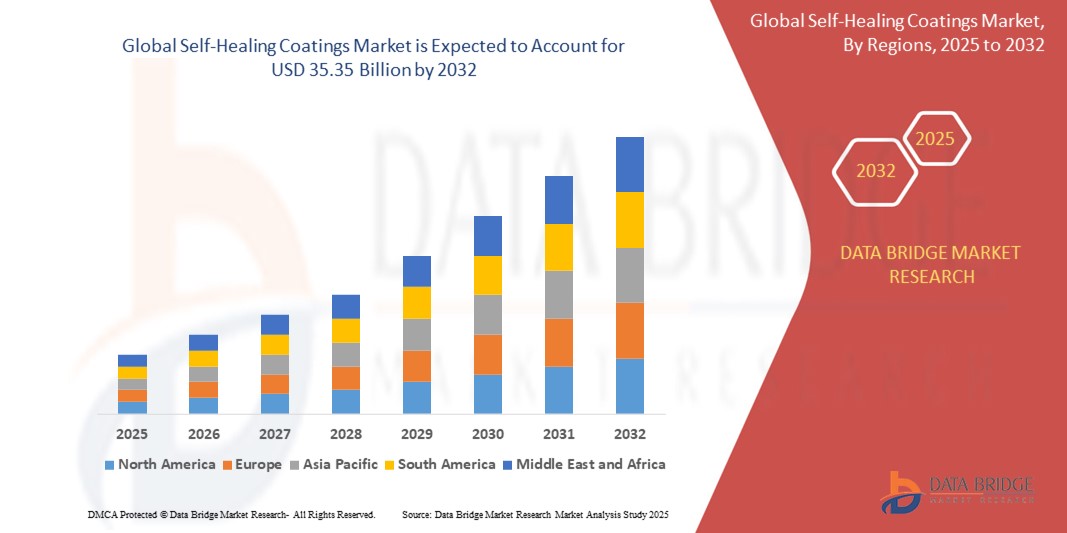
- As per Data Bridge Market Research Analysis the global Self Healing Coatings market size was valued at USD 3.2 Billion in 2024 and is expected to reach USD 35.35 Billion by 2032, at a CAGR of 34.5% during the forecast period
- The market growth is largely fueled by increasing demand for durable and low-maintenance coatings in automotive, aerospace, and construction sectors. Technological advancements in microencapsulation and nanotechnology, combined with rising sustainability concerns, are accelerating adoption of self-healing coatings to reduce maintenance costs and extend material lifespan.
- Furthermore, growing investments in infrastructure development, coupled with government initiatives promoting advanced materials, are boosting market expansion. The rising focus on extending product durability and performance in harsh environments further supports the increasing adoption of self-healing coatings across diverse industries.
Market Size & Forecast
- Global Market Value (2024): USD 3.2 Billion
- Expected Market Value (2032): USD 35.35 Billion
- Forecast CAGR (2024–2032): 34.5%
What are the Major Takeaways of Self-Healing Coatings?
- The market is driven by rising demand in automotive, construction, and aerospace industries for durable, low-maintenance materials. Technological advancements in self-repairing polymers and microencapsulation techniques are enabling broader commercial adoption, improving cost-efficiency, and extending material life cycles significantly.
- The shift toward eco-friendly and sustainable solutions is encouraging the development of bio-based and non-toxic self-healing coatings. Continuous innovation in nanotechnology and smart materials is enhancing performance, attracting regulatory support, and opening new opportunities in emerging sectors like electronics and renewable energy.
- North America dominates the Self-Healing Coatings market with a 35% revenue share in 2025, due to its advanced industrial infrastructure, strong focus on R&D and innovation, high adoption of cutting-edge materials in automotive and aerospace sectors, and supportive government regulations promoting sustainable and durable coatings, which together drive rapid market growth and lead adoption.
- Additionally, North America benefits from well-established supply chains, presence of key market players, significant investment in smart manufacturing, and growing awareness about reducing maintenance costs through innovative coatings. These factors collectively enhance the region’s leadership in the self-healing coatings market.
- The extrinsic segment is expected to dominate the Self-Healing Coatings market with a significant share of around 60% in 2025, driven by its effective damage repair mechanisms, widespread application across automotive and aerospace industries, and advancements in microcapsule and vascular network technologies.
Report Scope and Self-Healing Coatings Market Segmentation
|
Attributes |
Self-Healing Coatings Key Market Insights |
|
Segments Covered |
|
|
Countries Covered |
North America
Europe
Asia-Pacific
Middle East and Africa
South America
|
|
Key Market Players |
|
|
Market Opportunities |
|
|
Value Added Data Infosets |
|
What is the Key Trend in the Self-Healing Coatings?
“Rising adoption of nanotechnology driving advanced self-healing coating innovations”
- Nanotechnology enables the integration of micro- and nanoparticles that significantly improve self-healing speed and effectiveness by allowing coatings to repair microscopic damages instantly, extending product lifespan and reducing maintenance costs across industries like automotive and aerospace.
- Incorporating nanomaterials enhances mechanical strength, corrosion resistance, and thermal stability of coatings, resulting in multifunctional surfaces that withstand harsh environmental conditions while maintaining self-healing capabilities for longer durations.
- Nanotech facilitates precise encapsulation and controlled release of healing agents within coatings. This targeted delivery ensures that the repair process activates only when damage occurs, improving efficiency and minimizing material waste.
- Advancements in nanotechnology expand the usability of self-healing coatings to electronics, medical devices, and renewable energy sectors, where tiny surface defects can drastically affect performance and longevity.
- Nanotechnology allows development of environmentally friendly coatings by reducing reliance on toxic chemicals, promoting sustainable production methods, and enabling longer-lasting products that reduce waste and environmental impact.
Self-Healing Coatings Market Dynamics
Driver
“Increasing demand for durable, low-maintenance coatings across multiple industries”
- The automotive sector requires robust coatings to protect vehicles from corrosion, scratches, and environmental damage, reducing repair costs and improving vehicle longevity. Self-healing coatings provide efficient solutions, enhancing aesthetic appeal and durability, driving demand in this fast-growing market.
- Rapid urbanization and infrastructure expansion necessitate durable coatings that withstand harsh weather and mechanical wear. Self-healing coatings minimize maintenance, repair frequency, and downtime, offering cost-effective solutions for bridges, buildings, and roads, thus fueling market growth.
- Aerospace applications demand materials that resist extreme temperatures and mechanical stress. Self-healing coatings improve aircraft safety and performance by autonomously repairing micro-damages, lowering maintenance costs and increasing operational efficiency, thereby boosting market demand.
- The electronics industry benefits from protective coatings that guard delicate components against scratches and corrosion. Self-healing coatings enhance product durability and lifespan, responding to consumer demand for long-lasting, high-quality devices.
- Industries are increasingly focusing on sustainability and reducing lifecycle costs. Durable, low-maintenance coatings reduce material waste, energy consumption, and environmental impact, aligning with regulatory requirements and corporate responsibility goals, driving widespread adoption.
Restraint/Challenge
“High production costs and complex manufacturing limit market growth”
- The use of advanced polymers, microcapsules, and nanomaterials increases production costs, making self-healing coatings less affordable compared to conventional options, which limits adoption, especially among price-sensitive industries and emerging markets.
- Developing coatings with reliable self-healing properties involves intricate processes like microencapsulation and precise formulation control, requiring specialized equipment and expertise, which raise production complexity and hinder large-scale manufacturing.
- Translating lab-scale innovations into mass production faces challenges in maintaining consistent quality and performance, increasing costs and slowing commercialization efforts, thus restricting market growth.
- A small number of suppliers for key advanced materials restricts competitive pricing and availability, causing supply chain vulnerabilities that can delay production and increase costs.
- Integrating self-healing coatings into existing manufacturing lines requires additional investment and adjustments, which some manufacturers avoid due to costs and potential disruptions, further limiting widespread market adoption.
How is the Self-Healing Coatings Segmented?
The market is segmented on the basis of form and end-use industry.
- By Form
On the basis of form, the Self-Healing Coatings market is segmented into extrinsic, intrinsic. The extrinsic segment dominates the largest market revenue share of approximately 38% in 2025, driven by its effective microcapsule-based healing mechanisms, widespread use in automotive and aerospace industries, and advancements in vascular network technologies that enable faster and more reliable self-repair of coatings.
The extrinsic segment is anticipated to witness the fastest growth rate of around 35% CAGR from 2025 to 2032, fueled by increasing demand for advanced damage repair systems, ongoing innovations in microencapsulation technologies, and expanding applications in aerospace, automotive, and electronics industries.
- By End-Use Industry
On the basis of end-use industry, the Self-Healing Coatings market is segmented in to automotive, building and construction, aerospace, marine. The automotive segment drives the Self-Healing Coatings market due to rising demand for scratch-resistant, durable coatings that enhance vehicle aesthetics and longevity, alongside increasing adoption of lightweight materials requiring advanced protective solutions to reduce maintenance and improve safety.
The automotive segment is expected to witness the fastest CAGR from 2025 to 2032, driven by growing consumer demand for high-performance, durable vehicles, stringent government regulations on emissions and safety, and increased use of self-healing coatings to reduce repair costs and extend vehicle lifespan.
Self-Healing Coatings Market Regional Analysis
- North America dominates the Self-Healing Coatings market with a 35% revenue share in 2025, due to its advanced industrial infrastructure, strong focus on R&D and innovation, high adoption of cutting-edge materials in automotive and aerospace sectors, and supportive government regulations promoting sustainable and durable coatings, which together drive rapid market growth and lead adoption
- North America benefits from a well-established manufacturing ecosystem with numerous key players, advanced supply chains, and strong collaboration between academia and industry. This environment fosters innovation, accelerates product development, and supports large-scale production, reinforcing the region’s leadership in self-healing coatings.
- High investment levels in research and development by both private companies and government agencies enable continuous technological advancements. This commitment to innovation enhances the performance and cost-efficiency of self-healing coatings, attracting diverse industrial applications and expanding market opportunities in North America.
U.S. Self-Healing Coatings Market Insight
The U.S. Self-Healing Coatings market captured the largest revenue share of approximately 42% within Asia-Pacific (APAC) in 2025, driven by advanced R&D infrastructure, strong automotive and aerospace industries, and increasing investments in sustainable and innovative coating technologies.
Asia-Pacific Self-Healing Coatings Market Insight
The Asia-Pacific market is projected to expand at a substantial CAGR due to rapid industrialization, increasing automotive and electronics manufacturing, rising infrastructure development, growing environmental regulations encouraging sustainable coatings, and expanding investments in advanced materials and technology adoption across emerging economies like China and India.
China. Self-Healing Coatings Market Insight
The China market is due to its massive manufacturing base, rapid urbanization, strong government support for advanced materials, growing automotive and electronics sectors, and significant investments in research and development.
Which are the Top Companies in Self-Healing Coatings?
The Self-Healing Coatings industry is primarily led by well-established companies, including:
- AkzoNobel N.V. (Netherlands)
- PPG Industries, Inc. (USA)
- BASF SE (Germany)
- The Sherwin-Williams Company (USA)
- Axalta Coating Systems Ltd. (USA)
- Hempel A/S (Denmark)
- Jotun Group (Norway)
- RPM International Inc. (USA)
- Nippon Paint Holdings Co., Ltd. (Japan)
- Sherwin-Williams (USA)
- Clariant AG (Switzerland)
- Michelman, Inc. (USA)
- Covalent Materials Corporation (USA)
- Mankiewicz Gebr. & Co. GmbH (Germany)
- Huntsman Corporation (USA)
What are Latest Developments in Self-Healing Coatings?
- In December 2024, India’s Cosmo introduced an advanced self-healing paint protection film (PPF) for vehicles. The product offers UV, chemical, and scratch resistance with a lifetime warranty. Its Gold variant enhances durability for up to five years.
- In May 2024, RideWrap launched the Lotus Pro 10, a bicycle-specific protection film made from 77% recycled material. Embedded with superhydrophobic ceramic, it possesses self-healing properties, enhancing durability and reducing maintenance needs.
- In October 2024, Hyundai Motor Group unveiled a self-healing polymer coating for automotive applications. This coating autonomously repairs scratches and damages, enhancing durability and reducing maintenance costs, while promoting environmental sustainability.
- In June 2024, Shiv Nadar University researchers developed sustainable self-healing polymers from industrial waste. These polymers aim for carbon neutrality and have applications in flexible coatings, adhesives, and battery materials, contributing to environmental sustainability.
- In January 2024, AkzoNobel joined a major Dutch research program involving over 82 organizations to develop sustainable technologies for coatings. The focus is on improving durability, functionality, and recyclability, aiming for a 50% reduction in carbon emissions by 2030.

- Interactive Data Analysis Dashboard
- Company Analysis Dashboard for high growth potential opportunities
- Research Analyst Access for customization & queries
- Competitor Analysis with Interactive dashboard
- Latest News, Updates & Trend analysis
- Harness the Power of Benchmark Analysis for Comprehensive Competitor Tracking
Global Self Healing Coatings Market, Supply Chain Analysis and Ecosystem Framework
To support market growth and help clients navigate the impact of geopolitical shifts, DBMR has integrated in-depth supply chain analysis into its Global Self Healing Coatings Market research reports. This addition empowers clients to respond effectively to global changes affecting their industries. The supply chain analysis section includes detailed insights such as Global Self Healing Coatings Market consumption and production by country, price trend analysis, the impact of tariffs and geopolitical developments, and import and export trends by country and HSN code. It also highlights major suppliers with data on production capacity and company profiles, as well as key importers and exporters. In addition to research, DBMR offers specialized supply chain consulting services backed by over a decade of experience, providing solutions like supplier discovery, supplier risk assessment, price trend analysis, impact evaluation of inflation and trade route changes, and comprehensive market trend analysis.
Data collection and base year analysis are done using data collection modules with large sample sizes. The stage includes obtaining market information or related data through various sources and strategies. It includes examining and planning all the data acquired from the past in advance. It likewise envelops the examination of information inconsistencies seen across different information sources. The market data is analysed and estimated using market statistical and coherent models. Also, market share analysis and key trend analysis are the major success factors in the market report. To know more, please request an analyst call or drop down your inquiry.
The key research methodology used by DBMR research team is data triangulation which involves data mining, analysis of the impact of data variables on the market and primary (industry expert) validation. Data models include Vendor Positioning Grid, Market Time Line Analysis, Market Overview and Guide, Company Positioning Grid, Patent Analysis, Pricing Analysis, Company Market Share Analysis, Standards of Measurement, Global versus Regional and Vendor Share Analysis. To know more about the research methodology, drop in an inquiry to speak to our industry experts.
Data Bridge Market Research is a leader in advanced formative research. We take pride in servicing our existing and new customers with data and analysis that match and suits their goal. The report can be customized to include price trend analysis of target brands understanding the market for additional countries (ask for the list of countries), clinical trial results data, literature review, refurbished market and product base analysis. Market analysis of target competitors can be analyzed from technology-based analysis to market portfolio strategies. We can add as many competitors that you require data about in the format and data style you are looking for. Our team of analysts can also provide you data in crude raw excel files pivot tables (Fact book) or can assist you in creating presentations from the data sets available in the report.













