


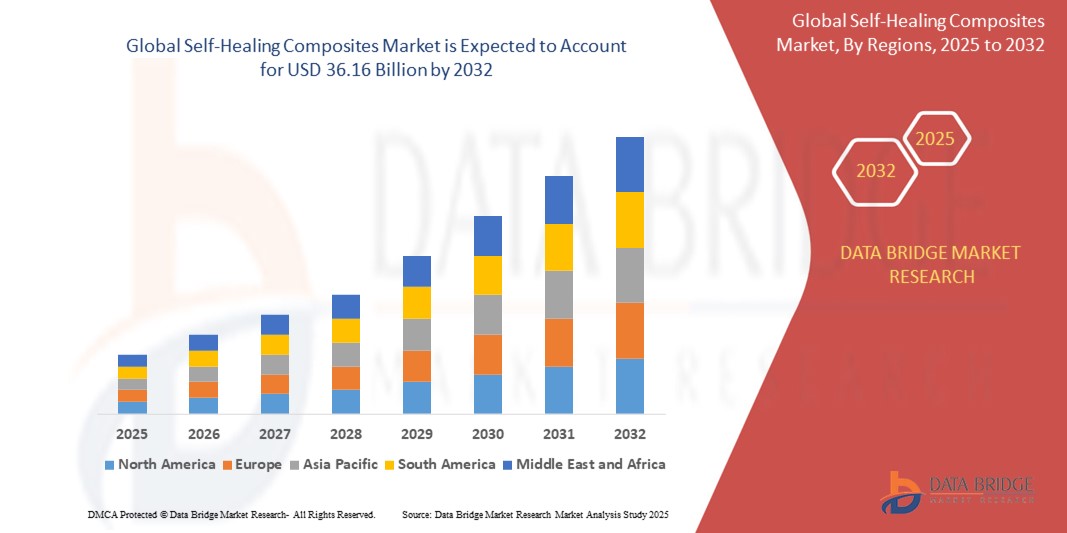
Self-Healing Composites Market Size
- The global Self-Healing Composites market size was valued at USD 1.82 billion in 2024 and is expected to reach USD 36.16 billion by 2032, at a CAGR of 45.30% during the forecast period
- This growth is driven by factors such as the durable and sustainable materials, rising adoption in aerospace and automotive industries, and advancements in self-healing technologies.
Self-Healing Composites Market Analysis
- Self-Healing Composites are innovative materials designed to autonomously repair damage such as cracks or microfractures, enhancing the longevity and safety of structures in automotive, aerospace, construction, and electronics industries.
- The demand for these composites is significantly driven by the need to reduce maintenance costs, improve safety standards, and increase the lifespan of critical components.
- North America is expected to dominate the Self-Healing Composites market due to well-established aerospace and automotive sectors, along with substantial investments in R&D and advanced manufacturing infrastructure.
- Asia-Pacific is anticipated to be the fastest-growing region during the forecast period, driven by rapid industrialization, increasing automotive production, and growing awareness about sustainable materials.
- The automotive segment is expected to hold the largest market share due to rising demand for lightweight, damage-tolerant materials that improve fuel efficiency and vehicle safety.
Report Scope and Self-Healing Composites Market Segmentation
|
Attributes |
Self-Healing Composites Key Market Insights |
|
Segments Covered |
|
|
Countries Covered |
North America
Europe
Asia-Pacific
Middle East and Africa
South America
|
|
Key Market Players |
|
|
Market Opportunities |
|
|
Value Added Data Infosets |
In addition to the insights on market scenarios such as market value, growth rate, segmentation, geographical coverage, and major players, the market reports curated by the Data Bridge Market Research also include import export analysis, production capacity overview, production consumption analysis, price trend analysis, climate change scenario, supply chain analysis, value chain analysis, raw material/consumables overview, vendor selection criteria, PESTLE Analysis, Porter Analysis, and regulatory framework. |
Self-Healing Composites Market Trends
“Advancements in Self-Healing Mechanisms & Smart Materials”
- One prominent trend in the development of self-healing composites is the increasing innovation in autonomous healing mechanisms such as microcapsules, vascular networks, and intrinsic polymer-based systems.
- These advancements enable materials to detect and repair damage without external intervention, significantly improving material longevity and safety..
- For instance, microvascular self-healing composites incorporate networks that transport healing agents to damaged areas, allowing for multiple healing cycles and enhanced durability in aerospace and automotive applications.
- These cutting-edge technologies are transforming industries by reducing maintenance costs, enhancing safety, and enabling longer service life of critical components, driving demand for next-generation self-healing composite materials.
Self-Healing Composites Market Dynamics
Driver
“Increasing Demand for Durable and Sustainable Materials”
- Rising industrial focus on sustainability and cost-efficiency is driving the adoption of self-healing composites across sectors such as aerospace, automotive, and construction.
- The need to reduce downtime and repair costs in critical infrastructure and vehicles makes self-healing materials highly attractive.
- As manufacturers seek to extend product lifespans while maintaining safety standards, demand for autonomous repair capabilities grows.
For instance,
- In 2023, a report by the International Aerospace Manufacturers Association highlighted that aerospace companies increasingly invest in self-healing composites to minimize in-service maintenance and extend flight safety.
- As a result rising environmental regulations and cost-saving imperatives are fueling market growth.
Opportunity
“Integration of Nanotechnology and Smart Sensors”
- Embedding nanoscale healing agents and smart sensors within composites offers opportunities to develop materials that not only heal but also self-monitor their health in real-time.
- Such intelligent composites can provide early warnings of damage and automatically trigger healing processes, optimizing safety and maintenance schedules.
- This integration can open new applications in sectors requiring high reliability, such as defense, electronics, and renewable energy.
For instance,
- In 2024 study published in Advanced Materials, nanotechnology-enabled self-healing composites showed up to 90% recovery of mechanical strength after damage, with embedded sensors providing real-time structural health monitoring.
- The combination of healing and sensing technologies presents a promising frontier for smart, resilient materials.
Restraint/Challenge
“High Production Costs and Scalability Issues”
- The complex manufacturing processes and expensive raw materials used in self-healing composites limit large-scale adoption, especially in cost-sensitive industries.
- Scaling lab-scale healing mechanisms to commercial production while maintaining performance and affordability remains a significant hurdle.
- High initial investment and longer production cycles can deter manufacturers from switching to these materials.
For instance,
- In 2024 market survey by Materials Today noted that over 60% of potential industrial users cited cost and production complexity as major barriers to adopting self-healing composites in automotive applications.
- Consequently, economic and technical challenges could slow down market penetration despite technological promise.
Self-Healing Composites Market Scope
The market is segmented on the basis Type, Application, technology,
|
Segmentation |
Sub-Segmentation |
|
By Type |
|
|
By Application |
|
|
By Technology |
|
In 2025, the Intrinsic Self-healing Material is projected to dominate the market with a largest share in Type segment
The Intrinsic Self-healing Material segment is expected to dominate the Self-Healing Composites market with the largest share of 56.22% in 2025 due to its superior ability to autonomously repair damage without external healing agents. Advancements in polymer chemistry and material design enhance its healing efficiency and durability, driving market growth. Increasing adoption in aerospace and automotive sectors, where long-term reliability is critical, further contributes to its market dominance.
The Reversible Polymers is expected to account for the largest share during the forecast period in technology market
In 2025, the Reversible Polymers segment is expected to dominate the market with the largest market share of 51.31% due to its effective and repeatable healing mechanism. This technology allows composites to reversibly reform bonds, providing high structural integrity and cost efficiency. Growing demand for lightweight and sustainable materials in automotive and construction industries, along with technological advancements, supports its leading position.
Self-Healing Composites Market Regional Analysis
“North America Holds the Largest Share in the Self-Healing Composites Market”
- North America dominates the Self-Healing Composites market, driven by the well-established aerospace and automotive industries, advanced manufacturing infrastructure, and strong presence of key market players.
- The U.S. holds a significant share due to increasing investments in research & development, adoption of innovative materials for lightweight and durable components, and stringent safety and environmental regulations.
- Availability of robust government support and incentives for sustainable manufacturing further strengthens market growth.
- Additionally, rising demand for high-performance materials in defense, electronics, and renewable energy sectors fuels market expansion across the region
“Asia-Pacific is Projected to Register the Highest CAGR in the Self-Healing Composites Market”
- The Asia-Pacific region is expected to witness the highest growth rate in the Self-Healing Composites market, driven by rapid industrialization, increasing automotive and aerospace production, and rising awareness about sustainable materials.
- Countries such as China, India, Japan, and South Korea are emerging as key markets due to expanding manufacturing bases and government initiatives promoting advanced material technologies.
- Japan, with its strong focus on innovation and high technology manufacturing, remains a crucial market for next-generation self-healing composites, supporting adoption in automotive and electronics sectors.
- China and India, with their large industrial sectors and growing emphasis on eco-friendly materials, are witnessing increasing investments from global material manufacturers and improving infrastructure, which further propels market growth.
Self-Healing Composites Market Share
The market competitive landscape provides details by competitor. Details included are company overview, company financials, revenue generated, market potential, investment in research and development, new market initiatives, global presence, production sites and facilities, production capacities, company strengths and weaknesses, product launch, product width and breadth, Type dominance. The above data points provided are only related to the companies' focus related to market.
The Major Market Leaders Operating in the Market Are:
- Solvay (Belgium)
- TORAY INDUSTRIES, INC. (Japan)
- Mitsubishi Chemical Corporation (Japan)
- Hexcel Corporation (U.S.)
- HYOSUNG ADVANCED MATERIALS (South Korea)
- TEIJIN LIMITED (Japan)
- Owens Corning (U.S.)
- PPG Industries, Inc. (U.S.)
- Huntsman International LLC (U.S.)
- SGL Carbon (Germany)
- Momentive (U.S.)
- DuPont (U.S.)
- Saint-Gobain Performance Plastics (France)
- Weyerhaeuser NRCompany (U.S.)
- Acciona, S.A. (Spain)
- Akzo Nobel N.V. (Netherlands)
- Applied Thin Films Inc. (U.S.)
- Arkema (France)
- Autonomic Materials, Inc. (U.S.)
- BASF SE (Germany)
- Covestro AG (Germany)
Latest Developments in Global Self-Healing Composites Market
- In March 2025, Solvay announced the commercial launch of its next-generation self-healing epoxy resin system designed for aerospace applications. This new resin features enhanced intrinsic healing capabilities with faster repair cycles and improved mechanical strength, enabling longer service life for aircraft components and reducing maintenance costs.
- In January 2025, Toray Industries, Inc. unveiled a novel carbon fiber-reinforced self-healing composite that integrates microvascular networks for autonomous damage repair. This innovation aims to boost durability and safety in automotive and sporting goods sectors and is slated for commercial rollout in late 2025.
- In December 2024, Mitsubishi Chemical Corporation expanded its self-healing composite product portfolio with a reversible polymer technology that enables multiple damage-healing cycles at room temperature, enhancing recyclability and sustainability in construction materials.
- In November 2024, Hexcel Corporation partnered with a leading aerospace manufacturer to develop lightweight self-healing composites tailored for UAVs (Unmanned Aerial Vehicles), combining high strength with autonomous damage repair to extend UAV operational endurance.
- In October 2024, Teijin Limited announced advancements in its intrinsic self-healing fiber-reinforced composites, improving healing efficiency by 20%, targeted at electric vehicle battery enclosures and protective casings for electronics.

- Interactive Data Analysis Dashboard
- Company Analysis Dashboard for high growth potential opportunities
- Research Analyst Access for customization & queries
- Competitor Analysis with Interactive dashboard
- Latest News, Updates & Trend analysis
- Harness the Power of Benchmark Analysis for Comprehensive Competitor Tracking
Global Self Healing Composites Market, Supply Chain Analysis and Ecosystem Framework
To support market growth and help clients navigate the impact of geopolitical shifts, DBMR has integrated in-depth supply chain analysis into its Global Self Healing Composites Market research reports. This addition empowers clients to respond effectively to global changes affecting their industries. The supply chain analysis section includes detailed insights such as Global Self Healing Composites Market consumption and production by country, price trend analysis, the impact of tariffs and geopolitical developments, and import and export trends by country and HSN code. It also highlights major suppliers with data on production capacity and company profiles, as well as key importers and exporters. In addition to research, DBMR offers specialized supply chain consulting services backed by over a decade of experience, providing solutions like supplier discovery, supplier risk assessment, price trend analysis, impact evaluation of inflation and trade route changes, and comprehensive market trend analysis.
Data collection and base year analysis are done using data collection modules with large sample sizes. The stage includes obtaining market information or related data through various sources and strategies. It includes examining and planning all the data acquired from the past in advance. It likewise envelops the examination of information inconsistencies seen across different information sources. The market data is analysed and estimated using market statistical and coherent models. Also, market share analysis and key trend analysis are the major success factors in the market report. To know more, please request an analyst call or drop down your inquiry.
The key research methodology used by DBMR research team is data triangulation which involves data mining, analysis of the impact of data variables on the market and primary (industry expert) validation. Data models include Vendor Positioning Grid, Market Time Line Analysis, Market Overview and Guide, Company Positioning Grid, Patent Analysis, Pricing Analysis, Company Market Share Analysis, Standards of Measurement, Global versus Regional and Vendor Share Analysis. To know more about the research methodology, drop in an inquiry to speak to our industry experts.
Data Bridge Market Research is a leader in advanced formative research. We take pride in servicing our existing and new customers with data and analysis that match and suits their goal. The report can be customized to include price trend analysis of target brands understanding the market for additional countries (ask for the list of countries), clinical trial results data, literature review, refurbished market and product base analysis. Market analysis of target competitors can be analyzed from technology-based analysis to market portfolio strategies. We can add as many competitors that you require data about in the format and data style you are looking for. Our team of analysts can also provide you data in crude raw excel files pivot tables (Fact book) or can assist you in creating presentations from the data sets available in the report.













