


Self-Healing Hydrogels Market Size
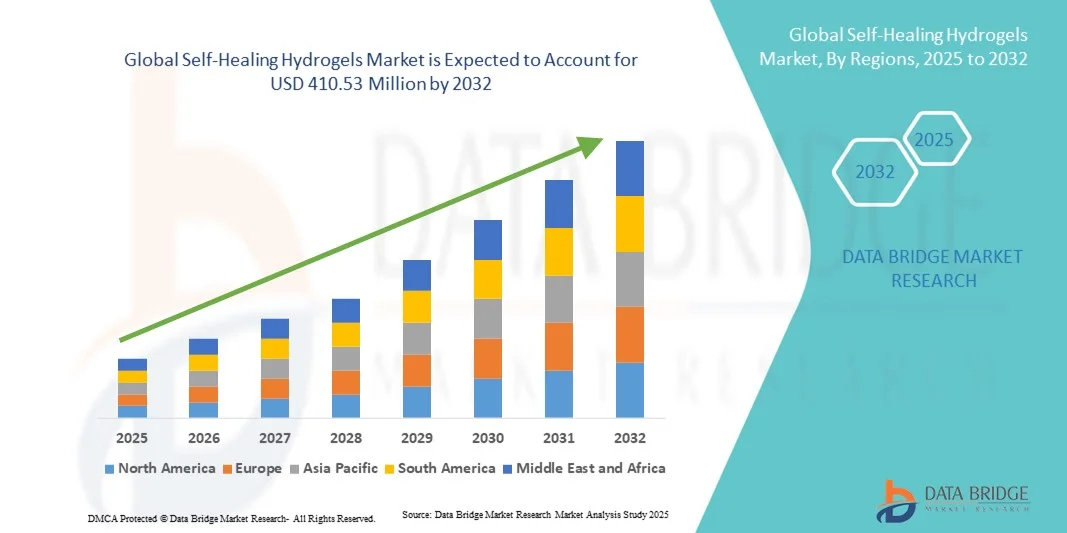
- The global self-healing hydrogels market size was valued at USD 246.20 Million in 2024 and is expected to reach USD 410.53 Million by 2032, at a CAGR of 6.60% during the forecast period
- The market growth is largely fueled by increasing research and development in biomedical applications, drug delivery systems, and tissue engineering, driving the adoption of innovative hydrogel materials
- Furthermore, rising demand for advanced wound care products, regenerative medicine solutions, and customizable materials with improved biocompatibility and mechanical properties is accelerating the uptake of Self-Healing Hydrogels solutions, thereby significantly boosting the industry's growth
Self-Healing Hydrogels Market Analysis
- Self-Healing Hydrogels, known for their ability to autonomously repair damages and restore structural integrity, are increasingly vital in biomedical, pharmaceutical, and industrial applications due to their enhanced durability, biocompatibility, and multifunctionality
- The escalating demand for self-healing hydrogels is primarily fueled by their growing use in wound healing, drug delivery systems, tissue engineering, and soft robotics, alongside increasing R&D investment in advanced biomaterials
- North America dominated the self-healing hydrogels market with the largest revenue share of 40.5% in 2024, characterized by advanced biomedical research infrastructure, high adoption of innovative healthcare solutions, and a strong presence of key industry players. The U.S. witnessed substantial growth in self-healing hydrogel adoption in clinical, pharmaceutical, and industrial applications, driven by innovations from both established biotech companies and startups focusing on stimuli-responsive and biocompatible hydrogel formulations
- Asia-Pacific is expected to be the fastest growing region in the self-healing hydrogels market during the forecast period, with a CAGR of 11.8% from 2025 to 2032, due to increasing investments in healthcare research, rising awareness of advanced biomaterials, and expanding applications in tissue engineering, wound care, and drug delivery in countries such as China, Japan, and India
- The Chemical Crosslinking segment dominated the largest market revenue share of 44.3% in 2024, driven by its superior mechanical strength, long-term stability, and ability to form robust, covalently bonded networks
Report Scope and Self-Healing Hydrogels Market Segmentation
|
Attributes |
Self-Healing Hydrogels Key Market Insights |
|
Segments Covered |
|
|
Countries Covered |
North America
Europe
Asia-Pacific
Middle East and Africa
South America
|
|
Key Market Players |
|
|
Market Opportunities |
|
|
Value Added Data Infosets |
In addition to the insights on market scenarios such as market value, growth rate, segmentation, geographical coverage, and major players, the market reports curated by the Data Bridge Market Research also include in-depth expert analysis, patient epidemiology, pipeline analysis, pricing analysis, and regulatory framework. |
Self-Healing Hydrogels Market Trends
Enhanced Convenience Through Advanced Biomedical Applications
- A significant and accelerating trend in the global self-healing hydrogels market is the development of multifunctional hydrogels that integrate regenerative medicine, drug delivery, and tissue engineering applications. These advanced hydrogels are significantly enhancing therapeutic efficacy, wound healing, and patient outcomes
- For instance, in June 2023, a new injectable self-healing hydrogel was developed that can deliver growth factors and stem cells simultaneously, promoting faster tissue regeneration and improved biocompatibility. Similarly, researchers in the U.S. demonstrated self-healing hydrogels for cartilage repair that can adapt to mechanical stress and restore structural integrity
- Integration of bioactive components into self-healing hydrogels enables features such as controlled drug release, antibacterial properties, and enhanced cellular adhesion, improving therapeutic outcomes. Furthermore, multifunctional hydrogels can be tailored for minimally invasive applications, allowing for easy implantation and faster recovery
- The use of self-healing hydrogels in combination with 3D bioprinting and microfluidic systems facilitates precise tissue engineering and regenerative medicine applications. Through these innovations, clinicians can design patient-specific scaffolds and wound dressings, creating more personalized and efficient treatment solutions
- This trend towards smarter, multifunctional, and regenerative hydrogel systems is fundamentally reshaping expectations in biomedical applications. Consequently, companies such as SentrX Bio and Advanced BioMatrix are developing hydrogels with properties such as enhanced mechanical strength, rapid self-healing, and targeted drug delivery capabilities
- The demand for self-healing hydrogels with advanced therapeutic and biomedical functionalities is growing rapidly across healthcare and research sectors, as stakeholders increasingly prioritize efficacy, biocompatibility, and patient-specific solutions
Self-Healing Hydrogels Market Dynamics
Driver
Rising Demand for Advanced Wound Care and Regenerative Medicine Applications
- The increasing prevalence of chronic wounds, tissue injuries, and degenerative diseases is a significant driver for the growing adoption of self-healing hydrogels in healthcare and research
- For instance, in March 2024, Advanced BioMatrix launched a next-generation self-healing hydrogel optimized for wound healing and tissue regeneration, enhancing patient recovery times. Such initiatives by key companies are expected to drive the Self-Healing Hydrogels industry growth in the forecast period
- The ability of self-healing hydrogels to provide controlled drug delivery, structural support, and biocompatible scaffolding makes them a compelling alternative to conventional biomaterials
- Furthermore, the growing emphasis on personalized medicine, minimally invasive procedures, and tissue engineering is accelerating the adoption of hydrogels in both clinical and research settings
- Enhanced patient outcomes, reduced healing times, and the capacity to combine hydrogels with stem cells, growth factors, or bioactive molecules are key factors propelling adoption. The trend towards advanced biomedical research and availability of multifunctional hydrogel formulations further contribute to market growth
Restraint/Challenge
Challenges Related to Scalability, Biocompatibility, and Cost
- Challenges surrounding large-scale manufacturing, long-term biocompatibility, and regulatory approvals pose significant barriers to broader adoption of self-healing hydrogels. As hydrogels are highly sensitive to chemical composition and synthesis conditions, ensuring consistent quality and performance at scale is difficult
- For instance, stringent regulatory requirements and clinical validation processes have slowed market entry for certain advanced hydrogel formulations
- Addressing these challenges through robust material characterization, improved production techniques, and compliance with global regulatory standards is crucial for building trust among healthcare providers
- Companies such as SentrX Bio and Gelomics emphasize comprehensive preclinical and clinical testing to ensure safety and efficacy. In addition, the relatively high cost of advanced self-healing hydrogels compared to traditional wound care or tissue engineering materials can be a barrier for price-sensitive healthcare providers, particularly in developing regions
- While costs are gradually decreasing due to innovations in scalable synthesis and biofabrication, the perceived premium for multifunctional hydrogels can still hinder widespread adoption, especially for institutions with limited budgets
- Overcoming these challenges through improved biocompatible formulations, cost-effective production methods, and extensive clinical validation will be vital for sustained market growth
Self-Healing Hydrogels Market Scope
The market is segmented on the basis of type and application.
- By Type
On the basis of type, the Self-Healing Hydrogels market is segmented into Chemical Crosslinking and Physical Crosslinking. The Chemical Crosslinking segment dominated the largest market revenue share of 44.3% in 2024, driven by its superior mechanical strength, long-term stability, and ability to form robust, covalently bonded networks. These hydrogels are widely used in biomedical applications, including tissue scaffolds and wound healing, due to their biocompatibility and tunable degradation rates. Researchers and manufacturers prefer chemical crosslinking for drug delivery systems because it allows precise control over release kinetics and ensures reproducibility. The segment also benefits from ongoing innovations in crosslinking chemistries, enabling multifunctional hydrogels with antimicrobial, adhesive, and stimuli-responsive properties. Chemical crosslinking hydrogels are compatible with 3D printing technologies, enhancing their utility in personalized medicine. Industrial adoption is rising for coatings and sealants where durability is critical. Pharmaceutical companies leverage these hydrogels in controlled drug release applications. The growing prevalence of regenerative medicine and advanced wound care further sustains demand. Strategic collaborations between academia and biotech startups accelerate commercialization. Continuous improvement in polymer chemistry ensures product differentiation and market leadership.
The Physical Crosslinking segment is anticipated to witness the fastest CAGR of 15.8% from 2025 to 2032, fueled by its reversible bonding, easy processing, and environmentally friendly preparation methods. Physical hydrogels are gaining traction in tissue engineering and drug delivery due to their shear-thinning properties and injectability, allowing minimally invasive administration. Their reversible nature supports self-healing and stimuli-responsive behavior, which is increasingly valuable in dynamic biological environments. Academic research is intensifying on physically crosslinked hydrogels for 3D cell culture and regenerative scaffolds. These hydrogels also offer high water retention, making them suitable for wound dressings and biomedical implants. Growing interest in biocompatible and solvent-free fabrication further drives adoption. They are widely applied in polymer scaffolds for soft tissue regeneration, leveraging tunable mechanical properties. Startups and SMEs are investing in R&D for cost-effective production. Integration with nanomaterials enhances their functional properties. Government initiatives supporting advanced biomaterials accelerate development. Overall, their versatility and sustainability make physical crosslinking hydrogels the fastest-growing type segment in the market.
- By Application
On the basis of application, the Self-Healing Hydrogels market is segmented into Tissue Engineering and Regeneration, Polymer Scaffolds, Drug Delivery Systems, Sealants, and Others. The Tissue Engineering and Regeneration segment dominated the largest market revenue share of 41.7% in 2024, driven by rising demand for regenerative medicine, organ repair, and advanced wound healing. Hydrogels in this segment provide a 3D environment for cell proliferation and differentiation, essential for tissue reconstruction. Adoption is fueled by increasing clinical trials, government support for regenerative therapies, and investments from biotech companies. Self-healing hydrogels reduce implant failures and improve patient outcomes. Compatibility with stem cell therapies and 3D bioprinting expands their utility. The segment also benefits from collaborations between research institutes and pharmaceutical companies. Material scientists continuously optimize mechanical properties, biodegradability, and bioactivity. The segment addresses critical needs in orthopedic, cardiovascular, and skin tissue engineering. Continuous product innovation ensures improved patient care. High adoption in academic and clinical research sustains market leadership. Strategic partnerships with healthcare providers drive widespread utilization. Regulatory approvals in multiple countries support commercialization.
The Drug Delivery System segment is expected to witness the fastest CAGR of 16.3% from 2025 to 2032, fueled by demand for controlled, targeted, and sustained therapeutic delivery. Self-healing hydrogels are ideal carriers due to their biocompatibility, stimuli-responsiveness, and high payload capacity. They allow localized drug release, reducing systemic toxicity and enhancing efficacy. Pharmaceutical and biotech companies are increasingly using hydrogels for anticancer, antimicrobial, and vaccine delivery. Integration with nanoparticles, growth factors, or therapeutic cells further improves functionality. Ongoing R&D focuses on improving degradation kinetics, mechanical stability, and patient compliance. Growth in chronic disease management and personalized medicine supports market expansion. Investment in advanced drug delivery platforms by governments and private firms boosts adoption. Injectable and minimally invasive hydrogel systems are gaining popularity. Clinical studies demonstrate their effectiveness in wound healing, tissue repair, and oncology. Emerging applications in combination therapies expand the segment’s potential. The scalability and versatility of hydrogel-based delivery systems underpin rapid market growth.
Self-Healing Hydrogels Market Regional Analysis
- North America dominated the self-healing hydrogels market with the largest revenue share of 40.5% in 2024, characterized by advanced biomedical research infrastructure, high adoption of innovative healthcare solutions, and a strong presence of key industry players. The U.S. witnessed substantial growth in self-healing hydrogel adoption in clinical, pharmaceutical, and industrial applications, driven by innovations from both established biotech companies and startups focusing on stimuli-responsive and biocompatible hydrogel formulations
- Consumers in the region highly value the versatility, biocompatibility, and therapeutic efficacy offered by self-healing hydrogels in applications such as tissue engineering, wound care, and drug delivery
- This widespread adoption is further supported by high healthcare expenditure, robust research capabilities, and the growing focus on advanced biomedical solutions, establishing self-healing hydrogels as a preferred material across multiple healthcare and industrial applications
U.S. Self-Healing Hydrogels Market Insight
The U.S. self-healing hydrogels market captured the largest revenue share in 2024 within North America, fueled by the swift adoption of innovative hydrogel formulations and the expanding trend of advanced biomedical research. Researchers and clinicians are increasingly prioritizing the integration of stimuli-responsive, biocompatible hydrogels in tissue engineering, wound healing, and drug delivery platforms. The growing preference for multifunctional hydrogel systems, combined with robust demand for scalable, clinically validated formulations, further propels the Self-Healing Hydrogels industry. Moreover, the increasing presence of key biotech companies and startups, alongside collaborations with academic institutions, is significantly contributing to the market's expansion.
Europe Self-Healing Hydrogels Market Insight
The Europe self-healing hydrogels market is projected to expand at a substantial CAGR throughout the forecast period, primarily driven by stringent regulatory standards and the escalating need for advanced biomaterials in healthcare and pharmaceutical applications. The increase in biomedical research funding, coupled with the demand for innovative wound care, drug delivery, and tissue engineering solutions, is fostering the adoption of self-healing hydrogels. European healthcare providers and research institutions are also drawn to the versatility, safety, and performance efficiency these hydrogels offer. The region is experiencing significant growth across clinical, industrial, and research applications, with self-healing hydrogels being incorporated into both new biomedical products and ongoing pharmaceutical research projects.
U.K. Self-Healing Hydrogels Market Insight
The U.K. self-healing hydrogels market is anticipated to grow at a noteworthy CAGR during the forecast period, driven by the escalating focus on advanced biomedical research and innovation in therapeutic materials. In addition, the rising prevalence of chronic wounds, tissue injuries, and regenerative medicine applications is encouraging both healthcare providers and researchers to utilize self-healing hydrogels. The UK’s robust pharmaceutical and biotech ecosystem, alongside its strong academic research infrastructure, is expected to continue to stimulate market growth.
Germany Self-Healing Hydrogels Market Insight
The Germany self-healing hydrogels market is expected to expand at a considerable CAGR during the forecast period, fueled by increasing awareness of biomaterials innovation and the demand for technologically advanced, biocompatible solutions. Germany’s well-developed research infrastructure, combined with its emphasis on sustainability and healthcare innovation, promotes the adoption of self-healing hydrogels, particularly in clinical and pharmaceutical applications. The integration of hydrogels in wound healing, drug delivery, and tissue engineering is also becoming increasingly prevalent, with a strong preference for high-performance, safety-compliant materials aligning with local research and healthcare expectations.
Asia-Pacific Self-Healing Hydrogels Market Insight
The Asia-Pacific self-healing hydrogels market is poised to grow at the fastest CAGR of 11.8% during the forecast period of 2025 to 2032, driven by increasing investments in healthcare research, rising awareness of advanced biomaterials, and expanding applications in tissue engineering, wound care, and drug delivery in countries such as China, Japan, and India. The region's growing inclination towards innovative biomedical solutions, supported by government initiatives promoting healthcare research and material science development, is driving the adoption of self-healing hydrogels. Furthermore, as APAC emerges as a hub for biomedical research and hydrogel manufacturing, the affordability and accessibility of advanced formulations are expanding to a wider consumer and research base.
Japan Self-Healing Hydrogels Market Insight
The Japan self-healing hydrogels market is gaining momentum due to the country’s high-tech research culture, rapid expansion of biomedical research infrastructure, and demand for advanced therapeutic materials. The Japanese market places a significant emphasis on biocompatibility, multifunctionality, and innovative healthcare applications, and the adoption of self-healing hydrogels is driven by the increasing focus on tissue engineering, regenerative medicine, and advanced wound care. Moreover, Japan's aging population is likely to spur demand for efficient, biocompatible hydrogel solutions in both clinical and industrial sectors.
China Self-Healing Hydrogels Market Insight
The China self-healing hydrogels market accounted for the largest market revenue share in Asia Pacific in 2024, attributed to the country's rising healthcare research investments, expanding biomedical infrastructure, and increasing awareness of advanced biomaterials. China stands as one of the largest markets for self-healing hydrogel applications, and hydrogels are becoming increasingly popular in tissue engineering, drug delivery, wound care, and industrial applications. The push towards innovative biomedical research and the availability of scalable, affordable hydrogel formulations, alongside strong domestic manufacturers, are key factors propelling the market in China.
Self-Healing Hydrogels Market Share
The Self-Healing Hydrogels industry is primarily led by well-established companies, including:
• BASF SE (Germany)
• Evonik Industries AG (Germany)
• Wacker Chemie AG (Germany)
• 3M Company (U.S.)
• DSM Biomedical (Netherlands)
• Lubrizol Corporation (U.S.)
• GELITA AG (Germany)
• Guerbet Group (France)
• Dow Inc. (U.S.)
• Ashland Global Holdings, Inc. (U.S.)
• Hexion Inc. (U.S.)
• Merck KGaA (Germany)
• Cellendes GmbH (Germany)
• AdvanSource Biomaterials Corporation (U.S.)
• Nitta Gelatin Inc. (Japan)
Latest Developments in Global Self-Healing Hydrogels Market
- In March 2025, a team of researchers from Aalto University and the University of Bayreuth developed a novel hydrogel that uniquely combines strength, flexibility, and self-healing properties. This advancement opens new avenues for applications in drug delivery, wound healing, soft robotics sensors, and artificial skin
- In August 2025, scientists introduced an antioxidant self-healing hydrogel incorporating myricetin, a natural flavonoid. This hydrogel demonstrates enhanced properties for full-thickness wound repair, highlighting the potential of integrating natural products with self-healing hydrogels for biomedical applications
- In March 2025, researchers presented a new strategy to fabricate a composite hydrogel exhibiting self-healing, adhesiveness, injectability, printability, responsiveness, and conductivity. By incorporating polyethylene glycol diacrylate, dithiothreitol, borax, and gold nanoparticles, these composite hydrogels offer broad potential for applications such as drug delivery, wound healing, and bioelectronic devices

- Interactive Data Analysis Dashboard
- Company Analysis Dashboard for high growth potential opportunities
- Research Analyst Access for customization & queries
- Competitor Analysis with Interactive dashboard
- Latest News, Updates & Trend analysis
- Harness the Power of Benchmark Analysis for Comprehensive Competitor Tracking
Data collection and base year analysis are done using data collection modules with large sample sizes. The stage includes obtaining market information or related data through various sources and strategies. It includes examining and planning all the data acquired from the past in advance. It likewise envelops the examination of information inconsistencies seen across different information sources. The market data is analysed and estimated using market statistical and coherent models. Also, market share analysis and key trend analysis are the major success factors in the market report. To know more, please request an analyst call or drop down your inquiry.
The key research methodology used by DBMR research team is data triangulation which involves data mining, analysis of the impact of data variables on the market and primary (industry expert) validation. Data models include Vendor Positioning Grid, Market Time Line Analysis, Market Overview and Guide, Company Positioning Grid, Patent Analysis, Pricing Analysis, Company Market Share Analysis, Standards of Measurement, Global versus Regional and Vendor Share Analysis. To know more about the research methodology, drop in an inquiry to speak to our industry experts.
Data Bridge Market Research is a leader in advanced formative research. We take pride in servicing our existing and new customers with data and analysis that match and suits their goal. The report can be customized to include price trend analysis of target brands understanding the market for additional countries (ask for the list of countries), clinical trial results data, literature review, refurbished market and product base analysis. Market analysis of target competitors can be analyzed from technology-based analysis to market portfolio strategies. We can add as many competitors that you require data about in the format and data style you are looking for. Our team of analysts can also provide you data in crude raw excel files pivot tables (Fact book) or can assist you in creating presentations from the data sets available in the report.













