


Self-Healing Materials Market Size
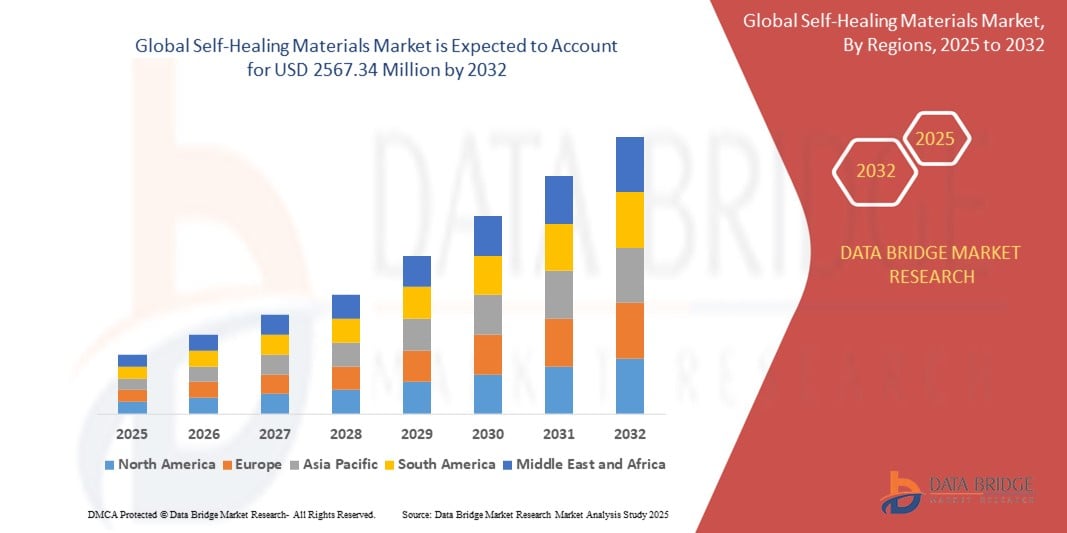
- The Global Self-Healing Materials Market was valued at USD 924.67 Million in 2024 and is expected to reach USD 2,567.34 Million by 2032
- During the forecast period of 2025 to 2032 the market is likely to grow at a CAGR of 25.6%, primarily driven by increasing urbanization and construction activities, growing product utilization across the automotive, aerospace, and electronic sectors, and the rising adoption of advanced materials in infrastructure projects
- This growth is further supported by the increasing awareness of sustainability, the demand for longer-lasting materials, and innovations in microencapsulation, vascular, and reversible polymer-based self-healing technologies
Self-Healing Materials Market Analysis
- Self-healing materials are extensively used in coatings, concrete, polymers, and composites to autonomously repair damage, extending the life cycle and reducing maintenance costs in end-use applications
- These materials possess the ability to repair micro-cracks and mechanical damages through mechanisms such as microencapsulation, reversible chemistry, and shape memory polymers, making them highly valuable in construction, electronics, automotive, and aerospace sectors
- The demand for self-healing materials is primarily driven by the rising need for durable and sustainable infrastructure, increasing focus on cost-effective maintenance solutions, and technological innovations aimed at enhancing material performance and longevity
Report Scope and Self-Healing Materials Market Segmentation
|
Attributes |
Self-Healing Materials Key Market Insights |
|
Countries Covered |
North America
Europe
Asia-Pacific
Middle East and Africa
South America
|
|
Key Market Players |
|
|
Market Opportunities |
|
|
Value Added Data Infosets |
In addition to the insights on market scenarios such as market value, growth rate, segmentation, geographical coverage, and major players, the market reports curated by the Data Bridge Market Research also include in-depth expert analysis, pricing analysis, brand share analysis, consumer survey, demography analysis, supply chain analysis, value chain analysis, raw material/consumables overview, vendor selection criteria, PESTLE Analysis, Porter Analysis, and regulatory framework. |
Self-Healing Materials Market Trends
“Rising Emphasis on Sustainable and High-Performance Self-Healing Materials”
- Manufacturers are increasingly focusing on developing bio-based, recyclable, and low-emission self-healing materials to align with global sustainability goals and comply with stringent environmental regulations
- Technological advancements are propelling the development of next-generation self-healing materials that offer superior thermal stability, lightweight properties, and greater compatibility with green formulations
- For instance, the University of Tokyo unveiled a novel biodegradable self-healing plastic named VPR (Vitrimer Incorporated with Polyrotaxane) in November 2023. This material possesses remarkable self-repair capabilities when subjected to heat, retains its original form, and exhibits partial biodegradability, outperforming typical vitrimers
- This trend reflects a broader industry shift towards sustainable material innovations, bolstered by increased regulatory frameworks, rising R&D investments, and growing awareness of eco-conscious manufacturing practices
Self-Healing Materials Market Dynamics
Driver
“Expanding Applications in Construction and Renewable Energy Sectors”
- The growing adoption of self-healing materials in the construction industry is a key driver of market growth. These materials enhance the durability and lifespan of buildings and infrastructure by autonomously repairing cracks and damages, reducing maintenance costs
- In the renewable energy sector, self-healing materials are increasingly used in wind turbine blades and solar panels to repair microcracks, thereby improving efficiency and extending service life
- For instance, Acciona S.A. developed self-healing materials to extend the lifespan and workability of infrastructures, participating in European projects like Shine and Healcon to establish road surfaces and concrete that can repair themselves
- The integration of self-healing materials in these sectors supports the global push towards sustainable and energy-efficient solutions
Opportunity
“Advancements in Electronics and Consumer Goods Applications”
- The electronics and consumer goods industries are increasingly utilizing self-healing materials to manufacture durable and lightweight components with excellent mechanical strength and thermal stability
- The trend towards smart electronics and sustainable consumer goods creates opportunities for advanced self-healing material applications in device housings, smart packaging, and durable electronics coatings
- For instance, Samsung and Apple have encouraged the usage of self-healing materials in electronic devices, including mobiles, laptops, and desktops, to enhance durability and reduce maintenance
- The increasing demand for high-performance materials in electronics, consumer goods, and smart technologies presents substantial growth opportunities for self-healing material manufacturers
Restraint/Challenge
““High Production Costs and Technological Challenges”
- The production of specialized self-healing materials, especially those used in automotive, electronics, or medical applications, involves complex manufacturing processes and requires high-quality raw materials, leading to elevated costs
- Technical complexities, such as ensuring uniformity in particle size and achieving desired material properties, can hinder scalability and increase development time
- For instance, the manufacturing of precision-engineered self-healing materials involves stringent quality control standards, significantly increasing R&D expenses and operational costs
- The combination of high production costs, complex manufacturing requirements, and limited availability of skilled personnel presents a major challenge for the widespread adoption of self-healing materials, especially in price-sensitive markets
Self-Healing Materials Market Scope
The market is segmented on the basis of product, raw material, and application.
|
Segmentation |
Sub-Segmentation |
|
By Form |
|
|
By Material Type |
|
|
By End-Use Industry |
|
Self-Healing Materials Market Regional Analysis
“Europe is the Dominant Region in the Self-Healing Materials Market”
- Europe holds a significant share in the global self-healing materials market due to its well-established industrial infrastructure, strong R&D capabilities, and high demand from sectors like automotive, aerospace, and construction
- Germany, the U.K., and France are leading contributors, driven by advanced manufacturing, presence of major material science firms, and increased adoption of sustainable materials
- The region benefits from robust regulatory support for eco-friendly innovations and initiatives promoting smart infrastructure and energy-efficient buildings
- Additionally, the integration of self-healing technologies in coatings and construction materials across Europe is accelerating market growth
“Asia-Pacific is Projected to Register the Highest Growth Rate”
- Asia-Pacific is anticipated to witness the fastest growth in the self-healing materials market, fueled by rapid urbanization, infrastructure development, and a booming automotive sector
- China, India, and Japan are key countries driving demand due to their expanding construction activities, supportive government policies, and growth in electric vehicles and electronics
- The presence of cost-effective manufacturing facilities and increasing foreign investments further support regional expansion
- Moreover, the growing emphasis on sustainable building solutions and durable infrastructure is expected to propel the use of self-healing materials in the region
Self-Healing Materials Market Share
The market competitive landscape provides details by competitor. Details included are company overview, company financials, revenue generated, market potential, investment in research and development, new market initiatives, global presence, production sites and facilities, production capacities, company strengths and weaknesses, product launch, product width and breadth, application dominance. The above data points provided are only related to the companies' focus related to market.
The Major Market Leaders Operating in the Market Are:
- BASF SE
- Dow
- ACCIONA
- Akzo Nobel N.V.
- applied thin films inc.
- Arkema
- Autonomic Materials, Inc.
- Avecom
- Stratosphere S.A.
- DEVAN
- DuPont
- Evonik Industries
- Sensor Coating System Limited
- Adaptive Surface Technologies
- High Impact Technology, LLC
- Huntsman International LLC
- MICHELIN
- MacDermid Autotype Ltd.
- NEI Corporation
Latest Developments in Global Self-Healing Materials Market
- Shandong Longhua New Materials Co., Ltd. completed the integration of its self-healing materials upgrading project in August 2024, achieving a production capacity of 310,000 tons per year. This expansion supports the company's goal of reaching one million tons of polyether products, aligning with efforts to meet increasing demand in clean energy and construction sectors.
- University of Tokyo researchers unveiled a novel biodegradable self-healing plastic named VPR (Vitrimer Incorporated with Polyrotaxane) in November 2023. This material possesses remarkable self-repair capabilities when subjected to heat, retains its original form, and exhibits partial biodegradability, outperforming typical vitrimers.
- Acciona S.A., a Spanish infrastructure company, has been actively developing self-healing materials to extend the lifespan and workability of infrastructures. The company has participated in European projects like Shine and Healcon to establish road surfaces and concrete that can repair themselves, enhancing durability and reducing maintenance costs.
- Samsung and Apple have encouraged the usage of self-healing materials in electronic devices, including mobiles, laptops, and desktops, to enhance durability and reduce maintenance.
- BASF SE focuses on expanding its product portfolio through R&D, while Arkema Group invests in sustainable solutions. These companies are pivotal in leveraging innovative technologies to enhance market presence in the self-healing nanomaterials sector

- Interactive Data Analysis Dashboard
- Company Analysis Dashboard for high growth potential opportunities
- Research Analyst Access for customization & queries
- Competitor Analysis with Interactive dashboard
- Latest News, Updates & Trend analysis
- Harness the Power of Benchmark Analysis for Comprehensive Competitor Tracking
Global Self Healing Materials Market, Supply Chain Analysis and Ecosystem Framework
To support market growth and help clients navigate the impact of geopolitical shifts, DBMR has integrated in-depth supply chain analysis into its Global Self Healing Materials Market research reports. This addition empowers clients to respond effectively to global changes affecting their industries. The supply chain analysis section includes detailed insights such as Global Self Healing Materials Market consumption and production by country, price trend analysis, the impact of tariffs and geopolitical developments, and import and export trends by country and HSN code. It also highlights major suppliers with data on production capacity and company profiles, as well as key importers and exporters. In addition to research, DBMR offers specialized supply chain consulting services backed by over a decade of experience, providing solutions like supplier discovery, supplier risk assessment, price trend analysis, impact evaluation of inflation and trade route changes, and comprehensive market trend analysis.
Data collection and base year analysis are done using data collection modules with large sample sizes. The stage includes obtaining market information or related data through various sources and strategies. It includes examining and planning all the data acquired from the past in advance. It likewise envelops the examination of information inconsistencies seen across different information sources. The market data is analysed and estimated using market statistical and coherent models. Also, market share analysis and key trend analysis are the major success factors in the market report. To know more, please request an analyst call or drop down your inquiry.
The key research methodology used by DBMR research team is data triangulation which involves data mining, analysis of the impact of data variables on the market and primary (industry expert) validation. Data models include Vendor Positioning Grid, Market Time Line Analysis, Market Overview and Guide, Company Positioning Grid, Patent Analysis, Pricing Analysis, Company Market Share Analysis, Standards of Measurement, Global versus Regional and Vendor Share Analysis. To know more about the research methodology, drop in an inquiry to speak to our industry experts.
Data Bridge Market Research is a leader in advanced formative research. We take pride in servicing our existing and new customers with data and analysis that match and suits their goal. The report can be customized to include price trend analysis of target brands understanding the market for additional countries (ask for the list of countries), clinical trial results data, literature review, refurbished market and product base analysis. Market analysis of target competitors can be analyzed from technology-based analysis to market portfolio strategies. We can add as many competitors that you require data about in the format and data style you are looking for. Our team of analysts can also provide you data in crude raw excel files pivot tables (Fact book) or can assist you in creating presentations from the data sets available in the report.













