


What is the Self-Service Technology Market Size and Growth Rate?
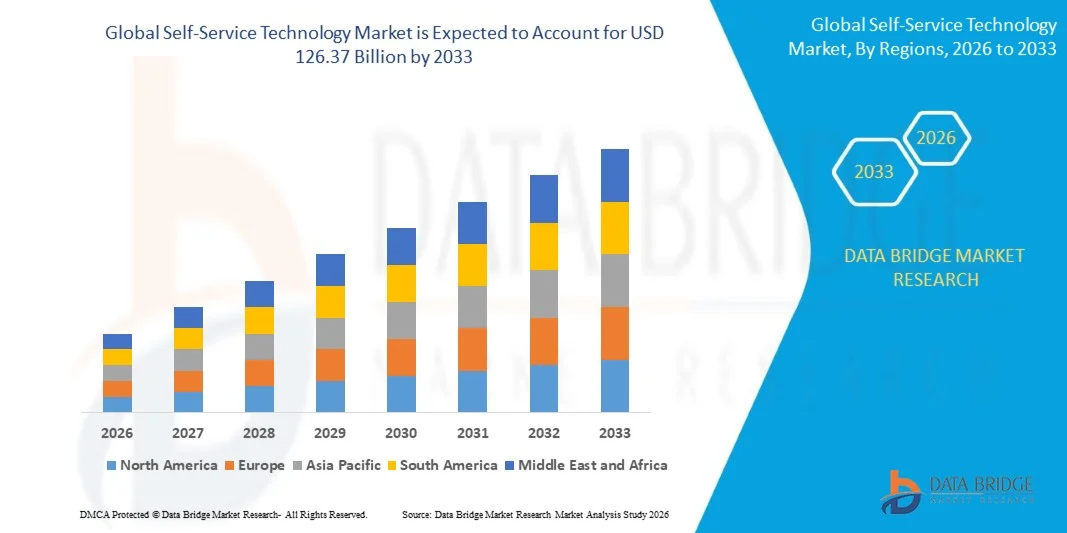
- As per Data Bridge Market Research analysis, the self-service technology market was valued at USD 37.50 billion in 2025 and is projected to reach USD 126.37 billion by 2033, growing at a CAGR of 16.40% from 2026 to 2033.
- The market is experiencing consistent growth driven by rising demand for faster and more convenient customer service, increasing adoption of automated transaction systems, and expanding applications across retail, banking, hospitality, healthcare, and transportation.
- The increasing preference for contactless and automated services, combined with technological advancements in artificial intelligence, cloud computing, touchscreen interfaces, and digital payments, is compelling businesses and public-sector organizations to deploy self-service solutions. Kiosks, automated teller machines, self-checkout systems, and vending machines are increasingly replacing conventional assisted-service models, offering cost-effective, scalable, and convenient customer experiences.
Market Size & Forecast
- Global Market Value (2025): USD 37.50 Billion
- Expected Market Value (2033): USD 126.37 Billion
- Forecast CAGR (2026–2033): 16.40%
- Leading Region in 2025: North America
- Fastest Growing Region: Asia Pacific
What are the Major Takeaways of the Self-Service Technology Market?
- North America dominated the self-service technology market with the largest revenue share of 36.8% in 2025, supported by high adoption of automated customer-service solutions, advanced digital infrastructure, and widespread deployment across retail, banking, healthcare, and hospitality.
- Asia-Pacific is expected to be the fastest-growing region at a CAGR of 12.5% from 2026 to 2033, fueled by rapid digitalization, rising urbanization, expanding retail and banking sectors, and increasing adoption of self-service technologies across emerging economies.
- The ATM segment led the market with a 58.5% share in 2025, driven by continued demand for convenient cash access and automated banking services
- Vending machine are the fastest-growing type, projected to register a CAGR of 17.0%, reflecting the surge in demand for automated and convenient purchasing options.
- The on-premise segment dominated the deployment mode category with a 62.3% revenue share in 2025, led by the continued use of locally installed infrastructure across banking and other security-sensitive applications.
- Hardware accounted for 48.5% of the market share in 2025, preferred by widespread deployment of ATMs, kiosks, vending machines, and interactive terminals.
- The software segment is the fastest-growing component category, with a CAGR of 12.2%, driven by increasing demand for intelligent management, analytics, personalization, and connected self-service capabilities.
Report Scope and Self-Service Technology Market Segmentation
|
Attributes |
Self-Service Technology Key Market Insights |
|
Segments Covered |
|
|
Countries Covered |
North America
Europe
Asia-Pacific
Middle East and Africa
South America
|
|
Key Market Players |
|
|
Market Opportunities |
|
|
Value Added Data Infosets |
In addition to the insights on market scenarios such as market value, growth rate, segmentation, geographical coverage, and major players, the market reports curated by the Data Bridge Market Research also include in-depth expert analysis, geographically represented company-wise production and capacity, network layouts of distributors and partners, detailed and updated price trend analysis and deficit analysis of supply chain and demand. |
What is the Key Trend in the Self-Service Technology Market?
- AI-powered, contactless, and connected self-service platforms are increasingly being adopted to improve transaction speed, personalization, and customer convenience across retail, banking, hospitality, and healthcare environments.
- For instance, in January 2025, NCR Voyix introduced Halo Checkout, an AI-enabled self-checkout solution developed with Everseen that uses computer vision to identify items and strengthen loss prevention, demonstrating the shift toward intelligent, automated self-service checkout.
- The integration of artificial intelligence, computer vision, IoT, cloud computing, and digital payments is transforming conventional kiosks and terminals into intelligent platforms capable of real-time monitoring and automated decision-making.
- Retailers are increasingly deploying checkout-free and mobile-enabled self-service technologies to reduce queues, improve operational efficiency, and provide customers with faster purchasing experiences across physical stores.
- Cloud-connected self-service systems are gaining traction because centralized software management enables remote monitoring, predictive maintenance, faster updates, and consistent deployment across geographically distributed locations.
- For instance, in April 2024, ALDI launched ALDIgo at an Aurora, Illinois store with Grabango, using AI-powered computer vision and ceiling-mounted scanners to track products and enable checkout-free shopping, demonstrating the growing adoption of frictionless, automated retail.
- As businesses increasingly prioritize automation, contactless transactions, and personalized customer interactions, the integration of AI, cloud connectivity, and digital payment capabilities is expected to accelerate, reinforcing intelligent self-service technology as a core component of modern customer-service infrastructure
What are the Key Drivers of the Self-Service Technology Market?
- The rapid shift toward contactless and automated transactions has significantly increased demand for self-service technologies capable of reducing waiting times, improving operational efficiency, and delivering convenient customer experiences across retail, restaurants, banking, transportation, and other high-volume service environments.
- For instance, in April 2024, Sam’s Club expanded its AI-powered exit technology to more than 120 locations, with the system using artificial intelligence and computer vision to verify purchases without associate receipt checks; members at equipped clubs were leaving 23% faster, demonstrating how demand for faster, more convenient transactions is driving self-service technology adoption.
- Retailers, restaurants, banks, and transportation providers are increasingly integrating kiosks, mobile ordering, automated checkout, digital payments, and self-service terminals to address labor constraints while reallocating employees toward higher-value customer-facing activities.
- For instance, in August 2024, Tata Consultancy Services enabled 100% in-store mobile checkout across Croma’s 500+ stores, using its AI-powered OmniStore platform to provide mobile checkout and reduce checkout time, demonstrating the growing demand for automated and contactless retail experiences.
- With consumer expectations increasingly centered on speed, convenience, contactless interactions, and personalized digital experiences, self-service technologies will remain essential for organizations seeking to reduce operational costs while improving service capacity and customer satisfaction across multiple industries.
Which Factors are Challenging the Growth of the Self-Service Technology Market?
- Advanced self-service systems require significant upfront investment because organizations must integrate specialized kiosks, payment terminals, sensors, software platforms, connectivity infrastructure, cybersecurity systems, and ongoing maintenance capabilities.
- For instance, in March 2024, Walmart ended a self-checkout theft-prevention test at selected stores after evaluating the challenges associated with self-checkout, highlighting how theft, customer errors, and the need for additional oversight can reduce the expected cost benefits of automated checkout systems.
- These investment requirements can restrict adoption among small businesses, independent retailers, smaller restaurants, healthcare providers, and organizations operating in price-sensitive markets where technology budgets and technical resources remain limited.
- Furthermore, integrating self-service systems with existing point-of-sale, payment, inventory, customer relationship management, and enterprise platforms can increase implementation complexity and create additional costs for organizations replacing legacy infrastructure.
- For instance, in June 2024, Dollar General significantly scaled back self-checkout, removing the technology from approximately 12,000 of its 20,000 stores, citing theft and inventory losses; the decision demonstrates how shrinkage and associated operational costs can constrain wider self-service deployment.
- The high initial investment, integration complexity, maintenance requirements, and need for continuous software and security upgrades therefore continue to challenge widespread deployment, particularly among smaller organizations and businesses operating across emerging or cost-sensitive markets.
How is the Self-Service Technology Market Segmented?
The self-service technology market is segmented on the basis of type, deployment mode, component, and end user.
- By Type
On the basis of type, the self-service technology market is segmented into ATM, vending machine, kiosks, and others. The ATM segment dominated the market with a 58.5% share in 2025, owing to continued demand for convenient cash access and automated banking services. Banks continue to deploy ATMs and cash-recycling machines to provide 24/7 customer access while improving operational efficiency. The segment benefits from extensive existing infrastructure across developed and emerging economies. Increasing integration of contactless transactions, biometric authentication, cash recycling, and remote monitoring is further improving ATM functionality. Banks are also modernizing older ATM fleets with advanced transaction and security capabilities.
The vending machine segment is projected to register the fastest growth at a CAGR of 17.0% from 2026 to 2033, driven by increasing demand for automated and convenient purchasing options. Vending machines are expanding beyond traditional food and beverage applications into corporate offices, transportation facilities, healthcare institutions, and other high-traffic environments. Integration of cashless payments, QR codes, mobile wallets, IoT connectivity, and remote inventory monitoring is enhancing their functionality. Smart vending systems allow operators to monitor inventory, sales, and machine performance remotely. Growing consumer preference for contactless purchasing is further encouraging deployment
- By Deployment Mode
On the basis of deployment mode, the self-service technology market is segmented into on-premise, cloud-based, and hybrid. The on-premise segment dominated with 62.3% share in 2025, supported by the continued use of locally installed infrastructure across banking and other security-sensitive applications. On-premise deployment provides organizations with greater control over hardware, software, data, and transaction processing. Financial institutions particularly benefit from direct control over sensitive transaction infrastructure and data. Existing ATM networks and legacy self-service installations also contribute to continued on-premise adoption. The model remains relevant where organizations prioritize data control, system customization, and local processing. However, increasing cloud adoption is gradually reducing its share of new deployments.
The cloud-based segment is projected to register the fastest growth at a CAGR of 13.6% from 2026 to 2033, driven by increasing demand for scalable and remotely managed self-service infrastructure. Cloud deployment allows businesses to centrally manage self-service terminals across multiple locations through unified platforms. It enables remote software updates, real-time monitoring, performance analytics, and automated troubleshooting. Retailers and other multi-location businesses can deploy new terminals without establishing extensive local IT infrastructure. Cloud connectivity also facilitates integration with artificial intelligence, digital payment systems, enterprise platforms, and customer-data applications. The combination of centralized management, scalability, and reduced infrastructure requirements is expected to accelerate cloud adoption during the forecast period.
- By Component
On the basis of component, the self-service technology market is segmented into hardware, software, and services. The hardware segment dominated the market with 48.5% revenue share in 2025, supported by widespread deployment of ATMs, kiosks, vending machines, and interactive terminals. Hardware encompasses touchscreens, displays, payment terminals, card readers, printers, scanners, sensors, and computing equipment. Growing deployment of physical self-service systems directly increases demand for these components. Manufacturers are also incorporating advanced displays, biometric technologies, contactless payment capabilities, and improved sensors into newer systems. Replacement of aging equipment and modernization of existing self-service infrastructure further support hardware demand.
The software segment is projected to register the fastest growth at a CAGR of 12.2% from 2026 to 2033, driven by increasing demand for intelligent management, analytics, personalization, and connected self-service capabilities. Software enables real-time monitoring, predictive maintenance, transaction management, and integration with cloud-based enterprise systems. Artificial intelligence is increasingly being incorporated to improve recommendations, customer interactions, security, and operational decision-making. Software platforms also allow organizations to manage large networks of self-service devices from centralized locations. Integration with digital payments, inventory systems, enterprise applications, and customer platforms is increasing the value of software within self-service ecosystems.
- By End User
On the basis of end user, the self-service technology market is segmented into retail, quick service restaurant, hospitality, healthcare, corporate offices, transportation, BFSI, and others. The quick service restaurant segment dominated the market with a 35.4% share in 2025, supported by increasing adoption of self-ordering kiosks, automated payment systems, and digital ordering technologies. QSR operators use self-service systems to reduce queues and improve ordering efficiency during high-traffic periods. Kiosks allow customers to customize orders, make payments, and complete transactions with limited employee assistance. These systems can also help restaurants optimize employee allocation toward food preparation and customer-service activities. Growing consumer preference for faster, convenient, and contactless ordering experiences continues to support QSR adoption.
The healthcare segment is projected to register the fastest growth at a CAGR of 13.7% from 2026 to 2033, driven by increasing deployment of patient check-in, registration, payment, and information kiosks. Healthcare providers are adopting self-service technologies to reduce administrative workloads and improve patient-flow management. These systems allow patients to complete routine registration and payment processes independently, reducing pressure on front-desk personnel. Integration with electronic health records and other hospital information systems is further improving the efficiency of self-service applications. Growing healthcare digitalization and demand for shorter waiting times are encouraging hospitals and clinics to adopt automated patient-service solutions.
Which Region Holds the Largest Share of the Self-Service Technology Market?
- North America dominated the self-service technology market with the largest revenue share of 36.8% in 2025, supported by high adoption of automated customer-service solutions, advanced digital infrastructure, and widespread deployment across retail, banking, healthcare, and hospitality.
- · The region also benefits from strong adoption of AI-powered kiosks, mobile ordering platforms, cloud-based management systems, and automated self-checkout solutions, while businesses increasingly use self-service technologies to reduce labor costs and improve operational efficiency. High consumer demand for fast, convenient, and contactless services, combined with established technology infrastructure and continued digital transformation across major industries, continues to strengthen North America’s leadership position in the global market
U.S. Self-Service Technology Market Insight
The U.S. self-service technology market is witnessing strong growth due to rising investments in automated retail, self-checkout, digital payment systems, and AI-powered customer-service technologies. The country’s mature retail, banking, hospitality, and quick-service restaurant ecosystem, along with increasing adoption of intelligent kiosks and contactless solutions, is driving demand across commercial and service applications. In addition, growing emphasis on reducing checkout times, improving operational efficiency, and addressing labor shortages is accelerating self-service technology adoption across businesses.
Asia-Pacific Self-Service Technology Market Insight
The Asia-Pacific self-service technology market is expected to witness rapid growth, driven by increasing urbanization, expanding retail and banking infrastructure, and rising investments in digital payment technologies across countries such as China, India, and Japan. Growing consumer preference for convenient and contactless transactions, rising adoption of automated kiosks, and increasing demand for scalable service solutions are supporting regional market expansion. In addition, the growing presence of quick-service restaurants, modern retail outlets, transportation networks, and technology-enabled businesses is accelerating self-service technology adoption across the region.
Japan Self-Service Technology Market Insight
The Japan self-service technology market is witnessing consistent growth due to rising investments in automation, labor-saving technologies, and advanced customer-service solutions. Retailers, restaurants, transportation operators, and financial institutions are increasingly adopting self-checkout systems, vending machines, ATMs, and intelligent kiosks to improve operational efficiency. Moreover, increasing integration of artificial intelligence, robotics, cashless payments, and contactless technologies, combined with Japan’s focus on addressing workforce shortages, is further contributing to market growth.
China Self-Service Technology Market Insight
The China self-service technology market is growing rapidly, driven by increasing urbanization, expanding retail infrastructure, and rising adoption of digital payments and automated customer-service solutions. Growing deployment of AI-enabled kiosks, self-checkout systems, smart vending machines, and automated payment platforms across retail, restaurants, banking, and transportation sectors is significantly boosting market demand. In addition, rising investments in smart-city infrastructure, increasing consumer acceptance of contactless services, and rapid technological advancements are positioning China as one of the fastest-growing markets for self-service technology globally.
U.K. Self-Service Technology Market Insight
The U.K. self-service technology market is experiencing steady growth, supported by rising adoption of self-checkout systems, self-ordering kiosks, automated banking services, and contactless payment technologies. Increasing investments in advanced self-service infrastructure and growing demand for convenient, efficient, and labor-saving customer-service solutions are contributing to market growth. Furthermore, integration of artificial intelligence, cloud connectivity, digital payments, and data analytics is improving self-service performance and customer experiences, positioning the U.K. as an important market for self-service technology innovation.
Germany Self-Service Technology Market Insight
The Germany self-service technology market is expanding steadily due to the country’s strong retail, banking, manufacturing, transportation, and hospitality sectors, along with increasing adoption of automation technologies. Retailers, financial institutions, restaurants, and transportation operators are increasingly utilizing self-service kiosks, automated checkout systems, vending machines, and digital payment terminals to improve operational efficiency. Continuous advancements in artificial intelligence, cloud-based management, contactless payments, and connected devices, along with strong emphasis on digitalization and labor productivity, are further driving market growth in Germany.
Which are the Top Companies in Self-Service Technology Market?
The self-service technology industry is primarily led by well-established companies, including:
- NCR Voyix Corporation (U.S.)
- NEC Corporation (Japan)
- Panasonic Holdings Corporation (Japan)
- GLORY LTD. (Japan)
- Hitachi Channel Solutions, Corp. (Japan)
- Diebold Nixdorf, Incorporated (U.S.)
- Advantech Co., Ltd. (Taiwan)
- Seaga Manufacturing Inc. (U.S.)
- Toshiba Tec Corporation (Japan)
- Azkoyen, S.A. (Spain)
- StrongPoint ASA (Norway)
- Fujitsu Limited (Japan)
- Ingenico (France)
- VeriFone, Inc. (U.S.)
- SUZOHAPP, Inc. (U.S.)
- Zebra Technologies Corporation (U.S.)
- Seiko Epson Corporation (Japan)
- Elo Touch Solutions, Inc. (U.S.)
- GRG Banking Equipment Co., Ltd. (China)
- HYOSUNG TNS INC. (South Korea)
What are Latest Developments in Self-Service Technology Market?
- In April 2025, SumUp announced the expansion of its Kiosk solution into additional markets, building on its existing availability in the U.K., France, Germany, Switzerland, Spain, and Italy. The company highlighted the technology’s ability to streamline service and improve customer and staff experiences in quick-service restaurants, with further market expansion planned during 2025.
- In March 2025, Samsung announced that Mr. Pickle’s Sandwich Shop would introduce Samsung Kiosks powered by GRUBBRR across its more than 60 locations, integrating self-ordering technology with the restaurant’s existing POS system. The kiosks are designed to improve operational efficiency, reduce customer wait times, and support intelligent upselling, while Samsung’s cloud-based VXT platform enables remote management of digital menu boards across the network.
- In May 2023, Samsung launched the KMC-W, an updated Windows-based version of its Samsung Kiosk, featuring a 24-inch interactive display and expanded software compatibility. The solution was designed for self-service applications across food and beverage, retail, travel, and healthcare, enabling businesses to provide contactless ordering, payments, and other automated services.
- In March 2022, Walmart expanded its use of self-checkout screens as part of its Walmart Connect retail-media platform, allowing brands to reach customers through advertising placements at self-checkout areas. The development demonstrated how self-service terminals were evolving beyond transaction processing into digitally connected customer-engagement platforms within physical stores.
- In June 2021, Samsung expanded the availability of its all-in-one Kiosk for contactless ordering and payment to 12 countries, including the U.S., U.K., Canada, Australia, and Singapore. The 24-inch touchscreen solution integrated ordering and payment capabilities while eliminating the need for an external PC, highlighting the growing global deployment of compact, contactless self-service technology.

- Interactive Data Analysis Dashboard
- Company Analysis Dashboard for high growth potential opportunities
- Research Analyst Access for customization & queries
- Competitor Analysis with Interactive dashboard
- Latest News, Updates & Trend analysis
- Harness the Power of Benchmark Analysis for Comprehensive Competitor Tracking
Global Self Service Technology Market, Supply Chain Analysis and Ecosystem Framework
To support market growth and help clients navigate the impact of geopolitical shifts, DBMR has integrated in-depth supply chain analysis into its Global Self Service Technology Market research reports. This addition empowers clients to respond effectively to global changes affecting their industries. The supply chain analysis section includes detailed insights such as Global Self Service Technology Market consumption and production by country, price trend analysis, the impact of tariffs and geopolitical developments, and import and export trends by country and HSN code. It also highlights major suppliers with data on production capacity and company profiles, as well as key importers and exporters. In addition to research, DBMR offers specialized supply chain consulting services backed by over a decade of experience, providing solutions like supplier discovery, supplier risk assessment, price trend analysis, impact evaluation of inflation and trade route changes, and comprehensive market trend analysis.
Data collection and base year analysis are done using data collection modules with large sample sizes. The stage includes obtaining market information or related data through various sources and strategies. It includes examining and planning all the data acquired from the past in advance. It likewise envelops the examination of information inconsistencies seen across different information sources. The market data is analysed and estimated using market statistical and coherent models. Also, market share analysis and key trend analysis are the major success factors in the market report. To know more, please request an analyst call or drop down your inquiry.
The key research methodology used by DBMR research team is data triangulation which involves data mining, analysis of the impact of data variables on the market and primary (industry expert) validation. Data models include Vendor Positioning Grid, Market Time Line Analysis, Market Overview and Guide, Company Positioning Grid, Patent Analysis, Pricing Analysis, Company Market Share Analysis, Standards of Measurement, Global versus Regional and Vendor Share Analysis. To know more about the research methodology, drop in an inquiry to speak to our industry experts.
Data Bridge Market Research is a leader in advanced formative research. We take pride in servicing our existing and new customers with data and analysis that match and suits their goal. The report can be customized to include price trend analysis of target brands understanding the market for additional countries (ask for the list of countries), clinical trial results data, literature review, refurbished market and product base analysis. Market analysis of target competitors can be analyzed from technology-based analysis to market portfolio strategies. We can add as many competitors that you require data about in the format and data style you are looking for. Our team of analysts can also provide you data in crude raw excel files pivot tables (Fact book) or can assist you in creating presentations from the data sets available in the report.













