


What is the Semiconductor Precursors Market Size and Growth Rate?
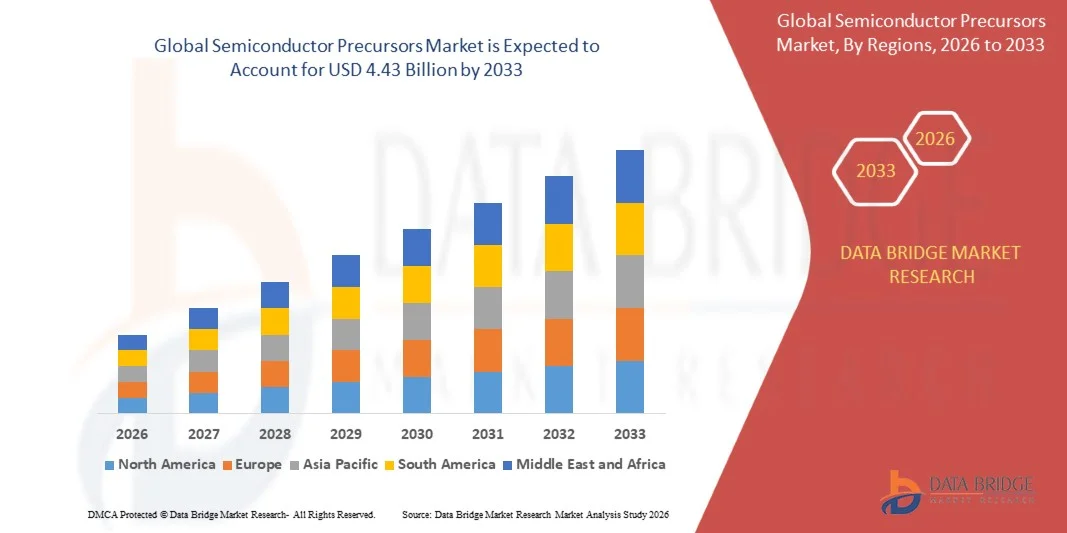
- As per Data Bridge Market Research analysis the semiconductor precursors market was valued at USD 2.11 billion in 2025 and is projected to reach USD 4.43 billion by 2033, growing at a CAGR of 9.74% from 2026 to 2033.
- The market is experiencing strong growth driven by increasing semiconductor fabrication activities, rising demand for advanced deposition materials, and the rapid adoption of next-generation technologies such as artificial intelligence, high-performance computing, 5G, and electric vehicles.
- The continuous advancement of semiconductor manufacturing processes, including atomic layer deposition (ALD) and chemical vapor deposition (CVD), combined with growing investments in advanced chip production facilities, is accelerating demand for high-purity precursors used in logic chips, memory devices, and advanced packaging applications.
Market Size & Forecast
- Market Value (2025): USD 2.11 Billion
- Expected Market Value (2033): USD 4.43 Billion
- Forecast CAGR (2026–2033): 9.74%
- Leading Region in 2025: North America
- Fastest Growing Region: Asia-Pacific
What are the Major Takeaways of the Semiconductor Precursors Market?
- North America dominated the semiconductor precursors market with a significant revenue share in 2025, supported by the presence of advanced semiconductor manufacturing facilities, strong demand for high-performance chips, and increasing investments in domestic semiconductor production.
- Asia-Pacific dominated the semiconductor precursors market with the largest revenue share in 2025, supported by the presence of major semiconductor manufacturing hubs, including China, Taiwan, South Korea, and Japan.
- The metal precursors segment held the largest market revenue share in 2025, driven by their extensive use in advanced semiconductor fabrication processes, including atomic layer deposition (ALD), chemical vapor deposition (CVD), and advanced interconnect formation. Metal precursors such as tungsten, titanium, copper, and cobalt-based materials are widely adopted for manufacturing logic chips, memory devices, and advanced semiconductor structures due to their ability to enable precise thin-film deposition.
- The dielectric precursors segment is projected to register the fastest growth at a CAGR from 2026 to 2033, driven by increasing demand for high-k dielectric materials, gate insulation layers, and advanced transistor architectures. The growing adoption of advanced nodes and three-dimensional semiconductor structures is accelerating the requirement for specialized dielectric precursor materials.
- The silicon-based precursors segment accounted for the largest market revenue share in 2025, driven by their widespread application in semiconductor wafer fabrication, silicon nitride deposition, and silicon oxide layer formation. Silicon precursors remain essential for logic devices, memory chips, and advanced semiconductor manufacturing due to their compatibility with established fabrication processes.
- The tungsten precursors segment is anticipated to witness the fastest growth at a CAGR from 2026 to 2033, supported by increasing adoption in advanced interconnects, contact formation, and memory semiconductor applications. The growing demand for high-performance computing and advanced memory technologies is increasing the use of tungsten-based deposition materials in semiconductor manufacturing.
Report Scope and Semiconductor Precursors Market Segmentation
|
Attributes |
Semiconductor Precursors Key Market Insights |
|
Segments Covered |
|
|
Countries Covered |
North America
Europe
Asia-Pacific
Middle East and Africa
South America
|
|
Key Market Players |
|
|
Market Opportunities |
|
|
Value Added Data Infosets |
In addition to the insights on market scenarios such as market value, growth rate, segmentation, geographical coverage, and major players, the market reports curated by the Data Bridge Market Research also include import export analysis, production capacity overview, production consumption analysis, price trend analysis, climate change scenario, supply chain analysis, value chain analysis, raw material/consumables overview, vendor selection criteria, PESTLE Analysis, Porter Analysis, and regulatory framework. |
What is the Key Trend in the Semiconductor Precursors Market?
- Semiconductor manufacturers are increasingly adopting advanced semiconductor precursors with higher purity levels and improved deposition performance to support next-generation chip manufacturing, including advanced logic, memory devices, and 3D semiconductor architectures.
- For instance, in February 2024, ADEKA Corporation announced the construction of a new manufacturing building at ADEKA KOREA CORPORATION to expand production capacity for advanced semiconductor materials used in next-generation DRAM, logic, and NAND semiconductor applications. The expansion supports increasing demand for advanced deposition materials, including high-performance precursor materials required for semiconductor miniaturization and advanced chip manufacturing.
- The transition toward smaller semiconductor process nodes, increasing adoption of atomic layer deposition (ALD), and growing complexity of chip structures are driving demand for specialized metal, dielectric, and silicon-based precursors with enhanced process control and reliability.
- Semiconductor material suppliers are increasing investments in advanced precursor manufacturing facilities and localized supply chains to meet the growing requirements of semiconductor fabrication plants worldwide.
- For instance, in December 2025, Merck KGaA inaugurated its Semiconductor Solutions Mega Site in Kaohsiung, Taiwan, strengthening local production capabilities for semiconductor materials including thin films, formulations, specialty gases, and related materials used in advanced semiconductor manufacturing processes. The facility supports supply chain resilience for next-generation semiconductor fabrication and advanced node production.
- As semiconductor manufacturers continue advancing toward smaller geometries, advanced packaging, and high-performance computing applications, the adoption of next-generation semiconductor precursors is expected to accelerate, making precursor materials a critical component of future chip production.
What are the Key Drivers of the Semiconductor Precursors Market?
- The rapid expansion of semiconductor manufacturing capacity globally is significantly increasing demand for high-purity semiconductor precursors required for atomic layer deposition (ALD), chemical vapor deposition (CVD), and other advanced wafer fabrication processes.
- For instance, in June 2024, Entegris and the U.S. Department of Commerce announced a preliminary agreement for up to USD 75 million in proposed CHIPS Act funding to support a new manufacturing center in Colorado Springs, U.S. The facility is expected to strengthen production capabilities for semiconductor manufacturing materials and process solutions required by advanced chip manufacturers.
- The rising adoption of artificial intelligence, electric vehicles, 5G infrastructure, and data center technologies is accelerating semiconductor demand and encouraging manufacturers to invest in advanced deposition technologies that require precise and high-performance precursor materials.
- For instance, in 2024, Merck KGaA continued expanding its semiconductor materials portfolio through its Semiconductor Solutions business, supplying advanced materials for wafer processing, thin films, dielectric materials, and specialty gases used in semiconductor fabrication. The company highlighted increasing demand for materials supporting AI chips, advanced nodes, and next-generation semiconductor devices.
- With semiconductor manufacturers increasingly shifting toward advanced nodes, 3D architectures, and complex device structures, semiconductor precursors will remain essential for improving device performance, increasing manufacturing efficiency, and enabling next-generation electronic applications.
Which Factors are Challenging the Growth of the Semiconductor Precursors Market?
- Semiconductor precursors require extremely high purity levels, strict contamination control, and advanced manufacturing processes, resulting in high production costs and significant investment requirements for chemical suppliers.
- These cost-intensive manufacturing requirements create challenges for smaller market participants and increase dependency on established suppliers with specialized semiconductor-grade chemical production capabilities.
- For instance, in December 2024, Entegris continued investing in advanced semiconductor manufacturing infrastructure, including its Colorado Springs Manufacturing Center of Excellence, highlighting the significant capital requirements needed to expand production capabilities for semiconductor-grade materials and process solutions.
- In addition, semiconductor precursor manufacturers face challenges related to stringent environmental regulations, complex chemical handling requirements, and supply chain risks associated with specialized raw materials and production technologies.
- The high investment requirements, regulatory compliance burden, and need for continuous innovation continue to limit the entry of new suppliers while increasing operational complexity for existing manufacturers, particularly in regions developing new semiconductor manufacturing ecosystems.
How is the Semiconductor Precursors Market Segmented?
The market is segmented on the basis of type, material, deposition process, application, and end-use industry.
- By Type
On the basis of type, the semiconductor precursors market is segmented into metal precursors, dielectric precursors, silicon precursors, and other specialty precursors. The metal precursors segment held the largest market revenue share in 2025, driven by their extensive use in advanced semiconductor fabrication processes, including atomic layer deposition (ALD), chemical vapor deposition (CVD), and advanced interconnect formation. Metal precursors such as tungsten, titanium, copper, and cobalt-based materials are widely adopted for manufacturing logic chips, memory devices, and advanced semiconductor structures due to their ability to enable precise thin-film deposition.
The dielectric precursors segment is projected to register the fastest growth at a CAGR from 2026 to 2033, driven by increasing demand for high-k dielectric materials, gate insulation layers, and advanced transistor architectures. The growing adoption of advanced nodes and three-dimensional semiconductor structures is accelerating the requirement for specialized dielectric precursor materials.
- By Material
On the basis of material, the semiconductor precursors market is segmented into copper precursors, titanium precursors, tungsten precursors, aluminum precursors, silicon-based precursors, and other advanced materials. The silicon-based precursors segment accounted for the largest market revenue share in 2025, driven by their widespread application in semiconductor wafer fabrication, silicon nitride deposition, and silicon oxide layer formation. Silicon precursors remain essential for logic devices, memory chips, and advanced semiconductor manufacturing due to their compatibility with established fabrication processes.
The tungsten precursors segment is anticipated to witness the fastest growth at a CAGR from 2026 to 2033, supported by increasing adoption in advanced interconnects, contact formation, and memory semiconductor applications. The growing demand for high-performance computing and advanced memory technologies is increasing the use of tungsten-based deposition materials in semiconductor manufacturing.
- By Deposition Process
On the basis of deposition process, the semiconductor precursors market is segmented into chemical vapor deposition (CVD), atomic layer deposition (ALD), plasma-enhanced chemical vapor deposition (PECVD), and other deposition technologies. The atomic layer deposition (ALD) segment held the largest market revenue share in 2025, driven by its ability to provide highly controlled, uniform, and ultra-thin film deposition required for advanced semiconductor nodes. ALD technology is increasingly used in logic chips, 3D NAND memory, and advanced packaging applications due to its superior thickness control and conformality.
The atomic layer deposition (ALD) segment is also projected to register the fastest growth at a CAGR from 2026 to 2033, fueled by increasing semiconductor miniaturization, adoption of extreme ultraviolet (EUV) lithography, and growing complexity of transistor architectures. The rising demand for gate-all-around (GAA) and advanced memory technologies is further accelerating the adoption of ALD-based precursor solutions.
- By Application
On the basis of application, the semiconductor precursors market is segmented into logic chips, memory devices, advanced packaging, microelectromechanical systems (MEMS), and optoelectronics. The memory devices segment dominated the market with a revenue share in 2025, driven by increasing demand for DRAM, NAND flash, and high-bandwidth memory (HBM) technologies used in artificial intelligence, data centers, and consumer electronics. Semiconductor precursors play a critical role in enabling high-density memory structures and multilayer device fabrication.
The advanced packaging segment is expected to register the fastest growth at a CAGR from 2026 to 2033, supported by rising adoption of chiplet architectures, 2.5D and 3D packaging technologies, and high-performance computing applications. The increasing integration of multiple semiconductor dies is driving demand for advanced deposition materials and specialized precursor solutions.
- By End-Use Industry
On the basis of end-use industry, the semiconductor precursors market is segmented into consumer electronics, automotive, telecommunications, data centers & high-performance computing, aerospace & defense, and renewable energy. The consumer electronics segment accounted for the largest market revenue share in 2025, driven by increasing semiconductor integration in smartphones, laptops, wearable devices, and smart home electronics. Continuous demand for smaller, faster, and more efficient electronic devices is increasing the consumption of advanced semiconductor materials.
The data centers & high-performance computing segment is projected to grow at the fastest CAGR from 2026 to 2033, driven by increasing adoption of artificial intelligence, cloud computing, machine learning, and advanced processor technologies. The rapid expansion of AI infrastructure and demand for high-performance chips are significantly increasing the requirement for advanced semiconductor precursors used in next-generation chip manufacturing.
Which Region Holds the Largest Share of the Semiconductor Precursors Market?
- North America dominated the semiconductor precursors market with a significant revenue share in 2025, supported by the presence of advanced semiconductor manufacturing facilities, strong demand for high-performance chips, and increasing investments in domestic semiconductor production.
- The region’s growing focus on strengthening semiconductor supply chains, supported by initiatives such as the CHIPS and Science Act, is accelerating the adoption of high-purity precursor materials required for advanced deposition processes. The presence of leading semiconductor material suppliers, research institutions, and technology companies further supports the development and commercialization of advanced precursor solutions for logic chips, memory devices, and advanced packaging applications.
U.S. Semiconductor Precursors Market Insight
U.S. semiconductor precursors market captured the largest revenue share in 2025 within North America, driven by increasing semiconductor fabrication investments, rising demand for artificial intelligence processors, and expansion of high-performance computing infrastructure. The country’s growing semiconductor manufacturing ecosystem, supported by investments from leading chip manufacturers and material suppliers, is increasing demand for advanced deposition materials, including metal, dielectric, and silicon-based precursors. Furthermore, the presence of major semiconductor materials companies and government initiatives aimed at enhancing domestic chip production are significantly contributing to market growth.
Europe Semiconductor Precursors Market Insight
Europe semiconductor precursors market is expected to witness steady growth from 2026 to 2033, primarily driven by increasing investments in semiconductor manufacturing, rising demand for automotive chips, and efforts to establish a more resilient semiconductor supply chain. The region’s strong automotive, industrial automation, and renewable energy sectors are increasing the requirement for advanced semiconductor devices and specialized precursor materials. In addition, initiatives under the European Chips Act are encouraging semiconductor production expansion and supporting demand for high-purity materials used in advanced fabrication processes.
U.K. Semiconductor Precursors Market Insight
U.K. semiconductor precursors market is expected to witness significant growth from 2026 to 2033, supported by increasing investments in semiconductor research, compound semiconductor technologies, and advanced electronic applications. The country’s strong focus on semiconductor innovation, particularly in power electronics, photonics, and next-generation computing, is driving demand for specialized precursor materials. Furthermore, collaborations between research institutions, semiconductor companies, and technology developers are supporting the adoption of advanced deposition technologies and semiconductor material solutions.
Germany Semiconductor Precursors Market Insight
Germany semiconductor precursors market is expected to witness strong growth from 2026 to 2033, fueled by its leading position in automotive electronics, industrial automation, and advanced manufacturing technologies. The increasing adoption of electric vehicles, autonomous systems, and industrial digitalization is driving demand for semiconductor components and advanced materials required for chip production. Germany’s focus on expanding semiconductor manufacturing capabilities, combined with investments in sustainable and secure supply chains, is supporting the growth of high-purity semiconductor precursor materials.
Asia-Pacific Semiconductor Precursors Market Insight
Asia-Pacific dominated the semiconductor precursors market with the largest revenue share in 2025, supported by the presence of major semiconductor manufacturing hubs, including China, Taiwan, South Korea, and Japan. The region’s strong electronics manufacturing ecosystem, rapid expansion of semiconductor fabrication facilities, and increasing demand for advanced chips are driving the adoption of precursor materials used in atomic layer deposition (ALD), chemical vapor deposition (CVD), and other advanced processes. In addition, rising investments in artificial intelligence, 5G infrastructure, consumer electronics, and electric vehicles are accelerating semiconductor production and strengthening demand for advanced precursor solutions across the region.
Japan Semiconductor Precursors Market Insight
Japan semiconductor precursors market is expected to witness significant growth from 2026 to 2033, driven by the country’s strong semiconductor materials industry, advanced chemical manufacturing capabilities, and expertise in high-purity process materials. Japan plays a critical role in the global semiconductor supply chain, with leading companies supplying specialty chemicals and precursor materials required for advanced chip fabrication. Increasing investments in semiconductor manufacturing capacity, advanced packaging technologies, and next-generation electronic devices are further supporting market expansion in the country.
China Semiconductor Precursors Market Insight
China semiconductor precursors market accounted for a major revenue share in Asia-Pacific in 2025, attributed to the country’s expanding semiconductor manufacturing capacity, growing electronics production, and increasing focus on domestic semiconductor supply chains. The rapid development of semiconductor fabrication facilities, supported by government initiatives and investments, is driving demand for high-purity precursor materials used in advanced chip manufacturing. Moreover, China’s strong position in consumer electronics, electric vehicles, and telecommunications infrastructure is increasing the requirement for advanced semiconductor devices and precursor chemicals across multiple applications.
Which are the Top Companies in Semiconductor Precursors Market?
The semiconductor precursors industry is primarily led by well-established companies, including:
- Entegris (U.S.)
- Merck KGaA (Germany)
- Mitsubishi Chemical Group Corporation (Japan)
- DONGJIN SEMICHEM CO.LTD. (South Korea)
- SK ecoplant materials (South Korea)
- Air Liquide S.A. (France)
- Linde plc (U.K.)
- Shin-Etsu Chemical Co., Ltd. (Japan)
- ADEKA CORPORATION (Japan)
- Air Products and Chemicals, Inc. (U.S.)
- DuPont (U.S.)
- Versum Materials (U.S.)
- Soulbrain Co., Ltd. (South Korea)
- UP Chemical Co., Ltd. (South Korea)
- DNF Co., Ltd. (South Korea)
What are Latest Developments in Semiconductor Precursors Market?
- In October 2024, Merck KGaA expanded its semiconductor materials production capabilities in Kaohsiung, Taiwan, through the opening of a new Electronics Technology Center focused on advanced semiconductor materials and process solutions. The facility strengthens Merck’s ability to support semiconductor manufacturers with high-purity materials, including precursors used in advanced deposition processes such as atomic layer deposition (ALD) and chemical vapor deposition (CVD).
- In October 2023, Entegris completed the acquisition of CMC Materials, expanding its portfolio of critical semiconductor materials and strengthening its capabilities in advanced process materials used throughout semiconductor manufacturing. The acquisition enhanced Entegris’ position in supplying materials required for advanced chip fabrication, including deposition-related solutions and specialty materials for next-generation semiconductor nodes.
- In 2024, ADEKA Corporation expanded its semiconductor materials business by increasing production capabilities for high-performance precursors used in semiconductor manufacturing. The company continues to develop metal-organic precursors and advanced deposition materials supporting atomic layer deposition (ALD) and next-generation semiconductor device fabrication.
- In 2024, SK ecoplant materials strengthened its semiconductor materials portfolio by expanding production capacity for specialty gases and precursor-related materials used in semiconductor fabrication processes. The company is focusing on supporting growing demand for advanced semiconductor manufacturing materials driven by artificial intelligence, high-performance computing, and memory semiconductor applications.
- In 2025, Air Liquide expanded its semiconductor material solutions by strengthening its advanced gas and precursor supply capabilities for semiconductor manufacturers. The company continues investing in production infrastructure and supply networks to support the increasing demand for high-purity deposition materials used in advanced semiconductor fabrication.
- In 2025, semiconductor manufacturers and material suppliers continued increasing investments in advanced precursor development for atomic layer deposition (ALD), chemical vapor deposition (CVD), and advanced packaging applications. The growing transition toward smaller process nodes, 3D semiconductor architectures, and high-performance chips is accelerating demand for specialized semiconductor precursors with improved purity, stability, and deposition performance.

- Interactive Data Analysis Dashboard
- Company Analysis Dashboard for high growth potential opportunities
- Research Analyst Access for customization & queries
- Competitor Analysis with Interactive dashboard
- Latest News, Updates & Trend analysis
- Harness the Power of Benchmark Analysis for Comprehensive Competitor Tracking
Global Semiconductor Precursors Market, Supply Chain Analysis and Ecosystem Framework
To support market growth and help clients navigate the impact of geopolitical shifts, DBMR has integrated in-depth supply chain analysis into its Global Semiconductor Precursors Market research reports. This addition empowers clients to respond effectively to global changes affecting their industries. The supply chain analysis section includes detailed insights such as Global Semiconductor Precursors Market consumption and production by country, price trend analysis, the impact of tariffs and geopolitical developments, and import and export trends by country and HSN code. It also highlights major suppliers with data on production capacity and company profiles, as well as key importers and exporters. In addition to research, DBMR offers specialized supply chain consulting services backed by over a decade of experience, providing solutions like supplier discovery, supplier risk assessment, price trend analysis, impact evaluation of inflation and trade route changes, and comprehensive market trend analysis.
Data collection and base year analysis are done using data collection modules with large sample sizes. The stage includes obtaining market information or related data through various sources and strategies. It includes examining and planning all the data acquired from the past in advance. It likewise envelops the examination of information inconsistencies seen across different information sources. The market data is analysed and estimated using market statistical and coherent models. Also, market share analysis and key trend analysis are the major success factors in the market report. To know more, please request an analyst call or drop down your inquiry.
The key research methodology used by DBMR research team is data triangulation which involves data mining, analysis of the impact of data variables on the market and primary (industry expert) validation. Data models include Vendor Positioning Grid, Market Time Line Analysis, Market Overview and Guide, Company Positioning Grid, Patent Analysis, Pricing Analysis, Company Market Share Analysis, Standards of Measurement, Global versus Regional and Vendor Share Analysis. To know more about the research methodology, drop in an inquiry to speak to our industry experts.
Data Bridge Market Research is a leader in advanced formative research. We take pride in servicing our existing and new customers with data and analysis that match and suits their goal. The report can be customized to include price trend analysis of target brands understanding the market for additional countries (ask for the list of countries), clinical trial results data, literature review, refurbished market and product base analysis. Market analysis of target competitors can be analyzed from technology-based analysis to market portfolio strategies. We can add as many competitors that you require data about in the format and data style you are looking for. Our team of analysts can also provide you data in crude raw excel files pivot tables (Fact book) or can assist you in creating presentations from the data sets available in the report.













