


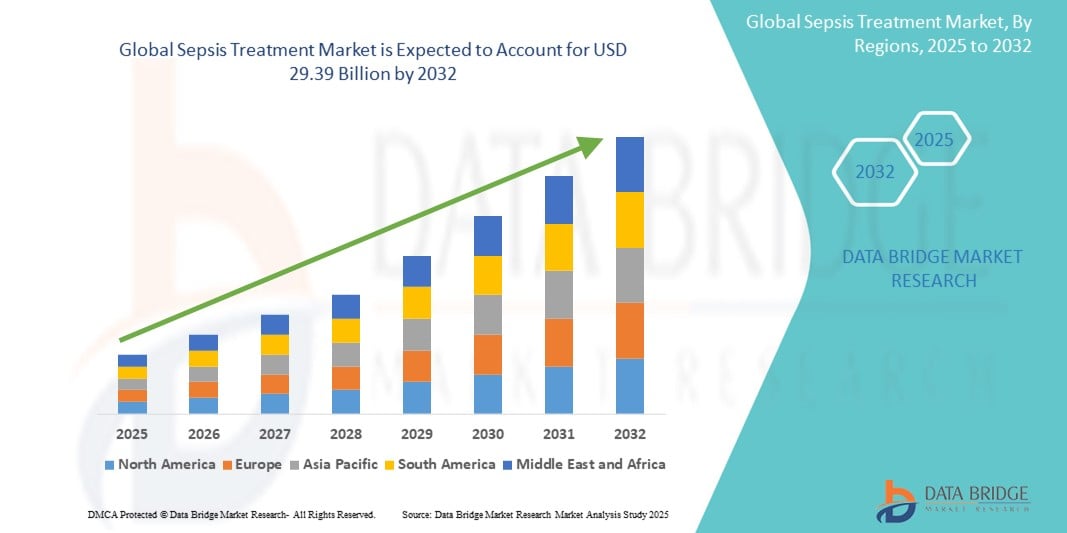
Sepsis Treatment Market Size
- The global sepsis treatment market size was valued at USD 17.10 billion in 2024 and is expected to reach USD 29.39 billion by 2032, at a CAGR of 7.00% during the forecast period
- The market growth is largely fueled by the increasing prevalence of sepsis cases worldwide and significant advancements in early diagnosis, antimicrobial therapies, and critical care management, leading to improved treatment outcomes in both hospital and ICU settings
- Furthermore, rising healthcare awareness, increasing investments in hospital infrastructure, and a growing demand for effective, rapid-response treatment options are establishing sepsis treatment as a critical area of focus in modern healthcare systems. These converging factors are accelerating the uptake of sepsis treatment solutions, thereby significantly boosting the industry's growth
Sepsis Treatment Market Analysis
- Sepsis treatment solutions, particularly intravenous antibiotics and vasopressors, are increasingly vital components of modern critical care protocols in both emergency and intensive care settings due to their effectiveness in managing rapid infection progression, organ dysfunction, and septic shock
- The escalating demand for sepsis treatment is primarily fueled by the rising global incidence of hospital-acquired infections, growing aging populations, and increasing awareness among healthcare professionals regarding early intervention strategies to reduce mortality
- North America dominated the sepsis treatment market with the largest revenue share of 41.8% in 2024, driven by advanced healthcare infrastructure, early adoption of innovative therapeutics, and strong reimbursement policies. The U.S. leads the region with substantial investment in sepsis detection and treatment technologies, alongside a high burden of chronic conditions that elevate sepsis risk
- Asia-Pacific is expected to be the fastest-growing region in the sepsis treatment market, projected to register a CAGR of 7.9% from 2025 to 2032, due to improving healthcare access, increasing government initiatives to reduce infectious disease mortality, and growing investment in hospital infrastructure in countries such as China and India
- Sepsis segment dominated the sepsis treatment market with a market share of 48.6% in 2024, driven by increasing awareness, early diagnostic interventions, and rising hospitalization rates for bloodstream infections
Report Scope and Sepsis Treatment Market Segmentation
|
Attributes |
Sepsis Treatment Key Market Insights |
|
Segments Covered |
|
|
Countries Covered |
North America
Europe
Asia-Pacific
Middle East and Africa
South America
|
|
Key Market Players |
|
|
Market Opportunities |
|
|
Value Added Data Infosets |
In addition to the insights on market scenarios such as market value, growth rate, segmentation, geographical coverage, and major players, the market reports curated by the Data Bridge Market Research also include in-depth expert analysis, pricing analysis, brand share analysis, consumer survey, demography analysis, supply chain analysis, value chain analysis, raw material/consumables overview, vendor selection criteria, PESTLE Analysis, Porter Analysis, and regulatory framework. |
Sepsis Treatment Market Trends
“Rising Burden of Infections and Demand for Early Intervention”
- The global sepsis treatment market is experiencing substantial growth due to the increasing prevalence of hospital-acquired infections, antimicrobial resistance, and aging populations with weakened immune systems. These factors are driving the urgent need for rapid, effective sepsis diagnosis and treatment
- According to global health estimates, sepsis affects over 49 million people annually and is responsible for 11 million deaths, making it a leading cause of preventable mortality. This rising disease burden has catalyzed healthcare providers and governments to invest in more advanced treatment modalities and early detection protocols
- The market is also being driven by the increased adoption of evidence-based sepsis care bundles, such as those recommended by the Surviving Sepsis Campaign. These include early goal-directed therapy, timely administration of broad-spectrum antibiotics, fluid resuscitation, and organ support interventions, all contributing to improved patient outcomes and higher treatment uptake
- Innovations in drug development, including the launch of next-generation antibiotics, immunomodulators, and monoclonal antibodies, are further expanding the treatment landscape. Biopharmaceutical companies are actively pursuing pipeline candidates that target the host immune response and mitigate the progression of sepsis to septic shock
- In addition, the growing awareness and implementation of sepsis screening protocols in emergency departments and ICUs are enabling faster diagnosis and timely therapeutic interventions. Combined with advances in diagnostic tools, this trend is significantly improving survival rates and enhancing the overall efficiency of sepsis care
Sepsis Treatment Market Dynamics
Driver
“Growing Need Due to Rising Infection Rates and Critical Care Demand”
- The rising incidence of sepsis cases globally, driven by bacterial, viral, and fungal infections, particularly in hospital settings, is a major factor fueling demand for effective sepsis treatment solutions
- For instance, in April 2024, InflaRx Pharmaceuticals Inc. advanced its monoclonal antibody IFX-1 (vilobelimab) into late-stage trials for sepsis-induced organ dysfunction. Such developments reflect the increasing investment by key players to address the unmet needs in critical care therapeutics
- As public health systems become more aware of the high mortality and healthcare burden associated with sepsis, there is growing demand for early diagnostic tools, rapid antibiotic administration, and effective supportive therapies to improve patient outcomes
- Furthermore, the aging population, rising antimicrobial resistance, and higher rates of hospital-acquired infections are accelerating the need for targeted therapies and advanced treatment strategies
- The increasing adoption of novel anti-inflammatory agents, immunomodulators, and advanced fluid management techniques in both emergency and intensive care settings is driving the evolution of the global sepsis treatment market
Restraint/Challenge
“Delayed Diagnosis and Limited Therapeutic Innovations”
- One of the critical challenges in sepsis management is the difficulty in rapid and accurate diagnosis, often resulting in delayed or inappropriate treatment initiation, which significantly increases morbidity and mortality rates
- For instance, many healthcare providers still rely on conventional biomarkers and blood cultures, which may take hours or even days to yield actionable results. This lag in diagnosis remains a major barrier to timely treatment
- In addition, the development of sepsis-specific therapeutics has been limited, with many clinical trials failing to demonstrate significant survival benefits, leading to cautious investment from pharmaceutical companies
- The high cost of newer biologics, limited access in low-income regions, and the complexity of patient-specific treatment approaches also restrict market growth
- Overcoming these barriers will require integrated efforts in biomarker innovation, development of point-of-care diagnostic tools, and personalized medicine strategies, alongside government support for critical care infrastructure and education
Sepsis Treatment Market Scope
The market is segmented on the basis of stages, pathogen type, mechanism of action, treatment, route of administration, end user, and distribution channel.
• By Stage
On the basis of stage, the sepsis treatment market is segmented into sepsis, severe sepsis, and septic shock. The sepsis segment dominated the market with the largest revenue share of 48.6% in 2024, driven by increasing awareness, early diagnostic interventions, and rising hospitalization rates for bloodstream infections.
The septic shock segment is expected to witness the fastest CAGR of 6.8% from 2025 to 2032, attributed to the growing number of critically ill patients requiring intensive care and vasopressor support.
• By Pathogen Type
On the basis of pathogen type, the market is segmented into bacteria, fungi, and virus. The Bacteria segment held the largest market share of 64.3% in 2024 due to the high incidence of gram-negative and gram-positive bacterial infections, especially in ICU settings.
The virus segment is projected to grow at the fastest CAGR of 7.2%, primarily fueled by emerging viral outbreaks and increased susceptibility among immunocompromised patients.
• By Mechanism of Action
On the basis of mechanism of action, the market is segmented into antibiotics, corticosteroids, vasoactive agents, analgesics, and others. The antibiotics segment accounted for the highest market share of 53.5% in 2024, as they remain the first-line therapy in sepsis management.
The vasoactive agents segment is anticipated to grow at a highest CAGR of 6.5% during the forecast period, driven by their use in managing hypotension in septic shock cases.
• By Treatment
On the basis of treatment, the market is segmented into drugs and surgery. The drugs segment held a dominant revenue share of 88.7% in 2024, supported by the extensive use of antimicrobial therapies, corticosteroids, and supportive medications.
The surgery segment is expected to witness the fastest CAGR from 2025 to 2032, with increasing relevance in cases requiring source control, such as drainage of abscesses or debridement of infected tissues.
• By Route of Administration
On the basis of route of administration, the market is segmented into oral, intravenous, and others. The intravenous segment captured the largest market share of 75.2% in 2024, driven by its effectiveness in delivering rapid systemic response in critical care.
The oral segment is expected to witness the fastest CAGR from 2025 to 2032, since it is primarily used in mild or recovering patients, while Others accounted for the remaining 6.3%.
• By End User
On the basis of end user, the Korea Aesthetic Market is segmented into hospitals, homecare, specialty clinics, and others.
The hospitals segment dominated the market with a revenue share of 67.9% in 2024, attributed to high patient inflow, the availability of advanced infrastructure, and the presence of skilled professionals to perform both surgical and non-surgical aesthetic procedures.
The homecare segment is expected to witness the fastest growth rate during the forecast period, driven by the increasing demand for minimally invasive and non-invasive procedures that can be administered in home settings, along with the growing popularity of portable aesthetic devices and tele-aesthetic consultations.
• By Distribution Channel
On the basis of distribution channel, the market is segmented into direct, online pharmacy, retailers, and others. The direct channel led the market with a 48.4% revenue share in 2024, owing to large-scale procurement by hospitals, dermatology clinics, and aesthetic centers for professional-grade equipment and supplies.
The online pharmacy segment is anticipated to grow at the fastest CAGR, driven by increased consumer preference for convenient, discreet purchases, the rise in e-commerce penetration, and the growing availability of cosmetic products and aesthetic devices through digital platforms.
Sepsis Treatment Market Regional Analysis
- North America dominated the sepsis treatment market with the largest revenue share of 41.8% in 2024, driven by the high prevalence of sepsis cases, strong healthcare infrastructure, and early adoption of advanced diagnostics and treatment protocols
- The presence of leading pharmaceutical and biotech companies, along with significant government funding for sepsis research and awareness campaigns, further supports market growth
- The region also benefits from early diagnosis via rapid testing systems, high ICU capacity, and adherence to standardized clinical care bundles
U.S. Sepsis Treatment Market Insight
The U.S. sepsis treatment market captured the largest revenue share of 82% within North America in 2024, fueled by high hospitalization rates, advanced healthcare infrastructure, and broad insurance coverage. Growing adoption of advanced diagnostic tools—such as biomarkers and molecular diagnostics—alongside an increase in FDA approvals for novel therapies is accelerating market growth. National initiatives by the CDC, including widespread sepsis awareness campaigns and standardized quality measures across hospitals, further support early detection and improved treatment outcomes.
Europe Sepsis Treatment Market Insight
The Europe sepsis treatment market is projected to expand at a robust CAGR of 7.9% during the forecast period, driven by the rising incidence of hospital-acquired infections and an aging population. Government support for antimicrobial stewardship and cross-country standardization of sepsis protocols are enhancing clinical outcomes. Furthermore, ongoing investments in health digitization, electronic health records (EHR), and integrated diagnostic tools across countries like Germany, France, and the U.K. are reinforcing early detection strategies in hospital settings.
U.K. Sepsis Treatment Market Insight
The U.K. sepsis treatment market is anticipated to grow at a noteworthy CAGR of 7.3%, bolstered by initiatives from the NHS to reduce preventable sepsis-related deaths. Programs such as the Sepsis Trust and NHS Sepsis CQUIN have significantly enhanced early screening and standardized treatment protocols across primary and emergency care. Public health awareness campaigns and workforce training initiatives continue to contribute to market expansion.
Germany Sepsis Treatment Market Insight
The Germany’s sepsis treatment market is expected to grow at a CAGR of 7.8% during the forecast period, fueled by a strong clinical research environment, advanced hospital infrastructure, and rapid adoption of digital diagnostic solutions. Collaborative efforts between academic institutions and hospitals are promoting innovation in immunotherapies and biomarker discovery. Increased ICU admissions and a focus on healthcare quality compliance further support demand for early and effective interventions.
Asia-Pacific Sepsis Treatment Market Insight
The Asia-Pacific sepsis treatment market is projected to grow at the fastest CAGR of 7.9% from 2025 to 2032, driven by a surge in healthcare-associated infections, improving hospital infrastructure, and rising healthcare accessibility in countries like China, Japan, and India. Regional growth is also supported by government programs aimed at early sepsis detection and increased participation from local pharmaceutical manufacturers offering cost-effective diagnostic tools and therapeutics.
Japan Sepsis Treatment Market Insight
The Japan sepsis treatment market is gaining traction, with a projected CAGR of 8.4%, propelled by an aging population and increased awareness among healthcare providers. Japan's emphasis on advanced ICU technologies and early intervention protocols is strengthening diagnosis and treatment outcomes. Government-backed infection prevention policies and ongoing digital integration in hospitals are also playing a key role in driving the market forward.
China Sepsis Treatment Market Insight
The China sepsis treatment market accounted for the largest market revenue share in Asia-Pacific in 2024, due to high sepsis-related hospitalization rates and substantial government investment in critical care services. The rapid growth of private healthcare providers, expansion of insurance coverage, and clinical trials for new treatments are propelling market development. In addition, China's accelerated adoption of AI-based diagnostic platforms and its robust domestic pharmaceutical manufacturing landscape further support the country's sepsis treatment market growth.
Sepsis Treatment Market Share
The sepsis treatment industry is primarily led by well-established companies, including:
- Abbott (U.S.)
- Pfizer Inc (U.S.)
- GSK plc (U.K.)
- Bristol-Myers Squibb Company (U.S.)
- AdrenoMed AG (Germany)
- AM-Pharma B.V. (Netherlands)
- Amomed Pharma GmbH (Austria)
- Asahi Kasei Corporation (Japan)
- ENDACEA (U.S.)
- InflaRx (Germany)
- Formosa Laboratories Inc. (U.S.)
- Lilly (U.S.)
- Takeda Pharmaceutical Company Limited (Japan)
- Eisai Co., Ltd (Japan)
- CirrusDx, Inc. (U.S.)
- AstraZeneca (U.K.)
- Merck & Co., Inc. (U.S.)
Latest Developments in Global Sepsis Treatment Market
- In April 2025, the Global Sepsis Innovations Platform (GSIP) was launched to accelerate the development of new tools and technologies for sepsis prevention, diagnosis, and treatment, with a particular focus on low- and middle-income countries. The initiative brings together stakeholders from across the globe to coordinate efforts in vaccines, AI-driven diagnostics, antimicrobial resistance solutions, and next-generation therapies. This strategic move reinforces global commitment to combating sepsis and reducing its significant mortality burden
- In March 2025, Mednition, a U.S.-based health tech company, introduced an advanced AI-powered clinical decision support tool for emergency departments. Their KATE platform achieved a 99% AUC score in identifying sepsis under Sepsis-3 criteria, enabling more accurate and early diagnosis. This advancement marks a significant step forward in integrating artificial intelligence into frontline sepsis care and improving patient outcomes in critical settings
- In February 2025, researchers at Osmania University in India developed a rapid and cost-effective sepsis diagnostic test using gold nanoparticles. The test, priced at Rs 500 and delivering results in 30 minutes, demonstrated nearly 90% accuracy. This innovation is specifically designed to benefit rural and resource-constrained areas, and it has already received a patent and commercialization grant to begin scaling its impact
- In January 2025, NeoTest, a global diagnostic initiative supported by organizations across India, South Africa, Kenya, and the U.S., launched a sepsis detection test for neonates. With a USD 120 million advance market commitment, the initiative aims to prevent hundreds of thousands of infant deaths annually by enabling faster and more reliable pathogen identification in newborns, especially in underserved regions
- In December 2024, Sepsis ImmunoScore, an AI-based biomarker identification platform, was recognized by Fast Company in its World Changing Ideas Awards. This technology enables clinicians to stratify sepsis patients more precisely and tailor treatments based on immunological profiles. The recognition highlights the growing importance of precision medicine and AI integration in sepsis treatment

- Interactive Data Analysis Dashboard
- Company Analysis Dashboard for high growth potential opportunities
- Research Analyst Access for customization & queries
- Competitor Analysis with Interactive dashboard
- Latest News, Updates & Trend analysis
- Harness the Power of Benchmark Analysis for Comprehensive Competitor Tracking
Data collection and base year analysis are done using data collection modules with large sample sizes. The stage includes obtaining market information or related data through various sources and strategies. It includes examining and planning all the data acquired from the past in advance. It likewise envelops the examination of information inconsistencies seen across different information sources. The market data is analysed and estimated using market statistical and coherent models. Also, market share analysis and key trend analysis are the major success factors in the market report. To know more, please request an analyst call or drop down your inquiry.
The key research methodology used by DBMR research team is data triangulation which involves data mining, analysis of the impact of data variables on the market and primary (industry expert) validation. Data models include Vendor Positioning Grid, Market Time Line Analysis, Market Overview and Guide, Company Positioning Grid, Patent Analysis, Pricing Analysis, Company Market Share Analysis, Standards of Measurement, Global versus Regional and Vendor Share Analysis. To know more about the research methodology, drop in an inquiry to speak to our industry experts.
Data Bridge Market Research is a leader in advanced formative research. We take pride in servicing our existing and new customers with data and analysis that match and suits their goal. The report can be customized to include price trend analysis of target brands understanding the market for additional countries (ask for the list of countries), clinical trial results data, literature review, refurbished market and product base analysis. Market analysis of target competitors can be analyzed from technology-based analysis to market portfolio strategies. We can add as many competitors that you require data about in the format and data style you are looking for. Our team of analysts can also provide you data in crude raw excel files pivot tables (Fact book) or can assist you in creating presentations from the data sets available in the report.












