


Sequencing Reagents Kits Market Overview
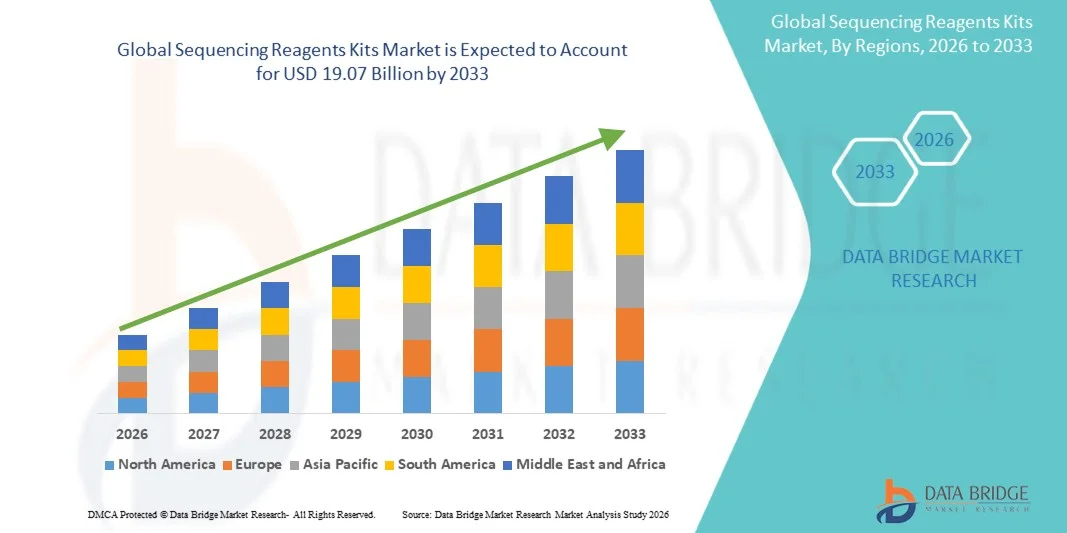
The Sequencing Reagents Kits Market was valued at USD 8.07 billion in 2025 and is projected to reach USD 19.07 billion by 2033, growing at a CAGR of 11.35% from 2026 to 2033. The market is experiencing consistent growth driven by rising demand for advanced genomic analysis solutions, increasing adoption of next-generation sequencing (NGS) technologies, and expanding applications across clinical diagnostics, precision medicine, biotechnology research, and pharmaceutical development.
The growing prevalence of genetic disorders, cancer, infectious diseases, and the increasing focus on personalized medicine are encouraging healthcare providers, research institutions, and biotechnology companies to adopt sequencing reagent kits for accurate and high-throughput genomic analysis. Advanced sequencing platforms and improved reagent formulations are enhancing sequencing accuracy, reducing turnaround time, and enabling cost-effective genomic testing. In addition, increasing investments in genomics research, biomarker discovery, and molecular diagnostics are accelerating the adoption of sequencing reagent kits across developed and emerging markets.
Key Market Trends & Insights
- North America dominated the Sequencing Reagents Kits Market with the largest revenue share of 38.6% in 2025, supported by the presence of leading genomics companies, advanced sequencing infrastructure, strong biotechnology research activities, and significant investments in precision medicine and genomic healthcare. The region benefits from widespread adoption of next-generation sequencing (NGS) technologies, increasing research funding, and growing demand for sequencing-based diagnostics across clinical, academic, and pharmaceutical applications.
- The next generation sequencing (NGS) segment dominated the market with a 62.5% share in 2025, supported by its widespread adoption in genomics research, clinical diagnostics, oncology testing, and personalized medicine applications.
- Asia-Pacific is expected to be the fastest-growing region at a CAGR of 10.2% from 2026 to 2033, fueled by expanding genomic research activities, increasing healthcare expenditure, rising adoption of precision medicine, and growing investments in biotechnology infrastructure across China, India, Japan, and South Korea. The region is witnessing rapid growth due to increasing clinical sequencing applications, government genomics initiatives, and expansion of sequencing facilities.
- RNA sequencing reagent kits are the fastest-growing product type, projected to register a CAGR of 11.1% from 2026 to 2033, reflecting increasing demand for transcriptomics research, gene expression analysis, cancer research, and biomarker discovery. Growing adoption of RNA-based studies in drug discovery and personalized medicine is accelerating the expansion of this segment.
- Research & academic institutions dominate the end-user category with a 35.7% revenue share in 2025, supported by extensive use of sequencing reagents kits in genomics research, molecular biology studies, and genetic analysis projects. Universities and research centers are increasingly adopting sequencing technologies for disease research, population genomics, and biological discovery applications.
Market Size & Forecast
- Global Market Value (2025): USD 8.07 Billion
- Expected Market Value (2033): USD 19.07 Billion
- Forecast CAGR (2026–2033): 11.35%
- Leading Region in 2025: North America
- Fastest Growing Region: Asia-Pacific
Report Scope and Sequencing Reagents Kits Market Segmentation
|
Attributes |
Sequencing Reagents Kits Key Market Insights |
|
Segments Covered |
|
|
Countries Covered |
North America · U.S. · Canada · Mexico Europe · Germany · France · U.K. · Netherlands · Switzerland · Belgium · Russia · Italy · Spain · Turkey · Rest of Europe Asia-Pacific · China · Japan · India · South Korea · Singapore · Malaysia · Australia · Thailand · Indonesia · Philippines · Rest of Asia-Pacific Middle East and Africa · Saudi Arabia · U.A.E. · South Africa · Egypt · Israel · Rest of Middle East and Africa South America · Brazil · Argentina · Rest of South America |
|
Key Market Players |
• Thermo Fisher Scientific Inc. (U.S.) Top of Form Bottom of Form |
|
Market Opportunities |
· Increasing adoption of next-generation sequencing (NGS) technologies in clinical diagnostics and precision medicine · Growing demand for genomic research, biomarker discovery, and personalized healthcare applications · Expansion of sequencing applications in oncology, infectious disease testing, and biotechnology research |
|
Value Added Data Infosets |
In addition to the insights on market scenarios such as market value, growth rate, segmentation, geographical coverage, and major players, the market reports curated by the Data Bridge Market Research also include in-depth expert analysis, geographically represented company-wise production and capacity, network layouts of distributors and partners, detailed and updated price trend analysis and deficit analysis of supply chain and demand. |
Sequencing Reagents Kits Market Trends
Trend: Expansion of Sequencing Reagents Kits in Precision Medicine and Genomic Research Applications
Healthcare providers, biotechnology companies, and research institutions are increasingly adopting sequencing reagents kits to support next-generation sequencing (NGS), whole-genome sequencing, transcriptomics, and molecular diagnostics applications. The growing demand for personalized medicine, cancer genomics, rare disease detection, and infectious disease surveillance is accelerating the adoption of advanced sequencing workflows. Sequencing reagent kits enable accurate sample preparation, library preparation, amplification, and sequencing analysis, improving efficiency and reducing turnaround time in genomic studies. For instance, pharmaceutical and biotechnology companies are increasingly using sequencing-based approaches for biomarker discovery, companion diagnostics development, and targeted therapy research. The expansion of large-scale genomic initiatives, such as population sequencing programs and precision healthcare projects, is further increasing demand for high-performance sequencing reagents across clinical and research laboratories.
Sequencing Reagents Kits Market Dynamics
Key Market Driver: Rising Adoption of Next-Generation Sequencing in Clinical Diagnostics and Drug Discovery
The increasing adoption of next-generation sequencing (NGS) technologies is a major driver for the Sequencing Reagents Kits Market. The growing need for high-throughput genomic analysis, faster disease diagnosis, and personalized treatment strategies is creating strong demand for advanced sequencing workflows. Pharmaceutical companies, academic institutions, and diagnostic laboratories are increasingly utilizing sequencing reagent kits for applications including oncology profiling, genetic disorder identification, infectious disease testing, and biomarker discovery. According to industry trends, global investments in genomics and precision medicine continue to increase, encouraging wider adoption of sequencing technologies in healthcare and research. The development of targeted sequencing panels, whole-exome sequencing, and RNA sequencing solutions is further expanding the application scope of sequencing reagents. In addition, increasing adoption of NGS-based companion diagnostics by pharmaceutical companies is supporting market growth by enabling patient-specific treatment selection and improving clinical decision-making.
Key Restraint/Challenge: High Cost and Technical Complexity of Sequencing Workflows
A significant challenge in the Sequencing Reagents Kits Market is the high cost associated with sequencing instruments, specialized reagents, laboratory infrastructure, and skilled technical expertise. Advanced sequencing workflows require continuous investment in consumables, quality control procedures, bioinformatics tools, and trained personnel, increasing operational expenses for laboratories and research organizations. The requirement for maintaining sequencing accuracy, managing large genomic datasets, and ensuring regulatory compliance creates additional complexity. Small and mid-sized laboratories, particularly in developing regions, may face adoption barriers due to limited infrastructure and funding availability. In addition, variations in sequencing platforms and reagent compatibility can create challenges for standardization across different laboratories. For instance, laboratories implementing NGS-based diagnostic workflows often require significant investment in sequencing equipment, data storage systems, and genomic interpretation capabilities to achieve reliable clinical outcomes.
Key Market Opportunity: Integration of Artificial Intelligence and Automation in Genomic Sequencing Workflows
The integration of artificial intelligence (AI), machine learning, and laboratory automation presents a significant growth opportunity for the sequencing reagents kits market. AI-driven genomic analysis platforms can improve interpretation of complex sequencing data, identify disease-associated genetic variations, and support faster clinical decision-making. Automation technologies are enabling higher sequencing throughput, reducing manual errors, and improving laboratory efficiency by streamlining sample preparation and processing workflows. The increasing adoption of cloud-based bioinformatics platforms is further enhancing data management and collaboration among researchers, healthcare providers, and pharmaceutical companies. Emerging markets across Asia-Pacific, including China and India, represent significant growth opportunities due to expanding genomics research programs, increasing healthcare investments, and rising adoption of precision medicine solutions. In addition, the growing application of sequencing technologies in oncology, rare disease diagnosis, and infectious disease monitoring is expected to further accelerate demand for advanced sequencing reagent kits globally.
Sequencing Reagents Kits Market Scope
The sequencing reagents Kits market is segmented on the basis of type, technology, application, and end user.
- By Type
On the basis of type, the Sequencing Reagents Kits Market is segmented into sequencing kits, control kits, template kits, library kits, and others. The Sequencing Kits segment dominated the market with a 38.7% share in 2025, owing to increasing adoption of next-generation sequencing (NGS) platforms, rising genomic research activities, and growing demand for high-throughput sequencing workflows. Sequencing kits play a critical role in DNA and RNA sequencing processes by providing essential reagents required for accurate and efficient genomic analysis. Increasing applications in oncology, rare disease diagnosis, infectious disease testing, and personalized medicine are driving demand for sequencing kits across clinical and research settings. Pharmaceutical companies and biotechnology organizations are increasingly adopting sequencing kits for biomarker discovery, drug development, and companion diagnostics. The growing number of genomic studies and expansion of precision medicine initiatives are further strengthening market growth. In addition, advancements in sequencing technologies and continuous improvements in reagent quality are enhancing sequencing accuracy and efficiency, supporting the leading position of this segment.
The library kits segment is expected to witness the fastest growth at a CAGR of 10.8% from 2026 to 2033, driven by increasing demand for efficient sample preparation and high-quality sequencing workflows. Library preparation is a crucial step in NGS processes, and advanced library kits enable faster processing, improved sequencing output, and better genomic analysis. Growing adoption of whole-genome sequencing, exome sequencing, and transcriptome analysis is increasing demand for advanced library preparation solutions. Pharmaceutical and biotechnology companies are increasingly using library kits for clinical research, drug discovery, and molecular diagnostics applications. The integration of automation technologies and improved reagent formulations is further accelerating segment growth. Increasing investments in genomics research and precision healthcare are expected to create significant opportunities for library kit manufacturers.
- By Technology
On the basis of technology, the Sequencing Reagents Kits Market is segmented into third generation sequencing, next generation sequencing, and sanger sequencing. The Next Generation Sequencing (NGS) segment dominated the market with a 62.5% share in 2025, supported by its widespread adoption in genomics research, clinical diagnostics, oncology testing, and personalized medicine applications. NGS technologies enable high-throughput sequencing of multiple genetic targets simultaneously, making them highly valuable for large-scale genomic studies. Increasing demand for faster and more accurate sequencing solutions is driving adoption across hospitals, research institutions, and biotechnology companies. The declining cost of sequencing and continuous technological advancements are further supporting market expansion. Pharmaceutical companies are increasingly utilizing NGS-based sequencing workflows for biomarker identification, drug development, and companion diagnostics. Growing government investments in genomic initiatives and precision medicine programs are also contributing to the dominance of this segment.
The third generation sequencing segment is expected to register the fastest CAGR of 12.1% from 2026 to 2033, driven by increasing demand for long-read sequencing technologies and advanced genomic analysis. Third-generation sequencing provides advantages such as real-time sequencing, longer reads, and improved detection of complex genetic variations. Rising applications in rare disease research, structural variant analysis, and personalized medicine are supporting segment growth. Increasing adoption of technologies such as single-molecule sequencing is expanding opportunities for advanced sequencing reagent solutions. Research organizations and biotechnology companies are investing in third-generation sequencing platforms to improve genomic understanding and diagnostic capabilities.
- By Application
On the basis of application, the Sequencing Reagents Kits Market is segmented into agrigenomics and forensics, clinical investigation, preventive health, Oncology, and Other Applications. The oncology segment dominated the market with a 36.4% share in 2025, driven by increasing adoption of genomic sequencing for cancer diagnosis, biomarker identification, and targeted therapy selection. Sequencing reagent kits are widely used in cancer research to analyze genetic mutations and support personalized treatment strategies. The growing prevalence of cancer worldwide and increasing demand for precision oncology solutions are significantly contributing to segment growth. Pharmaceutical companies are increasingly utilizing sequencing technologies in clinical trials and drug development programs for cancer therapies. The adoption of liquid biopsy, tumor profiling, and companion diagnostics is further increasing demand for sequencing reagents. In addition, advancements in genomic analysis are improving cancer detection accuracy and treatment outcomes.
The clinical investigation segment is expected to witness the fastest growth at a CAGR of 11.3% from 2026 to 2033, driven by increasing use of sequencing technologies in clinical research, disease diagnosis, and biomarker discovery. Growing adoption of genomic testing for rare diseases, infectious diseases, and personalized medicine is accelerating demand for sequencing reagent kits. Clinical laboratories are increasingly integrating sequencing-based approaches to improve diagnostic accuracy and treatment decisions. Expansion of clinical research activities and increasing investments in molecular diagnostics are further supporting segment growth.
- By End User
On the basis of end user, the Sequencing Reagents Kits Market is segmented into pharmaceutical and biotechnology companies, hospitals and clinics, academic and research institutes, and other end users. The pharmaceutical and biotechnology companies segment dominated the market with a 42.3% share in 2025, supported by increasing adoption of sequencing technologies in drug discovery, biomarker research, clinical trials, and precision medicine development. Pharmaceutical companies are increasingly utilizing sequencing reagent kits to support genomic analysis, companion diagnostics, and development of targeted therapies. Growing investments in biotechnology research and expansion of biologics and personalized medicine pipelines are driving demand for sequencing solutions. The segment benefits from increasing outsourcing of sequencing-based research activities and rising demand for advanced molecular analysis. In addition, pharmaceutical companies are adopting sequencing technologies to improve drug development efficiency and patient-specific treatment strategies.
The hospitals and clinics segment is expected to witness the fastest CAGR of 11.5% from 2026 to 2033, driven by increasing adoption of genomic diagnostics, cancer testing, and personalized healthcare solutions. Hospitals are increasingly integrating sequencing-based testing into clinical workflows to enable faster and more accurate disease diagnosis. Rising healthcare investments, improving diagnostic infrastructure, and growing awareness regarding genetic testing are supporting segment expansion. The increasing adoption of precision medicine approaches in clinical settings is expected to further accelerate demand for sequencing reagent kits.
Sequencing Reagents Kits Market Regional Analysis
North America dominated the Sequencing Reagents Kits Market and accounted for the largest revenue share of 38.6% in 2025, supported by the presence of leading genomics companies, advanced sequencing infrastructure, strong biotechnology research activities, and significant investments in precision medicine and genomic healthcare. The region benefits from widespread adoption of next-generation sequencing (NGS) technologies, increasing research funding, and growing demand for sequencing-based diagnostics across clinical, academic, pharmaceutical, and biotechnology applications. Strong healthcare infrastructure, availability of advanced laboratory facilities, and increasing use of sequencing solutions in oncology, genetic testing, and drug discovery are further strengthening North America’s leadership position in the global market.
U.S. Sequencing Reagents Kits Market Insight
The U.S. sequencing reagents kits market is witnessing strong growth due to rising investments in genomic research, precision medicine, and advanced molecular diagnostics. The country’s strong biotechnology ecosystem, presence of major sequencing technology companies, and increasing adoption of NGS platforms are driving demand for sequencing reagent kits across clinical laboratories, research institutions, and pharmaceutical companies. Growing applications in cancer genomics, infectious disease detection, biomarker discovery, and personalized healthcare are further accelerating market expansion. In addition, increasing government and private-sector funding for genomics initiatives is supporting the development and adoption of advanced sequencing technologies.
Europe Sequencing Reagents Kits Market Insight
The Europe sequencing reagents kits market remains a major contributor to global revenue, driven by increasing adoption of genomic technologies, strong research infrastructure, and growing focus on precision healthcare. The region benefits from rising investments in biotechnology research, clinical sequencing applications, and molecular diagnostics. Countries across Europe are increasingly utilizing sequencing reagent kits for oncology research, rare disease diagnosis, infectious disease monitoring, and pharmaceutical development. In addition, government-supported genomics programs, expanding sequencing facilities, and collaborations between academic institutions and biotechnology companies are supporting market growth throughout the region.
U.K. Sequencing Reagents Kits Market Insight
The U.K. sequencing reagents kits market is experiencing steady growth, supported by increasing adoption of genomic sequencing in healthcare, research, and pharmaceutical applications. The country’s strong academic research ecosystem, advanced healthcare infrastructure, and focus on precision medicine are driving demand for sequencing-based technologies. Increasing utilization of sequencing reagent kits in clinical diagnostics, genetic disease research, and population genomics initiatives is contributing to market expansion. Furthermore, investments in genomic healthcare programs and collaborations between research organizations and biotechnology companies are strengthening the U.K.’s position in the sequencing industry.
Germany Sequencing Reagents Kits Market Insight
The Germany sequencing reagents kits market is expanding steadily due to strong biotechnology capabilities, advanced healthcare infrastructure, and increasing investments in genomic research. The country’s well-established pharmaceutical and life sciences sector is driving demand for sequencing reagent kits across drug discovery, molecular diagnostics, and clinical research applications. Increasing adoption of NGS-based testing, precision medicine approaches, and advanced genomic analysis solutions is supporting market growth. In addition, Germany’s focus on healthcare innovation, research funding, and development of advanced sequencing facilities is further enhancing adoption of sequencing technologies.
Asia-Pacific Sequencing Reagents Kits Market Insight
The Asia-Pacific sequencing reagents kits market is expected to be the fastest-growing region at a CAGR of 10.2% from 2026 to 2033, fueled by expanding genomic research activities, increasing healthcare expenditure, rising adoption of precision medicine, and growing investments in biotechnology infrastructure across China, India, Japan, and South Korea. The region is witnessing rapid growth due to increasing clinical sequencing applications, government genomics initiatives, and expansion of sequencing facilities. Rising demand for genetic testing, infectious disease diagnostics, and personalized healthcare solutions is creating significant opportunities for sequencing reagent kit manufacturers across emerging markets.
Japan Sequencing Reagents Kits Market Insight
The Japan sequencing reagents kits market is witnessing consistent growth due to increasing investments in genomics research, advanced healthcare technologies, and precision medicine applications. The country’s strong biotechnology sector, aging population healthcare needs, and focus on early disease detection are driving adoption of sequencing-based diagnostics. Increasing use of sequencing reagent kits in oncology, genetic disorder analysis, and pharmaceutical research is supporting market expansion. Moreover, collaborations between universities, research institutions, and biotechnology companies are accelerating innovation in sequencing technologies across Japan.
China Sequencing Reagents Kits Market Insight
The China sequencing reagents kits market is growing rapidly, driven by expanding genomic research activities, rising healthcare investments, and increasing government focus on biotechnology and precision medicine. Growing adoption of NGS technologies across hospitals, research institutions, and pharmaceutical companies is significantly boosting demand for sequencing reagent kits. The country’s increasing focus on genetic testing, infectious disease surveillance, population genomics, and biomedical research is supporting market growth. In addition, expansion of sequencing facilities, increasing domestic biotechnology capabilities, and rising investments in advanced molecular diagnostics are positioning China as one of the fastest-growing markets for sequencing reagents globally.
Sequencing Reagents Kits Market Share
The Sequencing Reagents Kits industry is primarily led by well-established companies, including:
- Thermo Fisher Scientific Inc. (U.S.)
- Illumina, Inc. (U.S.)
- F. Hoffmann-La Roche Ltd. (Switzerland)
- QIAGEN N.V. (Netherlands)
- Bio-Rad Laboratories, Inc. (U.S.)
- Agilent Technologies, Inc. (U.S.)
- BGI Group (China)
- Oxford Nanopore Technologies plc (United Kingdom)
- PerkinElmer, Inc. (U.S.)
- Takara Bio Inc. (Japan)
- Promega Corporation (U.S.)
- New England Biolabs, Inc. (U.S.)
- Merck KGaA (Germany)
- Danaher Corporation (U.S.)
- Pacific Biosciences of California, Inc. (U.S.)
- Eurofins Scientific (Luxembourg)
- Integrated DNA Technologies, Inc. (U.S.)
- Zymo Research Corporation (U.S.)
- Bioline (Meridian Bioscience) (U.S.)
- GenScript Biotech Corporation (China)
- Azenta Life Sciences (U.S.)
- Tecan Group Ltd. (Switzerland)
- Hamilton Company (U.S.)
- Norgen Biotek Corp. (Canada)
- SeqMatic LLC (U.S.)
- Element Biosciences, Inc. (U.S.)
- Singular Genomics Systems, Inc. (U.S.)
- MGI Tech Co., Ltd. (China)
- Bioneer Corporation (South Korea)
- CD Genomics (U.S.)
- Macrogen Inc. (South Korea)
- Novogene Co., Ltd. (China)
- Twist Bioscience Corporation (U.S.)
- GeneMind Biosciences (China)
Latest Developments in Sequencing Reagents Kits Market
- In January 2022, Illumina announced the launch of its NextSeq 1000 and NextSeq 2000 XLEAP-SBS Reagent Kits, designed to improve sequencing performance, flexibility, and workflow efficiency for next-generation sequencing applications. The new reagent chemistry was developed to provide faster sequencing runs, improved data quality, and enhanced operational reliability for applications including oncology research, infectious disease studies, and genomic analysis. This development strengthened Illumina’s sequencing reagent portfolio by addressing the growing demand for high-throughput and cost-efficient sequencing solutions across research and clinical laboratories
- In March 2022, Oxford Nanopore Technologies expanded its sequencing consumables portfolio with improvements to its nanopore sequencing chemistry and library preparation workflows, supporting higher accuracy and broader genomic applications. The enhanced sequencing kits and reagents were designed to improve long-read sequencing capabilities, enabling applications such as whole-genome sequencing, transcriptomics, and pathogen surveillance. This advancement supported the increasing adoption of nanopore-based sequencing technologies in research institutes, clinical laboratories, and biotechnology applications
- In June 2023, Thermo Fisher Scientific expanded its Ion Torrent™ sequencing portfolio with new sequencing kits and reagent solutions supporting targeted sequencing, RNA sequencing, and genomic research applications. The company continued developing Ion Torrent sequencing reagents to improve library preparation, template processing, and sequencing workflow efficiency. These innovations supported growing demand for scalable sequencing solutions in clinical research, oncology testing, and precision medicine applications
- In January 2024, Illumina introduced updates to its NovaSeq X Series sequencing workflow, including enhancements to reagent kits and sequencing capabilities designed to support large-scale genomic and multiomic research. The updated NovaSeq X Series reagent solutions incorporated advanced XLEAP-SBS chemistry, enabling high-quality sequencing output for applications such as whole-genome sequencing, single-cell analysis, and spatial transcriptomics. This development highlighted the continued shift toward high-throughput sequencing platforms requiring advanced reagent technologies
- In June 2024, Illumina launched XLEAP-SBS™ Reagent Kits for the NextSeq 1000 and NextSeq 2000 sequencing platforms, replacing earlier standard SBS reagent kits with improved chemistry designed for enhanced sequencing speed and robustness. The new reagent kits were developed to improve sequencing performance, reduce workflow interruptions, and support a broad range of genomic applications including targeted sequencing, RNA sequencing, and research workflows. This launch demonstrated the company’s focus on improving reagent efficiency and sequencing reliability
- In October 2024, Illumina announced the launch of the MiSeq™ i100 Series sequencing platform along with supporting reagent solutions, targeting broader accessibility of sequencing technologies for smaller laboratories and research facilities. The new system was designed to provide faster sequencing turnaround times and simplified workflows, while the associated reagent ecosystem supported applications such as infectious disease research, oncology panels, and genomic testing. This development reflected the increasing market demand for compact sequencing solutions with easier reagent handling and lower operational complexity
- In January 2025, Illumina announced updates to the NovaSeq X Series, including new NovaSeq X 25B 100-cycle and 200-cycle reagent kits along with software enhancements to support multiomic applications. The updated reagent kits were designed to improve sequencing flexibility and enable laboratories to perform advanced genomic studies, including single-cell research, spatial biology, and large-scale sequencing projects. This advancement reinforced Illumina’s focus on expanding sequencing reagent applications beyond traditional genomics into emerging precision medicine fields
- In October 2025, Illumina launched the MiSeq i100 Series 25M Reagent Kit (1000 cycles), enabling longer read sequencing applications on the MiSeq i100 platform. The new reagent kit supported extended sequencing workflows, including 2×501 bp sequencing applications, allowing researchers to analyze larger genomic regions with improved flexibility. This launch highlighted ongoing innovation in sequencing reagent technologies aimed at expanding the capabilities of benchtop sequencing systems
- In December 2025, Illumina continued optimizing its sequencing reagent portfolio by transitioning selected NextSeq 1000/2000 standard SBS consumables toward newer XLEAP-SBS chemistry solutions. The transition reflected the company’s strategy to improve sequencing workflow performance, simplify consumable offerings, and provide laboratories with advanced reagent technologies supporting modern genomic applications. This development demonstrated the broader industry movement toward higher-performance sequencing reagents with improved reliability and efficiency

- Interactive Data Analysis Dashboard
- Company Analysis Dashboard for high growth potential opportunities
- Research Analyst Access for customization & queries
- Competitor Analysis with Interactive dashboard
- Latest News, Updates & Trend analysis
- Harness the Power of Benchmark Analysis for Comprehensive Competitor Tracking
Data collection and base year analysis are done using data collection modules with large sample sizes. The stage includes obtaining market information or related data through various sources and strategies. It includes examining and planning all the data acquired from the past in advance. It likewise envelops the examination of information inconsistencies seen across different information sources. The market data is analysed and estimated using market statistical and coherent models. Also, market share analysis and key trend analysis are the major success factors in the market report. To know more, please request an analyst call or drop down your inquiry.
The key research methodology used by DBMR research team is data triangulation which involves data mining, analysis of the impact of data variables on the market and primary (industry expert) validation. Data models include Vendor Positioning Grid, Market Time Line Analysis, Market Overview and Guide, Company Positioning Grid, Patent Analysis, Pricing Analysis, Company Market Share Analysis, Standards of Measurement, Global versus Regional and Vendor Share Analysis. To know more about the research methodology, drop in an inquiry to speak to our industry experts.
Data Bridge Market Research is a leader in advanced formative research. We take pride in servicing our existing and new customers with data and analysis that match and suits their goal. The report can be customized to include price trend analysis of target brands understanding the market for additional countries (ask for the list of countries), clinical trial results data, literature review, refurbished market and product base analysis. Market analysis of target competitors can be analyzed from technology-based analysis to market portfolio strategies. We can add as many competitors that you require data about in the format and data style you are looking for. Our team of analysts can also provide you data in crude raw excel files pivot tables (Fact book) or can assist you in creating presentations from the data sets available in the report.













