


Serum Separation Gel Market Size
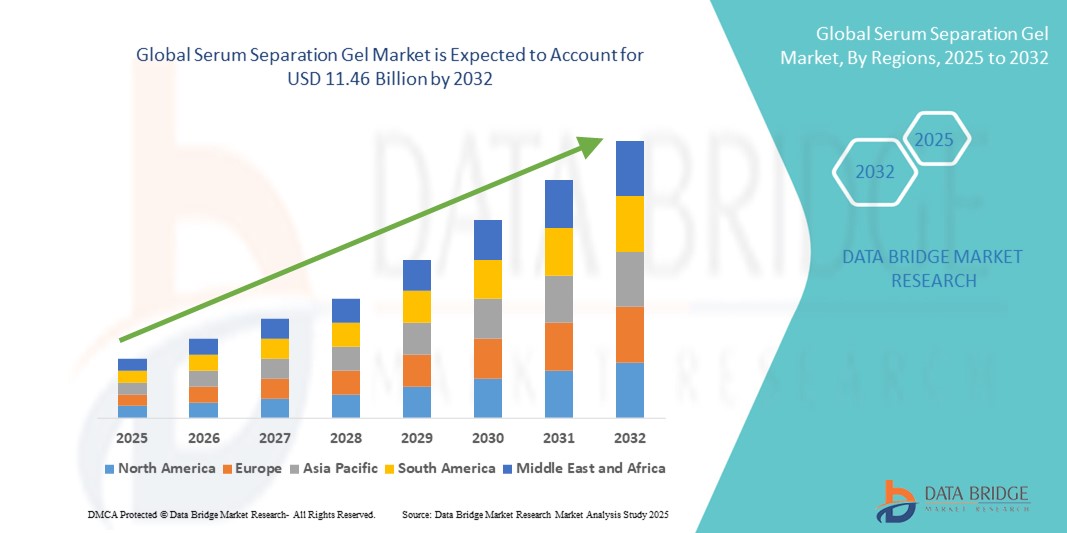
- The global serum separation gel market size was valued at USD 7.21 billion in 2024 and is expected to reach USD 11.46 billion by 2032, at a CAGR of 5.98% during the forecast period
- The market growth is primarily driven by the rising demand for accurate and efficient diagnostic testing, particularly in clinical laboratories and hospitals, where serum separation gels play a crucial role in improving sample integrity and reducing contamination
- Moreover, the increasing prevalence of chronic diseases and the expanding geriatric population have elevated the need for routine blood tests, further fueling demand for high-quality blood collection and separation products. These combined trends are propelling the adoption of serum separation gels, thereby significantly contributing to the market’s expansion
Serum Separation Gel Market Analysis
- Serum separation gels, used in blood collection tubes to efficiently separate serum from cellular components during centrifugation, are vital for ensuring accurate and contamination-free diagnostic results in clinical, research, and pharmaceutical applications
- The rising demand for serum separation gels is primarily driven by the global increase in diagnostic testing volumes, a growing focus on preventive healthcare, and the expanding burden of chronic and infectious diseases requiring regular blood monitoring
- North America dominated the serum separation gel market with the largest revenue share of 39.5% in 2024, owing to advanced diagnostic infrastructure, the presence of major healthcare providers, and widespread adoption of standardized blood collection systems, particularly in the U.S. where high testing volumes support consistent product demand
- Asia-Pacific is expected to be the fastest growing region in the serum separation gel market during the forecast period due to improving healthcare access, rising patient awareness, and increasing government investments in diagnostic capabilities
- Clinical diagnostics segment dominated the serum separation gel market with a market share of 49.2% in 2024, attributed to the high usage of serum separation tubes in routine blood tests and disease screening programs in hospitals and diagnostic labs
Report Scope and Serum Separation Gel Market Segmentation
|
Attributes |
Serum Separation Gel Key Market Insights |
|
Segments Covered |
|
|
Countries Covered |
North America
Europe
Asia-Pacific
Middle East and Africa
South America
|
|
Key Market Players |
|
|
Market Opportunities |
|
|
Value Added Data Infosets |
In addition to the insights on market scenarios such as market value, growth rate, segmentation, geographical coverage, and major players, the market reports curated by the Data Bridge Market Research also include in-depth expert analysis, pricing analysis, brand share analysis, consumer survey, demography analysis, supply chain analysis, value chain analysis, raw material/consumables overview, vendor selection criteria, PESTLE Analysis, Porter Analysis, and regulatory framework. |
Serum Separation Gel Market Trends
Technological Advancements Enhancing Diagnostic Precision and Workflow Efficiency
- A significant and accelerating trend in the global serum separation gel market is the innovation in gel formulations designed to improve diagnostic accuracy and laboratory efficiency. These advancements are enhancing serum purity, reducing pre-analytical errors, and supporting automation in high-throughput laboratory settings
- For instance, several leading manufacturers have developed thermally stable, thixotropic polymer gels that ensure clear separation and reduce the risk of sample contamination, even during extended storage and transport
- New-generation serum separation tubes now integrate clot activators and are optimized for faster clotting times and improved centrifugation efficiency. This allows laboratories to reduce turnaround time and increase workflow reliability in both routine and urgent diagnostic testing
- Moreover, gel tube designs are increasingly being tailored for compatibility with robotic and automated sample processing systems, aligning with the trend toward fully automated laboratories. These innovations allow for consistent performance, reduced manual handling, and higher throughput, especially in clinical and research institutions
- The growing focus on diagnostic precision, efficiency, and automation is fundamentally reshaping expectations for pre-analytical blood processing products. Consequently, companies are investing in advanced gel technologies to meet evolving demands across healthcare systems, diagnostics labs, and research environments
- The demand for technologically advanced serum separation gels that offer improved stability, compatibility, and processing efficiency is growing steadily across both developed and emerging markets, as laboratories increasingly prioritize quality and reliability in sample processing
Serum Separation Gel Market Dynamics
Driver
Growing Demand from Clinical Diagnostics and Routine Blood Testing
- The increasing prevalence of chronic and lifestyle-related diseases, coupled with the global emphasis on preventive health and early diagnosis, is significantly driving the demand for serum separation gels in routine blood testing and clinical diagnostics
- For instance, the growing volume of diagnostic tests performed in hospitals, outpatient clinics, and diagnostic laboratories requires reliable serum separation products that ensure consistent sample quality for accurate results
- Serum separation gels offer several advantages such as reduced hemolysis, enhanced sample clarity, and minimal interference with test reagents, making them essential in both routine and specialized diagnostic panels
- Furthermore, healthcare infrastructure development in emerging markets and rising awareness about disease monitoring have led to increased adoption of standardized blood collection and processing methods, further supporting the growth of the serum separation gel market
- The rising global health burden and the growing importance of lab-based diagnostics are making serum separation gels an integral part of pre-analytical processes, with increasing adoption observed across clinical, pharmaceutical, and research sectors
Restraint/Challenge
Potential for Sample Integrity Issues and Regulatory Compliance Challenges
- Concerns over sample integrity, particularly due to improper storage, transportation, or incompatible gel formulations, pose a significant challenge in the serum separation gel market. Improper separation may lead to inaccurate test results, affecting diagnosis and patient outcomes
- For instance, environmental conditions such as extreme temperatures can alter the performance of certain gel types, especially in regions lacking robust cold chain logistics, increasing the risk of serum contamination or clot disruption
- In addition, stringent regulatory frameworks across global markets impose rigorous validation, quality assurance, and compliance protocols on manufacturers, particularly for products used in clinical diagnostics. These regulatory requirements can increase development costs and time-to-market
- Companies must also navigate diverse international regulations such as FDA approvals in the U.S. and CE marking in Europe, which can be resource-intensive, especially for small and mid-sized manufacturers
- Moreover, cost pressures in resource-constrained healthcare systems may lead to preference for conventional blood collection methods over gel-based solutions. Addressing these challenges through high-quality, cost-effective innovations, global compliance alignment, and clinician training will be essential for sustained market expansion
Serum Separation Gel Market Scope
The market is segmented on the basis of application, product type, and end user.
- By Application
On the basis of application, the serum separation gel market is segmented into clinical diagnostics, blood banking, research, and pharmaceuticals. The clinical diagnostics segment dominated the market with the largest market revenue share of 49.2% in 2024, driven by the rising demand for routine blood testing and diagnostic investigations related to chronic and infectious diseases. The high frequency of blood sample analysis in hospitals and diagnostic labs has resulted in widespread usage of serum separation gels to ensure sample integrity and accuracy. Their ability to provide reliable separation of serum from blood components is critical for precise test results.
The blood banking segment is expected to witness the fastest growth rate of 19.3% from 2025 to 2032, as the global demand for blood components continues to rise. Serum separation gels are increasingly utilized in blood banks to improve plasma and serum collection quality and facilitate long-term storage, helping reduce contamination and extend shelf life.
- By Product Type
On the basis of product type, the serum separation gel market is segmented into serum separation gel integrated with tube and serum separation gel without tubes. The serum separation gel integrated with tube segment held the largest market revenue share of 55.3% in 2024, owing to its convenience, reduced handling errors, and ability to streamline pre-analytical processing in high-volume settings. These integrated products are favored in hospitals and laboratories where operational efficiency and sample reliability are essential.
The serum separation gel without tubes segment is projected to grow at the fastest CAGR during the forecast period due to its flexibility in custom applications, particularly in research and pharmaceutical sectors, where specific sample preparation protocols often require tailored gel solutions.
- By End User
On the basis of end user, the serum separation gel market is segmented into hospitals, diagnostic laboratories, blood banks, research institutions, and pharmaceutical companies. The hospitals segment dominated the market with the largest revenue share of 41.9% in 2024, attributed to the large volume of blood tests conducted for both inpatient and outpatient services. Hospitals require high-quality serum separation to ensure accurate diagnostics, treatment planning, and monitoring of patients.
The diagnostic laboratories segment is expected to register the fastest growth rate of 20.5% from 2025 to 2032, driven by the increasing outsourcing of diagnostic services, rising lab automation, and expanding use of high-throughput testing systems that rely on standardized, gel-based blood collection solutions for efficiency and accuracy.
Serum Separation Gel Market Regional Analysis
- North America dominated the serum separation gel market with the largest revenue share of 39.5% in 2024, owing to advanced diagnostic infrastructure, the presence of major healthcare providers, and widespread adoption of standardized blood collection systems, particularly in the U.S. where high testing volumes support consistent product demand
- Healthcare providers in the region prioritize accuracy, efficiency, and reliability in diagnostics, making serum separation gels a critical component of blood sample processing in hospitals and laboratories
- This strong market position is further supported by well-established healthcare infrastructure, extensive diagnostic networks, and the presence of leading medical device and diagnostic companies, contributing to widespread adoption of serum separation products across both clinical and research settings
U.S. Serum Separation Gel Market Insight
The U.S. serum separation gel market captured the largest revenue share of 79% in 2024 within North America, fueled by the country’s advanced diagnostic infrastructure and high volume of routine blood testing. A growing aging population and the rising incidence of chronic diseases continue to drive demand for reliable, high-throughput blood collection solutions. The widespread adoption of automation in clinical laboratories, coupled with a strong focus on accuracy and contamination prevention, supports the consistent use of serum separation gels across hospitals and diagnostic labs.
Europe Serum Separation Gel Market Insight
The Europe serum separation gel market is projected to expand at a substantial CAGR throughout the forecast period, primarily driven by stringent diagnostic standards and the growing emphasis on preventive healthcare. The increase in chronic disease screening and government-led health initiatives across countries such as Germany, France, and Italy are accelerating the use of high-quality serum separator tubes. The demand for standardized and efficient sample handling is encouraging healthcare providers across the region to adopt advanced serum separation gel products for improved diagnostic performance.
U.K. Serum Separation Gel Market Insight
The U.K. serum separation gel market is anticipated to grow at a noteworthy CAGR during the forecast period, driven by an increasing demand for accurate diagnostic solutions and strong government support for modernizing healthcare services. With a well-established NHS system and a high rate of blood testing, serum separation gels are essential for supporting streamlined lab operations. Growing research investments and public health initiatives are also contributing to product adoption in both clinical and academic research settings.
Germany Serum Separation Gel Market Insight
The Germany serum separation gel market is expected to expand at a considerable CAGR during the forecast period, fueled by the country’s focus on clinical precision, automation in diagnostic laboratories, and an aging population requiring regular health monitoring. The adoption of serum separation gels is increasing in both public and private healthcare sectors, with a preference for advanced, polymer-based formulations. Germany’s reputation for medical innovation and efficiency is driving demand for reliable, high-performance blood processing products.
Asia-Pacific Serum Separation Gel Market Insight
The Asia-Pacific serum separation gel market is poised to grow at the fastest CAGR of 21% during the forecast period of 2025 to 2032, driven by increasing healthcare access, expanding diagnostic networks, and rising investments in laboratory infrastructure. Countries such as China, India, and Japan are rapidly adopting serum separation technologies to meet the growing demand for routine and preventive diagnostics. Government initiatives promoting early disease detection and improved patient outcomes are also strengthening the regional market.
Japan Serum Separation Gel Market Insight
The Japan serum separation gel market is gaining momentum due to the country’s advanced healthcare system, strong demand for diagnostic precision, and growing elderly population. High testing volumes in hospitals and outpatient clinics are contributing to widespread use of standardized serum separation tubes. Japan’s focus on technological innovation and efficiency supports the integration of high-quality gel-based products into clinical and research diagnostics, aligning with the nation’s emphasis on medical excellence and patient safety.
India Serum Separation Gel Market Insight
The India serum separation gel market accounted for the largest market revenue share in Asia Pacific in 2024, attributed to rapid healthcare infrastructure development, increased diagnostic awareness, and growing demand for affordable, high-volume blood testing solutions. The expanding network of diagnostic laboratories and public health programs focused on disease screening have led to greater use of serum separation gel tubes. In addition, the presence of domestic manufacturers offering cost-effective, quality-assured products is driving market growth across urban and semi-urban regions.
Serum Separation Gel Market Share
The Serum Separation Gel industry is primarily led by well-established companies, including:
- Greiner Bio-One International GmbH (Austria)
- BD (U.S.)
- Terumo Corporation (Japan)
- FL Medical S.r.l. (Italy)
- Improve Medical Instruments Co., Ltd. (China)
- SARSTEDT AG & Co. KG (Germany)
- Kawasumi Laboratories, Inc. (Japan)
- Hindustan Syringes & Medical Devices Ltd. (India)
- TUDOR International Pty Ltd. (Australia)
- Nipro Corporation (Japan)
- Vitrex Medical A/S (Denmark)
- Sunphoria Co., Ltd. (South Korea)
- LABORATORIOS CONDA S.A. (Spain)
- SEKISUI CHEMICAL CO., LTD. (Japan)
- Lohmann & Rauscher GmbH & Co. KG (Germany)
- Medline Industries, LP (U.S.)
- Narang Medical Limited (India)
- Shandong Weigao Group Medical Polymer Co., Ltd. (China)
- Zhejiang Gongdong Medical Technology Co., Ltd. (China)
- Shanghai Kindly Enterprise Development Group Co., Ltd. (China)
What are the Recent Developments in Global Serum Separation Gel Market?
- In May 2024, Greiner Bio-One International GmbH, a key player in pre-analytical and diagnostics solutions, introduced an enhanced version of its VACUETTE serum separation tubes featuring an advanced polymer gel formulation. The innovation aims to improve serum clarity, reduce processing times, and support high-throughput diagnostic testing. This development reflects Greiner’s commitment to optimizing lab efficiency and ensuring accurate diagnostic results in both routine and emergency medical settings
- In April 2024, BD (Becton, Dickinson and Company) expanded its blood collection product line by launching BD Vacutainer SST Advance tubes in select European markets. The tubes feature a redesigned gel that improves barrier formation during centrifugation, minimizing sample contamination and improving stability for downstream testing. This advancement highlights BD’s dedication to advancing diagnostic safety and performance through continuous innovation in blood collection technologies
- In March 2024, Improve Medical, a China-based diagnostics company, announced the launch of a new range of serum separation gel tubes compliant with EU MDR regulations. The product series targets hospitals and labs seeking CE-certified, cost-effective pre-analytical solutions for clinical diagnostics. This strategic move strengthens Improve Medical’s presence in global markets and demonstrates its focus on regulatory alignment and product performance
- In February 2024, Terumo Corporation unveiled new gel tube products for blood analysis under its Venoject® brand, incorporating enhanced separation technology designed for compatibility with automated analyzers. These gel tubes aim to reduce hemolysis and improve serum yield, particularly in high-volume hospital labs across Asia-Pacific. Terumo’s innovation supports the region’s growing demand for automation-friendly diagnostic tools
- In January 2024, FL Medical, an Italian manufacturer of laboratory consumables, expanded its serum separation tube production capacity by opening a new facility dedicated to pre-analytical product development. The expansion is expected to increase supply to European and Middle Eastern markets, ensuring consistent availability of high-quality gel-based tubes. This initiative reflects the company’s strategic effort to meet rising global demand for reliable blood collection and processing solutions

- Interactive Data Analysis Dashboard
- Company Analysis Dashboard for high growth potential opportunities
- Research Analyst Access for customization & queries
- Competitor Analysis with Interactive dashboard
- Latest News, Updates & Trend analysis
- Harness the Power of Benchmark Analysis for Comprehensive Competitor Tracking
Data collection and base year analysis are done using data collection modules with large sample sizes. The stage includes obtaining market information or related data through various sources and strategies. It includes examining and planning all the data acquired from the past in advance. It likewise envelops the examination of information inconsistencies seen across different information sources. The market data is analysed and estimated using market statistical and coherent models. Also, market share analysis and key trend analysis are the major success factors in the market report. To know more, please request an analyst call or drop down your inquiry.
The key research methodology used by DBMR research team is data triangulation which involves data mining, analysis of the impact of data variables on the market and primary (industry expert) validation. Data models include Vendor Positioning Grid, Market Time Line Analysis, Market Overview and Guide, Company Positioning Grid, Patent Analysis, Pricing Analysis, Company Market Share Analysis, Standards of Measurement, Global versus Regional and Vendor Share Analysis. To know more about the research methodology, drop in an inquiry to speak to our industry experts.
Data Bridge Market Research is a leader in advanced formative research. We take pride in servicing our existing and new customers with data and analysis that match and suits their goal. The report can be customized to include price trend analysis of target brands understanding the market for additional countries (ask for the list of countries), clinical trial results data, literature review, refurbished market and product base analysis. Market analysis of target competitors can be analyzed from technology-based analysis to market portfolio strategies. We can add as many competitors that you require data about in the format and data style you are looking for. Our team of analysts can also provide you data in crude raw excel files pivot tables (Fact book) or can assist you in creating presentations from the data sets available in the report.













