What is the Shaving Foam Market Size and Growth Rate?
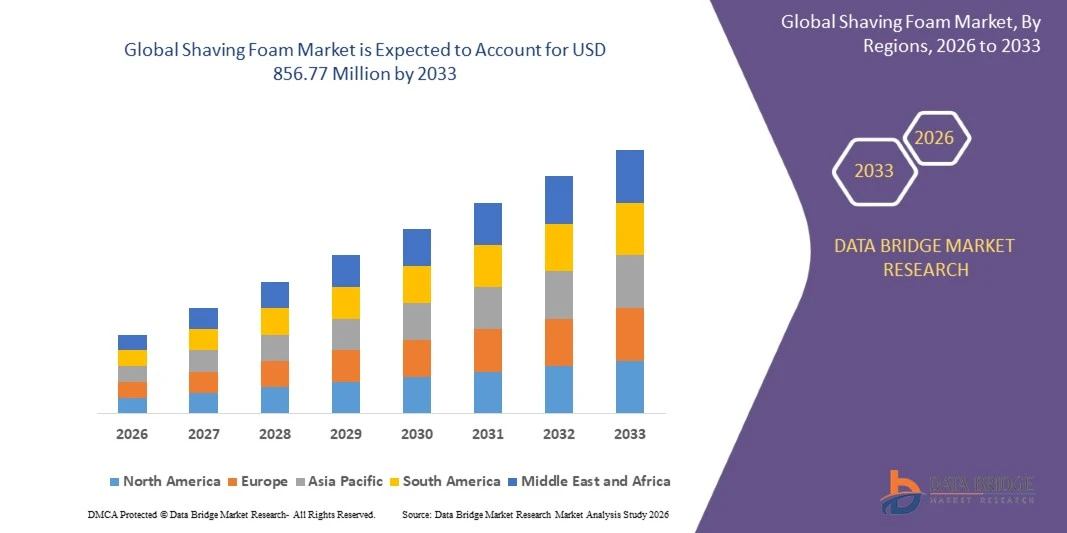
- As per Data Bridge Market Research analysis, the shaving foam market was valued at USD 597.88 million in 2025 and is projected to reach USD 856.77 million by 2033, growing at a CAGR of 4.60% from 2026 to 2033.
- The market is experiencing consistent growth driven by rising demand for convenient and effective shaving products, increasing consumer awareness of personal grooming and skincare, and expanding availability of shaving foam products across online and offline retail channels.
- The growing emphasis on personal hygiene and grooming, combined with increasing demand for products that provide smooth shaving and reduce skin irritation, is encouraging consumers to adopt specialized shaving formulations. Aerosol and non-aerosol shaving foams, including products designed for sensitive skin and those containing natural ingredients, are gaining traction as manufacturers focus on improved skin comfort, product performance, and convenient application.
Market Size & Forecast
- Global Market Value (2025): USD 597.88 Million
- Expected Market Value (2033): USD 856.77 Million
- Forecast CAGR (2026–2033): 4.60%
- Leading Region in 2025: North America
- Fastest Growing Region: Asia Pacific
What are the Major Takeaways of the Shaving Foam Market?
- North America dominated the shaving foam market with the largest revenue share of 34.5% in 2025, supported by high consumer spending on personal grooming products, strong brand presence, established retail distribution networks, and growing demand for premium shaving formulations.
- Asia-Pacific is expected to be the fastest-growing region at a CAGR of 6.23% from 2026 to 2033, fueled by rising disposable incomes, increasing urbanization, and growing demand for personal grooming products across China, India, and Japan.
- The conventional segment led the market with a 77.82% share in 2025, driven by established consumer preferences, competitive pricing, and widespread availability through traditional retail channels.
- Organic are the fastest-growing product type, projected to register a CAGR of 6.58%, reflecting the surge in naturally derived ingredients and ingredient transparency.
- The aerosol shaving foam segment dominated the type category with 75.82% revenue share in 2025, led by convenient dispensing, consistent foam formation, and widespread consumer familiarity.
- Men accounted for 85.02% of the market share in 2025, preferred by established facial-shaving routines and sustained demand for everyday grooming products.
- The women segment is the fastest-growing consumer category, with a CAGR of 7.05%, driven by increasing demand for convenient body-hair removal and specialized grooming products.
Report Scope and Shaving Foam Market Segmentation
|
Attributes |
Shaving Foam Key Market Insights |
|
Segments Covered |
|
|
Countries Covered |
North America
Europe
Asia-Pacific
Middle East and Africa
South America
|
|
Key Market Players |
|
|
Market Opportunities |
|
|
Value Added Data Infosets |
In addition to the insights on market scenarios such as market value, growth rate, segmentation, geographical coverage, and major players, the market reports curated by the Data Bridge Market Research also include in-depth expert analysis, pricing analysis, brand share analysis, consumer survey, demography analysis, supply chain analysis, value chain analysis, raw material/consumables overview, vendor selection criteria, PESTLE Analysis, Porter Analysis, and regulatory framework. |
What is the Key Trend in the Shaving Foam Market?
- Manufacturers are increasingly developing shaving foams with moisturizing, soothing, and sensitive-skin benefits to meet growing consumer demand for comfortable shaving and improved skin protection.
- For instance, in March 2025, Wilkinson Sword launched a new men's grooming range featuring shaving foam and gel designed for sensitive skin. The products include Pro-Vitamin B5 and are dermatologically tested and alcohol-free, reflecting the trend toward skin-friendly shaving formulations that prioritize comfort and reduce irritation
- Product differentiation increasingly focuses on skin comfort, fragrance, hydration, and formulations tailored to different skin types.
- Personal care brands are also emphasizing ingredient transparency and natural-inspired formulations to appeal to consumers seeking gentler grooming products.
- For instance, in September 2024, VI John India introduced its Premium Shaving Cream and Special Moisturising Formula-based Shaving Foam, highlighting the focus on moisturizing benefits and enhanced shaving experiences in men's grooming products.
- As consumers increasingly seek convenient grooming products that combine shaving performance with skincare benefits, manufacturers are expected to prioritize specialized formulations, product innovation, and enhanced skin comfort.
What are the Key Drivers of the Shaving Foam Market?
- The rising awareness of personal grooming and increasing consumer spending on men's skincare are driving demand for shaving foams that provide lubrication, reduce razor friction, and improve shaving comfort.
- For instance, in October 2025, Gillette India reported that its grooming segment revenue increased by approximately 3% to INR 6.66 billion for the quarter ended September 30, 2025, supported by sustained demand for grooming products such as razors and shaving creams. This highlights how rising personal grooming and self-care habits are supporting demand for shaving-related products
- Manufacturers are expanding product availability and developing specialized shaving formulations to serve consumers seeking convenient, effective, and skin-friendly grooming solutions.
- For instance, in October 2024, Gillette India reported a 23% increase in core grooming segment revenue to INR 6.49 billion for the quarter ended September 30, 2024, driven by strong demand for grooming products, including razors and shaving creams, alongside increased demand in rural markets. This demonstrates how growing consumer demand across urban and rural markets can support shaving product sales
- With consumers increasingly prioritizing convenient grooming routines and skin comfort, demand for differentiated shaving foam products is expected to support continued market growth.
What Factors are Challenging the Growth of the Shaving Foam Market?
- Shaving foam manufacturers face increasing costs associated with formulation development, aerosol packaging, product safety testing, and compliance with cosmetic regulations, which can place pressure on profit margins.
- For instance, in December 2024, the U.K. Office for Product Safety and Standards published updated guidance on the Aerosol Dispensers Regulations 2009, outlining safety testing, labelling, and conformity-marking requirements for aerosol products. These compliance obligations can increase testing and regulatory costs for shaving foam manufacturers using pressurized aerosol packaging.
- These requirements can create additional barriers for smaller manufacturers seeking to introduce new products or expand into markets with strict packaging and consumer safety standards.
- In addition, the European Union adopted Regulation (EU) 2025/40 on packaging and packaging waste in January 2025, establishing requirements intended to improve packaging sustainability and reduce environmental impacts.
- For instance, in January 2025, the European Union adopted Regulation (EU) 2025/40 on packaging and packaging waste, introducing requirements concerning packaging sustainability, recyclability, labelling, and waste reduction. Compliance may require shaving foam manufacturers to redesign packaging and invest in more sustainable materials, increasing product development and packaging costs
- Regulatory compliance, packaging redesign, and manufacturing expenses may continue to challenge smaller brands and price-sensitive market participants, making cost efficiency and compliant product innovation increasingly important for sustained growth.
How is the Shaving Foam Market Segmented?
The shaving foam market is segmented on the basis of product, type, consumer, and distribution channel.
- By Product
On the basis of product, the shaving foam market is segmented into organic and conventional products. The conventional segment dominated the market with 77.82% share in 2025, owing to established consumer preferences, competitive pricing, and widespread availability through traditional retail channels. Conventional shaving foams are widely used for everyday grooming because they provide convenient application and effective razor lubrication. Established brands offer multiple formulations, fragrances, and pack sizes to serve different consumer preferences. Strong brand recognition and extensive distribution networks support repeat purchases. Their accessibility across different price ranges further strengthens demand.
The organic shaving foam segment is projected to register the fastest growth at CAGR of 6.58% through 2033, driven by rising interest in naturally derived ingredients and ingredient transparency. Consumers are increasingly exploring personal care products containing botanical extracts, plant-derived oils, and skin-conditioning ingredients. Growing awareness of skincare is encouraging manufacturers to develop formulations positioned for gentle shaving and skin comfort. Premium grooming brands are expanding natural-inspired product offerings to differentiate themselves in a competitive market. Online retail enables specialist brands to reach consumers seeking alternative formulations.
- By Type
On the basis of type, the shaving foam market is segmented into aerosol shaving foam and non-aerosol shaving foam. The aerosol shaving foam segment dominated the market with 75.82% share in 2025, supported by convenient dispensing, consistent foam formation, and widespread consumer familiarity. Aerosol products produce ready-to-use lather that helps soften facial hair and improve razor glide. Their ease of application makes them suitable for everyday grooming routines. Established manufacturers benefit from mature production capabilities and extensive retail distribution. A wide selection of fragrances, formulations, and pack sizes supports consumer choice.
The non-aerosol shaving foam segment is projected to register the fastest growth at CAGR of 5.23% through 2033, driven by interest in alternative dispensing systems and reduced reliance on pressurized packaging. Pump-based products can provide convenient application without conventional aerosol propellants. Manufacturers are exploring packaging designs that support product usability and material efficiency. Increasing attention to packaging sustainability is encouraging innovation in alternative formats. Online channels help emerging brands introduce specialized products to targeted consumer groups. Continued improvements in foam quality, dispensing performance, and packaging design may encourage wider adoption.
- By Consumer
On the basis of consumer, the shaving foam market is segmented into men and women. The men's segment dominated the market with 75.02% share in 2025, supported by established facial-shaving routines and sustained demand for everyday grooming products. Shaving foam helps soften facial hair and improve razor movement across the skin. Leading brands offer products designed for different beard types and skin sensitivities. Growing awareness of skincare is encouraging demand for moisturizing and soothing formulations. Widespread availability through supermarkets, pharmacies, and online retailers supports repeat purchases. Established grooming habits continue to strengthen the segment's leading position.
The women's segment is projected to register the fastest growth at CAGR of 7.05% through 2033, driven by increasing demand for convenient body-hair removal and specialized grooming products. Consumers are seeking formulations that support smooth shaving and skin comfort. Moisturizing ingredients and sensitive-skin positioning are encouraging manufacturers to develop products tailored to women's grooming preferences. Greater product variety is helping brands serve different skin types and fragrance preferences. E-commerce platforms improve access to specialized and premium grooming products. Continued product innovation and changing personal care routines may support the segment's expansion.
- By Distribution Channel
On the basis of distribution channel, the shaving foam market is segmented into hypermarkets, supermarkets, and departmental stores, specialty stores, and online retail. Hypermarkets, supermarkets, and departmental stores dominated the distribution channel with 46.92% share in 2025, supported by broad product assortments, convenient access, and established consumer shopping habits. These outlets allow shoppers to compare brands, formulations, and pack sizes in one location. Promotional discounts and multi-pack offers encourage repeat purchases. Strong shelf visibility helps established brands reach a wide consumer base. Physical retail also supports the routine purchase of everyday grooming essentials. Extensive store networks continue to underpin this channel's leading position.
The online retail segment is projected to register the fastest growth at an approximate CAGR of 7.62% through 2033, driven by expanding e-commerce adoption and convenient home delivery. Online platforms offer access to a broad range of brands, formulations, and price points. Product descriptions and customer reviews help consumers compare grooming products before purchasing. Digital promotions and subscription-based replenishment can encourage repeat orders. Direct-to-consumer channels allow manufacturers to reach niche audiences without relying exclusively on physical retail. Improvements in delivery services and digital shopping experiences are further supporting adoption. These advantages are expected to strengthen online retail's role in shaving foam distribution
Which Region Holds the Largest Share of the Shaving Foam Market?
- North America dominated the shaving foam market with the largest revenue share of 34.5% in 2025, supported by high consumer spending on personal grooming products, strong brand presence, established retail distribution networks, and growing demand for premium shaving formulations.
- The region also benefits from well-developed retail distribution networks, high consumer awareness of skincare and grooming, and steady demand for premium shaving formulations. The availability of shaving foam products through supermarkets, pharmacies, specialty stores, and online platforms further strengthens North America's leading position in the global market.
U.S. Shaving Foam Market Insight
The U.S. shaving foam market is witnessing steady growth due to rising consumer spending on personal grooming products, increasing awareness of skincare, and sustained demand for convenient shaving solutions. The country's established personal care industry, along with the strong presence of leading grooming brands and extensive retail distribution networks, is driving demand across conventional and premium product categories. In addition, growing consumer interest in moisturizing formulations, sensitive-skin products, and convenient online purchasing is supporting market expansion.
Asia-Pacific Shaving Foam Market Insight
The Asia-Pacific shaving foam market is expected to witness rapid growth, driven by rising disposable incomes, increasing urbanization, and growing awareness of personal grooming across countries such as China, India, and Japan. Expanding middle-class populations, increasing availability of branded personal care products, and growing adoption of e-commerce platforms are supporting regional market expansion. Additionally, rising demand for convenient shaving solutions, specialized skin-friendly formulations, and affordable grooming products is accelerating adoption across diverse consumer groups.
Japan Shaving Foam Market Insight
The Japan shaving foam market is witnessing consistent growth due to rising interest in personal grooming, established skincare routines, and demand for convenient and high-quality shaving products. Personal care manufacturers are focusing on advanced formulations that provide smooth razor glide, moisturizing benefits, and improved comfort for sensitive skin. Moreover, increasing preference for premium grooming products, compact packaging, and convenient shopping through online and specialty retail channels is contributing to market development.
China Shaving Foam Market Insight
The China shaving foam market is growing steadily, driven by increasing urbanization, rising disposable incomes, and growing consumer awareness of personal grooming and skincare. Expanding e-commerce infrastructure and the growing availability of domestic and international personal care brands are significantly improving product accessibility. In addition, rising demand for premium grooming products, moisturizing formulations, and convenient shaving solutions is encouraging manufacturers to expand their product portfolios, supporting China's growing importance in the global shaving foam market.
U.K. Shaving Foam Market Insight
The U.K. shaving foam market is experiencing steady growth, supported by established grooming habits, increasing consumer interest in skincare, and demand for convenient personal care products. The presence of well-established retailers and leading grooming brands supports broad product availability across supermarkets, pharmacies, specialty stores, and online platforms. Furthermore, growing interest in sensitive-skin formulations, ingredient transparency, and sustainable packaging is encouraging product innovation and supporting continued market development.
Germany Shaving Foam Market Insight
The Germany shaving foam market is expanding steadily due to established personal care consumption, strong retail infrastructure, and growing demand for effective and skin-friendly grooming products. Consumers are increasingly seeking formulations that combine efficient shaving performance with moisturizing and soothing benefits. Continuous product development by personal care manufacturers, alongside increasing interest in ingredient-conscious formulations and packaging sustainability, is supporting market innovation. In addition, the widespread availability of shaving products through supermarkets, drugstores, and e-commerce channels is further contributing to market growth.
Which are the Top Companies in Shaving Foam Market?
The shaving foam industry is primarily led by well-established companies, including:
- Procter & Gamble Company (U.S.)
- Beiersdorf AG (Germany)
- Edgewell Personal Care Company (U.S.)
- Colgate-Palmolive Company (U.S.)
- Unilever PLC (U.K.)
- L’Oréal (France)
- Perio, Inc. (U.S.)
- Vi-John Group (India)
- Bombay Shaving Company (India)
- Harry’s, Inc. (U.S.)
- DORCO CO., LTD. (South Korea)
- Godrej Consumer Products Limited (India)
- Dabur India Limited (India)
- Emami Limited (India)
- NIVEA (Germany)
- Barbasol (U.S.)
- The Boots Company PLC (U.K.)
- Taylor of Old Bond Street Limited (U.K.)
- Proraso (Italy)
What are Latest Developments in Shaving Foam Market?
- In March 2025, Wilkinson Sword launched a new men's grooming range that included shaving foam, shaving gel, and aftershave lotion. The shaving foam and gel formulations feature Pro-Vitamin B5 and are designed to support sensitive-skin care, while the range emphasizes a more complete pre- and post-shave routine. The launch expanded Wilkinson Sword's presence beyond blades into complementary grooming products, reflecting growing industry attention to shaving comfort and skincare benefits.
- In September 2024, VI John India introduced its Premium Shaving Cream and Special Moisturising Formula-based Shaving Foam, showcasing the products through a promotional initiative during Ganesh Chaturthi. The company created an eight-foot Ganpati sculpture using shaving cream and foam, bringing attention to its recently launched grooming products. The initiative combined product promotion with a cultural event and highlighted the brand's focus on shaving and personal-care products for Indian consumers.
- In March 2023, Barbasol launched its “Can of Can-Do” brand campaign, featuring its iconic barber-pole-striped shaving cream can. The nationwide campaign used television advertising and social media to reinforce the brand's association with a close, comfortable shave and its long-standing presence in the grooming market. The initiative highlights how established shaving product manufacturers are using brand-led campaigns to maintain consumer engagement and strengthen product recognition.
- In September 2021, Pacific Shaving Company launched its #ShaveWithPurpose collection, comprising six moisturizing shaving creams in different colors for men and women. The company announced that 10% of proceeds from each sale would support nonprofit organizations addressing health and social causes. The launch combined shaving product innovation with cause-related marketing, demonstrating how grooming brands can differentiate their offerings through consumer engagement and social responsibility.
- In January 2021, Reckitt announced a £4 million investment in Bombay Shaving Company, supporting the Indian grooming brand's plans to scale its operations and expand its portfolio across shaving, bath and body, skincare, and beard care. The investment was intended to provide access to Reckitt's global expertise and resources, reflecting growing corporate interest in expanding innovative grooming brands and strengthening their market presence.
- Interactive Data Analysis Dashboard
- Company Analysis Dashboard for high growth potential opportunities
- Research Analyst Access for customization & queries
- Competitor Analysis with Interactive dashboard
- Latest News, Updates & Trend analysis
- Harness the Power of Benchmark Analysis for Comprehensive Competitor Tracking
Data collection and base year analysis are done using data collection modules with large sample sizes. The stage includes obtaining market information or related data through various sources and strategies. It includes examining and planning all the data acquired from the past in advance. It likewise envelops the examination of information inconsistencies seen across different information sources. The market data is analysed and estimated using market statistical and coherent models. Also, market share analysis and key trend analysis are the major success factors in the market report. To know more, please request an analyst call or drop down your inquiry.
The key research methodology used by DBMR research team is data triangulation which involves data mining, analysis of the impact of data variables on the market and primary (industry expert) validation. Data models include Vendor Positioning Grid, Market Time Line Analysis, Market Overview and Guide, Company Positioning Grid, Patent Analysis, Pricing Analysis, Company Market Share Analysis, Standards of Measurement, Global versus Regional and Vendor Share Analysis. To know more about the research methodology, drop in an inquiry to speak to our industry experts.
Data Bridge Market Research is a leader in advanced formative research. We take pride in servicing our existing and new customers with data and analysis that match and suits their goal. The report can be customized to include price trend analysis of target brands understanding the market for additional countries (ask for the list of countries), clinical trial results data, literature review, refurbished market and product base analysis. Market analysis of target competitors can be analyzed from technology-based analysis to market portfolio strategies. We can add as many competitors that you require data about in the format and data style you are looking for. Our team of analysts can also provide you data in crude raw excel files pivot tables (Fact book) or can assist you in creating presentations from the data sets available in the report.