


What is the Shock Sensor Market Size and Growth Rate?
- As per Data Bridge Market Research analysis, the Shock Sensor market was valued at USD 1.5 billion in 2025 and is projected to reach USD 7.63 billion by 2033, growing at a CAGR of 22.50% from 2026 to 2033
- The market is experiencing robust growth as a result of increasing demand for automotive safety systems, rapid expansion of consumer electronics and IoT devices, and growing emphasis on asset protection and real-time condition monitoring across various industries.
- The global shock sensor market has evolved significantly, with industries increasingly prioritizing asset protection, safety, and real-time condition monitoring in their operations. Shock sensors, which are precision monitoring instruments engineered to identify sudden mechanical impacts or vibrations and translate physical stimuli into electrical signals for immediate system activation or analysis, have gained substantial traction across the automotive, aerospace, consumer electronics, industrial, and logistics sectors.The global shock sensor market is poised for continued expansion in the coming years, driven by the escalating demand for advanced safety systems and the rapid growth of the automotive and consumer electronics industries worldwide.
Market Size & Forecast
- Global Market Value (2025): USD 1.5 Billion
- Expected Market Value (2033): USD 7.63 Billion
- Forecast CAGR (2026 to 2033): 22.50%
- Leading Region in 2025: North America
- Fastest Growing Region: Asia Pacific
What are the Major Takeaways of the Shock Sensor Market?
- North America dominated the global shock sensor market with the largest revenue share in 2025, supported by advanced automotive and aerospace sectors, well-established industrial automation infrastructure, and high adoption of advanced safety technologies across the region. North America held a revenue share of 34.3% in 2024.
- Asia Pacific is expected to be the fastest-growing region, reflecting a surge in consumer electronics and automotive applications, rapid industrialization, and expanding manufacturing sectors. Asia Pacific is anticipated to grow at a CAGR of 23.16% during the forecast period.
- The piezoelectric sensors segment accounted for the largest market share of over 35.6% in 2023, driven by their high sensitivity, reliability, and widespread adoption across automotive safety systems and industrial applications.
- The automotive security systems segment dominated the application category, driven by the increasing demand for advanced driver assistance systems (ADAS), airbag deployment systems, and crash detection modules in modern vehicles.
- The industrial automation segment is emerging as the fastest-growing end-use sector, driven by increasing adoption of predictive maintenance, equipment protection systems, and real-time condition monitoring across manufacturing facilities.
- The digital output segment is the fastest-growing output signal type, projected to register a CAGR of 22.6% from 2026 to 2033, driven by increasing demand for digital signal processing, integration with IoT platforms, and real-time data analytics capabilities.
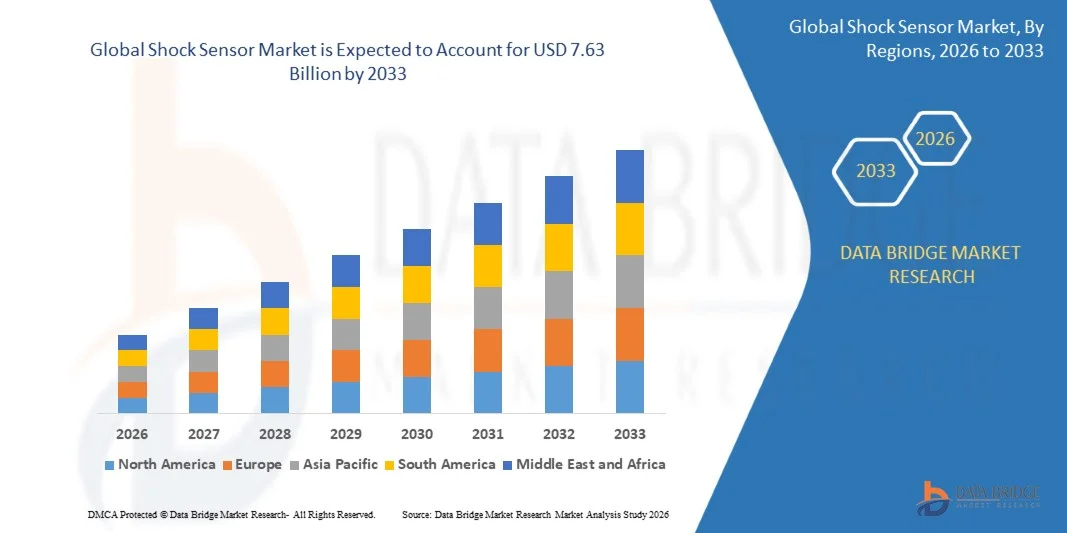
Report Scope and Shock Sensor Market Segmentation
|
Attributes |
Shock Sensor Key Market Insights |
|
Segments Covered |
|
|
Countries Covered |
North America
Europe
Asia-Pacific
Middle East and Africa
South America
|
|
Key Market Players |
|
|
Market Opportunities |
|
|
Value Added Data Infosets |
In addition to the market insights such as market value, growth rate, market segments, geographical coverage, market players, and market scenario, the market report curated by the Data Bridge Market Research team includes in-depth expert analysis, import/export analysis, pricing analysis, production consumption analysis, and pestle analysis. |
What is the Key Trend in the Shock Sensor Market?
- The shock sensor market is experiencing significant transformation as a result of increasing demand for IoT-enabled condition monitoring, growing integration of AI and edge computing platforms, and the rising emphasis on predictive maintenance and asset protection across industries.
- The trend toward miniaturization and MEMS-based designs is reshaping the market landscape, with manufacturers developing ultra-compact shock sensors suitable for integration in smartphones, wearables, and compact IoT devices.
- The shock sensor market is witnessing increased adoption of wireless and battery-efficient sensors, which have significantly expanded remote monitoring applications in logistics, construction, and industrial equipment.
- For instance, integration with IoT platforms allows shock sensors to transmit real-time data to cloud-based dashboards, enabling remote monitoring, event tracking, and automated alert systems.
- For instance, in May 2025, STMicroelectronics released the LSM6DSV320X, the industry's first AI-enabled inertial measurement unit (IMU) with a unique dual-accelerometer design, combining sensors tuned for activity tracking and high-g impact measurement in a single 3mm x 2.5mm module.
- As industries continue to prioritize asset protection, operational efficiency, and predictive maintenance, the adoption of advanced shock sensors is expected to accelerate, reinforcing sensing technology as a core component of modern industrial automation, automotive safety, and logistics monitoring systems.
What are the Key Drivers of the Shock Sensor Market?
- The rapid advancement of automotive safety systems and the rollout of Advanced Driver Assistance Systems (ADAS) has significantly increased demand for high-precision shock sensors capable of detecting impacts and vibrations in real time.
- For instance, the U.S. Department of Transportation reports that the use of advanced safety technology, such as shock sensors, has helped decrease traffic-related fatalities and injuries.
- Automotive OEMs, Tier-1 suppliers, and technology companies are integrating shock sensors into their product development cycles to enhance vehicle safety, enable airbag deployment, and protect high-voltage batteries in electric powertrains during accidents.
- The rapid growth of Industrial IoT and predictive maintenance solutions is significantly driving market growth. Manufacturing plants are increasingly utilizing vibration and shock sensors on heavy equipment to forecast failures before they happen, reducing expensive downtime.
- The expanding logistics and supply chain operations are driving demand for shock sensors to monitor fragile cargo during transit. Companies deploy shock sensors embedded in packaging or containers to detect potentially damaging impacts during transit.
- With the industrial and automotive sectors increasingly relying on sensor-based monitoring to accelerate innovation and ensure safety, shock sensors will remain indispensable for the development of connected vehicles, smart manufacturing, and intelligent logistics solutions.
Which Factors are Challenging the Growth of the Shock Sensor Market?
- High initial deployment costs serve as a significant restraint, as implementing advanced shock sensors requires substantial investment in hardware, software, and infrastructure.
- For instance, high-sensitivity sensors demand exact calibration to differentiate between routine vibrations and genuine damaging impacts, resulting in higher implementation expenses and an increased risk of false positives.
- Price competition from low-cost imports, particularly from China, suppresses revenue growth despite volume increases. For instance, MEMS sensors gain share from mechanical types, but price erosion limits value growth.
- Prolonged global semiconductor supply chain disruptions and regulatory fragmentation that discourages cross-border product standardization further challenge the market.
- The high capital investment and recurring operational costs continue to restrict adoption, particularly among small and medium-sized enterprises and cost-sensitive markets, slowing market penetration in price-sensitive regions.
How is the Shock Sensor Market Segmented?
The Shock Sensor market is segmented on the basis of type, output signal, application, and end-use.
- By Type
On the basis of type, the global shock sensor market is segmented into piezoelectric sensors, piezoresistive sensors, strain gage sensors, and others. The piezoelectric sensors segment dominated the market with a 35.60% share in 2025, driven by high sensitivity, reliability, and extensive use in demanding industrial, automotive, and aerospace applications. These sensors deliver precise impact detection and durability, making them the preferred choice for critical safety and monitoring systems. The widespread adoption of piezoelectric sensors in airbag deployment systems and structural health monitoring is further reinforcing their leading position in the market.
The MEMS-based sensors segment is projected to register the fastest growth at a CAGR of 23.80% from 2026 to 2033, driven by increasing demand for miniaturized, low-power sensors in consumer electronics, wearables, and IoT applications. Advances in MEMS architectures and declining manufacturing costs are accelerating segment expansion, with MEMS sensors expected to account for 60–65% of unit demand by 2035.
- By Output Signal
On the basis of output signal, the global shock sensor market is segmented into analog output and digital output. The digital output segment is expected to account for 53.9% of the market revenue in 2025, securing its position as the leading output type. Digital sensors provide precise, real-time data processing and seamless integration with IoT platforms, cloud-based dashboards, and edge computing systems.
The digital output segment is expected to witness the fastest growth at a CAGR of 22.60% from 2026 to 2033, driven by increasing demand for digital signal processing, integration with IoT platforms, and real-time data analytics capabilities. Advances in embedded signal processing and edge analytics are accelerating the adoption of digital sensors across automotive, industrial, and consumer electronics applications. The rising demand for smart sensors with built-in diagnostics and communication capabilities is further propelling segment expansion.
- By Application
On the basis of application, the global shock sensor market is segmented into tap detection, micro-drive protection, shipping and handling, automotive security systems, and others. The automotive security systems segment dominated the market with a 40.00% share in 2025, supported by widespread integration of shock sensors in airbag systems, crash detection modules, battery protection frameworks for electric vehicles, and advanced driver-assistance systems. Increasing safety regulations and growing adoption of ADAS technologies are reinforcing the leading position of this segment.
The industrial automation segment is expected to witness the fastest growth at a CAGR of 22.40% from 2026 to 2033, driven by increasing adoption of predictive maintenance, equipment protection systems, and real-time condition monitoring across manufacturing facilities. The shipping and handling segment is also witnessing significant growth at a CAGR of 21.80%, fueled by rising demand for shipment monitoring and impact detection in logistics operations. Growing e-commerce activities and increasing focus on supply chain visibility are accelerating adoption across these segments.
- By End-Use
On the basis of end-use, the global shock sensor market is segmented into automotive, aerospace, industrial, consumer electronics, and others. The automotive segment dominated the market with a 45.00% share in 2025, driven by increasing vehicle production, growing adoption of electric vehicles, and rising integration of advanced safety systems requiring precise impact detection. The implementation of stringent safety regulations and the increasing focus on occupant protection are further reinforcing the dominance of this segment.
The consumer electronics segment is expected to witness the fastest growth at a CAGR of 24.20% from 2026 to 2033, driven by increasing demand for shock sensors in smartphones, wearables, and portable devices for drop detection, warranty verification, and durability monitoring. Rising consumer demand for durable devices and insurance industry participation are accelerating segment expansion. The industrial segment is also experiencing robust growth at a CAGR of 21.60%, supported by increasing adoption of condition monitoring and predictive maintenance solutions across manufacturing and heavy machinery sectors.
Which Region Holds the Largest Share of the Shock Sensor Market?
- North America dominated the global shock sensor market and accounted for the largest revenue share of 34.3% in 2024, supported by advanced automotive and aerospace sectors, well-established infrastructure, and the presence of major market players. The U.S. market is estimated at USD 370.1 million in 2025.
- The region benefits from stringent automotive safety regulations, high adoption of advanced driver assistance systems, and growing use of shock sensors in industrial automation and aerospace applications. Increasing focus on predictive maintenance and asset protection continues to strengthen North America's leadership position in the global market.
U.S. Shock Sensor Market Insight
The U.S. shock sensor market dominates the global landscape, driven by increasing demand for security systems across automotive, aerospace, and defense industries. Integration of IoT-enabled sensors and growing focus on predictive maintenance across manufacturing sectors are further propelling market expansion. The presence of key market players and continuous technological advancements in sensor miniaturization and wireless connectivity are positioning the U.S. as a key innovation hub in the shock sensor industry. Additionally, the growing emphasis on workplace safety regulations and the increasing adoption of autonomous vehicles are creating new opportunities for shock sensor applications across various industries.
Europe Shock Sensor Market Insight
The Europe shock sensor market accounts for a significant share of the global market, driven by stringent automotive safety regulations, well-established aerospace industry, and increasing adoption of industrial automation. Germany leads the European market, supported by its strong automotive manufacturing base and focus on Industry 4.0 initiatives. The region's emphasis on vehicle safety systems and equipment protection is creating substantial demand for advanced shock sensing solutions across commercial and industrial sectors. Furthermore, the growing focus on renewable energy infrastructure and smart manufacturing is driving adoption of shock sensors in wind turbines and industrial machinery for condition monitoring applications.
Asia-Pacific Shock Sensor Market Insight
The Asia-Pacific shock sensor market is the fastest-growing region, driven by rapid industrialization, expanding automotive production, growing consumer electronics manufacturing, and increasing adoption of industrial automation across countries such as China, Japan, and India. The region's booming manufacturing sector and rising investments in smart technologies are creating significant opportunities for shock sensor manufacturers. Additionally, the growing adoption of IoT-enabled devices and smart city initiatives across the region is further accelerating market expansion. The increasing focus on workplace safety and equipment protection across manufacturing facilities is also contributing to the rising demand for shock sensors in industrial applications.
India Shock Sensor Market Insight
The India shock sensor market is witnessing significant growth, driven by increasing adoption across automotive, aerospace, defense, and consumer electronics industries. Rising demand for IoT-based asset tracking and security system modernization, combined with the country's expanding manufacturing sector, is creating substantial opportunities for market participants. Government initiatives promoting domestic manufacturing and smart city development are further accelerating market adoption across urban and industrial sectors. The growing automotive production and increasing focus on vehicle safety features are also contributing to the rising demand for shock sensors in the Indian market, with both domestic and international players expanding their presence in the region.
China Shock Sensor Market Insight
The China shock sensor market is experiencing significant growth driven by increasing adoption of IoT devices and smart technologies across automotive, consumer electronics, and aerospace industries. Rapid urbanization, expanding manufacturing base, and government focus on technological innovation are positioning China as a key growth engine for the global shock sensor market. The country's robust industrial automation sector and rising investments in smart manufacturing are further propelling demand for advanced shock sensing solutions. Additionally, government initiatives promoting electric vehicles and autonomous driving technologies are creating substantial opportunities for shock sensor manufacturers in the automotive safety segment.
Japan Shock Sensor Market Insight
The Japan shock sensor market is witnessing steady growth, driven by the country's strong manufacturing base in automotive, consumer electronics, and robotics industries. Japanese manufacturers such as Panasonic, Murata Manufacturing, and TDK Corporation are increasingly integrating advanced shock sensors in their product portfolios for applications ranging from automotive safety systems to industrial equipment protection. The country's focus on precision engineering and high-quality manufacturing is driving demand for reliable and accurate shock sensing solutions across various sectors.The growing adoption of robotics and industrial automation in Japan's manufacturing sector is creating substantial opportunities for shock sensor applications in predictive maintenance and equipment protection.
Which are the Top Companies in Shock Sensor Market?
The Shock Sensor industry is primarily led by well-established companies, including:
- Honeywell International Inc. (U.S.)
- Robert Bosch GmbH (Germany)
- TE Connectivity Ltd. (U.S.)
- Analog Devices, Inc. (U.S.)
- STMicroelectronics N.V. (Switzerland/France)
- NXP Semiconductors N.V. (Netherlands)
- Murata Manufacturing Co., Ltd. (Japan)
- PCB Piezotronics, Inc. (U.S.)
- Kistler Holding AG (Switzerland)
- Sensata Technologies Holding plc (U.S.)
- TDK Corporation (Japan)
- Vishay Intertechnology, Inc. (U.S.)
What are Latest Developments in Shock Sensor Market?
- In August 2026, Liberty Mutual Reinsurance and Safehub completed the world's first earthquake parametric insurance payout triggered by Safehub's Shake Network sensor data. The payout followed a magnitude 5.8 earthquake in Ica, Peru, with claims released within 21 days, demonstrating the growing role of shock and seismic sensors in commercial risk transfer programs.
- In July 2026, PCB Piezotronics launched the Series 3991 & 3993 MEMS-based miniature high-amplitude shock accelerometers, capable of measuring up to 20,000g. These sensors, available in single-axis and triaxial configurations, are designed for demanding aerospace and defense applications including crash testing, blast loading, and pyroshock measurement.
- In June 2026, STMicroelectronics introduced an industrial vibration sensor with embedded AI capabilities, targeting condition monitoring and predictive maintenance applications. The IIS3DWB10IS sensor offers a 200g measurement range and is priced from $25 per unit, scheduled for availability starting July 2026.
- In June 2026, German sensor and defense electronics specialist Hensoldt signed a Memorandum of Understanding with Austrian technology company Project Q at Eurosatory 2026 in Paris. The partnership focuses on sensor integration, edge computing, and multi-domain operations, including the development of seismic and acoustic ground sensors for detecting vehicles, personnel, and drones.
- In May 2026, Honeywell launched the SC100 Series ultra-compact seismic sensors designed to protect ATMs, safes, and vaults from intrusion attempts. The sensors offer superior discrimination between ambient vibration and actual attacks compared to traditional shock sensors, with integrated temperature sensors and end-of-line resistors for simplified installation.
- In January 2026, SpotSee introduced ShockWatch 2 QR, a connected impact indicator that provides real-time supply chain visibility through smartphone-enabled data capture and cloud-based reporting. The device is available in seven G-force activation levels ranging from 5G to 75G, supporting applications from delicate medical equipment to heavy industrial machinery.

- Interactive Data Analysis Dashboard
- Company Analysis Dashboard for high growth potential opportunities
- Research Analyst Access for customization & queries
- Competitor Analysis with Interactive dashboard
- Latest News, Updates & Trend analysis
- Harness the Power of Benchmark Analysis for Comprehensive Competitor Tracking
Data collection and base year analysis are done using data collection modules with large sample sizes. The stage includes obtaining market information or related data through various sources and strategies. It includes examining and planning all the data acquired from the past in advance. It likewise envelops the examination of information inconsistencies seen across different information sources. The market data is analysed and estimated using market statistical and coherent models. Also, market share analysis and key trend analysis are the major success factors in the market report. To know more, please request an analyst call or drop down your inquiry.
The key research methodology used by DBMR research team is data triangulation which involves data mining, analysis of the impact of data variables on the market and primary (industry expert) validation. Data models include Vendor Positioning Grid, Market Time Line Analysis, Market Overview and Guide, Company Positioning Grid, Patent Analysis, Pricing Analysis, Company Market Share Analysis, Standards of Measurement, Global versus Regional and Vendor Share Analysis. To know more about the research methodology, drop in an inquiry to speak to our industry experts.
Data Bridge Market Research is a leader in advanced formative research. We take pride in servicing our existing and new customers with data and analysis that match and suits their goal. The report can be customized to include price trend analysis of target brands understanding the market for additional countries (ask for the list of countries), clinical trial results data, literature review, refurbished market and product base analysis. Market analysis of target competitors can be analyzed from technology-based analysis to market portfolio strategies. We can add as many competitors that you require data about in the format and data style you are looking for. Our team of analysts can also provide you data in crude raw excel files pivot tables (Fact book) or can assist you in creating presentations from the data sets available in the report.













