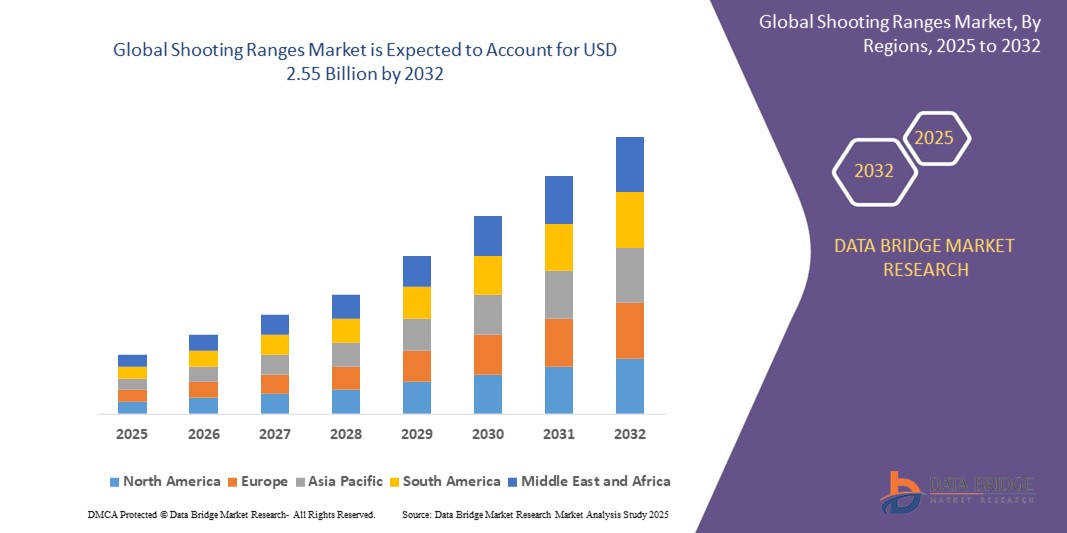
Shooting Ranges Market Size
- The global shooting ranges market size was valued at USD 1.38 billion in 2024 and is expected to reach USD 2.55 billion by 2032, at a CAGR of 8.00% during the forecast period
- The market growth is largely fuelled by the increasing popularity of shooting sports, growing demand for law enforcement and military training facilities, and rising interest in recreational firearms activities across both developed and emerging economies
- In addition, advancements in range safety technology and facility management systems are encouraging investments in modern, automated, and digitally enhanced shooting environments across urban and semi-urban locations
Shooting Ranges Market Analysis
- The market is experiencing significant expansion due to technological advancements in shooting range equipment, such as the adoption of smart targeting systems, automatic scoring, and augmented reality training modules
- Government investments in military modernization programs and public safety initiatives are further accelerating the development of both indoor and outdoor shooting ranges globally
- North America dominated the shooting ranges market with the largest revenue share of 38.5% in 2024, driven by rising firearm ownership, a strong culture of recreational shooting, and consistent demand for military and law enforcement training facilities
- Asia-Pacific region is expected to witness the highest growth rate in the global shooting ranges market, driven by rising military modernization programs, increasing defense budgets, and growing interest in recreational shooting sports across countries such as China, India, South Korea, and Australia
- The firearms segment dominated the market with the largest revenue share in 2024, driven by rising participation in recreational shooting, increasing firearm ownership, and continuous training demand from defense and law enforcement agencies. Firearms-based ranges are preferred due to their wide user base and integration of modern target systems, enabling real-time assessment and enhanced skill development across skill levels. Moreover, the segment benefits from strong regulatory frameworks and widespread availability of firearm training programs in both developed and developing regions
Report Scope and Shooting Ranges Market Segmentation
|
Attributes |
Shooting Ranges Key Market Insights |
|
Segments Covered |
|
|
Countries Covered |
North America
Europe
Asia-Pacific
Middle East and Africa
South America
|
|
Key Market Players |
|
|
Market Opportunities |
• Rising Demand for Virtual and Augmented Reality-Based Shooting Simulators • Expansion of Shooting Ranges in Emerging Economies |
|
Value Added Data Infosets |
In addition to the insights on market scenarios such as market value, growth rate, segmentation, geographical coverage, and major players, the market reports curated by the Data Bridge Market Research also include in-depth expert analysis, pricing analysis, brand share analysis, consumer survey, demography analysis, supply chain analysis, value chain analysis, raw material/consumables overview, vendor selection criteria, PESTLE Analysis, Porter Analysis, and regulatory framework. |
Shooting Ranges Market Trends
“Integration Of Smart Technologies in Shooting Ranges”
• Integration of automated target systems and digital scoring solutions is improving shooting accuracy, training throughput, and real-time performance feedback, reducing the need for manual supervision while increasing operational efficiency in both indoor and outdoor facilities
• Use of virtual and augmented reality technologies is enabling immersive training experiences for defense personnel and civilian users, allowing for repetition of complex scenarios, enhanced muscle memory, and simulation-based assessments in a controlled and safe environment
• Implementation of artificial intelligence and sensor-based analytics is helping operators monitor shooting metrics, predict user behavior, and design data-driven, personalized training programs while strengthening overall range security and automation
• For instance, several commercial shooting clubs in Germany have adopted virtual reality-enabled ranges with intelligent tracking systems, resulting in a notable rise in repeat visits and attracting younger demographics interested in gamified shooting environments
• These developments are collectively transforming traditional shooting ranges into smart, high-performance training ecosystems that offer efficiency, customization, and a safer environment for users across all experience levels
Shooting Ranges Market Dynamics
Driver
“Growing Defense Modernization Programs Worldwide”
• Increased investments in defense infrastructure are accelerating the demand for technologically advanced shooting ranges that support tactical drills, precision marksmanship, and real-time training analytics for combat readiness
• Deployment of simulation-based shooting systems in military academies is enabling safer and more frequent training cycles by reducing reliance on live ammunition during early-stage instruction and scenario-based testing
• Government-backed modernization programs are aligning national training facilities with global defense standards, particularly in nations prioritizing troop preparedness and interoperability in multinational operations
• For instance, India and Poland have initiated multi-million-dollar defense upgrade projects that include smart shooting ranges with automated scoring systems, environmental safety controls, and electronic monitoring frameworks
• These developments are establishing a long-term growth pathway for the shooting ranges market by embedding digital infrastructure into military ecosystems and reinforcing the importance of advanced training platforms in national defense strategies
Restraint/Challenge
“High Initial Investment and Maintenance Costs”
• High setup costs involving specialized construction, environmental safety measures, and compliance certifications are discouraging small and medium operators from entering or expanding in the market, as initial capital outlay often exceeds return expectations in the early years of operation and includes expenses for range design, ballistic containment, and safety compliance
• Ongoing maintenance expenses for smart range systems, HVAC installations, bullet containment, and electronic targets are placing heavy financial pressure on operators, especially in low-traffic or seasonal locations where usage rates cannot justify the operational overhead required to sustain high-tech infrastructure
• Complex urban zoning regulations and environmental objections are contributing to significant delays or cancellations of planned shooting ranges in densely populated regions where demand may otherwise be high, due to community pushback, legal restrictions on firearm use, and ecological assessments required for permitting
• For instance, several urban shooting range projects in Canada and Japan have been stalled or cancelled due to a mix of funding shortfalls, neighborhood resistance, and strict regulatory approval processes, making it difficult for private or institutional players to establish training facilities even when local interest and demand exist
• These financial and operational burdens are restricting market growth in underserved areas, highlighting the need for affordable range technologies and strategic government incentives to ensure broader accessibility and adoption while balancing public safety and commercial feasibility
Shooting Ranges Market Scope
The market is segmented on the basis of activity type, product type, and application.
- By Activity Type
On the basis of activity type, the shooting ranges market is segmented into firearms and archery. The firearms segment dominated the market with the largest revenue share in 2024, driven by rising participation in recreational shooting, increasing firearm ownership, and continuous training demand from defense and law enforcement agencies. Firearms-based ranges are preferred due to their wide user base and integration of modern target systems, enabling real-time assessment and enhanced skill development across skill levels. Moreover, the segment benefits from strong regulatory frameworks and widespread availability of firearm training programs in both developed and developing regions.
The archery segment is expected to witness the fastest growth rate from 2025 to 2032, supported by growing interest in traditional and competitive archery across youth and sporting communities. The increasing popularity of archery as an Olympic sport and a safe recreational activity has encouraged investments in dedicated indoor and outdoor archery facilities. In addition, the minimal noise and safety concerns associated with archery ranges make them attractive for urban and school-based settings.
- By Product Type
On the basis of product type, the shooting ranges market is segmented into indoor shooting range and outdoor shooting range. The indoor shooting range segment accounted for the largest market revenue share in 2024, primarily due to the rising number of urban training facilities and the year-round usability they offer. Indoor ranges are favored for their controlled environments, advanced air filtration systems, and integration of digital scoring technologies, making them ideal for both professional and recreational users. In addition, indoor ranges provide a safer and more accessible alternative in densely populated areas where outdoor ranges are less feasible.
The outdoor shooting range segment is expected to witness the fastest growth rate from 2025 to 2032, driven by increasing demand for long-range firearm training and combat simulation exercises. Outdoor ranges are widely adopted by military and police forces for tactical training, enabling realistic conditions and varied terrain exposure. Furthermore, outdoor setups are more scalable, accommodating large groups and diverse shooting disciplines including trap, skeet, and rifle practice.
- By Application
On the basis of application, the shooting ranges market is segmented into civil and military. The military segment held the largest market revenue share in 2024, fuelled by rising defense spending and modernization programs aimed at improving combat readiness through advanced shooting range infrastructure. Military training zones require high-precision, simulation-enabled shooting environments for both small arms and tactical weaponry, leading to sustained investments in range development globally. The need for continual firearms proficiency and evolving warfare training modules further supports the dominance of this segment.
The civil segment is expected to witness the fastest growth rate from 2025 to 2032, owing to growing recreational interest, rising civilian firearm ownership, and expanding participation in shooting sports and competitions. Civilian-focused shooting ranges are becoming more technologically advanced and accessible, with features such as virtual targets, smart scoring systems, and membership-based access. In addition, the increasing use of shooting ranges for security personnel and private training contributes to the segment’s accelerating momentum.
Shooting Ranges Market Regional Analysis
• North America dominated the shooting ranges market with the largest revenue share of 38.5% in 2024, driven by rising firearm ownership, a strong culture of recreational shooting, and consistent demand for military and law enforcement training facilities
• The region benefits from well-established shooting sports infrastructure, wide participation in competitive shooting events, and the presence of numerous private and public shooting ranges
• Supportive regulations, growing investments in defense training, and increasing popularity of firearm-based activities among civilians contribute to the sustained demand for both indoor and outdoor shooting ranges
U.S. Shooting Ranges Market Insight
The U.S. shooting ranges market captured the largest revenue share in 2024 within North America, supported by widespread gun ownership and a mature ecosystem of shooting sports and tactical training. The country has a dense concentration of commercial, military, and recreational shooting facilities catering to varied skill levels and activities. In addition, the integration of smart training systems and virtual target technologies is gaining momentum, further enhancing range utilization and attracting a broader demographic of users.
Europe Shooting Ranges Market Insight
The Europe shooting ranges market is expected to witness the fastest growth rate from 2025 to 2032, driven by an increasing focus on security preparedness, expanding defense budgets, and the resurgence of traditional shooting sports. Countries across the region are investing in advanced shooting range infrastructure for law enforcement and military units. Civilian interest in archery and shooting sports is also increasing, supported by organized training programs, international competitions, and favorable regulatory conditions in select countries.
U.K. Shooting Ranges Market Insight
The U.K. shooting ranges market is expected to witness the fastest growth rate from 2025 to 2032, spurred by the growing participation in target shooting and archery as competitive and recreational activities. Government efforts to modernize defense and police training centers are also contributing to market expansion. Moreover, rising awareness around personal safety and security preparedness is prompting interest in controlled firearm training, with indoor ranges gaining particular traction in urban regions.
Germany Shooting Ranges Market Insight
The Germany shooting ranges market is expected to witness the fastest growth rate from 2025 to 2032, supported by an increase in sports shooting associations, well-regulated civilian participation, and advanced training requirements for law enforcement. Germany’s robust defense and police training infrastructure includes high-end shooting ranges equipped with digital monitoring and safety systems. In addition, the rising popularity of archery as a low-impact sport is helping diversify market offerings in the country.
Asia-Pacific Shooting Ranges Market Insight
The Asia-Pacific shooting ranges market is expected to witness the fastest growth rate from 2025 to 2032, driven by expanding military budgets, increasing urban recreational demand, and a growing focus on combat readiness in emerging economies. Rapid development of training infrastructure in countries such as China, India, South Korea, and Japan is bolstering market expansion. In addition, the rise in archery sports participation and the integration of simulation-based ranges are opening up new opportunities across the region.
Japan Shooting Ranges Market Insight
The Japan shooting ranges market is expected to witness the fastest growth rate from 2025 to 2032, due to a heightened focus on defense preparedness, professional training, and expanding civilian interest in archery. Despite strict firearm laws, Japan has seen a growing adoption of simulation-based shooting ranges and virtual training tools for security personnel. The country’s cultural affinity for archery and martial disciplines is further supporting the development of indoor and urban shooting facilities with modern, non-lethal training setups.
China Shooting Ranges Market Insight
The China shooting ranges market accounted for the largest revenue share in Asia-Pacific in 2024, attributed to robust investments in defense modernization, the growth of tactical training academies, and increasing interest in sports shooting among youth. China is rapidly developing military and police shooting infrastructure while also encouraging recreational firearm use in regulated zones. The rise of competitive shooting leagues, along with government support for sports development, is contributing to the market’s dynamic expansion.
Shooting Ranges Market Share
The shooting ranges industry is primarily led by well-established companies, including:
- Saab (Sweden)
- Meggitt PLC (U.K.)
- InVeris Training Solutions (U.S.)
- Theissen Training Systems GmbH (Germany)
- Range Systems, Inc. (U.S.)
- Polytronic International AG (Switzerland)
- Shooting Range Industries LLC (U.S.)
- ACTION TARGET (U.S.)
- Advanced Training Systems LLC (U.S.)
- Cubic Corporation (U.S.)
- ELI OÜ(Israel)
- Laser Shot, Inc. (U.S.)
- Savage (U.S.)
Latest Developments in Global Shooting Ranges Market
- In February 2024, the Government of Finland announced a national development plan to establish 300 new shooting ranges across the country. This initiative aims to address the rising demand for training facilities following Finland’s NATO membership in April and heightened security concerns due to Russia’s invasion of Ukraine. The new ranges are expected to support national defense preparedness while also catering to hunters, police forces, and shooting enthusiasts. This development is likely to significantly boost the civil and military application segments of the shooting ranges market, reinforcing infrastructure and fostering skill development.

- Interactive Data Analysis Dashboard
- Company Analysis Dashboard for high growth potential opportunities
- Research Analyst Access for customization & queries
- Competitor Analysis with Interactive dashboard
- Latest News, Updates & Trend analysis
- Harness the Power of Benchmark Analysis for Comprehensive Competitor Tracking
Data collection and base year analysis are done using data collection modules with large sample sizes. The stage includes obtaining market information or related data through various sources and strategies. It includes examining and planning all the data acquired from the past in advance. It likewise envelops the examination of information inconsistencies seen across different information sources. The market data is analysed and estimated using market statistical and coherent models. Also, market share analysis and key trend analysis are the major success factors in the market report. To know more, please request an analyst call or drop down your inquiry.
The key research methodology used by DBMR research team is data triangulation which involves data mining, analysis of the impact of data variables on the market and primary (industry expert) validation. Data models include Vendor Positioning Grid, Market Time Line Analysis, Market Overview and Guide, Company Positioning Grid, Patent Analysis, Pricing Analysis, Company Market Share Analysis, Standards of Measurement, Global versus Regional and Vendor Share Analysis. To know more about the research methodology, drop in an inquiry to speak to our industry experts.
Data Bridge Market Research is a leader in advanced formative research. We take pride in servicing our existing and new customers with data and analysis that match and suits their goal. The report can be customized to include price trend analysis of target brands understanding the market for additional countries (ask for the list of countries), clinical trial results data, literature review, refurbished market and product base analysis. Market analysis of target competitors can be analyzed from technology-based analysis to market portfolio strategies. We can add as many competitors that you require data about in the format and data style you are looking for. Our team of analysts can also provide you data in crude raw excel files pivot tables (Fact book) or can assist you in creating presentations from the data sets available in the report.