


Shoulder Fired Weapons Market Size
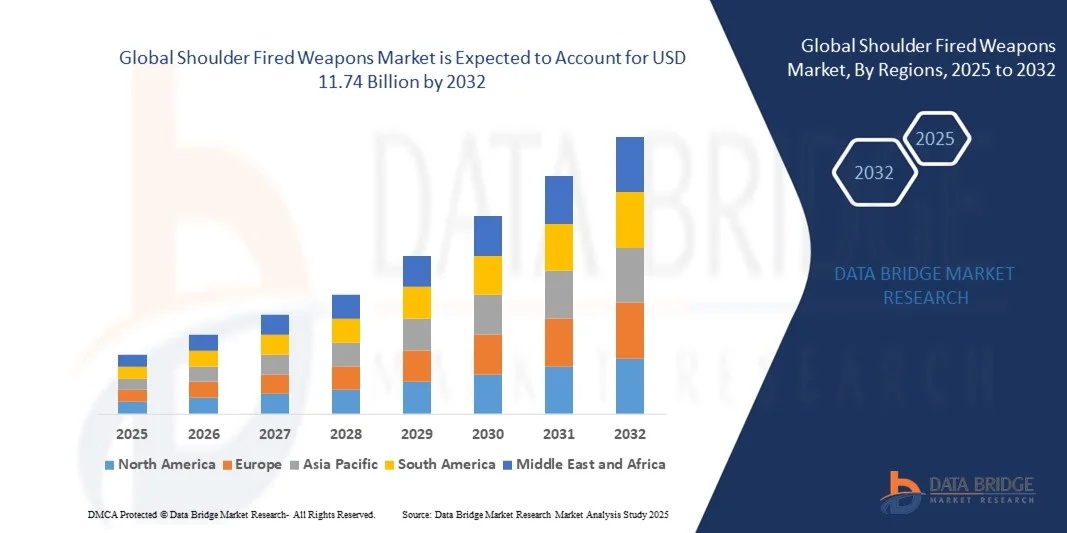
- The global shoulder fired weapons market size was valued at USD 8.12 billion in 2024 and is expected to reach USD 11.74 billion by 2032, at a CAGR of 4.72% during the forecast period
- The market growth is largely fueled by rising defense modernization programs, increasing defense budgets, and the growing demand for advanced infantry weaponry across global armed forces
- Furthermore, the need for precision, portability, and versatility in both guided and unguided shoulder-fired systems is driving procurement by militaries and paramilitary forces. These converging factors are accelerating the adoption of shoulder fired weapons, thereby significantly boosting the market's growth
Shoulder Fired Weapons Market Analysis
- Shoulder fired weapons are portable, infantry-launched weapon systems that include launchers and ammunition, available in guided and unguided formats. These systems enhance operational effectiveness by providing precision strike capability, increased mobility, and rapid deployment for both short- and medium-range engagements
- The escalating demand for shoulder fired weapons is primarily fueled by growing regional security concerns, modernization of armed forces, and increasing adoption of advanced guided systems to improve combat accuracy and reduce collateral damage
- North America dominated the shoulder fired weapons market with a share of 36.78% in 2024, due to increased defense spending, modernization of armed forces, and demand for advanced infantry weaponry
- Asia-Pacific is expected to be the fastest growing region in the shoulder fired weapons market during the forecast period due to increasing defense budgets, modernization of armed forces, and regional security concerns in countries such as China, India, and Japan
- Guided segment dominated the market with a market share of 69.95% in 2024, due to demand for precision targeting and reduced collateral damage in complex operational environments. Adoption is driven by advanced militaries and special operations forces seeking high mission effectiveness. Technological advancements in guidance systems, miniaturization, and sensor integration accelerate acceptance. Higher per-unit pricing and specialized training create lucrative revenue potential for manufacturers. Regulatory approvals and export restrictions influence deployment but do not hinder growth. The segment benefits from long-term contracts, software support, and upgrades that reinforce its rapid growth trajectory
Report Scope and Shoulder Fired Weapons Market Segmentation
|
Attributes |
Shoulder Fired Weapons Key Market Insights |
|
Segments Covered |
|
|
Countries Covered |
North America
Europe
Asia-Pacific
Middle East and Africa
South America
|
|
Key Market Players |
|
|
Market Opportunities |
|
|
Value Added Data Infosets |
In addition to the market insights such as market value, growth rate, market segments, geographical coverage, market players, and market scenario, the market report curated by the Data Bridge Market Research team includes in-depth expert analysis, import/export analysis, pricing analysis, production consumption analysis, and pestle analysis. |
Shoulder Fired Weapons Market Trends
Growing Use of Guided Shoulder-Fired Weapons
- The shoulder fired weapons market is experiencing a strong trend toward the adoption of guided systems integrated with advanced targeting and navigation technologies. Defense organizations are prioritizing precision engagement capabilities to reduce collateral damage and improve mission success across complex battlefield scenarios
- For instance, Saab AB’s Carl-Gustaf M4 and Raytheon Technologies’ FGM-148 Javelin have gained significant attention due to their advanced fire-and-forget guidance systems and lightweight portability. These systems allow soldiers to engage targets with high accuracy using infrared and laser guidance without maintaining visual contact after launch
- The incorporation of digital fire control systems and smart sensors into shoulder-fired platforms is enhancing situational awareness and operational flexibility. Modern guided weapons enable automatic target tracking, optimized trajectory calculation, and enhanced strike precision against armored vehicles, fortifications, and low-flying aircraft
- In addition, advances in microelectronics and miniaturization technologies are allowing manufacturers to integrate guidance modules into lightweight launchers without compromising maneuverability. This combination ensures both mobility and tactical superiority in close-range and asymmetric combat operations
- The growing relevance of urban warfare and counter-insurgency operations has further increased the demand for guided shoulder-fired systems, as they enable accurate strikes in restricted environments where heavy platforms cannot be deployed. This evolving combat scenario continues to shape procurement priorities across armies globally
- As precision weapon technologies become more accessible and cost-effective, the dominance of guided shoulder-fired systems is expected to expand. The trend marks a major evolution in man-portable defense weapons, aligning with military modernization efforts and the increasing need for accurate, soldier-operated systems in contemporary battlefields
Shoulder Fired Weapons Market Dynamics
Driver
Rising Global Defense Modernization Programs
- The expanding global focus on modernizing defense capabilities and upgrading infantry combat systems is a crucial driver for the shoulder fired weapons market. Governments are investing heavily in advanced man-portable systems to enhance flexibility, rapid deployment, and battlefield effectiveness
- For instance, in 2024, the U.S. Department of Defense and Lockheed Martin announced upgrades to the Javelin missile system incorporating improved guidance and extended range features. Similarly, India’s procurement of Saab’s Carl-Gustaf launchers demonstrates growing international collaboration in infantry modernization initiatives
- The growing geopolitical tensions, cross-border conflicts, and security challenges have prompted many nations to prioritize investments in technologically advanced portable weapons. These efforts aim to increase defense readiness while ensuring operational adaptability in various terrains and mission types
- In addition, modern military strategies emphasize mobility, interoperability, and precision firepower, making shoulder-fired weapons an integral element of infantry equipment. Their versatility against armored, air, and structure-based targets makes them essential assets for both defensive and offensive operations
- With ongoing modernization programs and multilateral defense alliances, procurement of shoulder-fired systems is expected to accelerate. The consistent demand from defense agencies to enhance soldier lethality and strategic agility will remain a primary force underpinning market growth in the coming years
Restraint/Challenge
Strict Export Regulations
- The presence of stringent export regulations and international arms control agreements presents a major challenge to the growth of the shoulder fired weapons market. Governments impose strict monitoring measures to prevent illicit proliferation of man-portable air-defense systems (MANPADS) and anti-tank guided weapons to unauthorized entities
- For instance, export controls enforced by the United States under the International Traffic in Arms Regulations (ITAR) restrict global distribution of guided shoulder-fired systems such as Stinger and Javelin to allied nations only. Similarly, the European Union’s arms trade directives require exhaustive end-user certifications before final export approval
- These regulatory frameworks often result in lengthy approval processes and logistical challenges for manufacturers aiming to expand into new markets. Export licensing restrictions also limit technology transfer and international collaborations, affecting production timelines and global supply distribution
- In addition, evolving geopolitical dynamics and concerns over non-state actors acquiring advanced weaponry have led to even tighter restrictions on cross-border trade of shoulder-fired systems. Such stringent oversight can impede defense partnerships and delay large-scale procurement programs
- While these export regulations play an essential role in maintaining global security and preventing misuse, they also constrain market expansion opportunities for key manufacturers. Balancing non-proliferation objectives with the defense needs of allied nations will be critical in mitigating the long-term impact of these restrictions on the global shoulder fired weapons market
Shoulder Fired Weapons Market Scope
The market is segmented on the basis of component, technology, and range.
- By Component
On the basis of component, the shoulder fired weapons market is segmented into launcher and ammunition. The launcher segment dominated the largest market revenue share in 2024, driven by its role as the primary platform determining operational capability and compatibility with existing infantry systems. Defense agencies prioritize launcher procurements due to higher unit prices, long replacement cycles, and bundled services including training and spare parts. Launchers also benefit from modularity, lifecycle support, and integration with soldier systems, enhancing their appeal to military customers. The segment’s dominance is further reinforced by institutional contracts and procurement strategies emphasizing platform upgrades. Recurring service revenues from maintenance and upgrades also contribute to sustained market demand. Overall, launchers represent a high-value, capital-intensive segment that shapes overall market revenue.
The ammunition segment is expected to witness the fastest CAGR from 2025 to 2032, fueled by increased training, modernization of stockpiles, and demand for specialized munitions. Shorter replenishment cycles and recurring purchase patterns accelerate revenue growth relative to launcher sales. The rising need for urban and asymmetric warfare capabilities further boosts ammunition adoption. Manufacturers benefit from steady demand driven by operational consumption rates. Export regulations and safety compliance influence ammunition deployment and create niche growth opportunities. Recurring revenue from consumables makes this segment highly attractive for long-term growth.
- By Technology
On the basis of technology, the market is segmented into guided and unguided shoulder fired weapons. The guided segment dominated the largest market revenue share of 69.95% in 2024, driven by demand for precision targeting and reduced collateral damage in complex operational environments. Adoption is driven by advanced militaries and special operations forces seeking high mission effectiveness. Technological advancements in guidance systems, miniaturization, and sensor integration accelerate acceptance. Higher per-unit pricing and specialized training create lucrative revenue potential for manufacturers. Regulatory approvals and export restrictions influence deployment but do not hinder growth. The segment benefits from long-term contracts, software support, and upgrades that reinforce its rapid growth trajectory.
The unguided segment is expected to witness the fastest CAGR from 2025 to 2032, fueled by its cost-effectiveness, mass issuance suitability, and established logistics chains. Unguided weapons are preferred for routine operations, training, and broad military deployment, ensuring high-volume procurement. Their reliability and simplicity make them attractive for diverse operational environments. Established supply chains and lower per-unit costs further reinforce market dominance. Large-scale replenishment programs by defense forces create consistent revenue streams. Overall, unguided weapons remain the backbone of shoulder fired weapons deployment globally.
- By Range
On the basis of range, the market is segmented into short range (>1 km), medium range (1 km–≤5 km), and extended range (>5 km). The short-range segment dominated the largest market revenue share in 2024, driven by its suitability for urban combat, close-support missions, and high training usage. Short-range systems are portable, easy to deploy, and align with immediate operational needs, making them widely adopted by armed forces. Lower costs and established supply chains further enhance their market share. The segment benefits from consistent replenishment cycles and recurring services for maintenance and training. Its dominance is reinforced by widespread deployment in both conventional and asymmetric operational environments.
The medium-range segment is expected to witness the fastest CAGR from 2025 to 2032, fueled by the need for increased engagement distance while maintaining portability. Modernization programs and evolving combat tactics are driving the adoption of medium-range systems. This segment balances operational flexibility and capability, appealing to forces seeking versatile deployment options. Procurement is influenced by performance, modularity, and interoperability with existing systems. Training and support contracts contribute to recurring revenues. Rising investments in force modernization and regional security concerns accelerate growth in this segment.
Shoulder Fired Weapons Market Regional Analysis
- North America dominated the shoulder fired weapons market with the largest revenue share of 36.78% in 2024, driven by increased defense spending, modernization of armed forces, and demand for advanced infantry weaponry
- Military and paramilitary organizations in the region highly value the reliability, precision, and operational efficiency offered by shoulder fired weapons in both training and active deployments
- This widespread adoption is further supported by well-established defense supply chains, technological advancements, and strategic procurement programs, establishing shoulder fired weapons as a core component of defense arsenals
U.S. Shoulder Fired Weapons Market Insight
The U.S. shoulder fired weapons market captured the largest revenue share in 2024 within North America, fueled by continuous military modernization and high defense budgets. The adoption of advanced launcher and guided systems is being prioritized to enhance operational capabilities. Programs aimed at improving infantry lethality, combined with rising investments in research and development of precision munitions, further propel market growth. Moreover, ongoing upgrades to training infrastructure and procurement of both unguided and guided ammunition are significantly contributing to the market’s expansion.
Europe Shoulder Fired Weapons Market Insight
The Europe shoulder fired weapons market is projected to grow at a substantial CAGR during the forecast period, primarily driven by rising defense modernization programs and geopolitical tensions. Increased spending on training, replacement of legacy systems, and procurement of modular weapons are fostering market adoption. European armed forces are increasingly focusing on precision-guided systems and enhanced ammunition types. The market is also witnessing growth across NATO-member countries due to standardization efforts and cross-border collaborations in defense procurement.
U.K. Shoulder Fired Weapons Market Insight
The U.K. shoulder fired weapons market is anticipated to grow at a noteworthy CAGR during the forecast period, driven by modernization of infantry arsenals and demand for high-precision, lightweight systems. Rising concerns over national security and border protection are encouraging defense organizations to procure advanced launchers and guided munitions. The U.K.’s defense sector, supported by robust manufacturing infrastructure and R&D initiatives, continues to stimulate market growth.
Germany Shoulder Fired Weapons Market Insight
The Germany shoulder fired weapons market is expected to expand at a considerable CAGR during the forecast period, fueled by the country’s focus on defense innovation and digitalization of military systems. Germany’s emphasis on technologically advanced, eco-conscious, and modular weapon systems promotes the adoption of both guided and unguided shoulder fired weapons. Integration with training simulators and operational platforms is increasingly prevalent, with strong preference for reliable, precision-capable solutions aligning with local defense strategies.
Asia-Pacific Shoulder Fired Weapons Market Insight
The Asia-Pacific shoulder fired weapons market is poised to grow at the fastest CAGR during the forecast period of 2025 to 2032, driven by increasing defense budgets, modernization of armed forces, and regional security concerns in countries such as China, India, and Japan. Rising procurement of advanced launchers, guided systems, and precision munitions is accelerating market adoption. The region’s growing domestic manufacturing capabilities and government initiatives promoting defense self-reliance are enhancing accessibility and affordability of shoulder fired weapons.
Japan Shoulder Fired Weapons Market Insight
The Japan shoulder fired weapons market is gaining momentum due to the country’s focus on technological innovation, strategic defense planning, and regional security considerations. The adoption of advanced, easy-to-deploy systems is driven by modernization programs and increasing integration with training and operational platforms. Precision-guided ammunition and lightweight launchers are fueling growth in both ground forces and specialized units.
China Shoulder Fired Weapons Market Insight
The China shoulder fired weapons market accounted for the largest market revenue share in Asia-Pacific in 2024, attributed to the country’s expanding defense budget, modernization of infantry systems, and focus on indigenous weapon development. China is actively procuring guided and unguided launchers and ammunition for both military and paramilitary forces. Domestic production capabilities, combined with strategic programs to equip forces with versatile shoulder fired weapons, are key factors propelling market growth.
Shoulder Fired Weapons Market Share
The shoulder fired weapons industry is primarily led by well-established companies, including:
- Saab AB (Sweden)
- Raytheon Technologies. (U.S.)
- Lockheed Martin Corporation. (U.S.)
- Rafael Advanced Defense Systems Ltd. (Israel)
- Thales Group (France)
- MBDA (France)
- Bazalt (Russia)
- Nammo AS (Norway)
- KBP Instrument Design Bureau (Russia)
- Denel SOC Ltd (South Africa)
- General Dynamics Ordnance and Tactical Systems (U.S.)
- BAE Systems. (U.K.)
- Rheinmetall AG (Germany)
- Bharatshakti (India)
- AirTronic USA, LLC (U.S.)
- BARRETT (U.S.)
- Konstruktorskoye byuro mashynostroyeniya (Russia)
- China North Industries Corporation Limited (China)
- Xtreme Alternative Defense Systems Ltd (U.S.)
- HDT Global (U.S.)
Latest Developments in Global Shoulder Fired Weapons Market
- In April 2025, the Philippines acquired a second BrahMos missile battery from India, strengthening its long-range strike capabilities. This procurement highlights growing regional demand for advanced, high-precision shoulder-fired and launch-capable missile systems. The deal reinforces India’s position as a key defense exporter in the Asia-Pacific and also signals increasing market opportunities for long-range guided shoulder-fired systems in Southeast Asia
- In February 2025, Lockheed Martin secured a USD 139 million order from the U.S. Army for Stinger fuse and warhead assemblies, with deliveries scheduled by November 2027. This order reflects sustained demand for shoulder-launched air-defense and precision munitions in North America. It underscores the market’s growth potential for technologically advanced ammunition and fuze components, highlighting recurring revenue opportunities from large-scale military procurement contracts
- In January 2025, Roketsan’s Karaok missile successfully achieved a 50 m dive-profile hit during trials, demonstrating improved accuracy and targeting capabilities. The successful test enhances the market appeal of guided shoulder-fired systems, as militaries increasingly prioritize precision and versatility in compact missile platforms. This milestone is expected to accelerate adoption in both domestic and export markets for guided infantry-launched systems
- In March 2024, Poland signed a large Carl-Gustaf framework deal with Saab AB, aimed at modernizing infantry weaponry. This strategic procurement demonstrates strong European demand for modular and multi-role shoulder-fired systems. The deal boosts revenue for OEMs and also reinforces the trend of standardized, long-term supply contracts shaping the market in NATO-aligned regions
- In October 2020, the Indian Defense Research and Development Organisation (DRDO) completed the final trial of its anti-tank missile system, featuring a shoulder-launch capability of approximately four kilometres with an infrared imaging seeker. This successful induction into the Indian Army strengthened domestic demand for guided shoulder-fired systems and highlighted India’s growing self-reliance in advanced missile technology. It also positioned the country as an emerging supplier of high-precision, shoulder-launched anti-tank weapons in global markets

- Interactive Data Analysis Dashboard
- Company Analysis Dashboard for high growth potential opportunities
- Research Analyst Access for customization & queries
- Competitor Analysis with Interactive dashboard
- Latest News, Updates & Trend analysis
- Harness the Power of Benchmark Analysis for Comprehensive Competitor Tracking
Data collection and base year analysis are done using data collection modules with large sample sizes. The stage includes obtaining market information or related data through various sources and strategies. It includes examining and planning all the data acquired from the past in advance. It likewise envelops the examination of information inconsistencies seen across different information sources. The market data is analysed and estimated using market statistical and coherent models. Also, market share analysis and key trend analysis are the major success factors in the market report. To know more, please request an analyst call or drop down your inquiry.
The key research methodology used by DBMR research team is data triangulation which involves data mining, analysis of the impact of data variables on the market and primary (industry expert) validation. Data models include Vendor Positioning Grid, Market Time Line Analysis, Market Overview and Guide, Company Positioning Grid, Patent Analysis, Pricing Analysis, Company Market Share Analysis, Standards of Measurement, Global versus Regional and Vendor Share Analysis. To know more about the research methodology, drop in an inquiry to speak to our industry experts.
Data Bridge Market Research is a leader in advanced formative research. We take pride in servicing our existing and new customers with data and analysis that match and suits their goal. The report can be customized to include price trend analysis of target brands understanding the market for additional countries (ask for the list of countries), clinical trial results data, literature review, refurbished market and product base analysis. Market analysis of target competitors can be analyzed from technology-based analysis to market portfolio strategies. We can add as many competitors that you require data about in the format and data style you are looking for. Our team of analysts can also provide you data in crude raw excel files pivot tables (Fact book) or can assist you in creating presentations from the data sets available in the report.













