


Shrimp Food Market Size
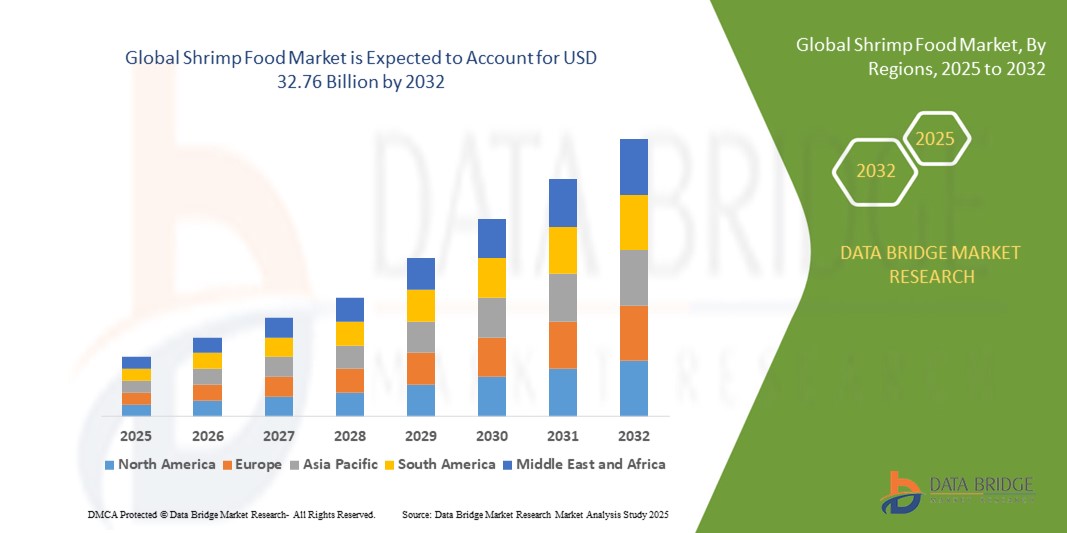
- The global shrimp food market size was valued at USD 21.51 billion in 2024 and is expected to reach USD 32.76 billion by 2032, at a CAGR of 5.40% during the forecast period
- The market growth is largely fueled by increasing global demand for shrimp as a protein source, along with the rapid expansion of aquaculture practices in developing regions, which is driving the need for high-quality and nutritionally balanced shrimp feed
- Furthermore, rising emphasis on sustainable and disease-resistant feed formulations, as well as innovations in feed additives and functional ingredients, are positioning shrimp food as a critical component in modern aquaculture. These converging factors are accelerating the adoption of advanced shrimp feed solutions, thereby significantly boosting the industry's growth
Shrimp Food Market Analysis
- Shrimp food, encompassing a variety of feed products tailored for different shrimp species and farming conditions, is a key enabler of aquaculture productivity, supporting the global shrimp industry's rapid growth across both intensive and semi-intensive farming systems
- The escalating demand for shrimp food is primarily fueled by the increasing global appetite for shrimp, technological advancements in feed formulation, and growing awareness among shrimp farmers about the benefits of nutritionally optimized and disease-resistant feed
- Asia-Pacific dominated the shrimp food market with the largest revenue share of 61.9% in 2024, attributed to its leading role in global shrimp production, high feed consumption, and the presence of established aquaculture economies such as India, Vietnam, China, and Thailand
- South America is expected to be the fastest growing region in the shrimp food market during the forecast period, driven by the expansion of shrimp farming in Ecuador and Brazil, favorable climatic conditions, and increasing investment in sustainable aquaculture practices
- Frozen/Canned segment dominated the shrimp food market, with a market share of 49.1% in 2024, due to its extended shelf life, ease of storage, and preference among commercial shrimp farms
Report Scope and Shrimp Food Market Segmentation
|
Attributes |
Shrimp Food Key Market Insights |
|
Segments Covered |
|
|
Countries Covered |
North America
Europe
Asia-Pacific
Middle East and Africa
South America
|
|
Key Market Players |
|
|
Market Opportunities |
|
|
Value Added Data Infosets |
In addition to the insights on market scenarios such as market value, growth rate, segmentation, geographical coverage, and major players, the market reports curated by the Data Bridge Market Research also include in-depth expert analysis, pricing analysis, brand share analysis, consumer survey, demography analysis, supply chain analysis, value chain analysis, raw material/consumables overview, vendor selection criteria, PESTLE Analysis, Porter Analysis, and regulatory framework. |
Shrimp Food Market Trends
Sustainable and Functional Feed Formulations Gaining Momentum
- A significant and accelerating trend in the global shrimp food market is the increasing shift toward sustainable and functional feed formulations designed to improve shrimp health, feed efficiency, and environmental impact. Feed manufacturers are focusing on reducing the use of fishmeal and incorporating alternative protein sources such as plant-based proteins, insect meal, and microbial ingredients
- For instance, companies such as Skretting and BioMar have launched eco-friendly shrimp feeds that integrate algae-based Omega-3s and low fishmeal content, aiming to enhance growth performance while promoting sustainability. Similarly, CP Foods has introduced functional feeds fortified with probiotics and immunostimulants to strengthen shrimp immunity and reduce disease outbreaks
- The adoption of functional ingredients such as enzymes, prebiotics, and antioxidants in shrimp feed is improving nutrient absorption and reducing environmental waste through better feed conversion ratios (FCR). This trend is also being driven by the rising incidence of shrimp diseases such as EMS (Early Mortality Syndrome), pushing producers to use feed that enhances resilience and productivity
- In addition, digitalization in aquaculture is enabling precision feeding and monitoring. Technologies such as automatic feeders and farm management software are being used in conjunction with smart feed formulations to optimize shrimp health and minimize overfeeding and waste
- This growing emphasis on sustainability and functionality is reshaping buyer expectations in the aquafeed industry. Companies are increasingly aligning with certifications such as ASC (Aquaculture Stewardship Council) and BAP (Best Aquaculture Practices) to meet the demands of environmentally conscious producers and global seafood buyers
- The demand for shrimp feed that balances high growth performance with ecological responsibility is rising across major shrimp-producing regions. This is prompting leading manufacturers to innovate continuously in formulation and feed delivery methods to remain competitive and compliant with global aquaculture sustainability standards
Shrimp Food Market Dynamics
Driver
Expansion of Global Shrimp Farming and Rising Demand for High-Quality Aquafeed
- The rapid expansion of shrimp farming, especially in Asia-Pacific and South America, is a major driver behind the growth of the shrimp food market
- Rising global consumption of shrimp, driven by increasing health consciousness and demand for protein-rich diets, is prompting the intensification of aquaculture practices and, in turn, the need for nutritionally optimized feed solutions
- For instance, Ecuador has significantly ramped up its shrimp production capacity in recent years, becoming a top exporter, which has led to a surge in demand for specialized feed suited to local farming environments. Similarly, India's growing shrimp exports have increased reliance on performance-enhancing feeds to maintain quality standards
- Modern shrimp farming operations are prioritizing feed that ensures faster growth, improves survival rates, and reduces susceptibility to disease outbreaks. Feed manufacturers are responding by developing product lines tailored to different shrimp species and lifecycle stages, incorporating trace minerals, probiotics, and functional additives
- Furthermore, the increasing demand for export-quality shrimp with traceable and sustainable production processes is pushing shrimp farmers to invest in certified and high-quality aquafeed products. This is strengthening partnerships between feed companies and farming cooperatives, driving innovation and consistent feed demand
Restraint/Challenge
Price Volatility of Raw Materials and Regulatory Pressures
- One of the key challenges facing the shrimp food market is the price volatility of key raw materials such as fishmeal, soybean meal, and other protein sources. Unpredictable fluctuations in commodity prices, often driven by climatic conditions, global demand, or supply chain disruptions, can increase production costs and pressure profit margins for both feed manufacturers and shrimp farmers
- For instance, the rising cost of fishmeal in 2024, driven by El Niño-related supply disruptions in Peru, led to a temporary spike in shrimp feed prices globally, forcing some farmers to cut back on feed quality or quantity, thereby affecting yield
- In addition, increasing regulatory scrutiny on the environmental impacts of aquaculture practices, especially in regions such as the EU and the U.S., is compelling feed producers to reformulate products with sustainable and traceable ingredients. Compliance with certifications such as ASC and BAP adds complexity and cost to the production process, particularly for smaller manufacturers
- The complexity of aligning feed production with evolving food safety regulations, labeling standards, and sustainable sourcing requirements poses a substantial challenge, especially in emerging markets with fragmented regulatory frameworks
- Overcoming these obstacles requires feed manufacturers to invest in alternative raw materials, enhance traceability across the supply chain, and develop cost-efficient, eco-friendly feed solutions. Scaling such innovations while maintaining affordability will be crucial for long-term market expansion
Shrimp Food Market Scope
The market is segmented on the basis of form, type, distribution channel, and end-user.
- By Form
On the basis of form, the shrimp food market is segmented into fresh/chilled, frozen/canned, and processed. The frozen/canned segment dominated the market with the largest market revenue share of 49.1% in 2024, owing to its extended shelf life, ease of storage, and convenience in handling large-scale feed requirements, especially among commercial shrimp farms. This segment is favored in export-oriented farming operations, where feed stability and preservation are critical to maintaining nutritional value and minimizing waste.
The processed segment is anticipated to witness the fastest growth rate of 19.4% from 2025 to 2032, driven by advancements in feed technology, increasing use of functional additives, and the rising demand for disease-preventive and nutritionally enriched feeds. Processed shrimp food is gaining traction for its ability to support improved feed conversion ratios (FCR), water stability, and better digestibility.
- By Type
On the basis of type, the shrimp food market is segmented into pink, white, brown, and others. The white shrimp segment held the largest market revenue share of 52.3% in 2024, supported by the dominance of Pacific white shrimp (Litopenaeus vannamei) in global aquaculture. These species are favored for their fast growth, high survival rates, and compatibility with intensive farming systems, which makes them the largest consumers of shrimp feed globally.
The brown shrimp segment is expected to witness the fastest CAGR from 2025 to 2032, due to growing interest in species diversification, particularly in North and South America. The need for tailored feed formulations for brown shrimp species is increasing as farmers seek to expand beyond conventional white shrimp farming to tap into niche market demands.
- By Distribution Channel
On the basis of distribution channel, the shrimp food market is segmented into B2B and B2C. The B2B segment dominated the market with the largest revenue share of 67.4% in 2024, driven by bulk purchases by commercial shrimp farms, aquafeed distributors, and seafood processing companies. B2B sales channels offer cost efficiency, contract-based supplies, and logistics support for large-scale farming operations.
The B2C segment is projected to grow at the fastest rate during the forecast period, fueled by the rise of small-scale and backyard shrimp farming, particularly in Southeast Asia and Latin America. Direct-to-consumer feed marketing, along with increasing e-commerce penetration, is helping manufacturers tap into decentralized farming communities and hobbyist aquaculturists.
- By End-User
On the basis of end-user, the shrimp food market is segmented into residential and commercial. The commercial segment accounted for the largest market share of 71.8% in 2024, owing to the high feed demand from industrial shrimp farms focused on export markets. These operations prioritize feed efficiency, quality certifications, and customized formulations to meet international standards and maximize profitability.
The residential segment is expected to expand at the fastest CAGR from 2025 to 2032, supported by the growing trend of home-based aquaculture and micro-farming. With rising awareness of sustainable food production and self-sufficiency, more individuals are engaging in shrimp cultivation for personal or local community consumption, thereby driving the demand for small-pack, easy-to-use shrimp food option
Shrimp Food Market Regional Analysis
- Asia-Pacific dominated the shrimp food market with the largest revenue share of 61.9% in 2024, attributed to its leading role in global shrimp production, high feed consumption, and the presence of established aquaculture economies such as India, Vietnam, China, and Thailand
- Producers in countries such as India, Vietnam, China, and Thailand are increasingly adopting advanced shrimp feed formulations to boost productivity, reduce mortality, and meet international export standards
- This widespread adoption is further supported by government initiatives promoting sustainable aquaculture, rising seafood consumption, and the presence of major feed manufacturers, positioning Asia-Pacific as the core hub for both shrimp production and feed innovation
India Shrimp Food Market Insight
The India shrimp food market accounted for the largest market revenue share in Asia-Pacific in 2024, owing to its position as one of the world's top shrimp producers and exporters. The country's expanding aquaculture sector, increasing adoption of scientifically formulated feed, and strong demand for export-grade shrimp have driven feed consumption. Government support through aquaculture development schemes, as well as the presence of domestic and multinational feed manufacturers, is fueling rapid innovation and market penetration.
Japan Shrimp Food Market Insight
The Japan shrimp food market is gaining traction due to the country's high emphasis on food safety, premium seafood, and advanced aquaculture practices. Indoor shrimp farming and recirculating aquaculture systems (RAS) are increasing the demand for high-quality, functional feed. Japanese producers value digestibility, biosecurity, and eco-friendliness, encouraging the use of fortified feeds that align with national sustainability standards. The market is further supported by strong consumer preferences for traceable and antibiotic-free shrimp.
The Europe Shrimp Food Market Insight
The Europe shrimp food market is projected to expand at a notable CAGR during the forecast period, driven by the region’s commitment to sustainable seafood sourcing and advanced aquaculture systems. European countries such as Spain, the U.K., and the Netherlands are investing in land-based shrimp farms that require precision nutrition and premium feed. Regulatory emphasis on antibiotic-free aquaculture and consumer demand for clean-label products are encouraging feed manufacturers to develop probiotic and functional formulations. Furthermore, increased seafood consumption and eco-label certification trends are further stimulating the demand for high-quality shrimp feed across Europe.
U.K. Shrimp Food Market Insight
The U.K. shrimp food market is anticipated to grow steadily during the forecast period, fueled by the expansion of recirculating aquaculture systems and the push for food security through local seafood production. Rising consumer interest in traceable and sustainably farmed shrimp is leading to increased demand for organic and high-performance feed. Government initiatives supporting aquaculture innovation and environmental compliance are further accelerating shrimp feed adoption in the country.
South America Shrimp Food Market Insight
The South America shrimp food market is projected to grow at the fastest CAGR of 24.1% during the forecast period of 2025 to 2032, fueled by expanding shrimp farming activities and increasing adoption of high-efficiency feed products. Countries across the region are witnessing a surge in aquaculture investment, technological upgrades, and government support for sustainable seafood production. The demand for quality shrimp feed is rising sharply as producers focus on optimizing growth rates, reducing mortality, and meeting international export standards.
Brazil Shrimp Food Market Insight
Brazil is emerging as a significant contributor to South America's shrimp food market, driven by rising domestic consumption and expanding shrimp farming operations in states such as Ceará and Rio Grande do Norte. The increasing use of biosecure farming systems and the shift towards nutritionally balanced feeds are enhancing shrimp productivity and survival rates. In addition, public and private investments in aquaculture innovation and feed R&D are boosting Brazil’s competitiveness in regional and international markets.
Argentina Shrimp Food Market Insight
Argentina is gradually strengthening its position in the South American shrimp food market, supported by growing demand for export-quality shrimp and the expansion of aquaculture along the Atlantic coast. The adoption of high-performance feed solutions, particularly for cold-water shrimp species, is gaining traction. Government-led fisheries modernization programs and interest in sustainable aquaculture practices are expected to accelerate the use of premium shrimp feed products in the country.
Shrimp Food Market Share
The Shrimp Food industry is primarily led by well-established companies, including:
- Cargill, Incorporated (U.S.)
- Nutreco N.V. (Netherlands)
- Alltech, Inc. (U.S.)
- BioMar Group A/S (Denmark)
- Charoen Pokphand Foods Public Company Limited (Thailand)
- ADM Animal Nutrition (U.S.)
- Skretting AS (Norway)
- Avanti Feeds Limited (India)
- Growel Feeds Pvt. Ltd. (India)
- Zeigler Bros., Inc. (U.S.)
- Dibaq Aquaculture (Spain)
- The Waterbase Limited (India)
- De Heus Animal Nutrition (Netherlands)
- Nutriad International NV (Belgium)
- Ridley Corporation Limited (Australia)
- INVE Aquaculture (Belgium)
- Viet Uc Seafood Corporation (Vietnam)
- Empagran S.A. (Ecuador)
- Beneo GmbH (Germany)
- Higashimaru Co., Ltd. (Japan)
What are the Recent Developments in Global Shrimp Food Market?
- In April 2023, Cargill Inc., a global leader in animal nutrition, announced the expansion of its shrimp feed production facility in Andhra Pradesh, India. This move aims to meet the rising demand for high-performance shrimp diets in South Asia. The facility upgrade includes the integration of advanced feed formulation technology and sustainable ingredient sourcing, reinforcing Cargill’s commitment to innovation and regional aquaculture development
- In March 2023, Skretting, the aquaculture division of Nutreco, launched a next-generation functional shrimp feed—“Lorica”—designed to enhance shrimp immunity and resilience against common diseases such as White Spot Syndrome Virus (WSSV). Developed through intensive R&D, Lorica is being adopted across Southeast Asia and Latin America, showcasing Skretting’s role in supporting sustainable and profitable shrimp farming through science-backed nutrition
- In February 2023, Charoen Pokphand Foods (CP Foods) introduced a new environmentally friendly shrimp feed line under its “Green Feed” initiative in Thailand. The product features reduced fishmeal content, alternative protein sources, and enhanced digestibility to improve feed conversion ratios while minimizing environmental impact. This launch reflects CP Foods’ strategic focus on responsible aquaculture and climate-conscious production practices
- In January 2023, BioMar Group completed its acquisition of Viet-UC Feedmill in Vietnam to expand its footprint in the fast-growing Asian shrimp feed sector. The acquisition provides BioMar with greater access to key markets and strengthens its ability to deliver high-performance diets adapted to local farming conditions. This development underscores the industry’s trend toward consolidation and regional capacity building
- In January 2023, Growel Feeds Pvt. Ltd., one of India’s leading aquafeed producers, unveiled its smart aquafeed monitoring system during AquaEx India 2023. The digital platform enables farmers to track feed consumption, water quality, and growth performance in real time. This innovation supports the company's efforts to promote data-driven aquaculture practices and improve farm profitability across its customer base

- Interactive Data Analysis Dashboard
- Company Analysis Dashboard for high growth potential opportunities
- Research Analyst Access for customization & queries
- Competitor Analysis with Interactive dashboard
- Latest News, Updates & Trend analysis
- Harness the Power of Benchmark Analysis for Comprehensive Competitor Tracking
Global Shrimp Food Market, Supply Chain Analysis and Ecosystem Framework
To support market growth and help clients navigate the impact of geopolitical shifts, DBMR has integrated in-depth supply chain analysis into its Global Shrimp Food Market research reports. This addition empowers clients to respond effectively to global changes affecting their industries. The supply chain analysis section includes detailed insights such as Global Shrimp Food Market consumption and production by country, price trend analysis, the impact of tariffs and geopolitical developments, and import and export trends by country and HSN code. It also highlights major suppliers with data on production capacity and company profiles, as well as key importers and exporters. In addition to research, DBMR offers specialized supply chain consulting services backed by over a decade of experience, providing solutions like supplier discovery, supplier risk assessment, price trend analysis, impact evaluation of inflation and trade route changes, and comprehensive market trend analysis.
Data collection and base year analysis are done using data collection modules with large sample sizes. The stage includes obtaining market information or related data through various sources and strategies. It includes examining and planning all the data acquired from the past in advance. It likewise envelops the examination of information inconsistencies seen across different information sources. The market data is analysed and estimated using market statistical and coherent models. Also, market share analysis and key trend analysis are the major success factors in the market report. To know more, please request an analyst call or drop down your inquiry.
The key research methodology used by DBMR research team is data triangulation which involves data mining, analysis of the impact of data variables on the market and primary (industry expert) validation. Data models include Vendor Positioning Grid, Market Time Line Analysis, Market Overview and Guide, Company Positioning Grid, Patent Analysis, Pricing Analysis, Company Market Share Analysis, Standards of Measurement, Global versus Regional and Vendor Share Analysis. To know more about the research methodology, drop in an inquiry to speak to our industry experts.
Data Bridge Market Research is a leader in advanced formative research. We take pride in servicing our existing and new customers with data and analysis that match and suits their goal. The report can be customized to include price trend analysis of target brands understanding the market for additional countries (ask for the list of countries), clinical trial results data, literature review, refurbished market and product base analysis. Market analysis of target competitors can be analyzed from technology-based analysis to market portfolio strategies. We can add as many competitors that you require data about in the format and data style you are looking for. Our team of analysts can also provide you data in crude raw excel files pivot tables (Fact book) or can assist you in creating presentations from the data sets available in the report.













