


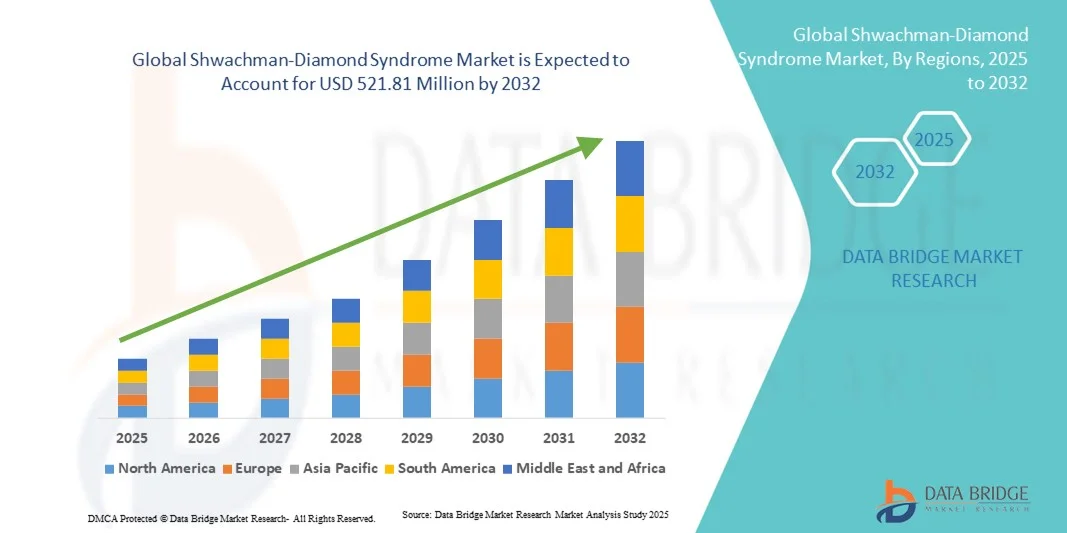
Shwachman-Diamond Syndrome Market Size
- The global Shwachman-Diamond syndrome market size was valued at USD 350.50 million in 2024 and is expected to reach USD 521.81 million by 2032, at a CAGR of5.10% during the forecast period
- The market growth is largely fueled by increasing awareness, early diagnosis, and advancements in genetic and therapeutic research for Shwachman-Diamond syndrome, leading to improved patient management and care in both pediatric and adult populations
- Furthermore, rising demand for effective treatment options, including bone marrow transplantation, supportive care, and emerging therapies, is driving investments in specialized healthcare infrastructure and increasing access to clinical solutions for patients with Shwachman-Diamond Syndrome. These converging factors are accelerating the uptake of disease management solutions, thereby significantly boosting the industry’s growth
Shwachman-Diamond Syndrome Market Analysis
- Shwachman-Diamond Syndrome (SDS), a rare genetic disorder affecting the bone marrow, pancreas, and skeletal system, is gaining increasing attention due to advancements in diagnosis, treatment options, and patient management strategies across healthcare systems globally
- The growing demand for specialized therapies, early diagnosis, and comprehensive care programs is driving market growth, supported by increased awareness among clinicians and caregivers, as well as the development of targeted interventions to manage hematological and pancreatic complications associated with SDS
- North America dominated the Shwachman-Diamond syndrome market with the largest revenue share of 39.5% in 2024, owing to the presence of advanced healthcare infrastructure, higher awareness levels, and active participation in clinical trials for rare genetic disorders. The U.S. experienced significant growth in SDS management, driven by research initiatives, specialized treatment centers, and improved accessibility to genetic testing and bone marrow transplantation
- Asia-Pacific is expected to be the fastest-growing region in the Shwachman-Diamond syndrome market during the forecast period, supported by rising healthcare investments, increasing availability of diagnostic services, and growing awareness about rare genetic disorders in countries such as China, India, and Japan
- The pancreatic enzyme supplements segment dominated the Shwachman-Diamond syndrome market with the largest market revenue share of 43.5% in 2024, as enzyme replacement therapy is essential for managing exocrine pancreatic insufficiency in SDS patients
Report Scope and Shwachman-Diamond Syndrome Market Segmentation
|
Attributes |
Shwachman-Diamond Syndrome Key Market Insights |
|
Segments Covered |
|
|
Countries Covered |
North America
Europe
Asia-Pacific
Middle East and Africa
South America
|
|
Key Market Players |
|
|
Market Opportunities |
|
|
Value Added Data Infosets |
In addition to the insights on market scenarios such as market value, growth rate, segmentation, geographical coverage, and major players, the market reports curated by the Data Bridge Market Research also include in-depth expert analysis, pricing analysis, brand share analysis, consumer survey, demography analysis, supply chain analysis, value chain analysis, raw material/consumables overview, vendor selection criteria, PESTLE Analysis, Porter Analysis, and regulatory framework. |
Shwachman-Diamond Syndrome Market Trends
Rising Focus on Early Diagnosis and Comprehensive Patient Management
- A significant and accelerating trend in the global Shwachman-Diamond syndrome market is the increasing emphasis on early diagnosis and comprehensive patient management through advanced biochemical, genetic, and clinical assessment tools. This trend is enhancing the accuracy of disease detection and improving long-term patient outcomes
- For instance, modern molecular genetic testing and enzyme analysis platforms allow clinicians to detect SDS at earlier stages, enabling timely interventions to manage pancreatic insufficiency, bone marrow dysfunction, and skeletal abnormalities. Similarly, prenatal screening tests are being increasingly used to identify potential cases before birth, supporting early clinical planning and counseling
- Integration of multiple diagnostic and monitoring approaches in clinical settings allows healthcare providers to track patient health comprehensively, evaluate treatment efficacy, and adjust therapy plans accordingly. Regular biochemical testing, coupled with dietary management and other therapeutic interventions, ensures personalized care for SDS patients
- The growing trend toward centralized and coordinated patient care systems facilitates improved collaboration among hospitals, clinics, and research centers. Through shared data and structured care pathways, clinicians can provide more informed recommendations, monitor disease progression effectively, and enhance the overall quality of life for patients
- This shift toward more proactive, data-driven, and patient-centered care is fundamentally reshaping expectations for SDS management. Consequently, healthcare institutions and biotechnology companies are increasingly developing advanced diagnostic platforms, patient monitoring programs, and specialized treatment protocols to support early intervention and holistic care
- The demand for integrated diagnostic and management solutions is growing rapidly across hospitals, clinics, and specialty care centers, as clinicians and patients increasingly prioritize early detection, continuous monitoring, and personalized therapeutic strategies
Shwachman-Diamond Syndrome Market Dynamics
Driver
Growing Need Due to Rising Awareness and Advancements in Rare Disease Management
- The increasing prevalence of rare genetic disorders, coupled with growing awareness among healthcare professionals and patients, is a significant driver for the heightened demand for Shwachman-Diamond Syndrome (SDS) diagnostics and therapeutic solutions
- For instance, in April 2024, several biotechnology companies and research institutions announced advancements in diagnostic platforms for SDS, focusing on improved detection of pancreatic insufficiency, bone marrow dysfunction, and skeletal anomalies. Such initiatives by key organizations are expected to drive SDS industry growth in the forecast period
- As clinicians and patients become more aware of the potential complications associated with SDS, including neutropenia, growth delays, and immune deficiencies, demand for early diagnosis and comprehensive disease management solutions is increasing. Advanced testing methods such as molecular genetic testing, enzyme analysis, and prenatal screening are providing more accurate and timely identification of SDS cases
- Furthermore, the growing emphasis on precision medicine and personalized treatment approaches is making SDS management solutions an integral part of healthcare strategies. Integration of patient monitoring, treatment planning, and follow-up care is enhancing the overall quality of care for SDS patients
- The convenience of early detection, accessible treatment options such as dietary management, plasmapheresis, hydrating creams, and medications, and the ability to manage care through specialized healthcare centers are key factors propelling the adoption of SDS management solutions in hospitals, clinics, and research facilities. The increasing availability of user-friendly diagnostic tools and growing patient support networks further contribute to market growth
Restraint/Challenge
Concerns Regarding Limited Treatment Options and High Diagnostic Costs
- Challenges surrounding limited therapeutic options and the high cost of advanced diagnostics pose significant barriers to broader market penetration for SDS. As a rare genetic disorder, treatment options primarily focus on symptom management, including dietary modifications, supportive therapies, and monitoring, rather than curative intervention
- For instance, the cost of genetic sequencing, enzyme assays, and specialized biochemical tests can limit accessibility for patients in developing regions or for those without sufficient healthcare coverage. In addition, the scarcity of specialized healthcare centers and trained professionals for rare metabolic disorders can delay diagnosis and treatment
- Addressing these challenges through increased research funding, patient support programs, and the development of cost-effective diagnostic solutions is crucial for expanding market access. Biotechnology companies and healthcare providers are emphasizing innovation in early detection tools and treatment methods to make SDS management more accessible and efficient
- Furthermore, the lifelong management requirements for SDS, including regular monitoring of neutropenia and pancreatic function, may discourage consistent treatment adherence among some patients. While research into novel therapies such as gene-based interventions and enzyme replacement is ongoing, these approaches are not yet widely available
- Overcoming these barriers through enhanced patient education, improved diagnostic infrastructure, and the development of affordable, scalable treatment solutions will be vital for sustained growth of the Shwachman-Diamond Syndrome market in the coming years
Shwachman-Diamond Syndrome Market Scope
The market is segmented on the basis of diagnosis, treatment, end user, and distribution channel.
- By Diagnosis
On the basis of diagnosis, the Shwachman-Diamond Syndrome market is segmented into hematology, genetic, imaging tests, and others. The hematology segment dominated the largest market revenue share of 41.8% in 2024, as blood tests and bone marrow evaluations are crucial for identifying neutropenia, anemia, and other hematological abnormalities associated with SDS. Hematology tests are widely available and cost-effective, allowing frequent monitoring of disease progression. Hospitals and specialty clinics prioritize hematology diagnostics due to their accuracy in assessing bone marrow function and response to treatment. Increased awareness among pediatricians and hematologists has boosted early detection rates. Blood testing helps guide therapy decisions, including G-CSF administration and transfusions. Hematology diagnostics also support monitoring of long-term outcomes. They are essential for risk assessment in patients with family history of SDS. Adoption of standardized testing protocols ensures reliability and consistency. Advanced lab facilities in developed regions further enhance the segment’s dominance. Hematology testing continues to be the backbone of SDS diagnosis and patient management.
The genetic testing segment is expected to witness the fastest CAGR of 9.2% from 2025 to 2032, driven by the increasing adoption of next-generation sequencing (NGS) and molecular diagnostic technologies. Identification of SBDS gene mutations allows early diagnosis and personalized treatment planning. Genetic testing is particularly useful for newborn screening and family risk assessment. Rising investments in rare disease genomics are supporting growth. Awareness campaigns by patient advocacy groups are improving demand. Genetic diagnostics enable precise differentiation from other inherited bone marrow failure syndromes. Collaboration between genetic labs and specialty clinics is expanding service reach. The test also supports prenatal and pre-symptomatic diagnosis. Cost reductions in genetic sequencing have made tests more accessible. Increased insurance coverage in some regions is further driving adoption. Rapid turnaround times and high accuracy make this the fastest-growing diagnostic segment.
- By Treatment
On the basis of treatment, the Shwachman-Diamond Syndrome market is segmented into pancreatic enzyme supplements, vitamin supplements, granulocyte-colony stimulating factor (G-CSF), hematopoietic stem cell transplantation (HSCT), and red cell or platelet transfusion. The pancreatic enzyme supplements segment dominated the largest market revenue share of 43.5% in 2024, as enzyme replacement therapy is essential for managing exocrine pancreatic insufficiency in SDS patients. Pancreatic enzymes improve nutrient absorption, support healthy growth, and enhance quality of life. Pediatric hospitals and specialty clinics widely prescribe enzyme therapy. High adoption is supported by increased physician awareness and patient education programs. The segment benefits from standardized dosing protocols. Supplements are often combined with vitamin therapy for comprehensive management. Availability in hospital pharmacies ensures proper administration and monitoring. Enzyme therapy reduces gastrointestinal complications. Chronic management requirements reinforce its market dominance. Rising diagnosis rates and early treatment initiation further strengthen the segment. It remains the first-line therapy in clinical practice.
The hematopoietic stem cell transplantation (HSCT) segment is expected to witness the fastest CAGR of 8.7% from 2025 to 2032, driven by its curative potential for severe bone marrow failure. HSCT is increasingly adopted due to improvements in donor matching, transplantation protocols, and supportive care, reducing mortality risks. Pediatric patients with severe neutropenia or myelodysplasia benefit the most. Investments in rare disease treatment programs expand access to transplant centers. Early intervention improves patient survival rates. Clinical guidelines recommend HSCT for eligible high-risk patients. Increasing awareness among physicians promotes timely referrals. Advances in immunosuppressive therapy reduce transplant-related complications. Collaboration between hospitals and international registries facilitates donor identification. Expanding insurance coverage in some regions supports adoption. Rapid advancements in transplantation technology make this the fastest-growing treatment segment.
- By End User
On the basis of end user, the Shwachman-Diamond Syndrome market is segmented into hospitals, specialty clinics, and others. The hospitals segment dominated the largest market revenue share of 52.1% in 2024, owing to the availability of comprehensive diagnostic and treatment services under one roof. Hospitals provide access to multidisciplinary teams including hematologists, geneticists, gastroenterologists, and dietitians. Hospitals manage inpatient monitoring, acute interventions, and long-term follow-up. They are key centers for HSCT and transfusion therapies. Hospital dominance is strengthened by participation in clinical trials and rare disease programs. Pediatric and adult SDS patients benefit from coordinated care. Advanced laboratory facilities support accurate diagnosis and monitoring. Hospitals ensure adherence to treatment protocols. Government funding and hospital networks enhance patient access. Integration with specialty services reinforces the segment’s leadership. Hospitals remain the preferred choice for complex SDS management.
The specialty clinics segment is expected to witness the fastest CAGR of 8.5% from 2025 to 2032, driven by the growing number of metabolic and rare disease centers. Clinics focus on early diagnosis, patient education, and personalized care. Telemedicine and remote consultation increase accessibility for underserved regions. Specialty clinics provide continuity of care for chronic SDS management. Awareness among clinicians and families promotes early referrals. Clinics often collaborate with hospitals for advanced treatments like HSCT. Genetic counseling and nutritional support services are widely offered. Clinics enhance patient compliance through structured follow-up programs. Expansion of private healthcare networks supports segment growth. Integration of diagnostic and monitoring services attracts more patients. Specialty clinics are becoming a preferred alternative for ongoing management, contributing to rapid CAGR.
- By Distribution Channel
On the basis of distribution channel, the Shwachman-Diamond Syndrome market is segmented into hospital pharmacy, retail pharmacy, and others. The hospital pharmacy segment dominated the largest market revenue share of 48.7% in 2024, as hospitals supply specialized medications, pancreatic enzyme supplements, vitamin therapy, and supportive care products. Hospital pharmacies ensure correct dosing, adherence, and emergency availability. Partnerships with pharmaceutical companies secure reliable supply chains. Hospitals provide monitoring and counseling alongside medication distribution. Centralized distribution enhances accessibility for inpatients and outpatients. Specialized staff ensures safe handling of rare disease therapies. Programs integrated with treatment protocols further strengthen the segment. Chronic care requirements reinforce hospital pharmacy dominance. Hospital pharmacies maintain inventory for rare treatments like HSCT supportive drugs. Patient education and adherence programs contribute to their market leadership.
The retail pharmacy segment is expected to witness the fastest CAGR of 8.2% from 2025 to 2032, driven by convenience and expanding access to medications, supplements, and supportive products. E-pharmacy platforms and home delivery services improve availability in remote areas. Retail pharmacies are increasingly participating in awareness campaigns. Community pharmacy programs support patient adherence and education. Expansion of private retail chains increases geographic coverage. Patients prefer retail options for routine medication refills. Integration of rare disease management tools supports segment growth. Partnerships with specialty clinics facilitate prescription fulfillment. Insurance coverage improvements enable wider access. Retail pharmacies provide flexibility for chronic treatment management. Convenience, accessibility, and patient preference drive rapid growth in this channel.
Shwachman-Diamond Syndrome Market Regional Analysis
- North America dominated the Shwachman-Diamond syndrome market with the largest revenue share of 39.5% in 2024, owing to the presence of advanced healthcare infrastructure
- Higher awareness levels, and active participation in clinical trials for rare genetic disorders
- The region’s growth is further supported by specialized treatment centers, robust patient support networks, and improved accessibility to genetic testing and bone marrow transplantation
U.S. Shwachman-Diamond Syndrome Market Insight
The U.S. Shwachman-Diamond syndrome market captured the largest revenue share within North America in 2024, fueled by increasing diagnosis rates, enhanced clinical focus on rare genetic disorders, and ongoing research initiatives. The availability of advanced genetic testing facilities, enzyme analysis laboratories, and specialized treatment programs has improved disease management significantly. Strong patient advocacy groups and educational campaigns are also contributing to greater awareness, early diagnosis, and better clinical outcomes.
Europe Shwachman-Diamond Syndrome Market Insight
The Europe Shwachman-Diamond syndrome market is projected to expand at a substantial CAGR throughout the forecast period, primarily driven by the strengthening of rare disease registries, government-led healthcare initiatives, and increasing investment in precision medicine. The region is witnessing rising awareness among clinicians and patients regarding early diagnosis, particularly in countries such as Germany, France, and the U.K. Collaborative research programs and specialized clinical centers are promoting timely diagnosis and comprehensive disease management across hospitals and clinics.
U.K. Shwachman-Diamond Syndrome Market Insight
The U.K. Shwachman-Diamond syndrome market is anticipated to grow at a noteworthy CAGR during the forecast period, driven by rising awareness of rare genetic disorders and adoption of advanced diagnostic tools. National health initiatives, genetic counseling programs, and specialized metabolic clinics are improving early detection and patient care. Increased funding for research on bone marrow disorders and pancreatic insufficiency is also supporting market growth.
Germany Shwachman-Diamond Syndrome Market Insight
The Germany Shwachman-Diamond syndrome market is expected to expand at a considerable CAGR during the forecast period, fueled by well-developed healthcare infrastructure, high clinical expertise, and investment in rare disease research. Hospitals and specialized metabolic disorder centers are increasingly providing advanced diagnostics and personalized management plans. Collaborations between universities, hospitals, and biotechnology firms are enhancing early diagnosis and treatment accessibility for SDS patients.
Asia-Pacific Shwachman-Diamond Syndrome Market Insight
The Asia-Pacific Shwachman-Diamond syndrome market is poised to grow at the fastest CAGR during the forecast period, supported by rising healthcare investments, increasing availability of diagnostic services, and growing awareness of rare genetic disorders in countries such as China, India, and Japan. Expansion of clinical testing facilities, enhanced research collaborations, and government initiatives promoting rare disease management are driving the region’s growth. Improved access to genetic testing and specialized care centers is further boosting adoption of SDS management solutions across hospitals and clinics.
Japan Shwachman-Diamond Syndrome Market Insight
The Japan Shwachman-Diamond syndrome market is gaining momentum due to the country’s advanced healthcare system, high clinical expertise, and rising awareness of rare genetic disorders. Rapid urbanization and increasing patient access to specialized diagnostic services are supporting early detection and treatment. Research programs focused on metabolic and hematologic disorders, combined with growing clinical experience, are expected to further expand market adoption.
China Shwachman-Diamond Syndrome Market Insight
The China Shwachman-Diamond syndrome market accounted for the largest market revenue share in Asia-Pacific in 2024, attributed to the country’s expanding healthcare infrastructure, rising middle-class population, and increasing awareness of rare genetic disorders. Government initiatives supporting rare disease diagnosis, expanding availability of genetic testing, and growing investments in metabolic disorder research are key factors driving market growth. Improved access to specialized care centers and educational programs is further accelerating the management of SDS in China.
Shwachman-Diamond Syndrome Market Share
The Shwachman-Diamond Syndrome industry is primarily led by well-established companies, including:
- Shire Pharmaceuticals (U.S.)
- Vertex Pharmaceuticals Incorporated (U.S.)
- Biomarin (U.S.)
- Amryt Pharma plc (Ireland)
- Recordati Industria Chimica e Farmaceutica S.p.A (Italy)
- Orphan Europe (France)
- Sanofi (France)
- Orphazyme (Denmark)
- Travere Therapeutics, Inc. (U.S.)
Latest Developments in Global Shwachman-Diamond Syndrome Market
- In February 2025, Elixirgen Therapeutics reported positive results from the first two patients to receive their novel gene therapy treatment for telomere biology disorders, including SDS. The therapy showed promising outcomes in improving bone marrow function and hematopoietic stem cell activity, marking a significant advancement in SDS treatment options
- In June 2025, Cincinnati hosted two pivotal events for SDS: the SDS Patient-Focused Drug Development (PFDD) meeting and the International Scientific Congress on Shwachman-Diamond Syndrome. These gatherings emphasized the importance of the patient voice in therapy development and fostered collaboration among researchers, clinicians, and the SDS community
- In July 2024, the SDS Alliance announced the assignment of a unique ICD-10 diagnostic code for Shwachman-Diamond Syndrome. This development aims to improve patient care, facilitate insurance coverage, and enhance data collection for SDS, marking a significant milestone in the recognition and management of the disease
- In August 2023, a study published in Blood identified antioxidants as a novel treatment approach to revert impaired angiogenic potential driven by metabolic alterations observed in SDS. This research opens new avenues for therapeutic strategies targeting vascular health in SDS patients

- Interactive Data Analysis Dashboard
- Company Analysis Dashboard for high growth potential opportunities
- Research Analyst Access for customization & queries
- Competitor Analysis with Interactive dashboard
- Latest News, Updates & Trend analysis
- Harness the Power of Benchmark Analysis for Comprehensive Competitor Tracking
Data collection and base year analysis are done using data collection modules with large sample sizes. The stage includes obtaining market information or related data through various sources and strategies. It includes examining and planning all the data acquired from the past in advance. It likewise envelops the examination of information inconsistencies seen across different information sources. The market data is analysed and estimated using market statistical and coherent models. Also, market share analysis and key trend analysis are the major success factors in the market report. To know more, please request an analyst call or drop down your inquiry.
The key research methodology used by DBMR research team is data triangulation which involves data mining, analysis of the impact of data variables on the market and primary (industry expert) validation. Data models include Vendor Positioning Grid, Market Time Line Analysis, Market Overview and Guide, Company Positioning Grid, Patent Analysis, Pricing Analysis, Company Market Share Analysis, Standards of Measurement, Global versus Regional and Vendor Share Analysis. To know more about the research methodology, drop in an inquiry to speak to our industry experts.
Data Bridge Market Research is a leader in advanced formative research. We take pride in servicing our existing and new customers with data and analysis that match and suits their goal. The report can be customized to include price trend analysis of target brands understanding the market for additional countries (ask for the list of countries), clinical trial results data, literature review, refurbished market and product base analysis. Market analysis of target competitors can be analyzed from technology-based analysis to market portfolio strategies. We can add as many competitors that you require data about in the format and data style you are looking for. Our team of analysts can also provide you data in crude raw excel files pivot tables (Fact book) or can assist you in creating presentations from the data sets available in the report.












