What is the Silage Additives Market Size and Growth Rate?
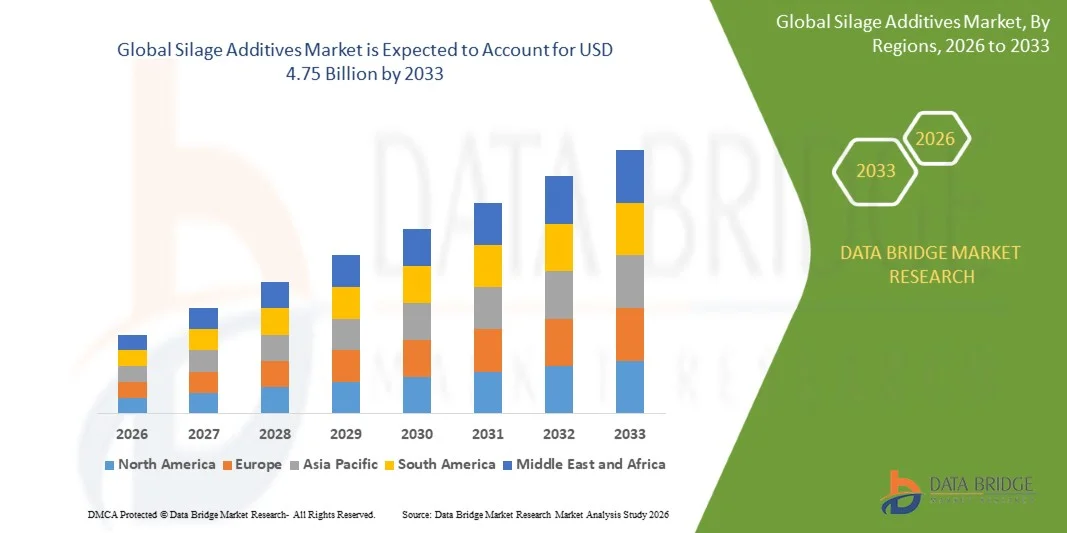
- As per Data Bridge Market Research analysis, the silage additives market was valued at USD 3.14 billion in 2025 and is projected to reach USD 4.75 billion by 2033, growing at a CAGR of 5.3% from 2026 to 2033.
- The market is experiencing steady growth driven by the rising global dairy and beef cattle populations, increasing farmer awareness of silage quality’s impact on livestock productivity, and growing adoption of biological inoculants to improve fermentation efficiency and reduce feed spoilage losses.
- The growing emphasis on maximizing forage nutritional value, minimizing dry matter losses during storage, and improving aerobic stability during feed-out is compelling dairy and livestock producers to adopt advanced silage additive solutions. Biological inoculants containing homofermentative and heterofermentative lactic acid bacteria strains are increasingly complementing and, in some applications, replacing traditional chemical preservatives, offering improved fermentation control with a more favorable environmental and handling profile.
- The increasing volatility of global feed grain prices is further reinforcing the economic case for silage additive investment, as producers seek to maximize the nutritional return from home-grown forage crops rather than relying more heavily on purchased concentrate feeds.
Market Size & Forecast
- Global Market Value (2025): USD 3.14 Billion
- Expected Market Value (2033): USD 4.75 Billion
- Forecast CAGR (2026–2033): 5.3%
- Leading Region in 2025: Europe
- Fastest Growing Region: Asia-Pacific
What are the Major Takeaways of the Silage Additives Market?
- Europe dominated the global silage additives market with the largest revenue share of 34.86% in 2025, supported by a well-established dairy farming industry, high silage adoption rates, and strong farmer awareness of forage preservation technologies across Germany, France, and the U.K.
- Asia-Pacific is expected to be the fastest-growing region at a CAGR of 7.4% from 2026 to 2033, fueled by rapidly expanding dairy and livestock farming operations, rising demand for high-quality animal feed, and growing government support for modern forage conservation practices across China and India.
- The biological additives segment led the market with a 46.72% share in 2025, driven by increasing farmer preference for bacterial inoculants that improve fermentation efficiency without the handling and corrosion concerns associated with chemical acid-based products.
- The enzymes segment is the fastest-growing additive type, projected to register a CAGR of 7.1%, reflecting rising adoption of fibrolytic and amylolytic enzyme blends that improve fiber digestibility and nutrient availability in stored forage.
- The corn/maize silage crop type segment dominated the market with a 41.53% revenue share in 2025, led by its widespread use as a primary energy source in dairy and beef cattle rations across major agricultural regions.
- Dairy cattle accounted for 52.64% of the market share among livestock segments in 2025, preferred due to the direct link between forage quality and milk yield, composition, and overall herd health.
- The fermentation enhancers function segment held a 44.18% share in 2025, reflecting its fundamental role in rapidly lowering silage pH to inhibit undesirable microbial activity and establish stable, well-preserved forage.
- The aerobic stability enhancers function segment is the fastest-growing category, with a CAGR of 6.8%, driven by increasing farmer focus on reducing feed spoilage and nutrient losses during the feed-out phase, particularly in warmer climates.
- The distributors & dealers channel accounted for 55.29% of the market share in 2025, supported by established relationships between agricultural input suppliers and farm cooperatives across major dairy and livestock producing regions.
Report Scope and Silage Additives Market Segmentation
|
Attributes |
Silage Additives Key Market Insights |
|
Segments Covered |
|
|
Countries Covered |
North America
Europe
Asia-Pacific
Middle East and Africa
South America
|
|
Key Market Players |
|
|
Market Opportunities |
|
|
Value Added Data Infosets |
In addition to the insights on market scenarios such as market value, growth rate, segmentation, geographical coverage, and major players, the market reports curated by the Data Bridge Market Research also include import export analysis, production capacity overview, production consumption analysis, price trend analysis, climate change scenario, supply chain analysis, value chain analysis, raw material/consumables overview, vendor selection criteria, PESTLE Analysis, Porter Analysis, and regulatory framework. |
What is the Key Trend in the Silage Additives Market?
- Dairy and livestock producers are increasingly adopting multi-strain bacterial inoculants that combine homofermentative and heterofermentative lactic acid bacteria to simultaneously optimize both rapid fermentation and long-term aerobic stability of stored silage.
- For instance, in March 2025, a leading silage inoculant manufacturer launched a new multi-strain bacterial blend combining fast-acting fermentation bacteria with heterofermentative strains specifically designed to extend bunker and pit silage stability during extended feed-out periods.
- Livestock nutritionists are increasingly recommending combination products that pair biological inoculants with enzyme blends, offering farmers a single-application solution that addresses both fermentation efficiency and fiber digestibility improvement.
- For instance, in March 2025, Lallemand Animal Nutrition highlighted its MAGNIVA forage inoculant range, including crop- and condition-specific solutions designed to improve fermentation, aerobic stability, forage digestibility, and feed value across different silage conditions.
- Manufacturers are increasingly investing in strain-specific research to develop bacterial inoculants tailored to particular forage crop types and regional climatic conditions, moving away from generic, one-size-fits-all product formulations toward more targeted, performance-validated solutions.
- For instance, in January 2025, Lallemand Animal Nutrition introduced a region-specific bacterial inoculant formulated for tropical and subtropical grass silage conditions, addressing the unique fermentation challenges associated with higher-moisture, lower-sugar tropical forage varieties.
- As dairy and livestock producers continue to prioritize forage quality, feed efficiency, and reduced storage losses, the adoption of advanced silage additive solutions is expected to accelerate, reinforcing their role as essential inputs for modern livestock feed management programs.
What are the Key Drivers of the Silage Additives Market?
- The rising global demand for dairy and beef products has significantly increased the number of cattle under intensive and semi-intensive management systems, driving greater reliance on high-quality, consistently preserved silage as a primary feed source.
- For instance, in April 2025, Novonesis expanded its silage inoculant manufacturing capacity in Europe to meet rising demand from dairy producers seeking to improve forage utilization efficiency amid increasing feed cost pressures.
- The growing recognition among farmers that silage dry matter and nutrient losses can be substantially reduced through proper additive use is driving increased adoption, as producers seek to maximize the economic value of home-grown forage crops amid rising feed input costs.
- For instance, in December 2024, Volac International expanded distribution of its Ecosyl-branded silage inoculant range to additional agricultural cooperatives across Eastern Europe, supporting improved forage conservation practices among dairy producers in the region.
- Growing consolidation of dairy and livestock operations into larger, more commercially oriented farms is supporting increased adoption of research-backed additive products, as larger operations are typically better positioned to evaluate and invest in additives with demonstrated return on investment.
- With rising global livestock populations, increasing feed cost pressures, and growing farmer awareness of silage quality’s impact on animal performance, silage additives will remain an essential component of modern forage conservation and livestock nutrition programs worldwide.
Which Factors are Challenging the Growth of the Silage Additives Market?
- Silage additive adoption remains inconsistent among smallholder and subsistence-level livestock farmers, particularly in emerging markets, due to limited awareness of additive benefits and constrained farm-level budgets for feed input investments.
- These adoption barriers limit market penetration in regions where silage-based feeding systems are still developing, slowing the pace of overall market expansion despite growing livestock populations in these areas.
- For instance, in September 2024, an agricultural extension survey in South Asia found that fewer than a third of smallholder dairy farmers surveyed were aware of biological silage inoculants, highlighting a significant education and adoption gap in emerging silage-producing regions.
- Storage and handling requirements for certain biological additives, including cold-chain considerations for maintaining bacterial viability, can create logistical challenges in regions with underdeveloped agricultural supply chain infrastructure, particularly in remote or rural farming areas.
- The variability in silage additive performance across different forage types, moisture conditions, and climatic environments continues to create uncertainty for farmers evaluating return on investment. This inconsistency in perceived value slows adoption among cost-conscious producers, limiting the widespread adoption of premium silage additive solutions despite their demonstrated benefits in controlled trial conditions.
How is the Silage Additives Market Segmented?
The silage additives market is segmented on the basis of type, silage crop type, livestock, form, function, and distribution channel.
- By Type
On the basis of type, the market is segmented into biological additives, chemical additives, enzymes, and others. The biological additives segment dominated the market with a 46.72% share in 2025, owing to increasing farmer preference for bacterial inoculants that improve fermentation efficiency without the handling and corrosion concerns associated with chemical acid-based products. These products remain the preferred choice for dairy and livestock producers seeking a cost-effective, easy-to-handle solution for improving silage fermentation quality.
The enzymes segment is projected to register the fastest growth at a CAGR of 7.1% from 2026 to 2033, driven by rising adoption of fibrolytic and amylolytic enzyme blends that improve fiber digestibility and nutrient availability in stored forage. Growing research into enzyme-bacteria synergies is further accelerating segment expansion.
- By Silage Crop Type
On the basis of silage crop type, the market is segmented into corn/maize silage, grass silage, legume silage, small grain cereal silage, and others. The corn/maize silage segment led the market with a 41.53% share in 2025, supported by its widespread use as a primary energy source in dairy and beef cattle rations across major agricultural regions including North America and Europe.
The legume silage segment is expected to experience the fastest growth at a CAGR of 6.9% from 2026 to 2033, driven by increasing adoption of alfalfa and other legume forages valued for their high protein content, requiring specialized additive formulations to manage their naturally higher buffering capacity during fermentation.
- By Livestock
On the basis of livestock, the market is segmented into dairy cattle, beef cattle, sheep & goats, and others. The dairy cattle segment dominated the market with a share of 52.64% in 2025 due to the direct link between forage quality and milk yield, composition, and overall herd health. the continued intensification of dairy production systems worldwide is reinforcing the dominance of this segment.
The beef cattle segment is expected to witness the fastest CAGR of 6.3% from 2026 to 2033, driven by this growth is fueled by rising global beef consumption and growing adoption of silage-based feeding systems in beef finishing operations seeking to improve feed conversion efficiency and reduce production costs.
- By Form
On the basis of form, the market is segmented into liquid and dry/granular. The liquid segment dominated the market with a share of 58.37% in 2025 due to its ease of application through standard forage harvester applicator systems and more uniform distribution across the ensiled crop. established farmer familiarity with liquid application equipment continues to reinforce this segment’s leading position.
The dry/granular segment is expected to witness the fastest CAGR of 6.5% from 2026 to 2033, driven by rising demand for products with longer shelf stability and simplified storage and handling requirements, particularly among smaller farm operations without dedicated liquid application infrastructure.
- By Function
On the basis of function, the market is segmented into fermentation enhancers, aerobic stability enhancers, nutrient preservation, and mold & yeast inhibitors. The fermentation enhancers segment dominated the market with a share of 44.18% in 2025 due to their fundamental role in rapidly lowering silage pH to inhibit undesirable microbial activity and establish stable, well-preserved forage. widespread adoption of homofermentative lactic acid bacteria inoculants continues to support strong demand for this segment.
The aerobic stability enhancers segment is expected to witness the fastest CAGR of 6.8% from 2026 to 2033, driven by increasing farmer focus on reducing feed spoilage and nutrient losses during the feed-out phase, particularly in warmer climates where heating and mold growth can significantly reduce feed quality after silage exposure to air.
- By Distribution Channel
On the basis of distribution channel, the market is segmented into direct/farm sales, distributors & dealers, and online retail. The distributors & dealers segment dominated the market with a share of 55.29% in 2025 due to its extensive reach across dairy and livestock farming regions, supported by established relationships between agricultural input suppliers and farm cooperatives. long-standing distribution networks continue to reinforce this segment’s leading position across both developed and emerging markets.
The online retail segment is expected to witness the fastest CAGR of 8.2% from 2026 to 2033, driven by growing farmer adoption of digital procurement platforms for agricultural inputs, offering convenient access to product information, pricing comparisons, and direct-to-farm delivery for smaller-volume purchases.
Which Region Holds the Largest Share of the Silage Additives Market?
- Europe dominated the silage additives market and accounted for the largest revenue share of 34.86% in 2025, supported by a well-established dairy farming industry, high silage adoption rates, and strong farmer awareness of forage preservation technologies across the region.
- The region also benefits from a high concentration of leading silage additive manufacturers, well-developed agricultural extension services, and long-standing farmer familiarity with biological inoculant technologies. Continued focus on sustainable dairy farming practices and feed efficiency optimization continues to strengthen Europe’s leadership position in the global market.
Germany Silage Additives Market Insight
Germany silage additives market is growing steadily, supported by the country’s large dairy cattle population, well-established silage-based feeding systems, and strong farmer awareness of forage quality’s impact on milk production efficiency. Dairy cooperatives and feed advisors continue to promote biological inoculant adoption to improve fermentation consistency and reduce feed losses. Continued investment in precision livestock farming and sustainable dairy production practices is further driving market growth in Germany.
France Silage Additives Market Insight
France silage additives market is expanding steadily, supported by extensive corn and grass silage production, a large dairy and beef cattle sector, and growing farmer adoption of biological additives to improve feed conservation efficiency. Agricultural cooperatives continue to play a significant role in promoting silage additive adoption among both large-scale and smaller family dairy operations. Continued government support for sustainable livestock farming practices is further reinforcing market growth in France.
Asia-Pacific Silage Additives Market Insight
Asia-Pacific silage additives market is expected to witness rapid growth, driven by rapidly expanding dairy and livestock farming operations, rising demand for high-quality animal feed, and growing government support for modern forage conservation practices across countries such as China and India. Increasing awareness of silage-based feeding systems among commercial dairy operations and rising investment in agricultural extension services are supporting regional market expansion. Additionally, the growing presence of international silage additive manufacturers establishing regional distribution networks is accelerating market adoption across the region.
China Silage Additives Market Insight
The China silage additives market is growing rapidly, driven by expanding commercial dairy farming operations, rising government investment in modernizing livestock feed practices, and growing awareness of silage quality’s role in improving milk yield and herd health. Growing adoption of biological inoculants across large-scale dairy operations is significantly boosting market demand. In addition, rising domestic silage additive manufacturing capabilities and increasing corn silage production are positioning China as one of the fastest-growing markets for silage additives globally.
India Silage Additives Market Insight
India silage additives market is witnessing robust growth, driven by rapidly expanding commercial dairy farming, rising government investment in livestock productivity improvement programs, and growing awareness of silage-based feeding systems as an alternative to traditional fodder practices. Increasing adoption of biological inoculants among progressive dairy farmers and growing agricultural extension outreach are supporting market expansion. Additionally, the entry of international silage additive manufacturers and growing domestic production capacity are further accelerating adoption across the country.
Which are the Top Companies in Silage Additives Market?
The silage additives industry is primarily led by well-established companies, including:
- Novonesis (Denmark)
- Lallemand Inc. (Canada)
- Kemin Industries, Inc. (U.S.)
- BASF SE (Germany)
- Volac International Limited (U.K.)
- Addcon Group GmbH (Germany)
- DSM-Firmenich AG (Switzerland)
- Corteva Agriscience (U.S.)
- Agri-King, Inc. (U.S.)
- Provita Supplements Ltd. (U.K.)
- Feedworks Pty Ltd (Australia)
- Nutreco N.V. (Netherlands)
- Yara International ASA (Norway)
- Perstorp Group (Sweden)
- Eastman Chemical Company (U.S.)
- Anpario plc (U.K.)
- Selko (Netherlands)
- Ecosyl Products Ltd. (Volac) (U.K.)
- Biomin Holding GmbH (Austria)
- Taminco (Belgium)
What are Latest Developments in Silage Additives Market?
- In September 2025, Novonesis launched a new generation multi-strain bacterial inoculant featuring enhanced heterofermentative lactic acid bacteria for improved aerobic stability, targeting dairy producers in warmer climates seeking to reduce feed-out spoilage losses.
- In January 2025, Lallemand Animal Nutrition expanded its silage inoculant manufacturing facility in North America to increase production capacity and meet rising demand from dairy and beef cattle producers across the region.
- In November 2025, Volac International introduced an upgraded Ecosyl-branded combination inoculant-enzyme product designed to simultaneously improve fermentation efficiency and fiber digestibility in corn and grass silage applications.
- In November 2024, Kemin Industries launched a new dry/granular silage additive formulation designed for smaller farm operations lacking liquid application infrastructure, expanding accessibility of biological inoculant technology to a broader customer base.
- In June 2023, DSM-Firmenich partnered with several European agricultural cooperatives to conduct field trials of its next-generation silage inoculant products, demonstrating improved fermentation consistency and reduced dry matter losses across multiple forage types and climatic conditions.
- In August 2024, Agri-King expanded its silage additive product portfolio with a new enzyme-enhanced inoculant specifically formulated for high-moisture corn silage applications, addressing growing demand from Midwest U.S. dairy and beef cattle operations.

- Interactive Data Analysis Dashboard
- Company Analysis Dashboard for high growth potential opportunities
- Research Analyst Access for customization & queries
- Competitor Analysis with Interactive dashboard
- Latest News, Updates & Trend analysis
- Harness the Power of Benchmark Analysis for Comprehensive Competitor Tracking
Data collection and base year analysis are done using data collection modules with large sample sizes. The stage includes obtaining market information or related data through various sources and strategies. It includes examining and planning all the data acquired from the past in advance. It likewise envelops the examination of information inconsistencies seen across different information sources. The market data is analysed and estimated using market statistical and coherent models. Also, market share analysis and key trend analysis are the major success factors in the market report. To know more, please request an analyst call or drop down your inquiry.
The key research methodology used by DBMR research team is data triangulation which involves data mining, analysis of the impact of data variables on the market and primary (industry expert) validation. Data models include Vendor Positioning Grid, Market Time Line Analysis, Market Overview and Guide, Company Positioning Grid, Patent Analysis, Pricing Analysis, Company Market Share Analysis, Standards of Measurement, Global versus Regional and Vendor Share Analysis. To know more about the research methodology, drop in an inquiry to speak to our industry experts.
Data Bridge Market Research is a leader in advanced formative research. We take pride in servicing our existing and new customers with data and analysis that match and suits their goal. The report can be customized to include price trend analysis of target brands understanding the market for additional countries (ask for the list of countries), clinical trial results data, literature review, refurbished market and product base analysis. Market analysis of target competitors can be analyzed from technology-based analysis to market portfolio strategies. We can add as many competitors that you require data about in the format and data style you are looking for. Our team of analysts can also provide you data in crude raw excel files pivot tables (Fact book) or can assist you in creating presentations from the data sets available in the report.