


What is the Silage Inoculants and Enzymes Market Size and Growth Rate?
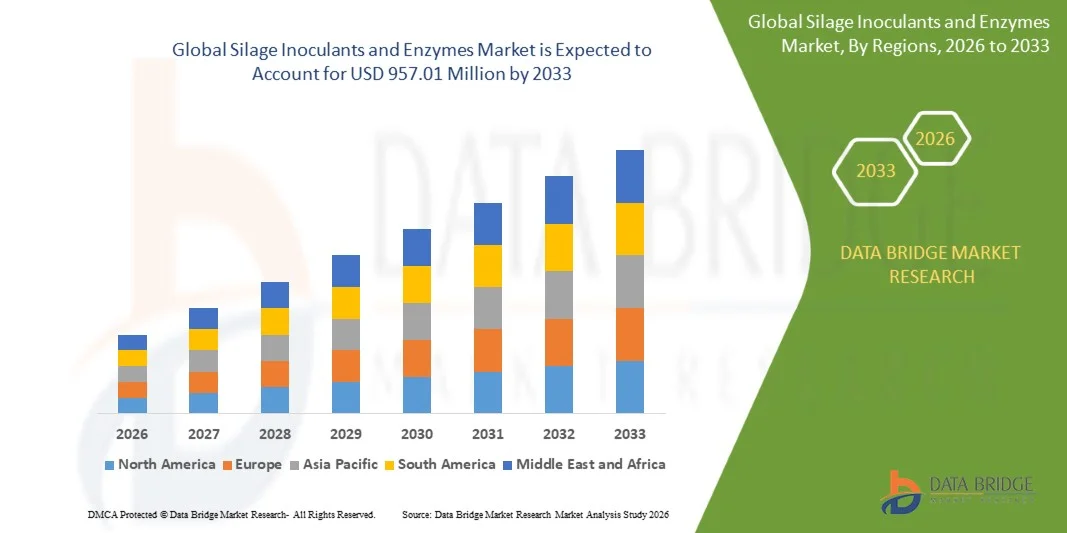
- As per Data Bridge Market Research analysis, the silage inoculants and enzymes market was valued at USD 633.13 million in 2025 and is projected to reach USD 957.01 million by 2033, growing at a CAGR of 5.30% from 2026 to 2033.
- The market is experiencing consistent growth driven by the rising demand for high-quality animal feed, improved silage preservation, enhanced nutrient retention, and greater feed digestibility. Silage inoculants composed of beneficial bacteria support the fermentation process by increasing lactic acid production and reducing spoilage
- The increasing emphasis on feed efficiency, livestock health, and sustainable livestock farming, combined with the growing use of silage inoculants in corn, alfalfa, grass, and sorghum, is encouraging the adoption of microbial and enzyme-based silage additives. The development of probiotic-enhanced and multi-strain inoculants with improved silage digestibility, aerobic stability, and fermentation efficiency is further supporting adoption among dairy farms, beef farms, and other livestock producers.
Market Size & Forecast
- Global Market Value (2025): USD 633.13 Million
- Expected Market Value (2033): USD 957.01 Million
- Forecast CAGR (2026–2033): 5.30%
- Leading Region in 2025: North America
- Fastest Growing Region: Asia Pacific
What are the Major Takeaways of the Silage Inoculants and Enzymes Market?
- North America dominated the silage inoculants and enzymes market with 40.5% share, supported by the region’s established livestock industry, high adoption of silage preservation technologies, and strong demand for feed efficiency.
- Asia-Pacific is expected to be the fastest-growing region at a CAGR of 8.2% from 2026 to 2033, fueled by expanding livestock production and increasing demand for improved animal feed and silage management solutions.
- The lactobacillus segment led the market with a 45% share in 2025, driven by its extensive use in silage fermentation and strong lactic acid-producing capability.
- Pediococcus are the fastest-growing species type, projected to register a CAGR of 5.3%, reflecting the surge in rapid acidification capability and increasing use in multi-strain inoculant formulations
- The homofermentative segment dominated the classification category with a 60% revenue share in 2025, led by its ability to rapidly produce lactic acid and lower silage pH.
- Fibre-digesting accounted for 55.7% of the market share in 2025, preferred by increasing demand for improved forage digestibility and nutrient availability
- The dry segment is the fastest-growing form category, with a CAGR of 6.4%, driven by storage convenience, transportation advantages, and increasing availability of concentrated microbial formulations.
Report Scope and Silage Inoculants and Enzymes Market Segmentation
|
Attributes |
Silage Inoculants and Enzymes Key Market Insights |
|
Segments Covered |
|
|
Countries Covered |
North America
Europe
Asia-Pacific
Middle East and Africa
South America
|
|
Key Market Players |
|
|
Market Opportunities |
|
|
Value Added Data Infosets |
In addition to the insights on market scenarios such as market value, growth rate, segmentation, geographical coverage, and major players, the market reports curated by the Data Bridge Market Research also include in-depth expert analysis, pricing analysis, brand share analysis, consumer survey, demography analysis, supply chain analysis, value chain analysis, raw material/consumables overview, vendor selection criteria, PESTLE Analysis, Porter Analysis, and regulatory framework. |
What is the Key Trend in the Silage Inoculants and Enzymes Market?
- Silage producers are increasingly adopting multi-strain lactic acid bacteria inoculants and enzyme combinations to improve fermentation efficiency, aerobic stability, nutrient preservation, and feed quality across different forage crops.
- For instance, in September 2023, researchers from the University of Guelph published a study evaluating Lentilactobacillus buchneri NCIMB 40788 in maize silage, examining its effects on fermentation and microbial communities, reflecting the growing focus on targeted microbial strains for improving silage quality and controlling undesirable microorganisms.
- The increasing focus on aerobic stability and reduction of dry matter losses is encouraging producers to select inoculants that maintain silage quality after silo opening and during feed-out periods.
- Livestock producers are increasingly seeking crop-specific inoculant solutions because fermentation performance varies according to forage species, dry matter content, moisture conditions, and microbial composition.
- For instance, in May 2023, a study published in Microbiology Spectrum evaluated commercial multispecies microbial inoculants containing combinations of Lactiplantibacillus plantarum, Lentilactobacillus buchneri, Lacticaseibacillus paracasei, and Pediococcus acidilactici in oat silage
- As dairy and beef producers continue prioritizing feed preservation, nutrient retention, and consistent silage quality, manufacturers are developing inoculant and enzyme solutions tailored to crop type, fermentation conditions, and livestock feeding requirements
What are the Key Drivers of the Silage Inoculants and Enzymes Market?
- The growing global demand for high-quality animal feed and improved livestock productivity is increasing the adoption of silage inoculants and enzymes that enhance fermentation, nutrient retention, digestibility, and feed stability.
- For instance, in January 2024, research published in Livestock Science evaluated lactic acid bacteria-treated grass silage in 48 Norwegian Red dairy cows, demonstrating continued research into silage additives as a means of improving feed utilization and dairy production.
- Dairy and beef producers are integrating microbial inoculants and enzymes into forage preservation practices to reduce spoilage, improve silage fermentation, increase nutrient availability, and support more efficient livestock feeding systems.
- With livestock producers increasingly focused on reducing feed losses and improving forage utilization, silage inoculants and enzymes are expected to remain important tools for enhancing fermentation performance, aerobic stability, and the nutritional value of preserved feed.
Which Factors are Challenging the Growth of the Silage Inoculants and Enzymes Market?
- Premium inoculant and enzyme products can involve higher costs, potentially limiting adoption among small-scale and cost-conscious farmers, particularly in developing regions where traditional silage preparation remains prevalent.
- For instance, in April 2022, a study published in the Journal of Dairy Science found that the effectiveness of a microbial inoculant varied with dry-matter content in whole-plant corn silage; after 60 days, aerobic-stability improvement was substantially greater in medium- and high-dry-matter silage than in low-dry-matter silage, demonstrating that forage conditions can influence inoculant performance.
- The effectiveness of microbial formulations can also be affected by storage and application conditions, while differences in crop moisture, dry matter, and microbial populations can influence inoculant performance.
- For instance, in July 2023, researchers from the Natural Resources Institute Finland evaluated homofermentative and heterofermentative lactic-acid-bacteria inoculants at low and high dry-matter contents in grass silage, showing that additive effects on preservation characteristics depended on dry-matter level and additive mode of action.
- The combination of product costs, formulation sensitivity, variable farm conditions, and the need for correct application continues to create adoption barriers, particularly where farmers have limited access to technical support and advanced silage-management practices.
How is the Silage Inoculants and Enzymes Market Segmented?
The silage inoculants and enzymes market is segmented on the basis of species, classifications, enzymes, form, and crop type.
- By Species
On the basis of species, the silage inoculants and enzymes market is segmented into pediococcus, enterococcus, and lactobacillus. The lactobacillus segment dominated the market with an estimated share of 45% in 2025, owing to its extensive use in silage fermentation and strong lactic acid-producing capability. Lactobacillus strains rapidly convert water-soluble carbohydrates into lactic acid, helping reduce silage pH and inhibit undesirable microorganisms. They are extensively used in commercial inoculant formulations for corn, alfalfa, grass, and other forage crops. The availability of both homofermentative and heterofermentative Lactobacillus strains expands their application across different silage conditions. Their established fermentation performance and contribution to nutrient preservation continue to support widespread adoption
The pediococcus segment is projected to register the fastest growth at an estimated CAGR of 5.3% from 2026 to 2033, driven by its rapid acidification capability and increasing use in multi-strain inoculant formulations. Pediococcus species can rapidly produce lactic acid during the initial stages of fermentation, helping establish favorable preservation conditions. Their rapid growth characteristics make them useful for accelerating fermentation when forage contains sufficient fermentable carbohydrates. Pediococcus is also combined with Lactobacillus and other lactic acid bacteria to provide complementary fermentation functions. Increasing development of specialized microbial blends is creating additional opportunities for Pediococcus-based products. Growing demand for efficient fermentation and improved silage preservation is expected to support the segment's expansion.
- By Classification
On the basis of classifications, the silage inoculants and enzymes market is segmented into heterofermentative and homofermentative. The homofermentative segment dominated the market with 60% share in 2025, owing to its ability to rapidly produce lactic acid and lower silage pH. Rapid pH reduction helps suppress undesirable microorganisms and supports efficient preservation of ensiled forage. Homofermentative bacteria are widely used in commercial silage inoculants because of their established fermentation performance. They are particularly valuable during the initial fermentation phase, when rapid stabilization of the crop is required. Their widespread application across corn, grass, and other forage silages supports their leading position. The established availability of homofermentative products and their recognized role in improving fermentation quality continue to sustain demand.
The heterofermentative segment is projected to register the fastest growth at an estimated CAGR of 5.0% from 2026 to 2033, driven by increasing demand for improved aerobic stability and reduced spoilage during feed-out. Heterofermentative bacteria produce lactic acid together with acetic acid and other fermentation products that help inhibit yeasts and molds. This characteristic is particularly important after silage is exposed to oxygen during silo opening and feed-out. Lactobacillus buchneri is widely investigated for improving aerobic stability in corn and other forage silages. Growing concerns regarding dry-matter losses and heating during feed-out are increasing interest in heterofermentative inoculants. Increasing emphasis on maintaining silage quality throughout storage and feeding is expected to accelerate adoption of these products.
- By Enzymes
On the basis of enzymes, the silage inoculants and enzymes market is segmented into fibre-digesting and starch-digesting enzymes. The fibre-digesting enzymes segment dominated the market with an estimated share of 55.7% in 2025, supported by increasing demand for improved forage digestibility and nutrient availability. Fibre-digesting enzymes help break down complex components of plant cell walls, including structural carbohydrates. Improved fibre degradation can increase the availability of nutrients for livestock and support more efficient forage utilization. These enzymes are particularly relevant to forage-based diets where fibre represents a major component of the feed. Their use with microbial inoculants can provide complementary benefits by improving both fermentation and subsequent feed utilization.
The starch-digesting enzymes segment is projected to register the fastest growth at an estimated CAGR of 5.6% from 2026 to 2033, driven by increasing utilization of high-energy corn silage in dairy and beef production. Starch-digesting enzymes help break down starch components and can improve the availability of nutrients during livestock feeding. Corn silage provides a significant application base because of its relatively high starch content. Growing demand for improved feed digestibility and nutrient utilization is supporting the adoption of starch-focused enzyme solutions. Manufacturers are also developing enzyme combinations that can complement fibre-digesting enzymes and microbial inoculants. Increasing emphasis on feed conversion, animal productivity, and efficient utilization of high-energy forage is expected to create further opportunities for this segment.
- By Form
On the basis of form, the silage inoculants and enzymes market is segmented into dry and liquid. The liquid segment dominated the market with an estimated share of 55% in 2025, supported by convenient application during forage harvesting and ensiling operations. Liquid formulations can be distributed across harvested forage using existing spraying and dosing equipment. Their compatibility with mechanized harvesting systems allows producers to apply inoculants efficiently during the ensiling process. Liquid products can also provide uniform distribution of microbial cultures across large quantities of forage. Their established use among commercial livestock producers supports their leading position in the market. Increasing mechanization of forage harvesting and growing adoption of precision application technologies are further supporting demand for liquid formulations.
The dry segment is projected to register the fastest growth at an estimated CAGR of 6.4% from 2026 to 2033, driven by storage convenience, transportation advantages, and increasing availability of concentrated microbial formulations. Dry formulations can be easier to transport and store than liquid products, particularly across geographically dispersed agricultural markets. Their handling characteristics can also reduce logistical challenges for distributors and livestock producers. Manufacturers are developing concentrated dry products containing selected microbial strains for specific silage applications. Increasing demand for convenient and stable inoculant formulations is supporting their adoption across developing livestock markets. Growing commercial livestock production and expanding distribution networks are expected to further strengthen the demand for dry silage inoculant products
- By Crop Type
On the basis of crop type, the silage inoculants and enzymes market is segmented into corn, sorghum, alfalfa, clovers, and others. The corn segment dominated the market with an estimated share of 35% in 2025, driven by the widespread use of corn silage in dairy and beef cattle feeding systems. Corn silage provides a high-energy forage source and is extensively produced in major livestock-producing regions. Inoculants and enzymes are applied to improve fermentation, preserve nutrients, and reduce dry-matter losses during storage. The high volume of corn silage production provides a substantial application base for microbial and enzyme-based additives. Increasing demand for high-quality feed and efficient forage preservation continues to support the dominance of corn. Strong adoption of corn silage in North America and other intensive dairy-producing regions further strengthens the segment's position.
The alfalfa segment is projected to register the fastest growth at an estimated CAGR of 5.8% from 2026 to 2033, supported by increasing demand for protein-rich forage in dairy and livestock production. Alfalfa has a high buffering capacity and relatively low concentrations of fermentable carbohydrates, creating greater challenges for effective fermentation. Appropriate inoculants can help improve fermentation performance and preserve the nutritional quality of alfalfa silage. Increasing dairy production is strengthening demand for high-quality forage capable of supporting milk production and animal performance. Manufacturers are also developing crop-specific formulations to address the distinct fermentation characteristics of legume silages.
Which Region Holds the Largest Share of the Silage Inoculants and Enzymes Market?
- North America dominated the silage inoculants and enzymes market with 40.5% share, supported by the region’s established livestock industry, high adoption of silage preservation technologies, and strong demand for feed efficiency.
- The region also benefits from highly mechanized forage harvesting, strong adoption of feed-preservation technologies, and increasing demand for improved livestock productivity. The United States represents the major contributor to regional demand, supported by extensive dairy and cattle production and established use of silage additives. Growing emphasis on reducing feed losses and improving forage quality continues to strengthen North America's position in the global market.
U.S. Silage Inoculants and Enzymes Market Insight
The U.S. silage inoculants and enzymes market is witnessing strong growth due to the country’s large dairy and beef cattle industry and extensive use of silage-based feeding systems. According to the USDA, the U.S. had approximately 9.35 million milk cows as of January 2025, creating a substantial demand base for high-quality forage preservation and feed-efficiency solutions. In addition, the University of Delaware evaluated an inoculant containing Pediococcus pentosaceus, Lactobacillus buchneri, and Lactobacillus hilgardii in whole-corn plant silage at low and high dry-matter levels of 26.2% and 39.7%, respectively, demonstrating active U.S. research into advanced multi-strain inoculant solutions.
Asia-Pacific Silage Inoculants and Enzymes Market Insight
The Asia-Pacific silage inoculants and enzymes market is expected to witness rapid growth, driven by expanding dairy and beef production, increasing adoption of quality forage preservation, and growing mechanization of corn and grass ensiling across countries such as China and India. Increasing producer awareness of dry-matter losses, aerobic stability, and feed-conversion efficiency is supporting adoption of microbial additives across the region. In April 2024, researchers at Inner Mongolia Minzu University in China published a study in Frontiers in Microbiology evaluating homofermentative and heterofermentative lactic acid bacteria inoculants in whole-plant soybean–corn mixed silage. The study found that LAB inoculation affected fermentation quality, nutrient composition, microbial diversity, and aerobic stability, demonstrating active development and application of advanced silage-inoculation technologies in Asia region.
Japan Silage Inoculants and Enzymes Market Insight
The Japan silage inoculants and enzymes market is witnessing consistent growth due to demand for efficient livestock feeding, improved forage preservation, and technologies that support high-quality animal nutrition. Japan’s dairy sector provides an established application base for silage-management technologies, while research institutions continue evaluating microbial treatments for improving fermented forage quality. A Japanese research study published in Animals evaluated the effects of lactic acid bacteria inoculation on the fermentation characteristics and microbial communities of silage, demonstrating continued scientific interest in improving silage preservation. Moreover, Japan’s emphasis on efficient livestock production and utilization of high-quality forage is supporting the adoption of technologies that improve feed preservation and nutritional value.
China Silage Inoculants and Enzymes Market Insight
The China silage inoculants and enzymes market is growing rapidly, driven by expanding livestock production, increasing demand for high-quality feed, and improving adoption of modern forage-preservation practices. China’s large dairy and beef production base provides a substantial potential market for microbial inoculants and enzyme-based silage additives. Research published in Frontiers in Microbiology evaluated lactic acid bacteria inoculation in whole-plant soybean-corn mixed silage and found effects on fermentation quality, nutrient composition, microbial diversity, and aerobic stability, demonstrating increasing application of advanced inoculation technologies in Chinese forage systems. Increasing focus on feed efficiency, livestock productivity, and preservation of locally produced forage is expected to further support market development.
U.K. Silage Inoculants and Enzymes Market Insight
The U.K. silage inoculants and enzymes market is experiencing steady growth, supported by the country’s established dairy and livestock sector and extensive use of grass and forage silage. Research published in the Journal of Dairy Science has demonstrated that microbial inoculation can influence silage fermentation and aerobic stability, reinforcing the relevance of inoculant technologies to livestock-feed preservation. The U.K.’s strong emphasis on efficient grassland management and livestock-feed quality is further supporting demand for technologies that reduce dry-matter losses and improve forage utilization. In addition, research conducted on grass silage under different dry-matter conditions has highlighted the importance of selecting appropriate additives for effective preservation.
Germany Silage Inoculants and Enzymes Market Insight
The Germany silage inoculants and enzymes market is expanding steadily due to the country’s significant dairy and livestock sector, strong forage-production base, and emphasis on efficient feed utilization. Germany is an important European dairy producer, while maize and grass silages are widely used as feed resources in intensive livestock systems. Research evaluating Lentilactobacillus buchneri inoculation in whole-plant corn silage has demonstrated its potential to reduce dry-matter losses and improve aerobic stability, supporting the application of advanced microbial technologies in European livestock production. Furthermore, European research on grass silage has evaluated homofermentative and heterofermentative lactic-acid-bacteria inoculants under different dry-matter conditions, highlighting continued development of silage-preservation solutions.
Which are the Top Companies in Silage Inoculants and Enzymes Market?
The silage inoculants and enzymes industry is primarily led by well-established companies, including:
- Lallemand Inc. (Canada)
- Alltech (U.S.)
- Kemin Industries, Inc. (U.S.)
- CORTEVA (U.S.)
- Volac International Limited (U.K.)
- Novonesis (Denmark)
- ADDCON GmbH (Germany)
- Provita Animal Health Limited (U.K.)
- Nutritech International Ltd (New Zealand)
- Ralco Nutrition, Inc. (U.S.)
- Agri-King, Inc. (U.S.)
- Sanoanimal, (Germany)
- Josera GmbH (Germany)
- Schaumann Agri International GmbH (Germany)
- BASF SE (Germany)
- ADM (U.S.)
- Cargill, Incorporated (U.S.)
- Global Nutritech (India)
- Schaumann BioEnergy Consult GmbH (Germany)
What are Latest Developments in Silage Inoculants and Enzymes Market?
- In July 2023, Ralco launched Anchor Silage Saver, a new silage inoculant under its Agnition agronomy brand. The product uses Ralco’s patented Microbial Catalyst technology together with a starter microbial blend to accelerate fermentation, rapidly reduce forage pH, preserve nutrients, and improve silage feed quality. The launch targeted dairy and livestock producers seeking improved forage preservation and reduced nutrient losses.
- In November 2022, Alltech launched its new Egalis line of silage inoculants, consisting of Egalis Ultra, Egalis Ultra HC, and Egalis Ultra HC-OA. The products were developed using selected strains of Lactobacillus plantarum and Pediococcus pentosaceus to accelerate fermentation, improve nutrient retention, reduce dry-matter losses, and enhance silage preservation. The HC-OA formulation was specifically designed for organic farms.
- In February 2022, BONSILAGE USA introduced a new Lactobacillus diolivorans strain for silage production, designed to accelerate aerobic stability. The company stated that the new strain could reduce the time required to achieve aerobic stability to 14 days, compared with the traditional 6–8 weeks. The development was aimed at giving producers faster access to stable, high-quality silage while reducing the risk of heating and spoilage.
- In March 2021, Pioneer announced that its silage inoculants had received certification for use on organic farms in the U.K., allowing organic livestock producers to use Pioneer’s inoculant portfolio to improve fermentation, feeding quality, and reduce aerobic losses. The certification included Pioneer 1188, which contains six strains of lactic-acid-producing bacteria and is designed for grass silage.
- In March 2021, Nutritech launched MAGNIVA Platinum, a new forage-inoculant technology developed after approximately ten years of development. The product uses Lactobacillus hilgardii and was designed to improve the quality and aerobic stability of maize, wholecrop, and other silages prone to heating. Nutritech reported that, after 15 days of fermentation, MAGNIVA Platinum provided 18 additional hours of aerobic stability compared with Lactobacillus buchneri alone.

- Interactive Data Analysis Dashboard
- Company Analysis Dashboard for high growth potential opportunities
- Research Analyst Access for customization & queries
- Competitor Analysis with Interactive dashboard
- Latest News, Updates & Trend analysis
- Harness the Power of Benchmark Analysis for Comprehensive Competitor Tracking
Global Silage Inoculants And Enzymes Market, Supply Chain Analysis and Ecosystem Framework
To support market growth and help clients navigate the impact of geopolitical shifts, DBMR has integrated in-depth supply chain analysis into its Global Silage Inoculants And Enzymes Market research reports. This addition empowers clients to respond effectively to global changes affecting their industries. The supply chain analysis section includes detailed insights such as Global Silage Inoculants And Enzymes Market consumption and production by country, price trend analysis, the impact of tariffs and geopolitical developments, and import and export trends by country and HSN code. It also highlights major suppliers with data on production capacity and company profiles, as well as key importers and exporters. In addition to research, DBMR offers specialized supply chain consulting services backed by over a decade of experience, providing solutions like supplier discovery, supplier risk assessment, price trend analysis, impact evaluation of inflation and trade route changes, and comprehensive market trend analysis.
Data collection and base year analysis are done using data collection modules with large sample sizes. The stage includes obtaining market information or related data through various sources and strategies. It includes examining and planning all the data acquired from the past in advance. It likewise envelops the examination of information inconsistencies seen across different information sources. The market data is analysed and estimated using market statistical and coherent models. Also, market share analysis and key trend analysis are the major success factors in the market report. To know more, please request an analyst call or drop down your inquiry.
The key research methodology used by DBMR research team is data triangulation which involves data mining, analysis of the impact of data variables on the market and primary (industry expert) validation. Data models include Vendor Positioning Grid, Market Time Line Analysis, Market Overview and Guide, Company Positioning Grid, Patent Analysis, Pricing Analysis, Company Market Share Analysis, Standards of Measurement, Global versus Regional and Vendor Share Analysis. To know more about the research methodology, drop in an inquiry to speak to our industry experts.
Data Bridge Market Research is a leader in advanced formative research. We take pride in servicing our existing and new customers with data and analysis that match and suits their goal. The report can be customized to include price trend analysis of target brands understanding the market for additional countries (ask for the list of countries), clinical trial results data, literature review, refurbished market and product base analysis. Market analysis of target competitors can be analyzed from technology-based analysis to market portfolio strategies. We can add as many competitors that you require data about in the format and data style you are looking for. Our team of analysts can also provide you data in crude raw excel files pivot tables (Fact book) or can assist you in creating presentations from the data sets available in the report.













