


What is the Silicon Anode Market Size and Overview?
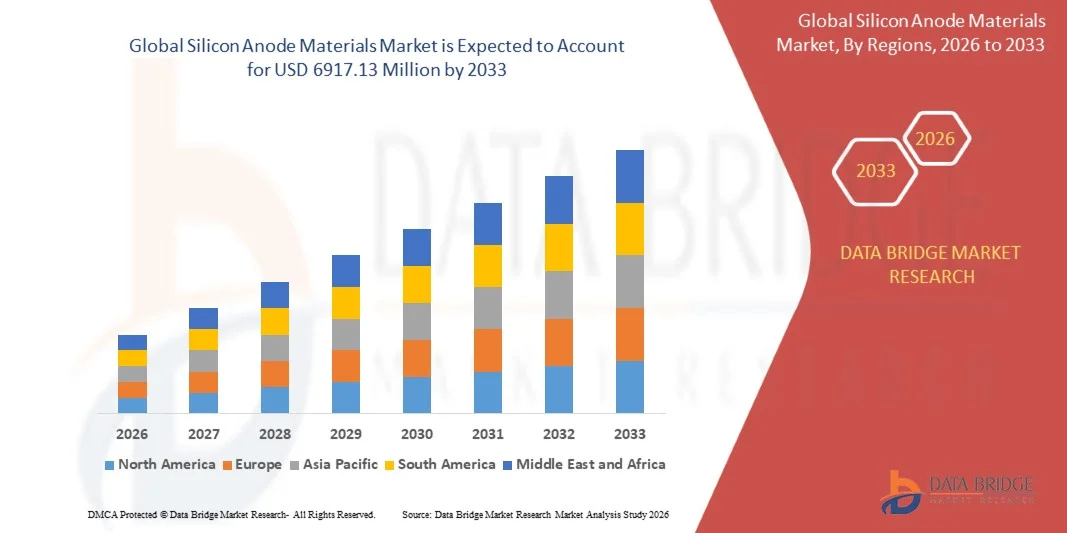
As per Data Bridge Market Research Analysis the Silicon Anode Materials Market was valued at USD 435.3 million in 2025 and is projected to reach USD 6917.13 million by 2033, growing at a CAGR of 41.30% from 2026 to 2033. The market is experiencing explosive growth, driven by the urgent need for next-generation battery technology with higher energy density, faster charging, and longer cycle life to support the accelerating global transition to electric vehicles and high-performance consumer electronics . Silicon anodes offer a theoretical energy density ten times higher than traditional graphite, enabling battery manufacturers to significantly reduce weight, extend driving range, and improve overall performance characteristics essential for mass-market EV adoption.
The convergence of technological breakthroughs in silicon nanowire and silicon-graphene composite manufacturing, declining material costs, and supportive government incentives for battery material innovation is creating unprecedented market opportunities through 2033.
Market Size & Forecast
- Global Market Value (2025): USD 435.3 Million
- Expected Market Value (2033): USD 6917.13 Million
- Forecast CAGR (2026–2033): 30%
- Leading Region in 2025: Asia-Pacific
- Fastest Growing Region: Asia-Pacific
What are the Major Takeaways of Silicon Anode Market?
- Asia-Pacific dominated the Silicon Anode Materials Market in 2025, accounting for 80% of global consumption. This leadership is driven by the concentration of battery manufacturing capacity in China, Japan, and South Korea, along with aggressive government backing for EV adoption and battery material localization
- The automotive segment is the largest and fastest-growing application, holding a dominant share of approximately 85% in 2025. Major automakers including Tesla, BMW, and Volkswagen are investing heavily in silicon-based anode technology to enhance battery performance and reduce costs per kilowatt-hour
- Shin-Etsu Chemical is the leading manufacturer, holding over 50% of the global market share, followed by BTR and Daejoo Electronic Materials . China is the largest production hub, accounting for approximately 54% of global production capacity
- The sio/c (silicon oxide/carbon) segment is the dominant product type, holding over 60% of the total market share, favored for its balance of performance and cycle life in commercial applications
- Silicon nanowires are emerging as the fastest-growing product segment, with a projected CAGR of 33.2% from 2026 to 2034, driven by superior electrochemical performance and successful commercialization by companies like Amprius Technologies and Sila Nanotechnologies
Report Scope and Silicon Anode Materials Market Segmentation
|
Attributes |
Silicon Anode Materials Key Market Insights |
|
Segments Covered |
|
|
Countries Covered |
North America
Europe
Asia-Pacific
Middle East and Africa
South America
|
|
Key Market Players |
|
|
Market Opportunities |
|
|
Value Added Data Infosets |
In addition to the insights on market scenarios such as market value, growth rate, segmentation, geographical coverage, and major players, the market reports curated by the Data Bridge Market Research also include import export analysis, production capacity overview, production consumption analysis, price trend analysis, climate change scenario, supply chain analysis, value chain analysis, raw material/consumables overview, vendor selection criteria, PESTLE Analysis, Porter Analysis, and regulatory framework. |
What is the Key Trend in the Silicon Anode Materials Market?
Trend: Shift Toward Higher Silicon Content for Increased Energy Density
The battery industry is increasingly moving toward anodes with higher silicon content to maximize energy density gains . While early commercial products utilized small amounts of silicon blended with graphite (e.g., SiO/C), advanced materials like silicon nanowires and silicon-graphene composites are now entering the market . This trend is particularly pronounced in the premium EV segment, where automakers are willing to accept higher costs for significant range improvements .
What are the Key Drivers of Silicon Anode Materials Market?
Key Market Driver: Electric Vehicle Proliferation and Battery Performance Requirements
The accelerating global transition to battery-electric vehicles is the primary catalyst for silicon anode adoption. With global EV sales projected to exceed 40 million units by 2034, automakers face intense pressure to improve energy density, reduce battery weight, extend driving range, and decrease cost per kilowatt-hour . Silicon anodes, with their superior theoretical capacity, enable 600+ mile ranges and 15-minute fast charging capabilities that address consumer range anxiety and convenience concerns . The automotive segment's dominance (approx. 85% market share) underscores this driver's critical importance .
Key Restraint/Challenge: Volume Expansion and Cycle Life Degradation
A significant technical challenge for silicon anodes is the massive volume expansion (up to 300%) during lithiation, which can cause mechanical degradation and shorten cycle life . This expansion leads to pulverization of the silicon particles and loss of electrical contact, reducing battery longevity. While advancements in nanostructuring, carbon composites, and binder materials are mitigating these issues, achieving cycle life comparable to graphite remains a key focus for R&D . The higher cost of silicon anode materials compared to graphite also presents a barrier to mass-market adoption in price-sensitive segments .
Key Market Opportunity: Next-Generation Battery Chemistries and Solid-State Batteries
Silicon anodes are a critical enabling component for next-generation battery technologies, including solid-state batteries . The emergence of solid-state electrolytes, which are inherently more stable than liquid electrolytes, could allow the use of high-silicon-content anodes without the safety concerns associated with conventional lithium-ion batteries. Companies like Samsung SDI and Panasonic are investing heavily in this area, creating significant opportunities for silicon anode suppliers to establish early partnerships and secure technology integration positions .
Silicon Anode Materials Market
The silicon anode materials market is segmented on the basis of product type, battery type, application, and region.
- By Product Type
On the basis of product type, the market is segmented into silicon nanowires, silicon microparticles, silicon-graphene composites, and others. The Silicon Nanowires segment is the fastest-growing, commanding 38.5% market share in 2025, driven by superior electrochemical performance, minimal volume expansion, and successful commercialization by companies like Amprius and Sila Nanotechnologies . The Silicon Microparticles segment holds 31.4% market share, offering a pragmatic, lower-cost approach that leverages existing graphite processing infrastructure, dominated by companies like BTR New Material Group . The Silicon-Graphene Composites segment captures 22.8% market share, combining silicon's energy density with graphene's conductivity and mechanical properties, with a projected growth to 28.6% share by 2034 .
- By Application
On the basis of application, the market is segmented into automotive, consumer electronics, energy storage, and others. The Automotive segment is the largest and fastest-growing, accounting for 42.3% of global demand in 2025, reflecting the critical importance of advanced battery technology for EV competitiveness . The Consumer Electronics segment is the second largest (28.7% share), driven by demand for extended battery life in smartphones, laptops, and wearables from manufacturers like Apple, Samsung, and Xiaomi . The Energy Storage segment is also experiencing significant growth (10.8% share), as grid-scale and residential battery systems seek longer duration and higher efficiency.
- By Battery Type
On the basis of battery type, the market is segmented into lithium-ion batteries, lithium-silicon batteries, and others. The Lithium-ion Batteries segment is the dominant chemistry, capturing 68.2% of market demand in 2025, due to mature manufacturing infrastructure and proven performance . The Lithium-Silicon Batteries segment represents a more aggressive chemistry with 50-80% higher energy density but faces manufacturing and cycle life challenges, commanding 24.5% market share .
Which Region Holds the Largest Share of the Silicon Anode Materials Market?
Asia-Pacific dominated the silicon anode materials market in 2025, accounting for over 80% of global consumption. This dominance is driven by the concentration of battery manufacturing capacity, semiconductor expertise, and EV production in China, South Korea, and Japan. China is the largest production hub, holding approximately 54% of global market share. North America captures the second-largest regional share, supported by Tesla's 4680 cell adoption, the U.S. INFLATION Reduction Act, and the presence of venture-backed anode technology companies like Sila Nanotechnologies and Group14 Technologies. Europe is also a significant market, driven by stringent EU emissions regulations and adoption by premium automakers BMW and Mercedes-Benz.
China Silicon Anode Materials Market Insight
China is the world's largest producer and consumer of silicon anode materials. The country's dominance is driven by the scale of its EV market (BYD, NIO, Li Auto), the presence of major battery manufacturers (CATL, BYD), and government policies supporting battery material self-sufficiency . BTR New Material Group, a leading Chinese manufacturer, supplies silicon microparticle anode materials to major battery producers . China's 14th Five-Year Plan designates battery materials as a strategic priority, with significant subsidies and tariff protections supporting domestic production .
Which are the Top Companies in Silicon Anode Materials Market?
The silicon anode materials industry is led by well-established companies, including:
- Shin-Etsu Chemical Co., Ltd. (Japan)
- BTR New Material Group (China)
- Daejoo Electronic Materials (South Korea)
- Sila Nanotechnologies (U.S.)
- Amprius Technologies (U.S.)
- Group14 Technologies (U.S.)
- Nexeon Limited (U.K.)
- OneD Material (U.S.)
- Targray Technology International (Canada)
- 3M Company (U.S.)
- LG Chem Ltd. (South Korea)
- Samsung SDI Co., Ltd. (South Korea)
- Panasonic Corporation (Japan)
- Cabot Corporation (U.S.)
What are Latest Developments in Silicon Anode Materials Market?
- In February 2026, Sila Nanotechnologies announced a long-term supply agreement with a major automotive OEM, securing capacity for its next-generation silicon anode production facility in Washington state, leveraging U.S. INFLATION Reduction Act incentives .
- In January 2026, Group14 Technologies began commercial production at its second manufacturing facility in South Korea, doubling its global production capacity for silicon-carbon composite anode materials .
- In October 2025, Shin-Etsu Chemical announced a significant capacity expansion for its silicon anode materials in Japan, investing over $100 million to meet growing demand from automotive and consumer electronics sectors .

- Interactive Data Analysis Dashboard
- Company Analysis Dashboard for high growth potential opportunities
- Research Analyst Access for customization & queries
- Competitor Analysis with Interactive dashboard
- Latest News, Updates & Trend analysis
- Harness the Power of Benchmark Analysis for Comprehensive Competitor Tracking
Global Silicon Anode Materials Market, Supply Chain Analysis and Ecosystem Framework
To support market growth and help clients navigate the impact of geopolitical shifts, DBMR has integrated in-depth supply chain analysis into its Global Silicon Anode Materials Market research reports. This addition empowers clients to respond effectively to global changes affecting their industries. The supply chain analysis section includes detailed insights such as Global Silicon Anode Materials Market consumption and production by country, price trend analysis, the impact of tariffs and geopolitical developments, and import and export trends by country and HSN code. It also highlights major suppliers with data on production capacity and company profiles, as well as key importers and exporters. In addition to research, DBMR offers specialized supply chain consulting services backed by over a decade of experience, providing solutions like supplier discovery, supplier risk assessment, price trend analysis, impact evaluation of inflation and trade route changes, and comprehensive market trend analysis.
Data collection and base year analysis are done using data collection modules with large sample sizes. The stage includes obtaining market information or related data through various sources and strategies. It includes examining and planning all the data acquired from the past in advance. It likewise envelops the examination of information inconsistencies seen across different information sources. The market data is analysed and estimated using market statistical and coherent models. Also, market share analysis and key trend analysis are the major success factors in the market report. To know more, please request an analyst call or drop down your inquiry.
The key research methodology used by DBMR research team is data triangulation which involves data mining, analysis of the impact of data variables on the market and primary (industry expert) validation. Data models include Vendor Positioning Grid, Market Time Line Analysis, Market Overview and Guide, Company Positioning Grid, Patent Analysis, Pricing Analysis, Company Market Share Analysis, Standards of Measurement, Global versus Regional and Vendor Share Analysis. To know more about the research methodology, drop in an inquiry to speak to our industry experts.
Data Bridge Market Research is a leader in advanced formative research. We take pride in servicing our existing and new customers with data and analysis that match and suits their goal. The report can be customized to include price trend analysis of target brands understanding the market for additional countries (ask for the list of countries), clinical trial results data, literature review, refurbished market and product base analysis. Market analysis of target competitors can be analyzed from technology-based analysis to market portfolio strategies. We can add as many competitors that you require data about in the format and data style you are looking for. Our team of analysts can also provide you data in crude raw excel files pivot tables (Fact book) or can assist you in creating presentations from the data sets available in the report.













