


What is the Silylation reagents Market Size and Growth Rate?
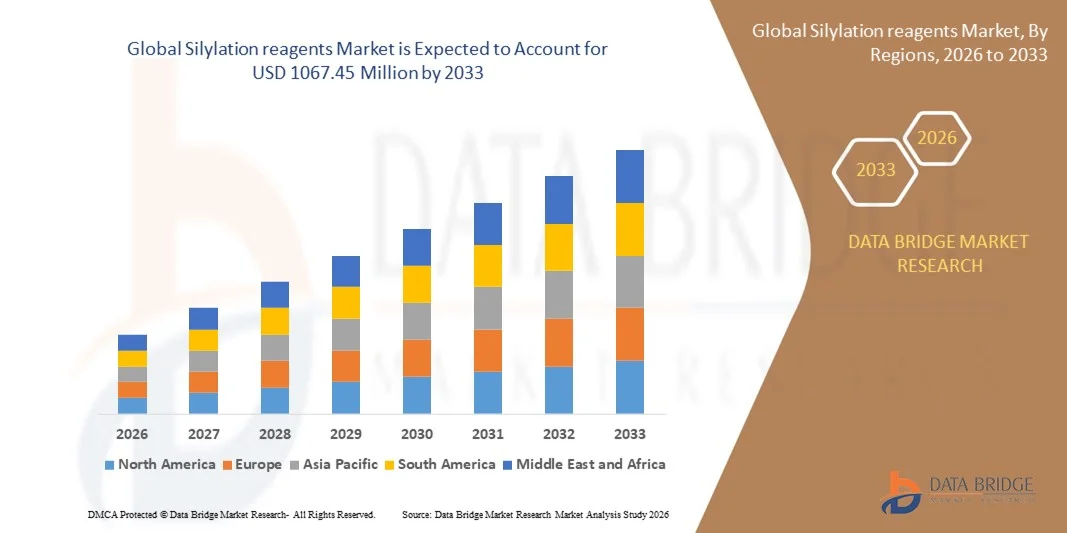
- As per Data Bridge Market Research Analysis the global Silylation Reagents Market size was valued at USD 733.60 million in 2025 and is expected to reach USD 1067.45 million by 2033, at a CAGR of 4.80% during the forecast period.
- The market growth is largely driven by increasing applications of silylation reagents in pharmaceuticals, biotechnology, and chemical industries, where they are essential for enhancing stability, selectivity, and analytical performance in various chemical processes.
- Furthermore, rising demand for advanced analytical techniques such as GC-MS and LC-MS for accurate detection and quantification of complex biomolecules is fueling the adoption of silylation reagents. These converging factors are accelerating the utilization of silylation solutions, thereby significantly boosting the industry’s growth.
What are the Major Takeaways of Silylation reagents Market?
- Silylation reagents, used for derivatization in analytical chemistry to enhance volatility, stability, and detectability of compounds, are increasingly vital components in pharmaceutical, biotechnology, and chemical industries due to their ability to improve analytical accuracy, reproducibility, and process efficiency.
- The escalating demand for silylation reagents is primarily fueled by the growing applications of advanced analytical techniques such as GC-MS and LC-MS, increasing pharmaceutical research and development activities, and the rising need for precise detection of complex biomolecules.
- North America dominated the Global Silylation Reagents Market with the largest revenue share of 31.8% in 2025, characterized by strong pharmaceutical and chemical manufacturing sectors, high adoption of advanced analytical instrumentation, and the presence of leading industry players, with the U.S. experiencing substantial growth in silylation reagent consumption driven by innovations in drug development and quality control processes.
- Asia-Pacific is expected to be the fastest growing region in the Global Silylation Reagents Market during the forecast period due to expanding pharmaceutical and chemical industries, increasing research investments, and rising demand for high-throughput analytical solutions.
- The Trimethylsilyl Monofunctional SBA segment dominated the market with the largest revenue share of 45.6% in 2025, driven by its versatility in derivatization for GC-MS and LC-MS analysis, as well as its widespread adoption in pharmaceutical and chemical laboratories.
Report Scope and Global Silylation reagents Market Segmentation
|
Attributes |
Silylation reagents Key Market Insights |
|
Segments Covered |
|
|
Countries Covered |
North America
Europe
Asia-Pacific
Middle East and Africa
South America
|
|
Key Market Players |
|
|
Market Opportunities |
|
|
Value Added Data Infosets |
In addition to the insights on market scenarios such as market value, growth rate, segmentation, geographical coverage, and major players, the market reports curated by the Data Bridge Market Research also include import export analysis, production capacity overview, production consumption analysis, price trend analysis, climate change scenario, supply chain analysis, value chain analysis, raw material/consumables overview, vendor selection criteria, PESTLE Analysis, Porter Analysis, and regulatory framework. |
What is the Key Trend in the Silylation reagents Market?
Enhanced Efficiency Through Automation and Advanced Analytical Integration
- A significant and accelerating trend in the global Silylation Reagents Market is the increasing integration with automated analytical systems and high-throughput instrumentation such as GC-MS, LC-MS, and robotic sample preparation platforms. This integration is significantly enhancing workflow efficiency, reproducibility, and accuracy in chemical and pharmaceutical analysis.
- For instance, silylation reagents such as BSTFA and MSTFA are widely used in automated GC-MS workflows, allowing seamless derivatization of samples without manual intervention, thereby reducing processing time and human error. Similarly, robotic liquid handling systems can perform silylation reactions in a controlled and reproducible manner, improving consistency in large-scale studies.
- Automation and advanced system integration enable features such as predictive reaction optimization and real-time monitoring of derivatization efficiency. For example, some high-throughput analytical setups use software algorithms to suggest optimal silylation conditions based on sample type and desired sensitivity, while simultaneously flagging unusual reaction behavior. Furthermore, automated systems minimize manual handling, improving safety and operational efficiency.
- The seamless integration of silylation reagents with digital laboratory platforms facilitates centralized control over multiple analytical processes. Through a single interface, laboratories can manage derivatization reactions, chromatography analysis, and data processing, creating a unified and highly efficient workflow.
- This trend towards more automated, precise, and integrated analytical workflows is fundamentally reshaping expectations for laboratory efficiency and accuracy. Consequently, companies such as Thermo Fisher Scientific and Sigma-Aldrich are developing silylation reagent kits optimized for automation and high-throughput applications, with compatibility across multiple analytical platforms.
- The demand for silylation reagents that offer seamless integration with automated analytical systems is growing rapidly across both pharmaceutical and chemical industries, as researchers increasingly prioritize precision, reproducibility, and operational efficiency.
Global Silylation reagents Market Dynamics
Driver
Growing Need Due to Expanding Pharmaceutical and Chemical Research Activities
- The increasing demand for accurate and efficient analytical solutions in pharmaceutical, biotechnology, and chemical industries, coupled with the rising focus on drug development and quality control, is a significant driver for the heightened adoption of silylation reagents.
- For instance, in 2025, Thermo Fisher Scientific launched a new automated derivatization kit compatible with GC-MS workflows, designed to improve sample throughput and reduce manual errors. Such innovations by key companies are expected to drive the silylation reagents market growth during the forecast period.
- As research laboratories aim for higher precision and reproducibility, silylation reagents offer critical benefits such as improved volatility, stability, and detectability of analytes, providing a compelling alternative to traditional sample preparation methods.
- Furthermore, the growing prevalence of high-throughput analytical techniques and the integration of silylation reagents with automated workflows are making these chemicals essential for modern laboratory operations, enabling seamless processing of complex samples.
- The efficiency gains from automation, compatibility with advanced analytical instruments, and the ability to process multiple samples simultaneously are key factors propelling the adoption of silylation reagents across pharmaceutical, chemical, and biotech sectors. Increasing availability of user-friendly reagent kits also contributes to market growth.
Restraint/Challenge
Concerns Regarding Cost and Handling Safety
- Concerns surrounding the relatively high cost of specialty silylation reagents and the need for careful handling due to their chemical reactivity pose a significant challenge to broader market penetration. As these reagents often require strict storage and handling protocols, some laboratories may be hesitant to adopt them extensively.
- For instance, reports highlighting the sensitivity of certain silylation reagents to moisture or air have made some smaller laboratories cautious about investing in high volumes, slowing adoption in cost-sensitive regions.
- Addressing these challenges through safer reagent formulations, comprehensive handling guidelines, and bulk pricing strategies is crucial for encouraging adoption. Companies such as Sigma-Aldrich and Merck KGaA emphasize stability-improved reagent variants and provide detailed safety documentation to reassure potential buyers. Additionally, premium reagent kits with high purity or automation compatibility often come at a higher price point, which can be a barrier for budget-conscious labs, particularly in developing regions.
- While prices for standard silylation reagents are gradually becoming more competitive, the perceived premium for advanced or automation-ready variants can still hinder widespread adoption among smaller research facilities.
- Overcoming these challenges through cost-effective formulations, enhanced safety protocols, and targeted education on reagent handling and benefits will be vital for sustained market growth.
How is the Silylation reagents Market Segmented?
The market is segmented on the basis of type and application.
- By Type
On the basis of type, the Global Silylation Reagents Market is segmented into Trimethylsilyl Monofunctional SBA, Steric Hindered Monofunctional SBA, Steric Hindered Bifunctional SBA, Other Protective Agents, and World Silylation Reagent Production. The Trimethylsilyl Monofunctional SBA segment dominated the market with the largest revenue share of 45.6% in 2025, driven by its versatility in derivatization for GC-MS and LC-MS analysis, as well as its widespread adoption in pharmaceutical and chemical laboratories. Its compatibility with a wide range of analytes, ease of handling, and cost-effectiveness make it a preferred choice for routine analytical workflows.
The Steric Hindered Monofunctional SBA segment is expected to witness the fastest CAGR of 21.3% from 2026 to 2033, fueled by increasing demand for high-purity reagents in specialized pharmaceutical synthesis and analytical applications, where improved selectivity and reduced side reactions are critical for achieving accurate results and regulatory compliance.
- By Application
On the basis of application, the Global Silylation Reagents Market is segmented into Pharmaceutical Industry, Industrial, Others, and World Silylation Reagent Production. The Pharmaceutical Industry segment accounted for the largest market revenue share of 52.4% in 2025, driven by the increasing use of silylation reagents for drug development, quality control, and bioanalytical research. Their ability to enhance compound stability, detectability, and chromatographic performance makes them indispensable for laboratories focusing on pharmacokinetics, metabolite analysis, and high-throughput screening.
The Industrial segment is expected to witness the fastest CAGR of 19.8% from 2026 to 2033, fueled by rising applications in chemical manufacturing, specialty coatings, and polymer research, where silylation reagents improve reaction efficiency, product consistency, and analytical reliability across diverse industrial processes.
Which Region Holds the Largest Share of the Silylation reagents Market?
- North America dominated the Global Silylation Reagents Market with the largest revenue share of 31.8% in 2025, driven by the strong presence of pharmaceutical, biotechnology, and chemical industries, along with advanced research infrastructure.
- Laboratories and research facilities in the region highly value the accuracy, reproducibility, and efficiency offered by silylation reagents in analytical workflows such as GC-MS and LC-MS.
- This widespread adoption is further supported by high research and development investments, a well-established regulatory framework, and the growing demand for high-throughput and automated analytical solutions, establishing silylation reagents as an essential component for both routine and specialized laboratory applications.
U.S. Silylation Reagents Market Insight
The U.S. silylation reagents market captured the largest revenue share of 81% in 2025 within North America, fueled by the strong presence of pharmaceutical, biotechnology, and chemical research industries. Growing investment in R&D, coupled with the widespread adoption of high-throughput analytical technologies, is driving the demand for silylation reagents in GC-MS and LC-MS workflows. Laboratories increasingly prioritize accurate, reproducible, and efficient derivatization methods, supporting the expansion of the market. Furthermore, the integration of automated analytical systems and demand for high-purity reagents enhances adoption in both academic and industrial research sectors.
Europe Silylation Reagents Market Insight
The Europe silylation reagents market is projected to expand at a substantial CAGR throughout the forecast period, primarily driven by stringent regulatory requirements for pharmaceutical and chemical analysis. The increasing adoption of advanced analytical techniques and the demand for high-quality reagents in drug development and quality control are fostering market growth. European laboratories also value reliability, reproducibility, and compatibility with GC-MS and LC-MS instruments, which encourages consistent use of silylation reagents across research applications.
U.K. Silylation Reagents Market Insight
The U.K. silylation reagents market is anticipated to grow at a noteworthy CAGR during the forecast period, driven by the increasing focus on pharmaceutical research, quality control, and industrial chemical analysis. Additionally, growing investments in life sciences, biotechnology, and analytical laboratories are supporting market expansion. The U.K.’s robust research infrastructure, combined with widespread adoption of automated and high-throughput analytical workflows, is expected to continue to stimulate demand for high-purity silylation reagents.
Germany Silylation Reagents Market Insight
The Germany silylation reagents market is expected to expand at a considerable CAGR during the forecast period, fueled by rising R&D investments, the adoption of innovative analytical technologies, and the growing demand for environmentally sustainable chemical processes. German laboratories increasingly prioritize high-efficiency derivatization techniques to improve accuracy and throughput in both pharmaceutical and industrial applications. The integration of silylation reagents with automated workflows and stringent quality standards further supports market growth.
Asia-Pacific Silylation Reagents Market Insight
The Asia-Pacific silylation reagents market is poised to grow at the fastest CAGR of 24% during the forecast period of 2026 to 2033, driven by rapid industrialization, expanding pharmaceutical and chemical research, and increasing adoption of advanced analytical instrumentation in countries such as China, Japan, and India. The region’s growing focus on quality control, drug development, and metabolite analysis is propelling the demand for silylation reagents. Furthermore, rising disposable incomes and government initiatives to strengthen R&D infrastructure are increasing accessibility to high-purity reagents across laboratories.
Japan Silylation Reagents Market Insight
The Japan silylation reagents market is gaining momentum due to the country’s advanced analytical research culture, emphasis on precision, and growing pharmaceutical and biotechnology sectors. The demand for high-throughput and automated derivatization workflows, coupled with a focus on reproducible and reliable results in GC-MS and LC-MS applications, is driving adoption. Additionally, Japan’s aging population is spurring the development of more efficient analytical solutions, further boosting demand for silylation reagents in both clinical and industrial research.
China Silylation Reagents Market Insight
The China silylation reagents market accounted for the largest market revenue share in Asia-Pacific in 2025, attributed to the country’s rapidly expanding pharmaceutical and chemical industries, growing research infrastructure, and increasing adoption of advanced analytical techniques. The push for quality control, drug safety, and metabolite analysis in a wide range of laboratories is driving strong demand. Moreover, the presence of domestic manufacturers and cost-competitive reagent options is making high-purity silylation reagents increasingly accessible, further propelling the market’s growth.
Global Silylation reagents Market Share
The Silylation reagents industry is primarily led by well-established companies, including:
• Sigma-Aldrich (U.S.)
• Thermo Fisher Scientific (U.S.)
• Tokyo Chemical Industry Co., Ltd. (Japan)
• Honeywell Specialty Chemicals (U.S.)
• SiliChem LLC (U.S.)
• ABCR GmbH & Co. KG (Germany)
• Acros Organics (Belgium)
• J&K Scientific Ltd. (China)
• Alfa Aesar (U.S.)
• Cambridge Isotope Laboratories (U.S.)
• Fluka Analytical (Switzerland)
• Merck KGaA (Germany)
• Shanghai Macklin Biochemical Co., Ltd. (China)
• TCI America (U.S.)
• Sigma-Aldrich Japan K.K. (Japan)
• Acme Chemicals (India)
• Avra Silylation Technologies (U.S.)
• Zeochem AG (Switzerland)
• Chengdu PureChem Co., Ltd. (China)
• LabNetwork (U.K.)
What are the Recent Developments in Global Silylation reagents Market?
- In April 2024, Sigma-Aldrich (Merck Group), a global leader in chemical and laboratory solutions, launched a strategic initiative in South Africa aimed at expanding access to high-purity silylation reagents for pharmaceutical and research laboratories. This initiative underscores the company’s dedication to delivering innovative, reliable chemical solutions tailored to the unique analytical needs of the regional market. By leveraging its global expertise and advanced reagent portfolio, Sigma-Aldrich is addressing local challenges while reinforcing its position in the rapidly growing global silylation reagents market.
- In March 2024, Tokyo Chemical Industry Co., Ltd. (TCI) introduced a new series of sterically hindered bifunctional silylation reagents optimized for complex metabolite analysis in pharmaceutical and biochemical research. The innovative reagents are designed to improve derivatization efficiency and analytical reproducibility, highlighting TCI’s commitment to developing cutting-edge chemical solutions that meet the evolving needs of research scientists and laboratories worldwide.
- In March 2024, Honeywell International Inc. successfully supplied its high-performance silylation reagents for the Bengaluru Advanced Analytical Laboratory Project, aimed at enhancing capabilities in drug development and chemical analysis. This initiative leverages Honeywell’s expertise in reagent formulation to support high-precision analytical workflows, demonstrating the increasing significance of high-quality silylation reagents in advanced research and industrial applications.
- In February 2024, SiliChem LLC, a leading provider of specialty silylation reagents, announced a strategic partnership with the Asia-Pacific Pharmaceutical Research Association (AP-PRA) to create a dedicated platform for reagent distribution and training. This collaboration is designed to streamline access, ensure reagent quality, and improve operational efficiency in research laboratories, emphasizing SiliChem’s commitment to innovation and supporting analytical excellence across the pharmaceutical sector.
- In January 2024, Thermo Fisher Scientific unveiled its new Trimethylsilyl Monofunctional SBA series at the Analytica 2024 conference. These advanced reagents enable highly reproducible derivatization for GC-MS applications, allowing researchers to achieve improved sensitivity and precision. The launch highlights Thermo Fisher Scientific’s dedication to integrating state-of-the-art chemistry into laboratory workflows, offering scientists enhanced efficiency and reliability while addressing complex analytical challenges in both industrial and academic research.

- Interactive Data Analysis Dashboard
- Company Analysis Dashboard for high growth potential opportunities
- Research Analyst Access for customization & queries
- Competitor Analysis with Interactive dashboard
- Latest News, Updates & Trend analysis
- Harness the Power of Benchmark Analysis for Comprehensive Competitor Tracking
Global Silylation Reagents Market, Supply Chain Analysis and Ecosystem Framework
To support market growth and help clients navigate the impact of geopolitical shifts, DBMR has integrated in-depth supply chain analysis into its Global Silylation Reagents Market research reports. This addition empowers clients to respond effectively to global changes affecting their industries. The supply chain analysis section includes detailed insights such as Global Silylation Reagents Market consumption and production by country, price trend analysis, the impact of tariffs and geopolitical developments, and import and export trends by country and HSN code. It also highlights major suppliers with data on production capacity and company profiles, as well as key importers and exporters. In addition to research, DBMR offers specialized supply chain consulting services backed by over a decade of experience, providing solutions like supplier discovery, supplier risk assessment, price trend analysis, impact evaluation of inflation and trade route changes, and comprehensive market trend analysis.
Data collection and base year analysis are done using data collection modules with large sample sizes. The stage includes obtaining market information or related data through various sources and strategies. It includes examining and planning all the data acquired from the past in advance. It likewise envelops the examination of information inconsistencies seen across different information sources. The market data is analysed and estimated using market statistical and coherent models. Also, market share analysis and key trend analysis are the major success factors in the market report. To know more, please request an analyst call or drop down your inquiry.
The key research methodology used by DBMR research team is data triangulation which involves data mining, analysis of the impact of data variables on the market and primary (industry expert) validation. Data models include Vendor Positioning Grid, Market Time Line Analysis, Market Overview and Guide, Company Positioning Grid, Patent Analysis, Pricing Analysis, Company Market Share Analysis, Standards of Measurement, Global versus Regional and Vendor Share Analysis. To know more about the research methodology, drop in an inquiry to speak to our industry experts.
Data Bridge Market Research is a leader in advanced formative research. We take pride in servicing our existing and new customers with data and analysis that match and suits their goal. The report can be customized to include price trend analysis of target brands understanding the market for additional countries (ask for the list of countries), clinical trial results data, literature review, refurbished market and product base analysis. Market analysis of target competitors can be analyzed from technology-based analysis to market portfolio strategies. We can add as many competitors that you require data about in the format and data style you are looking for. Our team of analysts can also provide you data in crude raw excel files pivot tables (Fact book) or can assist you in creating presentations from the data sets available in the report.













