


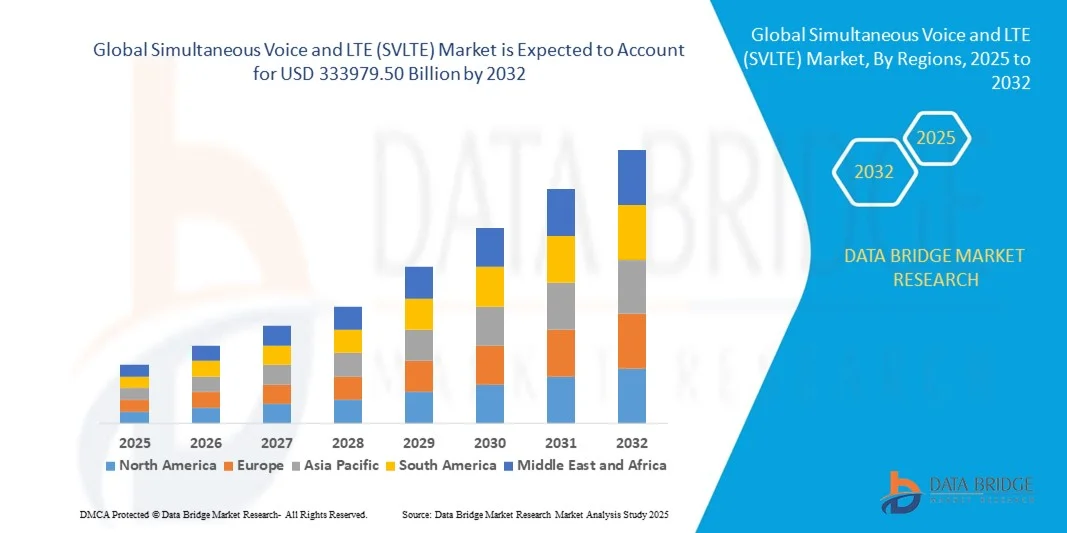
What is the Global Simultaneous Voice and LTE (SVLTE) Market Size and Growth Rate?
- The global simultaneous voice and LTE (SVLTE) market size was valued at USD 6540.00 billion in 2024 and is expected to reach USD 333979.50 billion by 2032, at a CAGR of 63.50% during the forecast period
- The growing spectrum efficiency is motivating the operators to adopt VOLTE technology while helps in enhancing the services related to VOLTE, decreasing maintenance as well as operational cost, provision of faster call set up time due to decreasing latency, operators are expanding the coverage of indoor networks by offering VoWi-Fi services and extending web real time networking (WebRTC) communication services are some of the major as well as impactful factors which will such asly to augment the growth of the simultaneous voice and LTE (SVLTE) market in the projected timeframe
What are the Major Takeaways of Simultaneous Voice and LTE (SVLTE) Market?
- Adoption of variable pricing strategy, rising demand of network function virtualization solution along with true device interoperability which will further contribute by generating immense opportunities that will led to the growth of the simultaneous voice and LTE (SVLTE) market in the above-mentioned projected timeframe
- Less availability of VOLTE enabled devices, increasing number of implementation issues along with no carrier inter-operability which will such asly to act as market restraint factor for the growth of the simultaneous voice and LTE (SVLTE) in the above-mentioned forecasted period
- North America dominated the simultaneous voice and LTE (SVLTE) market with the largest revenue share of 38.21% in 2024, driven by the widespread adoption of connected devices, high-speed mobile networks, and increasing awareness of digital communication technologies
- The Asia-Pacific SVLTE market is poised to grow at the fastest CAGR of 10.25% from 2025 to 2032, fueled by rapid urbanization, rising smartphone penetration, and increasing deployment of LTE networks in countries such as China, Japan, and India
- The FDD segment dominated the SVLTE market with the largest market revenue share of 55.3% in 2024, driven by its wide deployment in established LTE networks and compatibility with most mobile carriers worldwide
Report Scope and Simultaneous Voice and LTE (SVLTE) Market Segmentation
|
Attributes |
Simultaneous Voice and LTE (SVLTE) Key Market Insights |
|
Segments Covered |
|
|
Countries Covered |
North America
Europe
Asia-Pacific
Middle East and Africa
South America
|
|
Key Market Players |
|
|
Market Opportunities |
|
|
Value Added Data Infosets |
In addition to the insights on market scenarios such as market value, growth rate, segmentation, geographical coverage, and major players, the market reports curated by the Data Bridge Market Research also include in-depth expert analysis, pricing analysis, brand share analysis, consumer survey, demography analysis, supply chain analysis, value chain analysis, raw material/consumables overview, vendor selection criteria, PESTLE Analysis, Porter Analysis, and regulatory framework. |
What is the Key Trend in the Simultaneous Voice and LTE (SVLTE) Market?
Enhanced Connectivity and Multi-Device Integration
- A prominent trend in the global Simultaneous Voice and LTE (SVLTE) market is the increasing integration of SVLTE technology with multi-device ecosystems, including smartphones, tablets, and smart home hubs, enabling seamless voice and data services simultaneously. This integration enhances user convenience and ensures uninterrupted communication even while using multiple applications
- For instance, major SVLTE-enabled smartphones allow users to make voice calls while actively using high-speed LTE data services, supporting streaming, video calls, and cloud access without service interruptions. This capability is becoming a standard expectation among tech-savvy consumers
- SVLTE devices are increasingly incorporating AI algorithms to optimize network usage, enhance voice clarity, and prioritize data traffic based on real-time usage patterns. Some modern smartphones now adapt to network conditions dynamically to maintain call quality while streaming data
- The adoption of SVLTE in commercial environments, such as retail and field services, enables employees to stay connected while using enterprise applications, improving operational efficiency and responsiveness. Centralized device management platforms allow businesses to monitor voice and data usage effectively
- This trend towards uninterrupted multi-service connectivity is redefining user expectations for mobile communication. Consequently, companies such as Samsung and Huawei are developing advanced SVLTE-enabled devices with features such as dual-SIM SVLTE support and dynamic network optimization
- The demand for SVLTE devices capable of simultaneous high-speed data and voice transmission is accelerating globally across both individual and enterprise users, driven by increasing reliance on mobile connectivity and cloud-based services
What are the Key Drivers of Simultaneous Voice and LTE (SVLTE) Market?
- The growing need for uninterrupted communication and high-speed internet access is a primary driver for the increasing adoption of SVLTE devices among consumers and enterprises
- For instance, in 2024, Huawei launched SVLTE-enabled smartphones supporting seamless voice and LTE data connectivity, targeting professional users requiring continuous mobile connectivity. Such product innovations are expected to propel market growth during the forecast period
- The rapid expansion of LTE networks worldwide and the increasing penetration of smartphones facilitate SVLTE adoption, allowing users to access high-speed data while maintaining voice services, which was previously challenging on legacy networks
- Furthermore, the rise of mobile-dependent workforces and cloud-based services has amplified the need for SVLTE, particularly in sectors such as logistics, healthcare, and remote workforce management, where uninterrupted connectivity is critical
- Consumer preference for multi-functional smartphones, capable of simultaneous data-intensive applications and voice calls, drives SVLTE demand. The convenience of using voice, messaging, and internet services concurrently increases overall user satisfaction and productivity
- The push for next-generation mobile experiences, including streaming, gaming, and real-time collaboration apps, further reinforces the adoption of SVLTE technology across residential and enterprise segments
Which Factor is Challenging the Growth of the Simultaneous Voice and LTE (SVLTE) Market?
- Network infrastructure limitations and inconsistent LTE coverage in certain regions present a key challenge to the widespread adoption of SVLTE, affecting call quality and data speeds in rural or underdeveloped areas
- For instance, intermittent LTE coverage can result in dropped calls or reduced data throughput during simultaneous usage, making consumers cautious in adopting SVLTE devices in areas with unstable networks
- Ensuring device compatibility with multiple carriers and frequency bands globally adds complexity for manufacturers, leading to higher production costs and potential delays in product rollout. Companies such as Qualcomm and MediaTek are addressing this through multi-band chipset solutions, but costs remain high
- Moreover, SVLTE-capable devices often carry a premium price compared to standard LTE phones, which can limit adoption in price-sensitive markets. Although prices are gradually declining, high-end SVLTE models with advanced features such as dual-SIM support or enhanced voice codecs remain costly
- Cybersecurity and privacy concerns associated with constant data connectivity can also slow adoption, as users worry about potential breaches when devices transmit voice and data simultaneously
- Addressing network coverage issues, expanding infrastructure, reducing device costs, and educating consumers on the benefits and security of SVLTE will be essential for sustaining long-term market growth
How is the Simultaneous Voice and LTE (SVLTE) Market Segmented?
The market is segmented on the basis of technology and end-user device.
- By Technology
On the basis of technology, the simultaneous voice and LTE (SVLTE) market is segmented into Frequency Division Duplexing (FDD) and Time Division Duplexing (TDD). The FDD segment dominated the SVLTE market with the largest market revenue share of 55.3% in 2024, driven by its wide deployment in established LTE networks and compatibility with most mobile carriers worldwide. FDD allows simultaneous uplink and downlink communication on separate frequency bands, enabling stable voice and data transmission, which is crucial for enterprise users and high-demand residential areas. Its robustness in delivering uninterrupted SVLTE services across urban and semi-urban regions has strengthened its adoption.
The TDD segment is anticipated to witness the fastest growth rate of 23.1% from 2025 to 2032, fueled by its cost-effectiveness, flexibility in asymmetric data traffic handling, and rising deployment in emerging markets where spectrum efficiency is highly valued. TDD adoption is particularly accelerating in APAC and parts of Europe due to increasing 5G rollout initiatives.
- By End-User Device
On the basis of end-user device, the SVLTE market is segmented into smartphones, routers, dongles, and others. The smartphone segment held the largest market revenue share of 62% in 2024, driven by the global proliferation of SVLTE-enabled mobile phones and the growing consumer demand for uninterrupted voice and high-speed data services. Smartphones integrating SVLTE technology allow users to perform video streaming, online gaming, cloud access, and voice calls simultaneously without disruptions, making them the preferred device for both personal and professional use.
The dongle segment is expected to witness the fastest CAGR of 25% from 2025 to 2032, propelled by increasing demand for portable internet access devices in remote work, on-the-go connectivity, and enterprise field applications. These compact devices enable simultaneous voice and LTE services for laptops and tablets, supporting mobile productivity and bridging connectivity gaps in areas with limited infrastructure.
Which Region Holds the Largest Share of the Simultaneous Voice and LTE (SVLTE) Market?
- North America dominated the simultaneous voice and LTE (SVLTE) market with the largest revenue share of 38.21% in 2024, driven by the widespread adoption of connected devices, high-speed mobile networks, and increasing awareness of digital communication technologies
- Consumers and enterprises in the region value uninterrupted voice and LTE services, enhanced network reliability, and seamless integration with smartphones, routers, and IoT devices
- This extensive adoption is further supported by high disposable incomes, a tech-savvy population, and robust telecom infrastructure, positioning Simultaneous Voice and LTE (SVLTE) solutions as a preferred choice across residential, commercial, and enterprise applications
U.S. Simultaneous Voice and LTE (SVLTE) Market Insight
The U.S. Simultaneous Voice and LTE (SVLTE) market captured the largest revenue share of 81% in North America in 2024, driven by rapid deployment of LTE networks, early adoption of smartphones, and a strong preference for reliable, high-speed connectivity. Increasing demand for enterprise-grade communication, remote working solutions, and uninterrupted VoLTE services further boosts market expansion. The integration of SVLTE technology into consumer and enterprise devices strengthens its position as a leading mobile communication solution.
Europe Simultaneous Voice and LTE (SVLTE) Market Insight
The Europe SVLTE market is projected to grow steadily throughout the forecast period, primarily fueled by rising digitalization, stringent telecom regulations, and increasing demand for advanced communication services in businesses and homes. Urbanization, growing smartphone penetration, and emphasis on network reliability are encouraging SVLTE adoption in both new deployments and upgrades of existing networks.
U.K. Simultaneous Voice and LTE (SVLTE) Market Insight
The U.K. SVLTE market is anticipated to witness steady growth due to rising smartphone adoption, expansion of LTE infrastructure, and increasing enterprise reliance on mobile communication networks. The country’s well-developed telecom ecosystem and high consumer awareness are expected to support market growth over the forecast period.
Germany Simultaneous Voice and LTE (SVLTE) Market Insight
The Germany SVLTE market is expected to expand at a notable CAGR, driven by advancements in LTE networks, growing enterprise demand, and government initiatives supporting digital communication technologies. Integration of SVLTE in smartphones, routers, and IoT-enabled devices is promoting adoption across residential and commercial sectors.
Which Region is the Fastest Growing Region in the Simultaneous Voice and LTE (SVLTE) Market?
The Asia-Pacific SVLTE market is poised to grow at the fastest CAGR of 10.25% from 2025 to 2032, fueled by rapid urbanization, rising smartphone penetration, and increasing deployment of LTE networks in countries such as China, Japan, and India. Government initiatives promoting digital connectivity, along with growing enterprise and consumer reliance on uninterrupted voice and LTE services, are accelerating adoption.
Japan Simultaneous Voice and LTE (SVLTE) Market Insight
The Japan SVLTE market is expanding rapidly due to high smartphone usage, advanced telecom infrastructure, and the demand for reliable communication services. Adoption is being driven by smart homes, enterprises, and connected buildings, with SVLTE ensuring uninterrupted voice and data services.
China Simultaneous Voice and LTE (SVLTE) Market Insight
The China SVLTE market accounted for the largest revenue share in Asia-Pacific in 2024, supported by rapid LTE network expansion, growing middle-class smartphone users, and increasing adoption of digital services. Affordable SVLTE-enabled devices and the push toward smart city initiatives are further strengthening market growth across residential, commercial, and enterprise sectors.
Which are the Top Companies in Simultaneous Voice and LTE (SVLTE) Market?
The simultaneous voice and LTE (SVLTE) industry is primarily led by well-established companies, including:
- AT&T (U.S.)
- Telefonaktiebolaget LM Ericsson (Sweden)
- Huawei Technologies Co., Ltd. (China)
- KT Corporation (South Korea)
- Nokia (Finland)
- SK TELECOM CO., LTD. (South Korea)
- Verizon (U.S.)
- Apple Inc. (U.S.)
- Google (U.S.)
- LG Electronics. (South Korea)
- Qualcomm Technologies, Inc. (U.S.)
- TPG Internet Pty Ltd (Australia)
- NTT DOCOMO, INC (Japan)
- SAMSUNG (South Korea)
- China Mobile Hong Kong Company Limited. (China)
- Cisco (U.S.)
- D2 Technologies Inc. (U.S.)
- Rogers Communications (Canada)
- Singtel (Singapore)
- Aptilo Networks (Sweden)
- Mitel Networks Corp (Canada)

- Interactive Data Analysis Dashboard
- Company Analysis Dashboard for high growth potential opportunities
- Research Analyst Access for customization & queries
- Competitor Analysis with Interactive dashboard
- Latest News, Updates & Trend analysis
- Harness the Power of Benchmark Analysis for Comprehensive Competitor Tracking
Global Simultaneous Voice And Lte Svlte Market, Supply Chain Analysis and Ecosystem Framework
To support market growth and help clients navigate the impact of geopolitical shifts, DBMR has integrated in-depth supply chain analysis into its Global Simultaneous Voice And Lte Svlte Market research reports. This addition empowers clients to respond effectively to global changes affecting their industries. The supply chain analysis section includes detailed insights such as Global Simultaneous Voice And Lte Svlte Market consumption and production by country, price trend analysis, the impact of tariffs and geopolitical developments, and import and export trends by country and HSN code. It also highlights major suppliers with data on production capacity and company profiles, as well as key importers and exporters. In addition to research, DBMR offers specialized supply chain consulting services backed by over a decade of experience, providing solutions like supplier discovery, supplier risk assessment, price trend analysis, impact evaluation of inflation and trade route changes, and comprehensive market trend analysis.
Data collection and base year analysis are done using data collection modules with large sample sizes. The stage includes obtaining market information or related data through various sources and strategies. It includes examining and planning all the data acquired from the past in advance. It likewise envelops the examination of information inconsistencies seen across different information sources. The market data is analysed and estimated using market statistical and coherent models. Also, market share analysis and key trend analysis are the major success factors in the market report. To know more, please request an analyst call or drop down your inquiry.
The key research methodology used by DBMR research team is data triangulation which involves data mining, analysis of the impact of data variables on the market and primary (industry expert) validation. Data models include Vendor Positioning Grid, Market Time Line Analysis, Market Overview and Guide, Company Positioning Grid, Patent Analysis, Pricing Analysis, Company Market Share Analysis, Standards of Measurement, Global versus Regional and Vendor Share Analysis. To know more about the research methodology, drop in an inquiry to speak to our industry experts.
Data Bridge Market Research is a leader in advanced formative research. We take pride in servicing our existing and new customers with data and analysis that match and suits their goal. The report can be customized to include price trend analysis of target brands understanding the market for additional countries (ask for the list of countries), clinical trial results data, literature review, refurbished market and product base analysis. Market analysis of target competitors can be analyzed from technology-based analysis to market portfolio strategies. We can add as many competitors that you require data about in the format and data style you are looking for. Our team of analysts can also provide you data in crude raw excel files pivot tables (Fact book) or can assist you in creating presentations from the data sets available in the report.













