


What is the Single Mode Fibre Optic Market Size and Growth Rate?
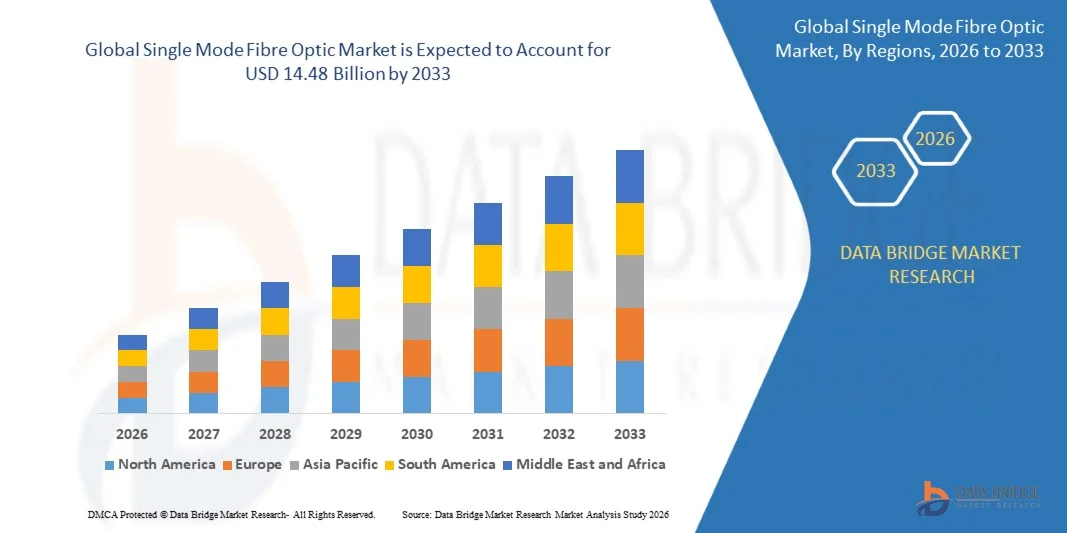
As per Data Bridge Market Research analysis, the single mode fibre optic market was valued at USD 6.61 billion in 2025 and is projected to reach USD 14.48 billion by 2033, growing at a CAGR of 10.30% from 2026 to 2033. The market is experiencing consistent growth driven by rising demand for high-speed data transmission networks, rapid expansion of telecommunications infrastructure, and increasing adoption of fibre optic technologies across data centers, broadband networks, and 5G communication systems.
The growing deployment of 5G networks globally, combined with increasing internet traffic, cloud computing adoption, and the need for higher bandwidth connectivity, is encouraging telecom operators, enterprises, and network infrastructure providers to adopt single mode fibre optic solutions. Single mode fibres are replacing traditional copper-based communication systems in many applications due to their ability to support long-distance transmission, lower signal loss, and high-capacity data transfer, making them essential for modern communication networks and next-generation digital infrastructure.
Market Size & Forecast
- Global Market Value (2025): USD 6.61 Billion
- Expected Market Value (2033): USD 14.48 Billion
- Forecast CAGR (2026–2033): 10.30%
- Leading Region in 2025: North America
- Fastest Growing Region: Asia Pacific
Key Market Trends & Insights
- North America dominated the single mode fibre optic market with the largest revenue share of 40.2% in 2025, supported by extensive fibre network deployment, increasing data center investments, growing 5G infrastructure development, and strong adoption of advanced communication technologies across the region.
- The telecommunication & networking segment led the market with a 50.55% share in 2025, driven by increasing demand for high-speed communication infrastructure, broadband expansion, and large-scale fibre network deployments.
- Asia-Pacific is expected to be the fastest-growing region during 2026–2033, with an estimated CAGR of 8.0%, fueled by rapid digital transformation, expanding fibre-to-the-home (FTTH) deployments, rising internet penetration, and increasing investments in 5G and telecom infrastructure across China, India, Japan, and Southeast Asia.
- Data centers are the fastest-growing application type, projected to register a CAGR of 10.2%, reflecting the surge in cloud computing adoption, artificial intelligence workloads, and rising demand for high-capacity data transmission.
- The quartz optical fibre cables segment dominated the cable type category with a 70.75% revenue share in 2025, led by their superior optical performance, low transmission loss, and widespread use in long-distance communication networks.
- LC connector accounted for 35.40% of the market, preferred by its compact design, high-density connectivity capability, and extensive adoption in telecommunications and data center applications
- The MT-RJ connector segment is the fastest-growing connector type category, with a CAGR of 6.8%, driven by increasing demand for compact fibre connectivity solutions in enterprise and communication networks.
Report Scope and Single Mode Fibre Optic Market Segmentation
|
Attributes |
Single Mode Fibre Optic Key Market Insights |
|
Segments Covered |
|
|
Countries Covered |
North America
Europe
Asia-Pacific
Middle East and Africa
South America
|
|
Key Market Players |
|
|
Market Opportunities |
|
|
Value Added Data Infosets |
In addition to the market insights such as market value, growth rate, market segments, geographical coverage, market players, and market scenario, the market report curated by the Data Bridge Market Research team includes in-depth expert analysis, import/export analysis, pricing analysis, production consumption analysis, and pestle analysis. |
What is the Key Trend in the Single Mode Fibre Optic Market?
Trend: Expansion of 5G Networks and Fibre-Based Broadband Infrastructure
Telecommunication operators worldwide are increasingly deploying single mode fibre optic networks to support 5G connectivity, high-speed broadband services, and increasing data traffic generated by digital transformation. The superior transmission distance, low signal attenuation, and high bandwidth capability of single mode fibre make it essential for long-haul communication networks, fibre-to-the-home (FTTH) deployments, and next-generation optical infrastructure. Enterprises and governments are similarly investing in fibre connectivity projects to enable smart cities, cloud services, and advanced digital applications, while continued network modernization is strengthening demand for high-performance optical fibre solutions. For instance, in February 2024, the International Telecommunication Union (ITU) announced additional global connectivity investment commitments, including fibre-to-the-home (FTTH) deployment initiatives by telecom operators, highlighting continued expansion of fibre-based broadband infrastructure to improve high-speed connectivity.
The increasing deployment of 5G and fibre broadband networks is expected to remain a major market trend, driving sustained demand for single mode fibre optic solutions across communication infrastructure applications.
Single Mode Fibre Optic Market Dynamics
Key Market Driver: Rising Demand for High-Speed Data Transmission and Data Center Connectivity
The rapid growth of cloud computing, artificial intelligence applications, hyperscale data centers, and internet-based services has created substantial demand for single mode fibre optic solutions capable of supporting high-capacity and low-latency data transmission. Data center operators, telecom providers, and enterprises are deploying single mode fibre as a critical connectivity infrastructure component to handle increasing bandwidth requirements and enable efficient optical interconnections across long distances. The adoption of advanced optical communication technologies is reducing network congestion, improving transmission efficiency, and supporting the expansion of next-generation digital ecosystems. For instance, in October 2024, the Optical Internetworking Forum (OIF) released its 800ZR coherent interface implementation agreement to address increasing demand for scalable, interoperable, high-capacity optical solutions, specifically targeting data center interconnect (DCI) applications and supporting next-generation network requirements
The development of high-capacity optical interconnect technologies for data centers highlights the growing importance of fibre-based connectivity solutions in supporting AI workloads, cloud computing, and increasing bandwidth requirements.
Key Restraint/Challenge: High Installation Cost and Complex Fibre Network Deployment
A significant restraint in the single mode fibre optic market is the high initial investment required for fibre network installation and infrastructure upgrades. Single mode fibre deployment involves substantial costs associated with cable installation, trenching, network equipment, skilled labour, and maintenance activities, particularly in remote and developing regions. The complexity of replacing existing copper-based systems and integrating fibre networks with current communication infrastructure can delay adoption among smaller enterprises and cost-sensitive markets. For instance, in 2023, the Broadband Commission for Sustainable Development highlighted that high infrastructure costs, investment gaps, and affordability challenges remain major barriers to achieving universal broadband access, particularly in underserved and rural regions, emphasizing the challenges involved in large-scale connectivity deployment.
High capital requirements and infrastructure deployment challenges continue to limit faster fibre network expansion, especially in remote and underserved areas, despite increasing global demand for high-speed connectivity.
Key Market Opportunity: Expansion of Fibre-to-the-Home (FTTH) and Next-Generation Communication Networks
The expansion of fibre-to-the-home (FTTH), smart city initiatives, and next-generation communication networks presents a significant market opportunity for single mode fibre optic adoption. Increasing internet penetration, remote working trends, digital services, and government-led broadband connectivity programs are accelerating investments in fibre-based infrastructure across emerging and developed economies. The deployment of single mode fibre in residential, commercial, and industrial networks provides opportunities for manufacturers and infrastructure providers to support higher bandwidth demand and future communication requirements. For instance, in January 2024, the FTTH Councils Global Alliance (FCGA) released its Global Policy & Regulation Review, highlighting the importance of policy frameworks, funding mechanisms, and regulatory support in accelerating Fibre-to-the-Home (FTTH) deployment worldwide.
Expanding FTTH deployments and government-backed digital connectivity initiatives are creating significant growth opportunities for single mode fibre optic manufacturers and network infrastructure providers globally.
How is the Single Mode Fibre Optic Market Segmented?
The single mode fibre optic market is segmented on the basis of type, application, cable type, and connector type.
- By Type
On the basis of type, the single mode fibre optic market is segmented into G.652, G.653, G.654, G.655, G.656, and G.657. The G.652 segment dominated the market with an estimated share of 45.50% in 2025, owing to its extensive adoption as the standard single mode fibre for telecommunication networks, broadband infrastructure, and long-distance optical transmission systems. G.652 fibres offer low attenuation, reliable transmission performance, and compatibility with conventional optical networking equipment. These fibres are widely deployed in metropolitan networks, submarine communication systems, and fibre-to-the-home (FTTH) applications due to their cost-effectiveness and operational reliability. Increasing global investments in broadband expansion and network modernization continue to support demand for G.652 fibre solutions. The widespread availability of compatible components and established manufacturing processes further strengthen its market position. Its suitability for general-purpose optical communication applications continues to make it the most widely used single mode fibre type globally.
The G.657 segment is projected to register the fastest growth at a CAGR of 8.0% from 2026 to 2033, driven by increasing demand for fibre-to-the-home (FTTH) deployments and advanced access network infrastructure. G.657 fibres are designed with improved bend-insensitive characteristics, enabling easier installation in dense urban environments and confined spaces. These fibres provide enhanced performance for last-mile connectivity applications where fibre routing flexibility is critical. Rising broadband penetration, smart city initiatives, and increasing deployment of high-speed residential networks are accelerating adoption of G.657 solutions. Telecom operators are increasingly adopting bend-insensitive fibres to reduce installation complexity and improve network reliability. Growing demand for compact optical networks and next-generation access systems is expected to further support expansion of this segment.
- By Application
On the basis of application, the single mode fibre optic market is segmented into telecommunication & networking, data centers, CATV, factory automation & industrial networking, military, and others. The telecommunication & networking segment dominated the market with an estimated share of 50.55% in 2025, supported by increasing demand for high-speed communication infrastructure, broadband expansion, and large-scale fibre network deployments. Single mode fibre is extensively used by telecom operators for long-distance transmission due to its low signal loss and high bandwidth capability. Expansion of 5G networks, fibre-to-the-home (FTTH) connectivity, and digital transformation initiatives are increasing adoption across telecom infrastructure. Governments and communication providers are investing in fibre-based networks to improve connectivity coverage and network capacity. The segment continues to benefit from increasing internet traffic and rising demand for reliable high-speed data transmission. Growing deployment of next-generation communication networks is expected to maintain its leading market position.
The data centers segment is expected to witness the fastest growth at a CAGR of 10.2% from 2026 to 2033, driven by increasing cloud computing adoption, artificial intelligence workloads, and rising demand for high-capacity data transmission. Data center operators are increasingly deploying single mode fibre for efficient optical interconnection across extended distances. The rapid expansion of hyperscale data centers and edge computing infrastructure is creating strong demand for advanced fibre connectivity solutions. Single mode fibre supports high bandwidth requirements required for data-intensive applications and next-generation networking technologies. Increasing investments by cloud service providers are further accelerating adoption in data center environments. The growing requirement for low-latency and scalable connectivity solutions is expected to strengthen growth opportunities for this segment.
- By Cable Type
On the basis of cable type, the single mode fibre optic market is segmented into quartz optical fibre cables, multicomponent glass fibre cables, plastic optical fibre cables, and others. The quartz optical fibre cables segment dominated the market with an estimated share of 70.75% in 2025, owing to their superior optical performance, low transmission loss, and widespread use in long-distance communication networks. Quartz-based fibres provide high reliability, excellent signal quality, and compatibility with advanced optical transmission systems. These cables are extensively used in telecommunications, broadband networks, and data transmission applications requiring high bandwidth capacity. Increasing deployment of fibre infrastructure globally is supporting demand for quartz optical fibre cables. Their ability to maintain performance over long distances makes them suitable for backbone communication networks. Continuous advancements in optical fibre manufacturing are further improving efficiency and reliability.
The plastic optical fibre cables segment is expected to grow at a CAGR of 7.9% during 2026–2033, supported by increasing adoption in short-distance communication applications and industrial networking environments. Plastic optical fibres offer advantages such as flexibility, lightweight design, and easier installation compared with traditional fibre solutions. Growing demand for cost-effective connectivity solutions in industrial automation and consumer applications is supporting adoption. These cables are increasingly used where installation simplicity and mechanical flexibility are important factors. Expansion of automation technologies and connected devices is creating new opportunities for plastic optical fibre deployment. However, their shorter transmission distance limits adoption in long-haul communication applications.
- By Connector Type
On the basis of connector type, the single mode fibre optic market is segmented into ST connectors, FC connectors, LC connectors, MT-RJ connectors, SC connectors, and others. The LC connector segment dominated the market with an estimated share of 35.40% in 2025, driven by its compact design, high-density connectivity capability, and extensive adoption in telecommunications and data center applications. LC connectors support high port density and are widely used in modern optical networking equipment. Their small form factor enables efficient space utilization in data centers and communication systems. Increasing demand for high-speed optical networks is strengthening adoption of LC connector solutions. These connectors provide reliable performance with low insertion loss and are compatible with advanced fibre optic systems. Growing deployment of high-density network infrastructure continues to support segment growth.
The MT-RJ connector segment is expected to witness steady growth at a CAGR of 6.8% from 2026 to 2033, driven by increasing demand for compact fibre connectivity solutions in enterprise and communication networks. MT-RJ connectors integrate multiple fibre connections into a smaller interface, supporting efficient network design. Their compact structure enables reduced space requirements and simplified installation in high-density environments. Increasing adoption of structured cabling systems and optical networking solutions is supporting demand. These connectors provide advantages in applications requiring efficient fibre management and reduced installation complexity. However, competition from LC and other advanced connector technologies may influence adoption rates.
Which Region Holds the Largest Share of the Single Mode Fibre Optic Market?
North America dominated the single mode fibre optic market with the largest revenue share of 40.2% in 2025, supported by extensive fibre network deployment, increasing data center investments, growing 5G infrastructure development, and strong adoption of advanced communication technologies across the region. The region benefits from the presence of major cloud service providers, telecom operators, and optical fibre manufacturers driving demand for high-capacity communication networks. Growing deployment of fibre-to-the-home (FTTH), hyperscale data centers, and enterprise networking solutions is accelerating market development. Increasing investments in artificial intelligence infrastructure, edge computing, and next-generation broadband networks are further strengthening demand for single mode fibre optic solutions. Rising focus on digital transformation, high-speed connectivity, and network modernization continues to maintain North America's leading position in the global market.
U.S. Single Mode Fibre Optic Market Insight
The U.S. single mode fibre optic market is witnessing strong growth due to rising investments in broadband infrastructure, hyperscale data centers, 5G network expansion, and high-speed communication technologies. The country’s advanced telecommunications ecosystem, along with increasing adoption of cloud computing, artificial intelligence infrastructure, and fibre-to-the-home (FTTH) networks, is driving demand across telecom, enterprise, and data center applications. In 2024, the U.S. Federal Communications Commission (FCC) continued implementation of the Broadband Equity, Access, and Deployment (BEAD) Program, providing USD 42.45 billion to expand high-speed broadband infrastructure, supporting increased demand for fibre optic networks. In addition, growing requirements for low-latency connectivity and large-scale data transmission are accelerating single mode fibre adoption across the country.
Europe Single Mode Fibre Optic Market Insight
The Europe single mode fibre optic market remains a major contributor to global revenue, driven by strong digital infrastructure investments, government-supported fibre broadband initiatives, and increasing demand for high-speed connectivity solutions. The widespread deployment of fibre-to-the-premises (FTTP), expansion of 5G networks, and modernization of communication infrastructure are supporting market expansion across the region. The FTTH Council Europe reported continued growth in fibre broadband coverage across Europe, highlighting increasing deployment of fibre-to-the-home and fibre-to-the-building networks. Increasing investments in digital transformation, smart city initiatives, and next-generation broadband connectivity continue to enhance adoption of single mode fibre optic solutions throughout Europe.
U.K. Single Mode Fibre Optic Market Insight
The U.K. single mode fibre optic market is experiencing steady growth, supported by rising adoption of full-fibre broadband networks, increasing data consumption, and government-led connectivity initiatives. Increasing investments in fibre infrastructure by telecom operators and broadband providers are contributing to market expansion. The U.K. Government continued the Project Gigabit programme to accelerate the rollout of gigabit-capable broadband across the country, supporting the expansion of full-fibre networks and increasing demand for fibre-based communication infrastructure. Furthermore, growing adoption of cloud services, enterprise networking solutions, and digital applications is improving demand for high-performance single mode fibre networks, positioning the U.K. as an important fibre broadband market in Europe.
Germany Single Mode Fibre Optic Market Insight
The Germany single mode fibre optic market is expanding steadily due to increasing investments in digital infrastructure, industrial connectivity, and fibre broadband deployment. The country’s strong industrial base, growing Industry 4.0 adoption, and rising demand for reliable high-speed networks are supporting fibre optic adoption across commercial and industrial applications. In 2024, Germany’s Federal Ministry for Digital and Transport (BMDV) continued its Gigabit Strategy to accelerate nationwide fibre rollout and improve digital infrastructure availability. Continuous expansion of FTTH networks, enterprise connectivity, and industrial automation applications is further driving demand for single mode fibre optic solutions in Germany.
Asia-Pacific Single Mode Fibre Optic Market Insight
The Asia-Pacific single mode fibre optic market is expected to witness rapid growth, driven by expanding telecommunications infrastructure, increasing internet penetration, 5G deployment, and rising investments in data centers across countries such as China, India, and Japan. Growing digital transformation initiatives, smart city projects, and government-backed broadband expansion programs are supporting regional market expansion. The Asia-Pacific region continued to represent one of the largest markets for fibre broadband deployment, supported by large-scale FTTH expansion and increasing 5G infrastructure investments across emerging economies. In addition, rising cloud computing adoption and the growing presence of global data center operators are accelerating demand for high-capacity single mode fibre networks across commercial and industrial sectors.
Japan Single Mode Fibre Optic Market Insight
The Japan single mode fibre optic market is witnessing consistent growth due to advanced telecommunications infrastructure, high fibre broadband penetration, and continued investments in next-generation communication technologies. Telecom operators, technology companies, and research institutions are increasingly adopting fibre optic solutions for high-speed connectivity, data transmission, and advanced digital applications. Japan has maintained one of the world’s highest fibre broadband adoption rates, with the Ministry of Internal Affairs and Communications (MIC) reporting continued expansion of fibre-based broadband services across the country. Moreover, increasing demand for data centers, cloud computing, and advanced communication networks is further contributing to market growth.
China Single Mode Fibre Optic Market Insight
The China single mode fibre optic market is growing rapidly, driven by extensive 5G deployment, large-scale broadband infrastructure development, and increasing investments in data centers and digital connectivity. The country’s strong telecommunications ecosystem and government focus on digital infrastructure are significantly boosting demand for fibre optic solutions across telecom, enterprise, and industrial applications. China continued expanding its 5G network infrastructure, with the Ministry of Industry and Information Technology (MIIT) reporting that the country had more than 3.8 million 5G base stations by the end of May 2024, supporting continued demand for fibre-based backhaul networks required for high-capacity mobile connectivity. In addition, rising cloud computing adoption, smart city development, and industrial digitalization are positioning China as one of the largest and fastest-growing markets for single mode fibre optic solutions globally.
Single Mode Fibre Optic Market Share
The single mode fibre optic industry is primarily led by well-established companies, including:
- Corning Incorporated (U.S.)
- Prysmian S.p.A. (Italy)
- FURUKAWA ELECTRIC CO., LTD. (Japan)
- Sumitomo Electric Industries, Ltd. (Japan)
- Nexans. (France)
- Fujikura Ltd. (Japan)
- CommScope Technologies LLC, (U.S.)
- Hengtong Group (China)
- Zhongtian Technology (China)
- YOFC (China)
- Sterlite Technologies Limited (India)
- OFS Fitel, LLC (U.S.)
- Belden Inc. (U.S.)
- HTGD Fiber Optic Co., Ltd. (China)
- Ningbo Orient Cable Co., Ltd. (China)
- AFL Telecommunications LLC (U.S.)
- LEONI AG (Germany)
- LS Cable & System Ltd. (South Korea)
What are Latest Developments in Single Mode Fibre Optic Market?
- In March 2025, Corning Incorporated showcased its next-generation single mode fibre and optical connectivity solutions at the Optical Fiber Communication Conference and Exposition (OFC 2025), designed to support AI-driven data center networks and high-density optical infrastructure. The company introduced CPO FlexConnect™ fibre, a single mode bend-resilient fibre optimized for co-packaged optics (CPO) applications, enabling higher data processing capacity and improved connectivity between GPUs and CPUs.
- In March 2024, Furukawa Electric developed a Forward Raman Unit technology to improve 800Gbps optical signal transmission quality in C+L band communication systems. The technology enhanced optical signal performance through bidirectional Raman amplification, supporting higher transmission capacity over existing optical networks
- In March 2024, Furukawa Electric announced that Movistar would deploy OFS InvisiLight® fibre technology to enhance broadband connectivity through Fibre-to-the-Room (FTTR) solutions. The solution enables easy installation of high-performance fibre optics in residential and business environments while maintaining building aesthetics
- In November 2023, Prysmian Group announced the launch of its 16-fiber Single-Mode and Multi-Mode FlexRibbon™ 2.0 mm cables in North America, designed to support next-generation data center networks and increasing bandwidth requirements. The new single mode fibre cable solution was engineered for hyperscale data center applications, including 800Gbps and future 1.6Tbps transmission speeds, addressing growing demand for higher fibre density and efficient network infrastructure
- In September 2022, Keysight Technologies and Nokia Bell Labs achieved a record 260 GBaud optical transmission over 100 km of standard single-mode fibre (SSMF), demonstrating advancements in ultra-high-speed optical communication systems. The demonstration supported data rates beyond 2 Tbit/s using coherent optical transmission technology, addressing increasing bandwidth requirements driven by artificial intelligence, 5G, and Internet of Things applications

- Interactive Data Analysis Dashboard
- Company Analysis Dashboard for high growth potential opportunities
- Research Analyst Access for customization & queries
- Competitor Analysis with Interactive dashboard
- Latest News, Updates & Trend analysis
- Harness the Power of Benchmark Analysis for Comprehensive Competitor Tracking
Data collection and base year analysis are done using data collection modules with large sample sizes. The stage includes obtaining market information or related data through various sources and strategies. It includes examining and planning all the data acquired from the past in advance. It likewise envelops the examination of information inconsistencies seen across different information sources. The market data is analysed and estimated using market statistical and coherent models. Also, market share analysis and key trend analysis are the major success factors in the market report. To know more, please request an analyst call or drop down your inquiry.
The key research methodology used by DBMR research team is data triangulation which involves data mining, analysis of the impact of data variables on the market and primary (industry expert) validation. Data models include Vendor Positioning Grid, Market Time Line Analysis, Market Overview and Guide, Company Positioning Grid, Patent Analysis, Pricing Analysis, Company Market Share Analysis, Standards of Measurement, Global versus Regional and Vendor Share Analysis. To know more about the research methodology, drop in an inquiry to speak to our industry experts.
Data Bridge Market Research is a leader in advanced formative research. We take pride in servicing our existing and new customers with data and analysis that match and suits their goal. The report can be customized to include price trend analysis of target brands understanding the market for additional countries (ask for the list of countries), clinical trial results data, literature review, refurbished market and product base analysis. Market analysis of target competitors can be analyzed from technology-based analysis to market portfolio strategies. We can add as many competitors that you require data about in the format and data style you are looking for. Our team of analysts can also provide you data in crude raw excel files pivot tables (Fact book) or can assist you in creating presentations from the data sets available in the report.













