




Global Slaughtering Equipment Market
Market Size in USD Billion
CAGR :
% 
 USD
6.00 Billion
USD
9.12 Billion
2025
2033
USD
6.00 Billion
USD
9.12 Billion
2025
2033
 Forecast Period Forecast Period |
2026 –2033 |
 Market Size (Base Year) Market Size (Base Year) |
USD 6.00 Billion |
 Market Size (Forecast Year) Market Size (Forecast Year) |
USD 9.12 Billion |
 CAGR CAGR |
% |
| Major Markets Players |
|
Slaughtering Equipment Market Size
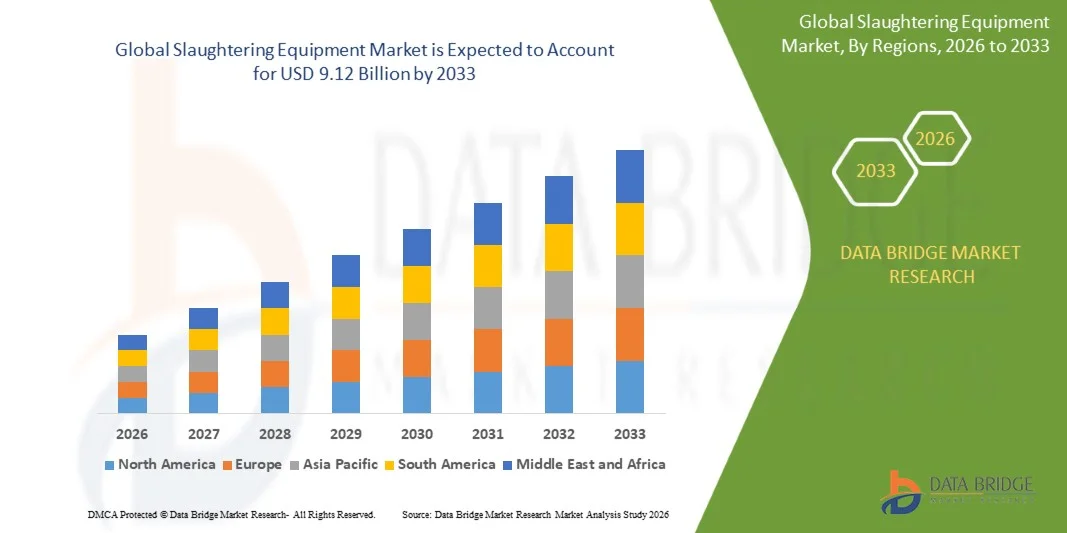
- The global slaughtering equipment market size was valued at USD 6.00 billion in 2025 and is expected to reach USD 9.12 billion by 2033, at a CAGR of 5.37% during the forecast period
- The market growth is largely fuelled by the rising global demand for processed meat products such as poultry, beef, and pork
- Increasing automation in meat processing facilities to improve operational efficiency, hygiene standards, and throughput is accelerating equipment adoption
Slaughtering Equipment Market Analysis
- The market is experiencing steady growth due to the increasing industrialization of meat processing operations and the need for high-capacity, automated slaughtering systems
- Technological advancements such as robotic cutting, automated stunning systems, and integrated processing lines are enhancing productivity and reducing labour dependency
- North America dominated the slaughtering equipment market with the largest revenue share in 2025, driven by the presence of advanced meat processing infrastructure and the strong demand for processed meat products across the region
- Asia-Pacific region is expected to witness the highest growth rate in the global slaughtering equipment market, driven by rising meat consumption, rapid urbanization, expansion of commercial meat processing facilities, and increasing adoption of advanced slaughtering equipment in emerging economies
- The stunning segment held the largest market revenue share in 2025 driven by its essential role in ensuring humane animal handling and compliance with strict animal welfare regulations during slaughtering operations. Stunning equipment is widely adopted in modern slaughterhouses as it helps improve operational efficiency, reduce stress in animals, and maintain meat quality during processing
Report Scope and Slaughtering Equipment Market Segmentation
|
Attributes |
Slaughtering Equipment Key Market Insights |
|
Segments Covered |
|
|
Countries Covered |
North America
Europe
Asia-Pacific
Middle East and Africa
South America
|
|
Key Market Players |
• Jarvis India (India) |
|
Market Opportunities |
• Rising Adoption Of Automated Meat Processing Technologies |
|
Value Added Data Infosets |
In addition to the insights on market scenarios such as market value, growth rate, segmentation, geographical coverage, and major players, the market reports curated by the Data Bridge Market Research also include in-depth expert analysis, pricing analysis, brand share analysis, consumer survey, demography analysis, supply chain analysis, value chain analysis, raw material/consumables overview, vendor selection criteria, PESTLE Analysis, Porter Analysis, and regulatory framework. |
Slaughtering Equipment Market Trends
“Increasing Automation and Smart Processing Technologies”
• The growing integration of automation and digital technologies is significantly shaping the slaughtering equipment market, as meat processing facilities increasingly adopt advanced systems to improve efficiency, precision, and hygiene standards. Automated slaughtering equipment is gaining traction due to its ability to streamline processing operations, reduce manual labour, and maintain consistent product quality. This trend strengthens its adoption across large-scale meat processing plants and encourages manufacturers to introduce technologically advanced machinery that enhances operational productivity
• Increasing pressure on meat processors to maintain high food safety standards and meet rising global meat consumption is accelerating the demand for automated slaughtering systems. Modern slaughtering equipment enables faster processing speeds, better carcass handling, and improved worker safety while ensuring compliance with strict food safety regulations. Meat processing companies are also investing in advanced equipment to reduce contamination risks and improve traceability across the processing chain
• Automation and digital monitoring technologies are influencing operational strategies, with manufacturers emphasizing efficiency, hygiene, and data-driven processing. These systems help optimize production capacity while reducing operational costs and waste. Equipment suppliers are also focusing on integrating robotics, sensors, and monitoring tools that enable real-time quality control and predictive maintenance, supporting long-term productivity improvements
• For instance, in 2024, Marel and BAADER expanded their automated slaughtering and meat processing equipment portfolios to support high-capacity processing facilities. These solutions were introduced to enhance productivity, improve hygienic processing conditions, and reduce labour dependency in modern slaughterhouses. The equipment was deployed across large-scale meat processing plants supplying retail, foodservice, and export markets
• While automation adoption is increasing, sustained market expansion depends on continuous innovation, cost-efficient equipment development, and the ability to integrate advanced technologies with existing processing infrastructure. Equipment manufacturers are also focusing on improving machine durability, operational efficiency, and digital integration capabilities to support evolving meat processing industry requirements
Slaughtering Equipment Market Dynamics
Driver
“Growing Global Demand for Processed Meat Products”
• Rising consumption of meat products such as poultry, beef, and pork is a major driver for the slaughtering equipment market. Meat processors are expanding production capacity to meet increasing demand for packaged and processed meat products, encouraging investments in modern slaughtering facilities and advanced equipment. This trend is also pushing equipment manufacturers to develop high-efficiency systems capable of handling large processing volumes
• Expanding food processing industries and growing urban populations are influencing market growth as demand for convenient and ready-to-cook meat products continues to rise. Slaughtering equipment plays a critical role in ensuring hygienic processing, efficient carcass handling, and compliance with food safety standards, enabling producers to deliver consistent product quality to retail and foodservice sectors
• Meat processing companies are actively investing in modern equipment to enhance operational efficiency, reduce processing time, and maintain strict hygiene standards. These efforts are supported by the increasing global demand for protein-rich diets and the expansion of organized meat processing sectors, encouraging collaborations between equipment manufacturers and meat processors to improve production capabilities
• For instance, in 2023, JBT Corporation and Meyn Food Processing Technology reported increased deployment of automated slaughtering and processing systems in poultry and meat processing facilities. These installations were driven by rising demand for processed meat products and the need for efficient, hygienic production lines to meet growing consumer demand
• Although rising meat consumption supports market growth, long-term expansion depends on continuous investment in advanced equipment, modernization of slaughterhouses, and improved processing efficiency. Strengthening food safety compliance, operational scalability, and technological innovation will be essential for supporting global market growth
Restraint/Challenge
“High Equipment Costs and Strict Regulatory Compliance”
• The relatively high cost of advanced slaughtering equipment compared to conventional manual systems remains a key challenge, particularly for small and medium-sized meat processors. Modern automated systems require substantial capital investment, including installation, maintenance, and skilled workforce training. These financial barriers can limit adoption in developing markets where processing infrastructure is still evolving
• Regulatory compliance related to food safety, sanitation, and animal welfare standards also affects equipment adoption. Meat processors must comply with stringent regulatory frameworks governing slaughterhouse operations, hygiene requirements, and waste management practices. Meeting these standards often requires additional investments in specialized equipment, facility upgrades, and monitoring systems
• Supply chain and operational challenges also influence market growth, as slaughtering equipment requires reliable maintenance services, spare parts availability, and skilled technicians for operation. Downtime due to equipment malfunction or maintenance can disrupt processing operations and increase operational costs, particularly in high-capacity processing plants
• For instance, in 2024, meat processing companies in countries such as Brazil and Thailand reported operational challenges associated with high equipment investment costs and strict compliance with international food safety and animal welfare regulations. These factors increased the overall cost of upgrading slaughterhouse facilities and slowed adoption among smaller processing facilities
• Addressing these challenges will require cost-efficient equipment solutions, improved financing options for processors, and stronger technical support networks. Equipment manufacturers are also focusing on developing modular systems, enhancing service capabilities, and improving operational efficiency to support broader adoption in global meat processing industries
Slaughtering Equipment Market Scope
The market is segmented on the basis of type, automation, livestock, and process type.
• By Type
On the basis of type, the slaughtering equipment market is segmented into Stunning, Killing, Cut-Up, Deboning, Skinning, and Others. The stunning segment held the largest market revenue share in 2025 driven by its essential role in ensuring humane animal handling and compliance with strict animal welfare regulations during slaughtering operations. Stunning equipment is widely adopted in modern slaughterhouses as it helps improve operational efficiency, reduce stress in animals, and maintain meat quality during processing.
The cut-up segment is expected to witness the fastest growth rate from 2026 to 2033, driven by the increasing demand for processed and portioned meat products across retail and foodservice sectors. Cut-up equipment enables precise portioning and efficient carcass processing, helping meat processors enhance productivity and meet rising consumer demand for ready-to-cook meat products.
• By Automation
On the basis of automation, the slaughtering equipment market is segmented into Fully Automated Line and Semi-Automated Line. The fully automated line segment held the largest market revenue share in 2025 driven by the increasing adoption of automation technologies in large-scale meat processing facilities. Fully automated systems help improve processing speed, reduce labour dependency, and maintain consistent hygiene and product quality standards across slaughtering operations.
The semi-automated line segment is expected to witness the fastest growth rate from 2026 to 2033, driven by its affordability and flexibility for small and medium-sized meat processors. Semi-automated systems offer a balance between manual operation and automation, allowing processors to improve operational efficiency while managing capital investment costs effectively.
• By Livestock
On the basis of livestock, the slaughtering equipment market is segmented into Poultry, Swine, Bovine, Seafood, and Others. The poultry segment held the largest market revenue share in 2025 driven by the high global consumption of poultry meat and the expansion of commercial poultry processing facilities. Poultry slaughtering equipment is widely used due to the large processing volumes required in poultry plants and the increasing demand for processed chicken products.
The seafood segment is expected to witness the fastest growth rate from 2026 to 2033, driven by the rising demand for processed fish and seafood products in retail and foodservice industries. Seafood processing facilities are increasingly investing in specialized slaughtering and processing equipment to improve efficiency, maintain product quality, and meet international food safety standards.
• By Process Type
On the basis of process type, the slaughtering equipment market is segmented into Line Slaughter, Batch Slaughter, and Small-Sized Slaughter. The line slaughter segment held the largest market revenue share in 2025 driven by its widespread use in large-scale meat processing facilities that require continuous and high-capacity slaughtering operations. Line slaughter systems enable streamlined processing, improved workflow efficiency, and better compliance with hygiene and safety standards.
The small-sized slaughter segment is expected to witness the fastest growth rate from 2026 to 2033, driven by the increasing number of local and small-scale meat processing facilities catering to regional demand. Small-sized slaughter systems provide cost-effective and compact processing solutions, enabling smaller processors to improve operational efficiency while maintaining product quality and regulatory compliance.
Slaughtering Equipment Market Regional Analysis
• North America dominated the slaughtering equipment market with the largest revenue share in 2025, driven by the presence of advanced meat processing infrastructure and the strong demand for processed meat products across the region
• Meat processing companies in the region emphasize operational efficiency, food safety, and compliance with strict animal welfare regulations, encouraging the adoption of modern slaughtering equipment and automated processing systems
• This widespread adoption is further supported by high investment in food processing technology, the presence of established meat processing companies, and the increasing demand for hygienic and efficient meat production systems for both domestic consumption and export markets
U.S. Slaughtering Equipment Market Insight
The U.S. slaughtering equipment market captured the largest revenue share in 2025 within North America, fueled by the strong presence of large-scale meat processing facilities and the high consumption of poultry, beef, and pork products. Meat processors are increasingly investing in advanced slaughtering equipment to improve productivity, maintain strict hygiene standards, and comply with food safety regulations. The growing demand for processed and packaged meat products, combined with continuous modernization of slaughterhouses, further supports the expansion of the slaughtering equipment market in the country.
Europe Slaughtering Equipment Market Insight
The Europe slaughtering equipment market is expected to witness steady growth from 2026 to 2033, primarily driven by strict regulatory standards related to animal welfare, food safety, and hygienic meat processing. The increasing demand for high-quality processed meat products and the modernization of slaughterhouse infrastructure are encouraging the adoption of technologically advanced slaughtering equipment. Meat processing companies across the region are also focusing on improving operational efficiency and ensuring compliance with environmental and safety regulations.
U.K. Slaughtering Equipment Market Insight
The U.K. slaughtering equipment market is expected to witness notable growth from 2026 to 2033, driven by the modernization of meat processing facilities and the increasing demand for high-quality meat products. Meat processors are investing in advanced equipment to improve operational efficiency, reduce contamination risks, and maintain compliance with strict food safety and animal welfare standards. The expansion of organized meat processing industries and rising consumer demand for processed meat products further support market growth.
Germany Slaughtering Equipment Market Insight
The Germany slaughtering equipment market is expected to witness steady growth from 2026 to 2033, supported by the country’s well-developed meat processing industry and strong focus on technological innovation. German meat processors are increasingly adopting automated slaughtering systems to improve productivity, enhance hygiene standards, and comply with stringent regulatory requirements. The presence of advanced manufacturing capabilities and continuous investment in food processing technologies also contribute to the market’s expansion.
Asia-Pacific Slaughtering Equipment Market Insight
The Asia-Pacific slaughtering equipment market is expected to witness the fastest growth rate from 2026 to 2033, driven by increasing meat consumption, rapid urbanization, and the expansion of commercial meat processing facilities. Countries across the region are witnessing growing demand for processed meat products, encouraging investments in modern slaughterhouses and advanced equipment. Government initiatives supporting food safety standards and improvements in meat processing infrastructure are further contributing to the adoption of slaughtering equipment.
Japan Slaughtering Equipment Market Insight
The Japan slaughtering equipment market is expected to witness steady growth from 2026 to 2033 due to the country’s focus on food safety, quality control, and advanced processing technologies. Japanese meat processors are increasingly adopting automated and precision-based slaughtering equipment to improve processing efficiency and maintain high hygiene standards. The growing demand for premium meat products and the integration of advanced technologies in food processing facilities are also contributing to market growth.
China Slaughtering Equipment Market Insight
The China slaughtering equipment market accounted for the largest market revenue share in Asia-Pacific in 2025, attributed to the country’s large meat production industry and expanding consumption of pork and poultry products. Rapid urbanization, rising disposable incomes, and the modernization of slaughterhouses are driving the adoption of advanced slaughtering equipment. In addition, government regulations aimed at improving food safety and upgrading meat processing facilities are further supporting market growth in China.
Slaughtering Equipment Market Share
The Slaughtering Equipment industry is primarily led by well-established companies, including:
• Jarvis India (India)
• BAYLE S.A. (France)
• Best & Donovan (U.S.)
• Prime Equipment Pvt. Ltd. (India)
• Marel (Iceland)
• MEATEK Food Machineries India (India)
• Industrial Riopel Inc. (Canada)
• CTB, Inc. (U.S.)
• Brower Equipment (U.S.)
• BAADER (Germany)
• Dhopeshwar Engineering Private Limited (India)
• BANSS GmbH (Germany)
• BLASAU (Spain)
• LIMOS d.o.o (Slovenia)
Latest Developments in Global Slaughtering Equipment Market
- In November 2026, Tyson Foods, Inc. announced an investment in AI-driven technologies to improve efficiency and reduce waste across its slaughtering operations. The initiative focuses on integrating advanced data analytics and automation tools to optimize processing lines and enhance operational monitoring. This development aims to improve productivity, reduce resource consumption, and strengthen sustainability practices. The adoption of AI-based systems is expected to support smarter processing operations and encourage technological innovation across the slaughtering equipment market
- In October 2025, Cargill, Inc. introduced a sustainable livestock sourcing initiative involving partnerships with local farmers to promote responsible and ethical animal farming practices. The program emphasizes improved traceability, better animal welfare standards, and environmentally responsible sourcing methods. This strategy helps the company strengthen its sustainability commitments while responding to increasing consumer demand for ethically produced meat products. The initiative is expected to encourage greater transparency in supply chains and influence sustainable practices across the meat processing industry
- In September 2024, JBS S.A. expanded its meat processing and slaughtering facilities in Brazil to increase overall production capacity. The expansion aims to improve supply chain efficiency and support the growing global demand for meat products. By enhancing its processing capabilities, the company can streamline operations and strengthen its export potential. This development is expected to support the adoption of modern slaughtering equipment and boost investments in advanced processing infrastructure
- In May 2024, Marel introduced advanced automated poultry processing solutions designed to enhance processing accuracy and efficiency in slaughterhouses. The new equipment integrates automation and precision technology to improve product quality, reduce manual labour requirements, and optimize processing speed. The development supports meat processors in achieving higher operational productivity while maintaining strict hygiene and safety standards. Such technological advancements are expected to accelerate the adoption of automated slaughtering systems globally
- In February 2023, BAADER launched the killing machine 2320 designed to address challenges related to stabilizing shackled birds and accurately aligning their necks during poultry processing. The equipment is engineered for precision cutting and efficient bleed-out, improving processing consistency and animal welfare compliance. This innovation helps poultry processors enhance operational efficiency while maintaining high processing standards. The launch reflects the growing focus on precision-engineered slaughtering equipment in modern poultry processing facilities
- In August 2022, BANSS GmbH introduced upgraded slaughtering systems designed to improve automation and operational efficiency in meat processing facilities. The new systems focus on enhancing processing throughput while maintaining strict hygiene and safety standards. This development supports meat processors in modernizing slaughterhouse infrastructure and improving productivity. The advancement is expected to contribute to the wider adoption of technologically advanced slaughtering equipment in the global market
SKU-
Get online access to the report on the World's First Market Intelligence Cloud

- Interactive Data Analysis Dashboard
- Company Analysis Dashboard for high growth potential opportunities
- Research Analyst Access for customization & queries
- Competitor Analysis with Interactive dashboard
- Latest News, Updates & Trend analysis
- Harness the Power of Benchmark Analysis for Comprehensive Competitor Tracking
Global Slaughtering Equipment Market, Supply Chain Analysis and Ecosystem Framework
To support market growth and help clients navigate the impact of geopolitical shifts, DBMR has integrated in-depth supply chain analysis into its Global Slaughtering Equipment Market research reports. This addition empowers clients to respond effectively to global changes affecting their industries. The supply chain analysis section includes detailed insights such as Global Slaughtering Equipment Market consumption and production by country, price trend analysis, the impact of tariffs and geopolitical developments, and import and export trends by country and HSN code. It also highlights major suppliers with data on production capacity and company profiles, as well as key importers and exporters. In addition to research, DBMR offers specialized supply chain consulting services backed by over a decade of experience, providing solutions like supplier discovery, supplier risk assessment, price trend analysis, impact evaluation of inflation and trade route changes, and comprehensive market trend analysis.
Research Methodology
Data collection and base year analysis are done using data collection modules with large sample sizes. The stage includes obtaining market information or related data through various sources and strategies. It includes examining and planning all the data acquired from the past in advance. It likewise envelops the examination of information inconsistencies seen across different information sources. The market data is analysed and estimated using market statistical and coherent models. Also, market share analysis and key trend analysis are the major success factors in the market report. To know more, please request an analyst call or drop down your inquiry.
The key research methodology used by DBMR research team is data triangulation which involves data mining, analysis of the impact of data variables on the market and primary (industry expert) validation. Data models include Vendor Positioning Grid, Market Time Line Analysis, Market Overview and Guide, Company Positioning Grid, Patent Analysis, Pricing Analysis, Company Market Share Analysis, Standards of Measurement, Global versus Regional and Vendor Share Analysis. To know more about the research methodology, drop in an inquiry to speak to our industry experts.
Customization Available
Data Bridge Market Research is a leader in advanced formative research. We take pride in servicing our existing and new customers with data and analysis that match and suits their goal. The report can be customized to include price trend analysis of target brands understanding the market for additional countries (ask for the list of countries), clinical trial results data, literature review, refurbished market and product base analysis. Market analysis of target competitors can be analyzed from technology-based analysis to market portfolio strategies. We can add as many competitors that you require data about in the format and data style you are looking for. Our team of analysts can also provide you data in crude raw excel files pivot tables (Fact book) or can assist you in creating presentations from the data sets available in the report.












