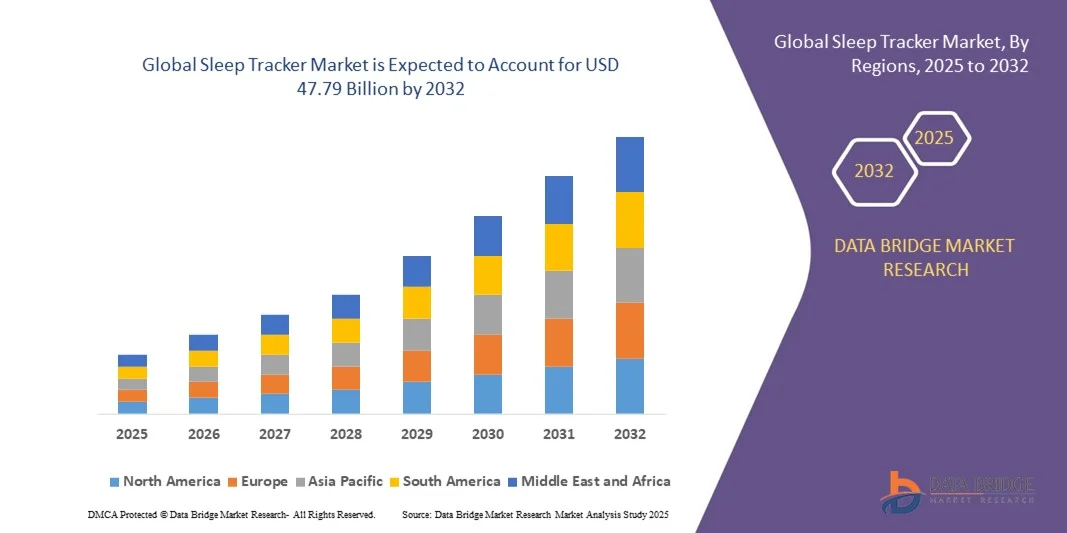
Sleep Tracker Market Size
- The global sleep tracker market size was valued at USD 26.6 billion in 2024 and is expected to reach USD 47.79 billion by 2032, at a CAGR of 7.60% during the forecast period
- The market growth is largely fuelled by the rising awareness of sleep health and increasing prevalence of sleep disorders among adults and adolescents
- Growing adoption of wearable devices and smart technology for monitoring sleep patterns, heart rate, and physical activity is driving demand for sleep trackers
Sleep Tracker Market Analysis
- The growing consumer inclination toward health and wellness, combined with technological advancements in wearable devices, is transforming the sleep tracker landscape
- Rising demand for accurate, real-time sleep monitoring solutions across home and clinical settings is boosting adoption of advanced sleep tracking devices
- North America dominated the sleep tracker market with the largest revenue share in 2024, driven by growing health awareness, rising adoption of wearable devices, and increasing focus on sleep wellness
- Asia-Pacific region is expected to witness the highest growth rate in the global sleep tracker market, driven by technological advancements, expanding e-commerce channels, and increasing focus on health and fitness across countries such as China, Japan, and India
- The wearable segment held the largest market revenue share in 2024, driven by the increasing adoption of smartwatches, fitness bands, and wristbands that allow continuous monitoring of sleep patterns, heart rate, and other vital metrics. Wearable sleep trackers offer real-time insights, mobile app integration, and ease of use, making them the preferred choice for personal health monitoring
Report Scope and Sleep Tracker Market Segmentation
|
Attributes |
Sleep Tracker Key Market Insights |
|
Segments Covered |
|
|
Countries Covered |
North America
Europe
Asia-Pacific
Middle East and Africa
South America
|
|
Key Market Players |
|
|
Market Opportunities |
|
|
Value Added Data Infosets |
In addition to the insights on market scenarios such as market value, growth rate, segmentation, geographical coverage, and major players, the market reports curated by the Data Bridge Market Research also include in-depth expert analysis, pricing analysis, brand share analysis, consumer survey, demography analysis, supply chain analysis, value chain analysis, raw material/consumables overview, vendor selection criteria, PESTLE Analysis, Porter Analysis, and regulatory framework. |
Sleep Tracker Market Trends
Rise of Wearable Sleep Monitoring Devices
- The growing adoption of wearable sleep trackers is transforming personal health management by enabling real-time monitoring of sleep patterns, duration, and quality. The portability and integration with smartphones allow users to track sleep habits and make informed lifestyle adjustments, resulting in improved sleep health and overall wellness. In addition, advanced features such as heart rate variability, oxygen saturation, and stress monitoring are increasing the value of these devices for holistic health tracking. The convenience of continuous monitoring encourages consistent usage and long-term behavior change, improving overall user outcomes
- Increasing demand for accurate sleep monitoring in remote and under-served regions is driving the use of mobile app-based trackers and wearable devices. These tools are particularly effective where access to professional sleep clinics is limited, helping users manage sleep disorders efficiently. With cloud connectivity, users can share data with healthcare providers for better diagnosis and personalized recommendations. The integration of AI-driven insights and personalized sleep coaching further enhances user engagement and treatment efficacy
- The affordability and ease of use of modern sleep trackers are making them attractive for routine personal health monitoring, allowing frequent tracking without professional assistance. Users benefit from actionable insights that support better sleep hygiene and lifestyle choices. Manufacturers are focusing on intuitive interfaces, long battery life, and lightweight designs to improve user experience. In addition, the availability of customizable alerts and reminders motivates users to maintain healthy sleep routines, promoting overall wellness
- For instance, in 2023, several fitness and wellness companies reported improved user engagement and sleep quality metrics after integrating advanced sleep tracking features into wearable devices, enhancing customer satisfaction and retention. Users experienced better awareness of sleep disruptions, leading to behavioral adjustments and improved productivity. Collaboration with health and wellness platforms helped broaden reach and adoption across different demographics. These initiatives also facilitated data-driven insights for product improvement and innovation
- While sleep trackers are improving awareness and self-management of sleep health, their impact depends on device accuracy, data privacy, and continuous innovation. Manufacturers must focus on personalized analytics and seamless integration with health platforms to maximize adoption. Ongoing R&D in sensor technology and algorithms is essential to maintain reliability and competitiveness. Furthermore, educating consumers on correct usage and data interpretation is vital to enhance trust and long-term engagement
Sleep Tracker Market Dynamics
Driver
Increasing Health Awareness and Focus on Sleep Wellness
- Rising awareness of the importance of sleep for physical and mental health is driving demand for sleep tracking devices, enabling early identification of sleep disorders such as insomnia and sleep apnea. Consumers are recognizing the long-term health benefits of quality sleep, influencing lifestyle choices. The integration of wellness apps and personalized health dashboards encourages proactive health management, fostering regular adoption of these devices
- Consumers are increasingly seeking wearable devices that offer insights into sleep quality, heart rate, and other health metrics, fostering regular adoption of sleep trackers. The growing popularity of holistic health monitoring platforms has fueled demand for multi-functional devices. Features such as stress monitoring, activity tracking, and personalized recommendations make these devices valuable for daily health management. The ability to integrate data with healthcare providers enhances diagnostic accuracy and preventive care
- Integration with smartphones, fitness apps, and wellness platforms is promoting the use of advanced sleep trackers, providing a holistic view of personal health and lifestyle. Users benefit from real-time notifications, trend analysis, and actionable recommendations for improving sleep patterns. Social sharing and gamification features further boost engagement and adherence to healthy routines. The combined ecosystem approach strengthens user retention and increases perceived value
- For instance, in 2022, North American and European wearable manufacturers introduced enhanced sleep tracking features, improving user engagement and promoting proactive sleep management. The addition of AI-based sleep coaching and detailed analytics allowed users to better understand sleep quality and make informed lifestyle adjustments. This led to increased brand loyalty and repeat purchases. Collaborative campaigns with healthcare professionals also strengthened credibility and market adoption
- While awareness and technology adoption are driving market growth, there remains a need to enhance device accuracy, affordability, and data security to ensure sustained consumer trust and market expansion. Investments in advanced sensors, longer battery life, and cloud infrastructure are essential. Educating users about data privacy and ethical use of health information is crucial for maintaining confidence and encouraging long-term adoption
Restraint/Challenge
High Device Costs and Data Privacy Concerns
- The high price of advanced sleep trackers limits adoption among cost-sensitive users and in emerging markets, restricting widespread use. Premium devices with multi-sensor capabilities remain inaccessible to large segments of the population. Limited availability of financing options or subscription models in these regions further constrains adoption. Manufacturers must explore cost-effective solutions to penetrate broader markets without compromising on quality or features
- In addition, concerns regarding personal data privacy and the security of health metrics may hinder consumer confidence, affecting market penetration. Users are wary of sharing sensitive health information with third-party apps and cloud platforms. Compliance with global data protection regulations, such as GDPR and HIPAA, is essential for credibility. Companies are investing in encryption, secure cloud storage, and anonymization techniques to alleviate these concerns and ensure trust
- Technical complexity and limited battery life of some wearable devices can reduce usability and user satisfaction, creating adoption barriers. Consumers often require training or guidance to utilize advanced features effectively. Interruptions due to device downtime or inaccurate readings can discourage continued use. Ongoing improvements in device ergonomics, intuitive interfaces, and battery optimization are needed to address these challenges and improve user retention
- For instance, in 2023, several small-scale users in Asia-Pacific reported reluctance to adopt wearable sleep trackers due to device costs and concerns over personal data storage and sharing. Concerns over potential misuse of data by third-party apps affected adoption rates. Limited technical support in remote regions also contributed to hesitancy, highlighting the need for localized education and service initiatives
- While devices continue to evolve, addressing cost, usability, and privacy challenges is critical. Market players must focus on user-friendly, affordable, and secure sleep tracking solutions to unlock long-term growth potential. Continuous innovation in sensor accuracy, analytics algorithms, and wearable design will enhance adoption across all demographics and geographies
Sleep Tracker Market Scope
The market is segmented on the basis of product, application, and distribution channel.
- By Product
On the basis of product, the sleep tracker market is segmented into wearable and non-wearable devices. The wearable segment held the largest market revenue share in 2024, driven by the increasing adoption of smartwatches, fitness bands, and wristbands that allow continuous monitoring of sleep patterns, heart rate, and other vital metrics. Wearable sleep trackers offer real-time insights, mobile app integration, and ease of use, making them the preferred choice for personal health monitoring.
The non-wearable segment is expected to witness the fastest growth rate from 2025 to 2032, driven by the demand for under-mattress sensors, bedside monitors, and smart home-integrated devices that track sleep without requiring direct contact. Non-wearable devices are particularly appealing for individuals seeking minimal intrusion and seamless integration with bedroom ecosystems, providing accurate data on sleep duration, movement, and breathing patterns.
- By Application
On the basis of application, the market is segmented into insomnia, sleep apnoea, and others. The insomnia segment accounted for the largest market share in 2024 due to the rising prevalence of sleep disorders and growing awareness of sleep health. Sleep trackers help users monitor sleep quality, identify disruptions, and make informed lifestyle adjustments to improve rest and overall well-being.
The sleep apnoea segment is expected to witness the fastest growth rate from 2025 to 2032, fueled by increased diagnosis of obstructive sleep apnoea and demand for devices that monitor breathing irregularities. Advanced trackers provide insights into oxygen saturation, snoring patterns, and apnea events, enabling timely interventions and better management of sleep-related health risks.
- By Distribution Channel
On the basis of distribution channel, the market is segmented into e-commerce, pharmacy and retail stores, hypermarkets and supermarkets, and others. The e-commerce segment held the largest market share in 2024, driven by the convenience of online shopping, availability of a wide product range, and competitive pricing. Online platforms also allow access to detailed product reviews, comparison features, and doorstep delivery, enhancing consumer purchasing experience.
The pharmacy and retail stores segment is expected to witness the fastest growth rate from 2025 to 2032, supported by partnerships with healthcare providers, wellness centers, and clinics. Consumers prefer offline channels for hands-on experience, immediate product availability, and personalized guidance from store personnel. Hypermarkets and supermarkets are also contributing to market expansion by offering bundled health and fitness products that include sleep trackers.
Sleep Tracker Market Regional Analysis
- North America dominated the sleep tracker market with the largest revenue share in 2024, driven by growing health awareness, rising adoption of wearable devices, and increasing focus on sleep wellness
- Consumers in the region highly value the convenience, real-time monitoring, and integration with smartphones and fitness platforms offered by sleep trackers, supporting proactive health management
- This widespread adoption is further supported by high disposable incomes, a health-conscious population, and the growing preference for preventive healthcare solutions, establishing sleep trackers as a favored device for personal health monitoring
U.S. Sleep Tracker Market Insight
The U.S. sleep tracker market captured the largest revenue share in 2024 within North America, fueled by the rising awareness of sleep disorders and the growing trend of wearable health monitoring devices. Consumers are increasingly prioritizing personalized health insights and proactive sleep management through connected devices. The strong presence of leading wearable device manufacturers, combined with the integration of trackers with wellness apps and platforms, further propels market growth. Moreover, increasing collaborations between technology and healthcare companies are expanding product offerings and enhancing user engagement.
Europe Sleep Tracker Market Insight
The Europe sleep tracker market is expected to witness the fastest growth rate from 2025 to 2032, primarily driven by rising health consciousness, increasing smartphone penetration, and government initiatives promoting digital health solutions. The growing urban population and demand for connected health devices are fostering the adoption of sleep trackers. European consumers are drawn to devices offering detailed sleep analytics, personalized recommendations, and integration with broader wellness platforms. The market is experiencing significant growth across both wearable and non-wearable solutions for home use and clinical applications.
U.K. Sleep Tracker Market Insight
The U.K. sleep tracker market is expected to witness the fastest growth rate from 2025 to 2032, driven by the rising focus on mental health, lifestyle management, and adoption of wearable devices. Growing concerns regarding sleep disorders and stress are encouraging both individuals and healthcare providers to leverage sleep monitoring solutions. The country’s advanced e-commerce ecosystem, coupled with robust retail infrastructure, supports the availability and adoption of a wide range of sleep trackers, stimulating market growth.
Germany Sleep Tracker Market Insight
The Germany sleep tracker market is expected to witness the fastest growth rate from 2025 to 2032, fueled by increasing health awareness, technological adoption, and emphasis on preventive healthcare. Germany’s well-developed healthcare and technology infrastructure promotes the use of wearable and non-wearable sleep monitoring devices. Integration with fitness and wellness apps, along with government initiatives encouraging digital health solutions, further supports the adoption of sleep trackers. Consumers are increasingly seeking secure, reliable, and easy-to-use devices for personal health tracking.
Asia-Pacific Sleep Tracker Market Insight
The Asia-Pacific sleep tracker market is expected to witness the fastest growth rate from 2025 to 2032, driven by rising disposable incomes, rapid urbanization, and growing awareness of health and wellness in countries such as China, Japan, and India. The increasing penetration of smartphones and wearable technology is boosting adoption. Government initiatives promoting digital healthcare and fitness monitoring, along with the emergence of local manufacturers offering affordable solutions, are expanding market accessibility. The region is witnessing growth across consumer, healthcare, and fitness applications.
Japan Sleep Tracker Market Insight
The Japan sleep tracker market is expected to witness the fastest growth rate from 2025 to 2032 due to the country’s high health awareness, technologically advanced population, and demand for personalized wellness solutions. Japanese consumers emphasize accurate monitoring of sleep quality, stress levels, and health metrics. The integration of sleep trackers with IoT-enabled health devices, fitness platforms, and mobile applications is fueling adoption. In addition, Japan’s aging population is driving demand for easier-to-use, health-focused sleep monitoring solutions for both residential and clinical settings.
China Sleep Tracker Market Insight
The China sleep tracker market accounted for the largest market revenue share in Asia-Pacific in 2024, attributed to the country’s expanding middle class, rapid urbanization, and high technological adoption. China stands as one of the largest markets for wearable and connected health devices, and sleep trackers are increasingly popular in both individual and clinical applications. The push towards smart health monitoring, rising awareness of sleep disorders, and availability of cost-effective devices from domestic manufacturers are key factors driving market growth in China.
Sleep Tracker Market Share
The Sleep Tracker industry is primarily led by well-established companies, including:
- Koninklijke Philips N.V. (Netherlands)
- Amazfit India (India)
- Huawei Device Co., Ltd. (China)
- Sleepace (China)
- Fitbit, Inc. (U.S.)
- Apple Inc. (U.S.)
- Sony Corporation (Japan)
- HTC Corporation (Taiwan)
- SAMSUNG (South Korea)
- Xiaomi Global Community (China)
- ADIDAS AG (Germany)
- Nike, Inc. (U.S.)
- LG Electronics (South Korea)
- Motorola Solutions, Inc. (U.S.)
- Fossil Group, Inc. (U.S.)
- Google LLC (U.S.)
- Polar Electro (Finland)
- Withings (France)
- Michael Kors (U.S.)
- CASIO AMERICA, INC. (U.S.)
- TomTom International BV (Netherlands)
- ASUSTeK Computer Inc. (Taiwan)

- Interactive Data Analysis Dashboard
- Company Analysis Dashboard for high growth potential opportunities
- Research Analyst Access for customization & queries
- Competitor Analysis with Interactive dashboard
- Latest News, Updates & Trend analysis
- Harness the Power of Benchmark Analysis for Comprehensive Competitor Tracking
Data collection and base year analysis are done using data collection modules with large sample sizes. The stage includes obtaining market information or related data through various sources and strategies. It includes examining and planning all the data acquired from the past in advance. It likewise envelops the examination of information inconsistencies seen across different information sources. The market data is analysed and estimated using market statistical and coherent models. Also, market share analysis and key trend analysis are the major success factors in the market report. To know more, please request an analyst call or drop down your inquiry.
The key research methodology used by DBMR research team is data triangulation which involves data mining, analysis of the impact of data variables on the market and primary (industry expert) validation. Data models include Vendor Positioning Grid, Market Time Line Analysis, Market Overview and Guide, Company Positioning Grid, Patent Analysis, Pricing Analysis, Company Market Share Analysis, Standards of Measurement, Global versus Regional and Vendor Share Analysis. To know more about the research methodology, drop in an inquiry to speak to our industry experts.
Data Bridge Market Research is a leader in advanced formative research. We take pride in servicing our existing and new customers with data and analysis that match and suits their goal. The report can be customized to include price trend analysis of target brands understanding the market for additional countries (ask for the list of countries), clinical trial results data, literature review, refurbished market and product base analysis. Market analysis of target competitors can be analyzed from technology-based analysis to market portfolio strategies. We can add as many competitors that you require data about in the format and data style you are looking for. Our team of analysts can also provide you data in crude raw excel files pivot tables (Fact book) or can assist you in creating presentations from the data sets available in the report.