


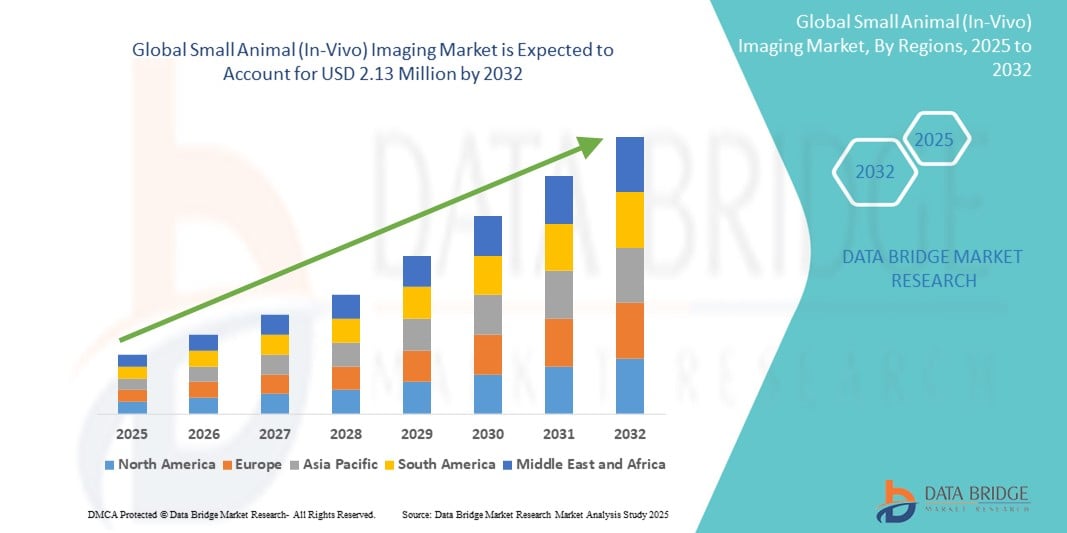
Small Animal (In-Vivo) Imaging Market Size
- The global small animal (in-vivo) imaging market size was valued at USD 1.14 million in 2024 and is expected to reach USD 2.13 million by 2032, at a CAGR of 8.10% during the forecast period
- This growth is driven by factors such as the increasing prevalence of chronic diseases, growing demand for personalized medicine, advancements in imaging technologies, and the rising focus on research and development in the pharmaceutical and biotechnology sectors
Small Animal (In-Vivo) Imaging Market Analysis
- The small animal in-vivo imaging market is seeing robust growth, primarily driven by the increasing use of advanced imaging technologies for detailed preclinical research and drug development
- The demand for non-invasive imaging techniques is growing, allowing researchers to closely observe disease progression and therapeutic effects in small animal models without the need for invasive procedures
- North America is expected to dominate the small animal (in-vivo) imaging market with share of 35.14% due to its well-established pharmaceutical and biotechnology sectors
- Asia-pacific is expected to be the fastest growing region in the small animal (in-vivo) imaging market during the forecast period with market share of 22.6% due to increasing investments in life sciences research
- The optical imaging systems segment is expected to dominate the small animal (in-vivo) imaging market with the largest share of 38.10% in 2025 due to its ability to provide high-resolution, real-time visualization of biological processes in living organisms. This technique is non-invasive and cost-effective, making it particularly suitable for longitudinal studies where repeated imaging of the same animal is required.
Report Scope and Small Animal (In-Vivo) Imaging Market Segmentation
|
Attributes |
Small Animal (In-Vivo) Imaging Key Market Insights |
|
Segments Covered |
|
|
Countries Covered |
North America
Europe
Asia-Pacific
Middle East and Africa
South America
|
|
Key Market Players |
|
|
Market Opportunities |
|
|
Value Added Data Infosets |
In addition to the insights on market scenarios such as market value, growth rate, segmentation, geographical coverage, and major players, the market reports curated by the Data Bridge Market Research also include in-depth expert analysis, patient epidemiology, pipeline analysis, pricing analysis, and regulatory framework. |
Small Animal (In-Vivo) Imaging Market Trends
“Growth in Non-Invasive Imaging Techniques for Research”
- The small animal in-vivo imaging market is growing steadily, with a focus on technological advancements in imaging techniques for preclinical research
- Non-invasive imaging methods, such as optical imaging and micro-CT, are increasingly preferred due to their ability to monitor live animals without causing harm
- For instance, optical imaging systems are commonly used to track disease progression, gene expression, and therapeutic responses in real-time
- These imaging tools allow researchers to gather valuable data on the effects of drugs, treatments, and disease mechanisms over time
- In conclusion, as a result, there is a shift toward these non-invasive methods, improving both the ethical standards and efficiency of preclinical studies
Small Animal (In-Vivo) Imaging Market Dynamics
Driver
“Technological Advancements in Imaging Methods”
- Increasing demand for precise, real-time imaging in small animal research is a key driver of market growth
- Technological advancements in non-invasive imaging techniques such as optical imaging, micro-MRI, and micro-CT enhance the accuracy and depth of animal studies
- For instance, optical imaging is widely used to track gene expression and monitor tumor growth, providing real-time insights into disease progression
- Hybrid imaging systems that combine multiple imaging techniques into one platform are gaining popularity for their ability to provide comprehensive data on disease mechanisms
- The evolution of these imaging methods leads to greater accuracy in modeling human diseases and contributes to the rapid development of treatments in the pharmaceutical and biotechnology sectors
- In conclusion, the advancements in imaging technology are significantly driving the growth of the in-vivo imaging market by improving research quality and enabling real-time monitoring
Opportunity
“Rising Demand for Personalized Medicine”
- An emerging opportunity in the small animal in-vivo imaging market is the growing emphasis on personalized medicine
- Personalized medicine tailors treatments based on individual patients' genetic makeup, lifestyle, and specific disease characteristics
- Small animal in-vivo imaging helps researchers monitor the effects of drugs and therapies on animal models that mimic human diseases
- For instance, non-invasive imaging systems enable longitudinal studies to assess how personalized drug regimens affect disease progression, such as cancer or neurological disorders
- The increasing demand for personalized treatments is expected to drive the need for advanced in-vivo imaging systems, fostering innovation and accelerating drug development
- In conclusion, personalized medicine is creating significant opportunities for growth in the in-vivo imaging market by driving the need for precise, real-time monitoring of therapeutic effects.
Restraint/Challenge
“High Cost of Imaging Equipment”
- A major challenge in the small animal in-vivo imaging market is the high cost of advanced equipment such as micro-MRI and hybrid imaging systems
- These systems require substantial capital investment and ongoing maintenance, creating financial barriers for many research institutions
- For instance, smaller academic labs often struggle to afford both the equipment and the specialized infrastructure needed to support it
- The requirement for highly skilled personnel to operate and interpret imaging data adds further operational expense, limiting access for under-resourced facilities
- This cost burden results in unequal access to advanced imaging technologies, where only well-funded institutions can fully benefit from their capabilities
- In conclusion, the high cost of imaging systems restricts broader adoption and creates disparity in research capabilities across institutions.
Small Animal (In-Vivo) Imaging Market Scope
The market is segmented on the basis of modality, reagents, and application.
|
Segmentation |
Sub-Segmentation |
|
By Modality |
|
|
By Reagents |
|
|
By Application |
|
In 2025, the optical imaging systems segment is projected to dominate the market with a largest share in modality segment
The optical imaging systems segment is expected to dominate the small animal (in-vivo) imaging market with the largest share of 38.10% in 2025 due to its ability to provide high-resolution, real-time visualization of biological processes in living organisms. This technique is non-invasive and cost-effective, making it particularly suitable for longitudinal studies where repeated imaging of the same animal is required. It is widely used in applications such as tumor tracking, gene expression analysis, and monitoring of infectious diseases, allowing researchers to observe disease progression and treatment response without the need to sacrifice animals.
The magnetic particle imaging systems segment is expected to account for the largest share during the forecast period in modality segment
In 2025, the magnetic particle imaging systems segment is expected to dominate the market with the largest market share of 8.06% due to its superior sensitivity and spatial resolution in detecting magnetic nanoparticles used as tracers in live animal studies. This imaging technique offers real-time, three-dimensional visualization without background noise from surrounding tissues, making it highly effective for tracking biological processes with precision. It is particularly useful in applications such as cardiovascular imaging, cancer detection, and stem cell tracking, where high contrast and specificity are critical.
Small Animal (In-Vivo) Imaging Market Regional Analysis
“North America Holds the Largest Share in the Small Animal (In-Vivo) Imaging Market”
- North America holds the dominant position in the global small animal in-vivo imaging market with share of 35.14% due to its well-established pharmaceutical and biotechnology sectors
- The region benefits from a strong presence of academic and research institutions actively involved in drug development and disease modeling
- High adoption of advanced imaging systems across laboratories and research facilities contributes to the widespread use of non-invasive imaging technologies
- The availability of funding and grants for preclinical research supports continuous innovation and integration of cutting-edge imaging platforms
- Regulatory clarity and supportive frameworks for biomedical research also encourage the use of small animal imaging technologies in various research pipelines
“Asia-Pacific is Projected to Register the Highest CAGR in the Small Animal (In-Vivo) Imaging Market”
- Asia-Pacific is emerging as the fastest growing region in the small animal in-vivo imaging market with market share of 22.6% due to increasing investments in life sciences research
- Countries such as China, India, and Japan are expanding their pharmaceutical and biotechnology infrastructure, creating a surge in demand for preclinical imaging tools
- Rising government support for research and development is accelerating the adoption of innovative imaging solutions in academic and clinical settings
- Growth in the number of clinical trials and translational research initiatives across the region is fueling the need for real-time imaging of disease models
- Collaborations between local research institutions and global industry players are helping bridge technology gaps and drive market growth at a rapid pace
Small Animal (In-Vivo) Imaging Market Share
The market competitive landscape provides details by competitor. Details included are company overview, company financials, revenue generated, market potential, investment in research and development, new market initiatives, global presence, production sites and facilities, production capacities, company strengths and weaknesses, product launch, product width and breadth, application dominance. The above data points provided are only related to the companies' focus related to market.
The Major Market Leaders Operating in the Market Are:
- Bruker (U.S.)
- General Electric (U.S.)
- Koninklijke Philips N.V. (Netherlands)
- Hitachi Ltd. (Japan)
- Siemens Healthcare GmbH (Germany)
- FUJIFILM Corporation (Japan)
- Bruker (U.S.)
- PerkinElmer Inc (U.S.)
- Miltenyi Biotec (Germany)
- CMR Naviscan (U.S.)
- SCANCO Medical AG (Switzerland)
- Aspect Imaging Ltd (Israel)
- Mediso Ltd (V.A.)
- LI-COR, Inc (USA)
- Takara Bio Inc (Japan)
- MILabs B.V. (Netherlands)
- M.R. Solutions (U.K.)
- Trifoil Imaging (U.S.)
- New England Biolabs (U.S.)
- Biospace Lab (France)
- Guerbet (France)
- Agilent Technologies, Inc (U.S.)
- Thermo Fisher Scientific Inc (U.S.)
Latest Developments in Global Small Animal (In-Vivo) Imaging Market
- In February 2024, Bruker a company manufacturing scientific instruments announced the acquisition of Special Instruments Imaging LLC, a preclinical in-vivo optical imaging systems company. The acquisition filled the gap in technology and product portfolio of Bruker BioSpin Preclinical Imaging division
- In March 2024, the IVSCOPE8000Pro small animal in-vivo imaging system was launched, offering high-resolution, multi-modal imaging capabilities for preclinical research. The system supports fluorescence, bioluminescence, and X-ray imaging, enabling real-time tracking of disease progression and therapeutic effects. It is designed for enhanced sensitivity and ease of use in drug development and biomedical studies
- In June 2025, the UVP iBox Scientia Small Animal Imaging System was introduced, offering high-resolution, non-invasive imaging capabilities for preclinical research. Equipped with a deeply cooled CCD camera, it enables sensitive detection of fluorescent and bioluminescent markers in live animals
- In March 2024, Thermo Fisher Scientific introduced the Small Animal In Vivo Imaging (SAIVI™) system, a comprehensive suite of reagents and kits designed for advanced preclinical imaging applications. The SAIVI system utilizes near-infrared (NIR) fluorescent dyes, including Alexa Fluor and Qdot probes, to label antibodies and proteins for non-invasive optical imaging in live small animals
- In July 2014, PerkinElmer and Sofie Biosciences announced a strategic partnership to deliver benchtop PET in vivo imaging systems to preclinical research professionals. This collaboration combines PerkinElmer's preclinical expertise with Sofie Biosciences' PET capabilities to offer advanced imaging solutions

- Interactive Data Analysis Dashboard
- Company Analysis Dashboard for high growth potential opportunities
- Research Analyst Access for customization & queries
- Competitor Analysis with Interactive dashboard
- Latest News, Updates & Trend analysis
- Harness the Power of Benchmark Analysis for Comprehensive Competitor Tracking
Data collection and base year analysis are done using data collection modules with large sample sizes. The stage includes obtaining market information or related data through various sources and strategies. It includes examining and planning all the data acquired from the past in advance. It likewise envelops the examination of information inconsistencies seen across different information sources. The market data is analysed and estimated using market statistical and coherent models. Also, market share analysis and key trend analysis are the major success factors in the market report. To know more, please request an analyst call or drop down your inquiry.
The key research methodology used by DBMR research team is data triangulation which involves data mining, analysis of the impact of data variables on the market and primary (industry expert) validation. Data models include Vendor Positioning Grid, Market Time Line Analysis, Market Overview and Guide, Company Positioning Grid, Patent Analysis, Pricing Analysis, Company Market Share Analysis, Standards of Measurement, Global versus Regional and Vendor Share Analysis. To know more about the research methodology, drop in an inquiry to speak to our industry experts.
Data Bridge Market Research is a leader in advanced formative research. We take pride in servicing our existing and new customers with data and analysis that match and suits their goal. The report can be customized to include price trend analysis of target brands understanding the market for additional countries (ask for the list of countries), clinical trial results data, literature review, refurbished market and product base analysis. Market analysis of target competitors can be analyzed from technology-based analysis to market portfolio strategies. We can add as many competitors that you require data about in the format and data style you are looking for. Our team of analysts can also provide you data in crude raw excel files pivot tables (Fact book) or can assist you in creating presentations from the data sets available in the report.













