


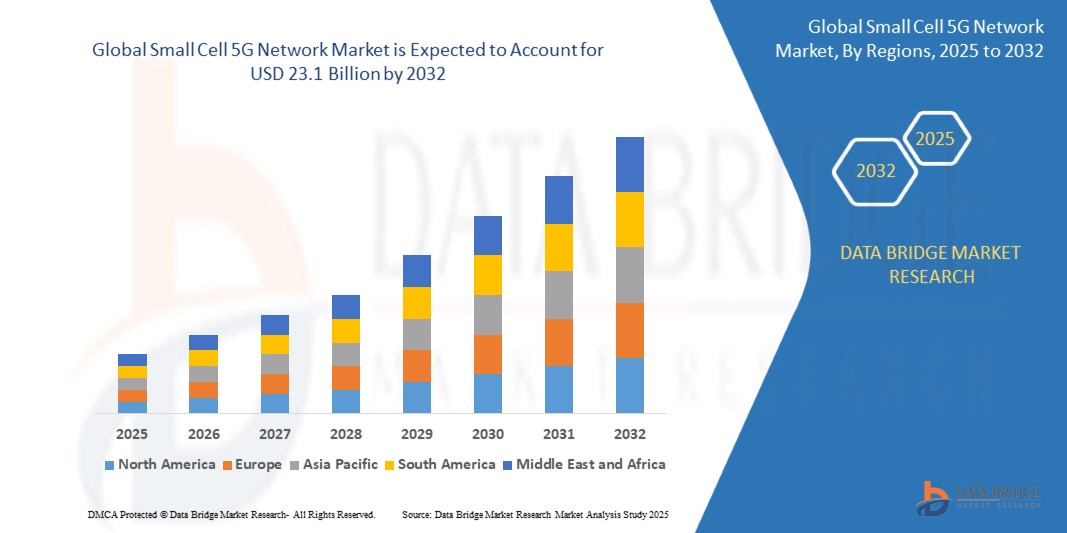
Global Small Cell 5G Network Market Size
- The Global Small Cell 5G Network Market Size was valued at USD 5.08 Billion in 2024 and is expected to reach USD 23.1 Billion by 2032, at a CAGR of 21.8% during the forecast period
- The Global Small Cell 5G Network Market's growth is fueled by the surging demand for enhanced mobile broadband, low-latency connectivity, and rapid 5G infrastructure deployment across urban and enterprise environments.
Global Small Cell 5G Network Market Analysis
The Global Small Cell 5G Network Market is experiencing rapid expansion as industries across telecommunications, smart cities, industrial automation, transportation, healthcare, and consumer electronics prioritize ultra-fast data transfer, low latency, and seamless connectivity. The accelerating deployment of 5G networks, rising demand for enhanced mobile broadband, and increasing data traffic due to IoT and edge computing are making small cells essential for densifying network infrastructure and ensuring consistent coverage.
A primary driver of market growth is the advancement in 5G radio access technologies and network architecture. Small cells particularly femtocells, picocells, and microcells—are being enhanced with massive MIMO, beamforming, and software-defined networking capabilities, allowing operators to deliver high capacity and low-latency services. These technological innovations are enabling more flexible, energy-efficient, and cost-effective deployments in urban, suburban, and enterprise environments.
The growing demand for high-capacity mobile services in densely populated areas such as stadiums, airports, offices, and public venues is reshaping the deployment strategy for telecom operators. Small cells offer an effective solution for offloading traffic from macro networks and enhancing indoor and outdoor coverage. In enterprise and industrial settings, private 5G networks powered by small cells are increasingly being used to support mission-critical applications, autonomous systems, and real-time analytics. The rise in smart manufacturing, autonomous vehicles, and connected healthcare devices further strengthens this trend.
Governments and telecom regulators across regions are actively supporting 5G small cell deployment through spectrum allocation (especially mmWave and sub-6 GHz bands), infrastructure sharing policies, and funding initiatives. At the same time, system integrators and network providers are collaborating to develop interoperable, plug-and-play small cell solutions that reduce deployment complexity and cost. The integration of AI and network automation is also enhancing the performance, scalability, and self-healing capabilities of these networks.
Despite the strong outlook, the market faces several challenges. These include the high initial cost of dense deployments, complexities in site acquisition and backhaul provisioning, and regulatory hurdles related to spectrum licensing. Additionally, small cell interference management and energy consumption remain key concerns, especially in large-scale rollouts. The requirement for skilled professionals to manage the evolving network ecosystem is also creating a talent gap.
Nonetheless, the future of the market is highly promising. Increasing investment from telecom operators, ongoing 5G infrastructure expansion, and the shift toward edge computing and hybrid cloud environments are expected to create significant opportunities. With continuous innovation in hardware design, software optimization, and network management tools, the Small Cell 5G Network Market is well-positioned for robust and sustained growth in the coming years.Top of Form
Report Scope and Global Small Cell 5G Network Market Segmentation
|
Attributes |
Global Small Cell 5G Network Market Insights |
|
Segments Covered |
|
|
Countries Covered |
North America
Europe
Asia-Pacific
Middle East and Africa
South America
|
|
Key Market Players |
|
|
Market Opportunities |
|
|
Value Added Data Infosets |
In addition to the insights on market scenarios such as market value, growth rate, segmentation, geographical coverage, and major players, the market reports curated by the Data Bridge Market Research also include in-depth expert analysis, pricing analysis, brand share analysis, consumer survey, demography analysis, supply chain analysis, value chain analysis, raw material/consumables overview, vendor selection criteria, PESTLE Analysis, Porter Analysis, and regulatory framework. |
Global Small Cell 5G Network Market Trends
Dense network deployments enabling enhanced coverage and capacity in high-traffic urban areas
- Dense network deployments are a critical trend in the global Small Cell 5G Network Market, particularly as data consumption continues to surge in metropolitan regions. These deployments involve placing a large number of small cell nodes in concentrated areas to ensure seamless connectivity and support for high user densities. As cities experience increasing mobile usage due to smart devices, streaming services, and IoT integration, traditional macro cells alone are unable to provide the necessary bandwidth and reliability.
- By using small cells in densely populated urban zones such as stadiums, shopping malls, airports, and downtown districts telecom operators can significantly enhance network capacity and reduce latency. This localized approach allows for efficient spectrum utilization and improves user experience through faster data speeds and more stable connections, especially in 5G environments that require high-frequency bands with limited range.
- Moreover, dense small cell networks are essential for supporting emerging technologies such as autonomous vehicles, real-time surveillance, and smart infrastructure, all of which depend on ultra-low latency and continuous connectivity. As such, the deployment of these cells is not only addressing current bandwidth challenges but also laying the foundation for future smart city applications.
Global Small Cell 5G Network Market Dynamics
Driver
Surging Demand for High-Speed Data
- The growing demand for high-speed data is one of the strongest catalysts behind the expansion of the Global Small Cell 5G Network Market. As digital transformation accelerates worldwide, data consumption is increasing at an unprecedented rate. From 4K video streaming and real-time multiplayer gaming to the growing use of AR/VR, autonomous vehicles, smart homes, and industrial automation, modern applications demand ultra-fast, low-latency, and uninterrupted connectivity. Traditional macrocell towers alone cannot handle this level of data traffic efficiently, especially in urban centers where user density and interference are high.
- Small cells address this challenge by creating dense, localized network architectures. These low-power, short-range base stations can be installed on streetlights, utility poles, rooftops, and indoor spaces to bring the 5G signal closer to users. As a result, they significantly improve network capacity, reduce latency, and offer consistent high-speed connectivity, even in data-heavy environments such as stadiums, airports, office buildings, and shopping malls.
- This growing demand for high-speed data is not limited to consumer usage. Enterprises, especially those in finance, healthcare, and manufacturing, are deploying data-intensive solutions such as AI-driven analytics, edge computing, telemedicine, and smart factories all of which require robust and reliable 5G connectivity. Small cells enable the scalability and coverage necessary to support these applications efficiently.
- Furthermore, the rise of remote work, online education, and the digital economy has reinforced the need for reliable broadband access everywhere. Governments and telecom operators are thus heavily investing in small cell infrastructure to close the connectivity gap, future-proof networks, and meet the performance expectations of 5G-enabled applications. This trend is expected to gain further momentum as next-generation services such as autonomous mobility, immersive virtual environments, and Industry 4.0 technologies continue to emerge.
Restraint/Challenge
High investment required for equipment, site acquisition, and backhaul infrastructure
- Major restraint in the Global Small Cell 5G Network Market is the complex and fragmented regulatory environment, particularly in urban areas. Small cells, by design, require dense deployment across public and private infrastructure. Each installation whether on a streetlight, building facade, or utility pole typically demands municipal permits, compliance with zoning laws, and approval from multiple local authorities. These bureaucratic hurdles vary significantly from region to region and can delay rollout timelines by months, adding further cost and operational uncertainty for telecom providers.
- Furthermore, integration with legacy infrastructure and existing macrocell networks poses technical challenges. Unlike macrocells, which cover broad areas with fewer units, small cells require a higher number of nodes in closer proximity. Coordinating handoffs, managing interference, and ensuring seamless service continuity between small and macro cells requires advanced planning and real-time network orchestration, which not all operators are fully equipped to handle.
- Another technical limitation is the short signal range and poor penetration capability of mmWave frequencies, which many 5G small cells utilize. These high-band frequencies offer ultra-fast speeds but struggle to pass through walls, glass, or dense materials. This makes them ideal for outdoor hotspots but less effective indoors or in rural settings without supplementary infrastructure such as indoor small cells or distributed antenna systems (DAS). Addressing these limitations requires additional hardware deployment, raising both cost and complexity.
- Lastly, there is growing public resistance to small cell installations in residential and historic areas, due to aesthetic concerns or perceived health risks related to radiofrequency exposure. While scientific evidence does not support such risks at regulatory limits, public opposition can trigger legal challenges, protests, or policy reversals that stall deployments.
- Together, these factors ranging from regulatory red tape and infrastructure costs to technical limitations and public perception represent significant restraints on the growth of the small cell 5G network market, especially in regions without strong government support or standardized deployment frameworks.
Global Small Cell 5G Network Market Scope
The market is segmented on the basis of Component, Network Model, Architecture Type, End-user.
- By Component
The Global Small Cell 5G Network Market, by component, is segmented into hardware and services. The hardware segment includes physical infrastructure such as small cell base stations, antennas, power supplies, and backhaul equipment that enable network connectivity. As 5G networks expand, the demand for compact, high-capacity, and energy-efficient hardware is rising, especially in dense urban environments and indoor settings. The services segment encompasses deployment, maintenance, network planning, and integration services necessary to manage the lifecycle of small cell infrastructure. With operators increasingly relying on third-party vendors and managed service providers to optimize network performance and reduce operational burdens, the services segment is witnessing significant growth. Together, both components are crucial to the widespread deployment and efficiency of 5G small cell networks.
- By Network Model
The Global Small Cell 5G Network Market, by network model, is categorized into non-standalone (NSA) and standalone (SA) architectures. The non-standalone model integrates 5G radios with existing 4G LTE infrastructure, allowing for faster deployment and reduced costs, making it a popular choice in the early phases of 5G rollout. It supports enhanced mobile broadband and acts as a transitional solution for operators upgrading their networks. On the other hand, the standalone model uses a dedicated 5G core network, offering full 5G capabilities such as ultra-low latency, massive machine-type communications, and network slicing. This model is crucial for unlocking the full potential of 5G across industrial automation, autonomous vehicles, and smart city applications. As the market matures, there is a growing shift toward standalone deployments to meet advanced connectivity demands.
- By Architecture Type
The Global Small Cell 5G Network Market, by architecture type, is segmented into virtualized and distributed architectures. In a virtualized architecture, the network functions are decoupled from the hardware and run as software on common servers, enabling scalability, centralized management, and cost efficiency. This approach supports dynamic network slicing and is well-suited for cloud-native environments and large-scale urban deployments. In contrast, the distributed architecture involves deploying network functions closer to the edge, often in individual small cell units. This reduces latency and improves performance in localized, high-density environments such as stadiums, campuses, and smart factories. Both architectures are essential for meeting different deployment needs, with virtualized systems offering flexibility and scalability, while distributed setups provide responsiveness and localized control.
- By End-user
The Global Small Cell 5G Network Market, by end-user, is segmented into Residential, Commercial, Industrial, Smart City, Transportation and Logistics, and Government and Defense sectors. The residential segment focuses on enhancing indoor connectivity for consumers, particularly in densely populated urban areas where traditional macro networks may struggle. Commercial users, such as office buildings, shopping malls, and hospitality venues, rely on small cells to support high-speed internet, seamless mobile experiences, and business-critical applications. The industrial segment leverages small cell 5G for automation, machine-to-machine communication, and real-time monitoring in environments such as manufacturing plants and warehouses. Smart city initiatives benefit from dense small cell deployments to support connected infrastructure, surveillance systems, and public Wi-Fi. In transportation and logistics, small cells ensure uninterrupted communication and tracking across railways, ports, and airports. Finally, government and defense entities utilize small cells to establish secure, high-bandwidth communication networks for mission-critical operations, disaster response, and national security.
Global Small Cell 5G Network Market Regional Analysis
- North America leads the global Small Cell 5G Network market, driven by early 5G deployment, strong presence of key telecom providers, and government initiatives aimed at expanding high-speed internet infrastructure. The United States, in particular, is witnessing robust investments in both urban and rural 5G network densification. The region benefits from advanced technological adoption, mature telecom infrastructure, and increasing demand for edge computing solutions across industries.
- Europe is experiencing steady growth in the small cell 5G network space due to stringent regulations for quality network coverage and rising demand for high-speed connectivity. Countries like Germany, the UK, and France are investing in smart city projects and public-private partnerships to drive digital transformation. The growing use of industrial IoT and the expansion of data centers across the continent are further boosting the deployment of small cells.
- Asia-Pacific is emerging as the fastest-growing region, fueled by massive investments in 5G infrastructure, particularly in China, South Korea, Japan, and India. The region's dense urban populations, rapid digitization, and large-scale smart city initiatives are creating a high demand for small cell deployment. Government-led 5G rollouts, along with heavy involvement from telecom giants and equipment manufacturers, are accelerating market growth.
- Latin America is showing gradual progress in small cell 5G deployment, with Brazil and Mexico leading regional adoption. Although economic constraints and infrastructure gaps pose challenges, growing mobile usage, rising data consumption, and efforts to bridge the digital divide are encouraging operators to invest in cost-effective network expansion through small cells.
- The MEA region is witnessing a growing focus on digital infrastructure, especially in the Gulf countries like the UAE and Saudi Arabia, which are actively investing in 5G as part of their national transformation plans. In Africa, while widespread 5G deployment is still in early stages, there is growing interest in small cell solutions to improve connectivity in underserved and high-traffic urban areas. Strategic collaborations and increasing government support are expected to drive long-term growth.
United States
The U.S. leads the market in North America with strong investments from telecom operators in 5G infrastructure. Growth is driven by early adoption of 5G technology, increasing data consumption, and demand for high-speed connectivity in urban and enterprise environments. The deployment of small cells is accelerating in smart cities, stadiums, and industrial hubs to ensure network densification.
Germany
Germany drives the European market with its strategic focus on digital transformation and Industry 4.0. The presence of leading network equipment providers and robust government initiatives are accelerating small cell deployments in manufacturing plants, urban centers, and transportation corridors, supporting low-latency communication and IoT applications.
China
China dominates the Asia-Pacific market in the production and deployment of small cell 5G networks. Strong government backing, large-scale urbanization, and leadership in 5G infrastructure manufacturing contribute to its global dominance. Small cells are widely deployed to support smart cities, high-density urban connectivity, and industrial automation.
India
India is an emerging market for small cell 5G networks, supported by rapid telecom expansion and Digital India initiatives. With rising mobile data demand and spectrum allocation for 5G services, telecom providers are focusing on deploying small cells in metropolitan and enterprise zones. Local manufacturing and public-private partnerships are also boosting growth.
South Korea
South Korea’s market is driven by its leadership in early 5G rollout and advanced digital ecosystem. Telecom operators are aggressively deploying small cells to improve indoor coverage and support high-bandwidth applications such as augmented reality (AR), autonomous driving, and smart infrastructure. Continued innovation and government support ensure sustained momentum.
Global Small Cell 5G Network Market Share
The Global Small Cell 5G Network industry is primarily led by well-established companies, including:
- Ericsson (Stockholm, Sweden)
- Nokia (Espoo, Finland)
- Huawei Technologies Co., Ltd. (Shenzhen, China)
- ZTE Corporation (Shenzhen, China)
- Samsung Electronics Co., Ltd. (Suwon, South Korea)
- Cisco Systems, Inc. (San Jose, USA)
- CommScope Inc. (Hickory, USA)
- Airspan Networks Inc. (Boca Raton, USA)
- Qualcomm Technologies, Inc. (San Diego, USA)
- NEC Corporation (Tokyo, Japan)
Latest Developments in Global Small Cell 5G Network Market
- In June 2025, Ericsson expanded its 5G capabilities by establishing over 150 new R&D roles in Bengaluru, India, focused on ASIC chip design to accelerate innovation in small cell and radio network solutions.
- In April 2025, Ericsson announced the local manufacturing of telecom antennas in India, aimed at enhancing small cell deployments for 5G hotspots while also supporting antenna exports to other regions.
- In March 2025, Ericsson and Mobily achieved a major milestone in Saudi Arabia by deploying a 5G standalone network with six‑carrier aggregation (6CC), delivering downlink speeds of 4.2 Gbps to boost dense urban small cell applications.
- In October 2024, Huawei launched its 5G-Advanced Antenna (5G‑AA) solution featuring Sub‑1 GHz Massive MIMO and U6 GHz AAU, engineered to improve small cell energy efficiency and expand coverage in urban areas.

- Interactive Data Analysis Dashboard
- Company Analysis Dashboard for high growth potential opportunities
- Research Analyst Access for customization & queries
- Competitor Analysis with Interactive dashboard
- Latest News, Updates & Trend analysis
- Harness the Power of Benchmark Analysis for Comprehensive Competitor Tracking
Data collection and base year analysis are done using data collection modules with large sample sizes. The stage includes obtaining market information or related data through various sources and strategies. It includes examining and planning all the data acquired from the past in advance. It likewise envelops the examination of information inconsistencies seen across different information sources. The market data is analysed and estimated using market statistical and coherent models. Also, market share analysis and key trend analysis are the major success factors in the market report. To know more, please request an analyst call or drop down your inquiry.
The key research methodology used by DBMR research team is data triangulation which involves data mining, analysis of the impact of data variables on the market and primary (industry expert) validation. Data models include Vendor Positioning Grid, Market Time Line Analysis, Market Overview and Guide, Company Positioning Grid, Patent Analysis, Pricing Analysis, Company Market Share Analysis, Standards of Measurement, Global versus Regional and Vendor Share Analysis. To know more about the research methodology, drop in an inquiry to speak to our industry experts.
Data Bridge Market Research is a leader in advanced formative research. We take pride in servicing our existing and new customers with data and analysis that match and suits their goal. The report can be customized to include price trend analysis of target brands understanding the market for additional countries (ask for the list of countries), clinical trial results data, literature review, refurbished market and product base analysis. Market analysis of target competitors can be analyzed from technology-based analysis to market portfolio strategies. We can add as many competitors that you require data about in the format and data style you are looking for. Our team of analysts can also provide you data in crude raw excel files pivot tables (Fact book) or can assist you in creating presentations from the data sets available in the report.













