


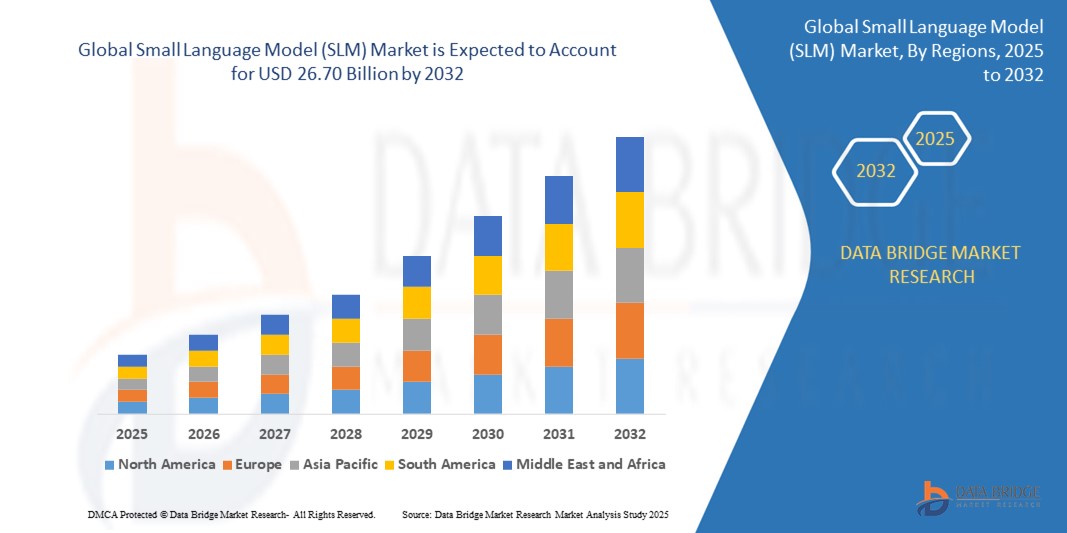
Small Language Model (SLM) Market Size
- The global Small Language Model (SLM) market size was valued at USD 5.3 billion in 2024 and is expected to reach USD 26.70 billion by 2032, at a CAGR of 22.40% during the forecast period
- The market growth is largely fueled by the increasing adoption of AI-powered automation and natural language processing across industries, leading to enhanced efficiency and improved user experiences in customer service, content creation, and data analysis
- Furthermore, rising demand for personalized, context-aware applications in healthcare, finance, retail, and legal sectors is establishing small language models as essential tools for intelligent decision-making and workflow optimization
Small Language Model (SLM) Market Analysis
- Small Language Models (SLMs), providing advanced natural language understanding and generation capabilities, are becoming essential components of modern AI-driven applications across multiple industries, including customer service, healthcare, finance, and retail, due to their ability to deliver personalized, context-aware interactions and automate complex language tasks
- The rising demand for SLMs is primarily driven by the rapid digital transformation, increasing adoption of AI-powered automation, and the growing need for efficient, scalable solutions that enhance user experience and streamline business processes
- North America dominated the Small Language Model (SLM) market with a share of 32.2% in 2024, due to widespread adoption of AI-powered applications across industries and strong investment in advanced AI research and infrastructure
- Asia-Pacific is expected to be the fastest growing region in the Small Language Model (SLM) market during the forecast period due to rapid digitalization, expanding internet penetration, and growing AI adoption across China, Japan, and India
- Machine learning based segment dominated the market with a market share of 55.6% in 2024, due to its versatility and cost-effectiveness in handling diverse language tasks. Its adoption is rising across industries that seek scalable solutions with moderate complexity and faster deployment times. Services, encompassing consulting, integration, and support, play a crucial role in facilitating the implementation and optimization of small language models, particularly for enterprises lacking in-house AI expertise
Report Scope and Small Language Model (SLM) Market Segmentation
|
Attributes |
Small Language Model (SLM) Key Market Insights |
|
Segments Covered |
|
|
Countries Covered |
North America
Europe
Asia-Pacific
Middle East and Africa
South America
|
|
Key Market Players |
|
|
Market Opportunities |
|
|
Value Added Data Infosets |
In addition to the market insights such as market value, growth rate, market segments, geographical coverage, market players, and market scenario, the market report curated by the Data Bridge Market Research team includes in-depth expert analysis, import/export analysis, pricing analysis, production consumption analysis, and pestle analysis. |
Small Language Model (SLM) Market Trends
“Increasing Cloud-based Deployment:”
- A significant and accelerating trend in the global Small Language Model (SLM) market is the increasing shift toward cloud-based deployment, enabling scalable, flexible, and cost-effective access to AI-powered language capabilities across industries
- For instance, OpenAI’s GPT models and Google’s Vertex AI provide cloud-hosted small language model services that allow businesses to integrate advanced language processing without heavy on-premises infrastructure investments
- Cloud deployment facilitates continuous model updates, seamless integration with other cloud services, and easier collaboration across teams, significantly improving accessibility and reducing time-to-market for AI applications
- Companies such as Microsoft Azure and Amazon Web Services (AWS) offer managed SLM platforms that support rapid development and deployment of natural language processing solutions, empowering enterprises to leverage cutting-edge AI without extensive technical overhead
- This trend toward cloud-based SLM deployment is driving broader adoption across sectors such as healthcare, finance, retail, and customer service, where scalable and reliable AI language solutions are critical for digital transformation
- The growing preference for cloud-hosted SLMs reflects the need for flexible, on-demand AI capabilities that can handle dynamic workloads, enabling organizations to innovate faster and deliver personalized user experiences at scale
Small Language Model (SLM) Market Dynamics
Driver
“Increasing Adoption of AI-Powered Automation”
- The increasing adoption of AI-powered automation across industries is a significant driver for the growing demand for Small Language Models (SLMs), as businesses seek to streamline operations, enhance productivity, and deliver intelligent, language-based user interactions
- For instance, in February 2024, Microsoft integrated small-scale AI language models into its Dynamics 365 suite, enabling automated customer responses, real-time data summarization, and natural language queries, allowing users to operate complex systems with simple text input
- As enterprises aim to reduce manual workloads and accelerate decision-making processes, SLMs provide efficient solutions for automating tasks such as customer service chatbots, document generation, and language translation, helping companies enhance user engagement and operational efficiency. Furthermore, the increasing deployment of AI assistants and virtual agents across sectors such as healthcare, finance, and retail is amplifying demand for compact, domain-specific language models that can deliver high performance with lower resource consumption
- The ability of SLMs to be fine-tuned for specific applications, combined with their lower cost of deployment compared to large language models, makes them particularly attractive for businesses adopting AI for the first time or expanding AI integration across various functions
- The trend towards AI-powered automation and the growing availability of pre-trained, cloud-hosted SLMs from providers such as OpenAI, Google Cloud, and AWS are expected to accelerate the adoption of these models across both SMEs and large enterprises
Restraint/Challenge
“Limited Model Size Restricting Accuracy and Contextual Understanding”
- Limited model size restricting accuracy and contextual understanding poses a significant challenge to the broader adoption of Small Language Models (SLMs), particularly in enterprise applications that demand nuanced, domain-specific responses
- For instance, while Meta’s LLaMA models and Cohere’s Command R+ are designed to operate efficiently at smaller scales, they often struggle with long-context comprehension or producing highly precise outputs required in sectors such as legal or healthcare
- Maintaining high-quality language generation with reduced computational resources forces developers to make trade-offs between efficiency and linguistic performance, especially when deploying SLMs in real-time or on edge devices
- As demand grows for compact, cost-effective AI tools that rival the capabilities of larger LLMs, overcoming the limitations of smaller architectures will require continued advancements in model design, training methodologies, and fine-tuning strategies
- Addressing this challenge through research innovation, investment in task-specific tuning, and improved training data quality will be essential to ensure SLMs can meet industry expectations without compromising performance
Small Language Model (SLM) Market Scope
The market is segmented on the basis of technology, deployment, and application.
- By Technology
On the basis of technology, the Small Language Model market is segmented into Deep Learning Based, Machine Learning Based, and Services. The Machine Learning Based segment accounted for the largest market revenue share of 55.6% in 2024, driven by its versatility and cost-effectiveness in handling diverse language tasks. Its adoption is rising across industries that seek scalable solutions with moderate complexity and faster deployment times. Services, encompassing consulting, integration, and support, play a crucial role in facilitating the implementation and optimization of small language models, particularly for enterprises lacking in-house AI expertise.
The Deep Learning Based segment is expected to witness the fastest growth rate from 2025 to 2032, fueled by its superior ability to understand complex language patterns and deliver more accurate and context-aware outputs. This technology benefits from continuous advancements in neural network architectures and vast datasets, making it the preferred choice for applications requiring high precision and adaptability.
- By Deployment
On the basis of deployment, the market is segmented into Cloud, On-premises, and Hybrid. The Cloud segment held the largest market revenue share of 45.3% in 2024, attributed to its scalability, cost-efficiency, and ease of access, enabling organizations to leverage small language models without heavy infrastructure investments. Cloud deployment also supports continuous model updates and seamless integration with other cloud services, enhancing functionality and user experience.
The Hybrid segment is expected to witness the fastest CAGR from 2025 to 2032, driven by enterprises’ growing demand for combining the flexibility of cloud computing with the security and control of on-premises infrastructure. Hybrid deployment suits industries with strict data privacy regulations, allowing sensitive data to remain on-site while benefiting from cloud capabilities. On-premises deployment remains significant for sectors requiring maximum control over data and models, especially in highly regulated environments.
- By Application
On the basis of application, the Small Language Model market is segmented into Consumer Applications, Enterprise Applications, Healthcare, Finance, Retail, Legal, Manufacturing, and Others. Consumer applications accounted for the largest market revenue share in 2024, fueled by increasing adoption in virtual assistants, chatbots, and personalized content generation. The ease of integration into everyday devices and services drives consumer engagement and demand.
The Enterprise Applications segment is expected to witness the fastest CAGR from 2025 to 2032, driven by growing needs for automated customer support, document processing, and knowledge management. Industries such as Healthcare and Finance benefit from specialized language models tailored for clinical documentation, fraud detection, and compliance, further accelerating adoption. Retail and Legal sectors increasingly leverage these models to enhance customer experience and streamline workflows, while Manufacturing uses language models for technical documentation and supply chain communication. The Others segment includes education, media, and government applications, which are also expanding due to growing digital transformation efforts.
Small Language Model (SLM) Market Regional Analysis
- North America dominated the Small Language Model (SLM) market with the largest revenue share of 32.2% in 2024, driven by widespread adoption of AI-powered applications across industries and strong investment in advanced AI research and infrastructure
- Organizations in the region highly value the integration of small language models in enhancing automation, improving customer interactions, and streamlining workflows in sectors such as healthcare, finance, and retail
- This adoption is further supported by technological expertise, high IT spending, and the presence of leading AI companies, establishing North America as a key hub for innovation and deployment of SLM solutions
U.S. Small Language Model Market Insight
U.S. SLM market captured the largest revenue share within North America in 2024, fueled by rapid digital transformation and demand for AI-driven tools to optimize business processes. Increasing use of virtual assistants, chatbots, and automated content generation contributes to market growth. The expanding focus on natural language understanding and customer experience enhancement, combined with strong government support for AI initiatives, further accelerates the market. Moreover, U.S.-based tech giants are continuously investing in developing sophisticated small language models, supporting widespread adoption across multiple sectors.
Europe Small Language Model Market Insight
The Europe SLM market is projected to grow steadily over the forecast period, driven by rising awareness of AI applications and supportive regulations fostering data privacy and responsible AI use. Increasing investments in AI research hubs and collaborations between industry and academia are propelling innovation. European enterprises are adopting SLMs to enhance operational efficiency, customer engagement, and compliance management, especially in finance, healthcare, and legal sectors.
U.K. Small Language Model Market Insight
The U.K. SLM market is expected to witness significant growth during the forecast period, driven by strong governmental focus on AI strategy and digital innovation. The rise in AI adoption across public services, finance, and retail sectors is boosting demand for small language models. In addition, growing startups and technology incubators are accelerating innovation and integration of AI-powered language solutions.
Germany Small Language Model Market Insight
The Germany SLM market is anticipated to expand at a robust CAGR, supported by its strong industrial base and emphasis on AI for Industry 4.0. Growing focus on data security, privacy, and ethical AI applications encourages adoption in manufacturing, legal, and healthcare sectors. Germany’s well-established AI research institutions and government initiatives promoting AI innovation further strengthen market growth.
Asia-Pacific Small Language Model Market Insight
The Asia-Pacific SLM market is poised for the fastest growth, with a CAGR between 2025 and 2032, driven by rapid digitalization, expanding internet penetration, and growing AI adoption across China, Japan, and India. Government initiatives promoting AI development and smart technologies are accelerating deployment. Increasing investments in AI startups and tech infrastructure are expanding accessibility and affordability of small language model solutions in the region.
Japan Small Language Model Market Insight
The Japan SLM market is gaining momentum due to its advanced technology ecosystem and focus on automation. Growing use of AI in consumer electronics, robotics, and enterprise applications drives demand. Japan’s aging population also fuels the need for AI solutions that enhance accessibility and efficiency, particularly in healthcare and customer service sectors. Integration of SLMs with IoT devices and smart systems supports continued market growth.
China Small Language Model Market Insight
China accounted for the largest revenue share in the Asia-Pacific SLM market in 2024, driven by government backing for AI development, an expanding digital economy, and a large base of technology companies investing in language AI. The push towards smart cities, e-commerce growth, and widespread mobile adoption supports demand across industries. Competitive pricing and rapid innovation from domestic AI firms are key factors sustaining market leadership in China.
Small Language Model (SLM) Market Share
The Small Language Model (SLM) industry is primarily led by well-established companies, including:
- OpenAI (U.S.)
- Anthropic (U.S.)
- Google DeepMind (U.K.)
- Cohere (Canada)
- Reka AI (U.S.)
- Zhipu AI (China)
- Nomic AI (U.S.)
- Stability AI (U.K.)
- LightOn (France)
- Sarvam AI (India)
- Arcee AI (U.S.)
- Prem Labs (U.S.)
- Meta AI (U.S.)
- Microsoft (U.S.)
- Salesforce AI (U.S.)
- Alibaba (China)
- Mosaic ML (U.S.)
- Technology Innovation Institute (TII) (U.A.E.)
- Hugging Face (U.S.)
Latest Developments in Global Small Language Model (SLM) Market
- In February 2025, Microsoft expanded its footprint in the SLM market with the launch of the Phi-4 series, including Phi-4-mini-instruct and Phi-4-multimodal. These models offer enhanced capabilities in reasoning, multilingual understanding, and coding, making them ideal for both enterprise and developer use. Their availability across platforms such as Hugging Face, Azure AI Foundry, and Ollama is expected to significantly broaden user access and accelerate adoption across various sectors
- In February 2025, IBM expanded its Granite model lineup to include multimodal and reasoning-focused models aimed at enterprise applications. With Granite Multimodal and Granite Reasoning, IBM is addressing a critical need for interpretable and logic-capable AI, potentially capturing a larger share of the enterprise-focused segment of the SLM market. These tools are designed for seamless integration and responsible adoption, enhancing AI-driven decision-making and automation
- In January 2025, Arcee AI strengthened its competitive position by releasing two new SLMs—Virtuoso-Lite and Virtuoso-Medium-v2—based on DeepSeek-V3. These models, especially Virtuoso-Medium-v2, which outperformed Arcee’s previous benchmarks, enhance performance in math and code applications. Their advanced architecture and proprietary techniques are likely to push innovation in academic and technical use cases within the SLM market
- In November 2024, Amazon reinforced its presence in the AI space by investing an additional USD 4 billion in Anthropic. This move, coupled with AWS Trainium-powered training for Claude models such as Claude 3.5 Haiku and Claude 3.5 Sonnet, underscores Amazon's ambition to lead in high-performance agentic models. The Claude series’ strong performance in coding tasks positions it as a major contributor to the commercial SLM landscape, especially in developer-focused applications
- In April 2024, Microsoft introduced ‘Phi-3-mini,’ a lightweight AI model aimed at bringing advanced language capabilities to a broader range of users at a lower cost. By making it available through platforms such as Microsoft Azure AI Model Catalog, Hugging Face, Ollama, and NVIDIA NIM, Microsoft is strengthening its position in the Small Language Model (SLM) market. This launch marks the beginning of its open SLM series, significantly enhancing accessibility and encouraging widespread adoption across industries

- Interactive Data Analysis Dashboard
- Company Analysis Dashboard for high growth potential opportunities
- Research Analyst Access for customization & queries
- Competitor Analysis with Interactive dashboard
- Latest News, Updates & Trend analysis
- Harness the Power of Benchmark Analysis for Comprehensive Competitor Tracking
Data collection and base year analysis are done using data collection modules with large sample sizes. The stage includes obtaining market information or related data through various sources and strategies. It includes examining and planning all the data acquired from the past in advance. It likewise envelops the examination of information inconsistencies seen across different information sources. The market data is analysed and estimated using market statistical and coherent models. Also, market share analysis and key trend analysis are the major success factors in the market report. To know more, please request an analyst call or drop down your inquiry.
The key research methodology used by DBMR research team is data triangulation which involves data mining, analysis of the impact of data variables on the market and primary (industry expert) validation. Data models include Vendor Positioning Grid, Market Time Line Analysis, Market Overview and Guide, Company Positioning Grid, Patent Analysis, Pricing Analysis, Company Market Share Analysis, Standards of Measurement, Global versus Regional and Vendor Share Analysis. To know more about the research methodology, drop in an inquiry to speak to our industry experts.
Data Bridge Market Research is a leader in advanced formative research. We take pride in servicing our existing and new customers with data and analysis that match and suits their goal. The report can be customized to include price trend analysis of target brands understanding the market for additional countries (ask for the list of countries), clinical trial results data, literature review, refurbished market and product base analysis. Market analysis of target competitors can be analyzed from technology-based analysis to market portfolio strategies. We can add as many competitors that you require data about in the format and data style you are looking for. Our team of analysts can also provide you data in crude raw excel files pivot tables (Fact book) or can assist you in creating presentations from the data sets available in the report.













