


Smart Active Packaging Market Overview
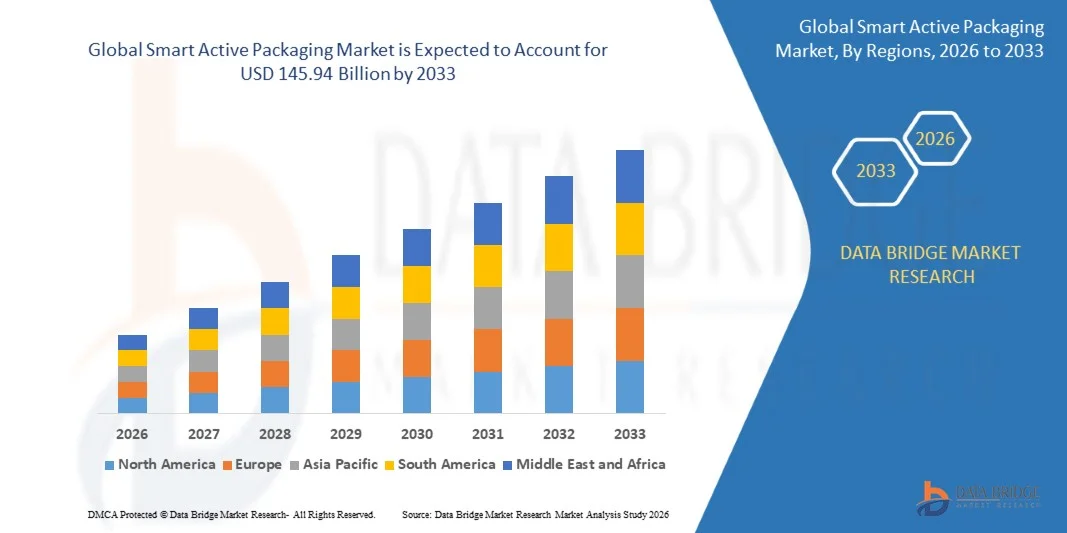
The Smart Active Packaging Market was valued at USD 70.1 Billion in 2025 and is projected to reach USD 145.94 Billion by 2033, growing at a CAGR of 9.60% from 2026 to 2033. The market is experiencing consistent growth driven by increasing demand for extended shelf-life solutions, rising adoption of intelligent packaging technologies, and growing emphasis on product safety, quality monitoring, and supply chain transparency. Expanding applications across food & beverages, pharmaceuticals, personal care, and e-commerce industries, coupled with advancements in sensor-enabled packaging, RFID technologies, and active preservation systems, are further supporting market expansion globally.
The increasing focus on reducing food waste, improving product traceability, and enhancing consumer engagement is encouraging manufacturers to adopt smart and active packaging solutions across diverse end-use sectors. Active packaging technologies such as oxygen scavengers, antimicrobial agents, and moisture regulators are increasingly being utilized to preserve product freshness and maintain quality throughout distribution networks. At the same time, smart packaging solutions incorporating QR codes, RFID tags, freshness indicators, and connected tracking systems are enabling real-time monitoring, authentication, and enhanced consumer interaction, driving the continued evolution of the global packaging industry.
Key Market Trends & Insights
- North America dominated the Smart Active Packaging Market with the largest revenue share of 34.5% in 2025, supported by strong demand for advanced food preservation technologies, high adoption of intelligent packaging solutions, and increasing focus on reducing product waste across supply chains
- The active segment led the market with a 58.4% share in 2025, driven by widespread adoption of technologies that actively enhance product quality, safety, and shelf life
- Asia-Pacific is expected to be the fastest-growing region at a CAGR of 9.95% from 2026 to 2033, fueled by rapid urbanization, expanding packaged food consumption, and increasing adoption of advanced packaging technologies across emerging economies
- Flexible packaging is the fastest-growing packaging type, projected to register a CAGR of 14.1% from 2026 to 2033, supported by rising demand for lightweight, convenient, and cost-efficient packaging solutions
- The rigid packaging segment dominated the packaging type category with a 55.2% revenue share in 2025, led by its extensive usage in food, beverage, pharmaceutical, and industrial packaging applications
- Plastic accounted for 46.8% of the market in 2025, preferred by its lightweight nature, cost-effectiveness, and strong compatibility with active and smart packaging technologies
- The smart segment is the fastest-growing technology category, with a CAGR of 13.8% from 2026 to 2033, driven by increasing digitalization of packaging and growing demand for real-time product monitoring
Market Size & Forecast
- Global Market Value (2025): USD 70.1 Billion
- Expected Market Value (2033): USD 145.94 Billion
- Forecast CAGR (2026–2033): 9.60%
- Leading Region in 2025: North America
- Fastest Growing Region: Asia-Pacific
Report Scope and Smart Active Packaging Market Segmentation
|
Attributes |
Smart Active Packaging Key Market Insights |
|
Segments Covered |
|
|
Countries Covered |
North America · U.S. · Canada · Mexico Europe · Germany · France · U.K. · Netherlands · Switzerland · Belgium · Russia · Italy · Spain · Turkey · Rest of Europe Asia-Pacific · China · Japan · India · South Korea · Singapore · Malaysia · Australia · Thailand · Indonesia · Philippines · Rest of Asia-Pacific Middle East and Africa · Saudi Arabia · U.A.E. · South Africa · Egypt · Israel · Rest of Middle East and Africa South America · Brazil · Argentina · Rest of South America |
|
Key Market Players |
· Avery Dennison Corporation (U.S.) · Mondi Group (Austria) · Ball Corporation (U.S.) · Huhtamaki Oyj (Finland) · WestRock Company (U.S.) · Tetra Pak International (Switzerland) · Mitsubishi Gas Chemical Company, Inc. (Japan) · Berry Global Inc. (U.S.) · Stora Enso Oyj (Finland) · Amcor plc (Switzerland) · AptarGroup, Inc. (U.S.) · Crown Holdings, Inc. (U.S.) · Thin Film Electronics ASA (Norway) · Sealed Air Corporation (U.S.) · Multisorb Technologies (U.S.) · BASF SE (Germany) · Coveris Holdings S.A. (Austria) · Zebra Technologies Corporation (U.S.) · Smurfit Kappa Group (Ireland) · 3M Company (U.S.) |
|
Market Opportunities |
· Expansion of Smart Packaging Applications in Pharmaceutical Cold Chain Logistics · Growing Adoption of Sustainable and Recyclable Active Packaging Materials · Increasing Integration of IoT, RFID, and QR-Based Consumer Engagement Solutions in Packaging |
|
Value Added Data Infosets |
In addition to the insights on market scenarios such as market value, growth rate, segmentation, geographical coverage, and major players, the market reports curated by the Data Bridge Market Research also include import export analysis, production capacity overview, production consumption analysis, price trend analysis, climate change scenario, supply chain analysis, value chain analysis, raw material/consumables overview, vendor selection criteria, PESTLE Analysis, Porter Analysis, and regulatory framework. |
Smart Active Packaging Market Trends
Trend: Growing Adoption of Smart Packaging Technologies
Manufacturers across food, pharmaceutical, and consumer goods industries are increasingly adopting smart packaging technologies to enhance product traceability, improve supply chain visibility, and strengthen consumer engagement. Solutions incorporating RFID tags, QR codes, NFC labels, freshness indicators, and temperature sensors are gaining significant traction as brands seek real-time monitoring and authentication capabilities. The growth of connected packaging is further supported by increasing digitalization across global supply chains and rising consumer demand for transparent product information.
Companies such as Avery Dennison have expanded their intelligent packaging offerings through advanced RFID and digital identification solutions. In October 2024, Avery Dennison launched AD Dura 2.0, a durable reusable RFID-enabled label designed to improve product tracking, lifecycle management, and sustainability performance across demanding logistics and industrial environments.
Smart Active Packaging Market Dynamics
Key Market Driver: Increasing Demand for Extended Shelf Life and Food Safety Solutions
The growing need to reduce food waste and maintain product quality throughout complex distribution networks is significantly driving demand for smart active packaging solutions. Active packaging technologies such as oxygen scavengers, antimicrobial agents, moisture absorbers, and ethylene absorbers help preserve freshness and extend product shelf life, particularly in food and beverage applications. Rising regulatory focus on food safety and increasing consumer preference for high-quality packaged products are further accelerating market adoption.
According to the United Nations Food and Agriculture Organization (FAO), approximately one-third of food produced globally is lost or wasted annually, encouraging manufacturers to adopt advanced packaging technologies that enhance preservation and reduce spoilage. Companies such as Multisorb Technologies and Mitsubishi Gas Chemical Company continue to expand active packaging solutions that support food safety and shelf-life optimization.s
Key Restraint/Challenge: High Implementation Costs
A major challenge in the Smart Active Packaging market is the high cost associated with integrating advanced packaging technologies into existing manufacturing and supply chain operations. Smart packaging systems often require investments in sensors, RFID infrastructure, digital tracking platforms, specialized materials, and data management systems. Small and medium-sized manufacturers frequently face difficulties in justifying the initial investment, particularly in price-sensitive markets where packaging costs directly impact product margins.
The implementation of intelligent packaging solutions also requires compatibility across logistics, retail, and inventory management systems, increasing deployment complexity. Advanced technologies such as connected sensors and digital traceability platforms can significantly raise packaging costs compared to conventional packaging formats, limiting adoption in certain end-use sectors.
Key Market Opportunity: Smart Packaging in Pharmaceutical Logistics
The rapid expansion of pharmaceutical cold-chain logistics and increasing demand for temperature-sensitive medicines are creating substantial growth opportunities for the Smart Active Packaging market. Pharmaceutical manufacturers are increasingly adopting intelligent packaging solutions to monitor temperature, humidity, handling conditions, and product authenticity throughout transportation and storage processes. These technologies help maintain drug efficacy, improve regulatory compliance, and reduce supply chain risks.
In April 2024, Avery Dennison partnered with Controlant to enhance real-time visibility across pharmaceutical supply chains through advanced digital identification and monitoring solutions. The collaboration highlights growing industry demand for smart packaging technologies that improve traceability, patient safety, and operational efficiency within global pharmaceutical logistics networks.
Smart Active Packaging Market Scope
The smart active packaging market is segmented on the basis of material, technology, packaging type, and end-user industry.
- By Material
On the basis of material, the Smart Active Packaging Market is segmented into Plastic, Paper & Paperboard, Glass, Metal, and Others. The Plastic segment dominated the market with the largest share of 46.8% in 2025, driven by its lightweight nature, cost-effectiveness, and strong compatibility with active and smart packaging technologies. Plastic materials support the integration of oxygen scavengers, moisture absorbers, freshness indicators, and RFID-enabled tracking systems without significantly increasing packaging weight. Food, beverage, pharmaceutical, and personal care manufacturers increasingly prefer plastic packaging due to its durability and ease of customization. The material also enables high-volume production while maintaining product protection and shelf-life performance. Continuous innovation in recyclable and bio-based plastics further strengthens the segment’s leadership position.
The Paper & Paperboard segment is projected to register the fastest growth at a CAGR of 12.7% from 2026 to 2033, driven by increasing demand for sustainable and environmentally friendly packaging solutions. Brand owners are actively shifting toward fiber-based packaging formats to meet regulatory requirements and consumer preferences for reduced plastic usage. Advances in smart labeling, printed sensors, and active coating technologies are enabling paper-based packaging to deliver enhanced functionality while maintaining recyclability. The rapid expansion of e-commerce and sustainable food packaging applications is creating significant growth opportunities for the segment. Rising investments in biodegradable and compostable packaging innovations are further accelerating adoption across global markets.
- By Technology
On the basis of technology, the Smart Active Packaging Market is segmented into Active and Smart. The Active segment dominated the market with a share of 58.4% in 2025, supported by widespread adoption of technologies that actively enhance product quality, safety, and shelf life. Oxygen scavengers, antimicrobial packaging, moisture regulators, and ethylene absorbers are increasingly used across food and pharmaceutical applications to minimize spoilage and product degradation. Manufacturers continue to prioritize active packaging solutions to reduce waste and improve supply chain efficiency. The technology offers measurable benefits in preserving freshness and extending product usability during transportation and storage. Strong demand from food and healthcare industries continues to reinforce its dominant market position.
The Smart segment is projected to register the fastest growth at a CAGR of 13.8% from 2026 to 2033, driven by increasing digitalization of packaging and growing demand for real-time product monitoring. Smart packaging technologies such as RFID tags, QR codes, temperature sensors, freshness indicators, and traceability systems are gaining traction across multiple industries. Companies are increasingly utilizing connected packaging solutions to improve inventory management, product authentication, and consumer engagement. Growing concerns regarding supply chain transparency and counterfeit prevention are supporting rapid adoption. Advancements in IoT-enabled packaging systems and intelligent labeling technologies are further accelerating segment expansion.
- By Packaging Type
On the basis of packaging type, the Smart Active Packaging Market is segmented into Rigid Packaging and Flexible Packaging. The Rigid Packaging segment dominated the market with the largest share of 55.2% in 2025, driven by its extensive usage in food, beverage, pharmaceutical, and industrial packaging applications. Rigid packaging formats provide superior protection against physical damage, contamination, and environmental factors while supporting integration of advanced active and smart packaging components. The segment benefits from strong demand for containers, bottles, trays, and cartons used in high-value product categories. Manufacturers prefer rigid structures for applications requiring enhanced durability and product stability. Continuous innovation in smart containers and intelligent closure systems further supports market dominance.
The Flexible Packaging segment is projected to register the fastest growth at a CAGR of 14.1% from 2026 to 2033, driven by rising demand for lightweight, convenient, and cost-efficient packaging solutions. Flexible formats enable easy integration of active packaging technologies while reducing material consumption and transportation costs. Food manufacturers increasingly adopt smart flexible packaging solutions to improve shelf-life monitoring and freshness preservation. The growing popularity of pouch-based packaging and sustainable packaging designs is supporting rapid market penetration. Expanding e-commerce activities and advancements in printed electronics are further contributing to strong segment growth.
- By End-use Industry
On the basis of end-use industry, the Smart Active Packaging Market is segmented into Food & Beverages, Pharmaceuticals & Healthcare, Personal Care & Cosmetics, Electronics & Industrial Goods, Logistics & E-commerce, and Others. The Food & Beverages segment dominated the market with the largest share of 41.6% in 2025, driven by the increasing need to maintain product freshness, safety, and quality throughout extended supply chains. Active packaging technologies help control moisture, oxygen, and microbial growth, while smart packaging solutions provide real-time monitoring of storage conditions and product integrity. Rising consumer demand for fresh, minimally processed, and packaged foods is encouraging adoption across the industry. Manufacturers are increasingly utilizing intelligent packaging to reduce food waste and strengthen traceability. Strong regulatory focus on food safety further reinforces the segment’s leadership position.
The Pharmaceuticals & Healthcare segment is projected to register the fastest growth at a CAGR of 14.5% from 2026 to 2033, driven by increasing requirements for product safety, compliance, and supply chain visibility. Smart packaging solutions are being adopted to monitor temperature-sensitive drugs, prevent counterfeiting, and enhance patient adherence. Active packaging technologies help maintain the stability and effectiveness of pharmaceutical products during storage and transportation. Growing demand for biologics, vaccines, and specialty medicines is creating significant opportunities for advanced packaging solutions. Increasing regulatory emphasis on drug traceability and quality assurance is further accelerating segment expansion.
Smart Active Packaging Market Regional Analysis
North America dominated the smart active packaging market and accounted for the largest revenue share of 34.5% in 2025, driven by strong demand for advanced food preservation technologies, high adoption of intelligent packaging solutions, and increasing focus on reducing product waste across supply chains. The region benefits from a highly developed food and beverage industry, stringent packaging safety regulations, and widespread integration of smart monitoring technologies. Manufacturers are increasingly investing in active packaging systems such as oxygen scavengers, antimicrobial packaging, and freshness indicators to enhance product quality and shelf life. Growing adoption of connected packaging solutions across pharmaceutical and consumer goods industries is further supporting market expansion. In addition, continuous innovation by packaging technology providers reinforces North America’s leadership position in the global market.
U.S. Smart Active Packaging Market Insight
The U.S. Smart Active Packaging market is experiencing strong growth driven by increasing demand for food safety, rising adoption of intelligent packaging technologies, and expanding use of active packaging solutions across healthcare and consumer goods sectors. Food manufacturers are actively implementing packaging systems that improve freshness retention and enhance product traceability throughout distribution networks. The country’s advanced packaging industry and strong investment in research and development are supporting continuous innovation in smart labeling and sensor technologies. Growing demand for sustainable and high-performance packaging formats is further accelerating adoption. In addition, increasing utilization of digital packaging platforms for consumer engagement continues to strengthen market growth across the U.S.
Canada Smart Active Packaging Market Insight
The Canada Smart Active Packaging market is witnessing steady growth supported by increasing consumer demand for sustainable packaging solutions and rising adoption of advanced food preservation technologies. Manufacturers are focusing on integrating active packaging components to improve product quality while reducing food waste throughout the supply chain. The country’s strong regulatory emphasis on food safety and environmental sustainability is encouraging investment in innovative packaging materials and technologies. Growing demand from pharmaceutical and healthcare sectors is further supporting adoption of intelligent packaging systems. In addition, expansion of packaged food consumption and e-commerce activities continues to contribute to market growth in Canada.
Europe Smart Active Packaging Market Insight
The Europe Smart Active Packaging market is expanding steadily due to increasing focus on sustainable packaging innovation, stringent product safety regulations, and growing demand for advanced shelf-life extension technologies. The region benefits from strong environmental policies that encourage development of recyclable and intelligent packaging solutions. Food and beverage manufacturers are increasingly utilizing active packaging technologies to improve freshness retention and reduce spoilage. Rising investments in smart labeling, traceability systems, and connected packaging platforms are supporting wider adoption across industries. In addition, continuous advancements in eco-friendly packaging materials continue to drive regional market expansion.
U.K. Smart Active Packaging Market Insight
The U.K. Smart Active Packaging market is growing steadily, driven by rising demand for sustainable food packaging, increasing adoption of intelligent labeling technologies, and growing focus on supply chain transparency. Businesses are actively implementing smart packaging systems to improve product tracking, consumer engagement, and quality assurance. The country’s strong retail and e-commerce sectors are creating significant opportunities for active and intelligent packaging solutions. Increasing consumer preference for environmentally responsible packaging products is encouraging innovation across the packaging industry. In addition, growing investments in digital packaging technologies are supporting market expansion in the U.K.
Germany Smart Active Packaging Market Insight
The Germany Smart Active Packaging market is expanding due to strong manufacturing capabilities, increasing adoption of sustainable packaging technologies, and growing demand for advanced product protection solutions. Food, pharmaceutical, and industrial manufacturers are increasingly deploying active packaging systems to enhance product stability and operational efficiency. The country’s emphasis on technological innovation and circular economy initiatives is accelerating the development of recyclable smart packaging formats. Rising implementation of sensor-enabled packaging and product authentication technologies is further supporting market growth. In addition, strong investment in research and development activities continues to strengthen Germany’s position within the European market.
Asia-Pacific Smart Active Packaging Market Insight
The Asia-Pacific Smart Active Packaging market is expected to register the fastest growth with a CAGR of 9.95% from 2026 to 2033, driven by rapid urbanization, expanding packaged food consumption, and increasing adoption of advanced packaging technologies across emerging economies. Rising disposable incomes and changing consumer lifestyles are creating strong demand for longer shelf-life and higher-quality packaged products. Countries such as China, India, Japan, and South Korea are witnessing substantial investments in smart packaging innovation and food safety infrastructure. Growing pharmaceutical manufacturing activities and increasing e-commerce penetration are further supporting market growth. In addition, rising awareness regarding product traceability and sustainability is accelerating regional market expansion.
Japan Smart Active Packaging Market Insight
The Japan Smart Active Packaging market is witnessing steady growth supported by advanced packaging technology adoption, strong food quality standards, and increasing demand for intelligent product monitoring systems. Manufacturers are utilizing active packaging solutions to improve freshness preservation and maintain product integrity during transportation and storage. The country’s mature consumer goods and healthcare sectors continue to create strong demand for innovative packaging technologies. Growing focus on automation and smart manufacturing practices is supporting integration of intelligent packaging systems. In addition, rising investments in sustainable packaging development are strengthening market growth in Japan.
China Smart Active Packaging Market Insight
The China Smart Active Packaging market is growing rapidly due to expanding food processing industries, increasing demand for packaged consumer goods, and rising adoption of advanced packaging technologies. Manufacturers are investing heavily in active and smart packaging systems to improve product safety, traceability, and shelf-life performance. The country’s large-scale e-commerce ecosystem is driving demand for packaging solutions that enhance product protection and logistics efficiency. Strong government support for food safety modernization and industrial innovation is further supporting market expansion. In addition, growing consumer preference for high-quality and technology-enabled packaging solutions continues to accelerate market growth in China.
Smart Active Packaging Market Share
The smart active packaging industry is primarily led by well-established companies, including:
- Avery Dennison Corporation (U.S.)
- Mondi Group (Austria)
- Ball Corporation (U.S.)
- Huhtamaki Oyj (Finland)
- WestRock Company (U.S.)
- Tetra Pak International (Switzerland)
- Mitsubishi Gas Chemical Company, Inc. (Japan)
- Berry Global Inc. (U.S.)
- Stora Enso Oyj (Finland)
- Amcor plc (Switzerland)
- AptarGroup, Inc. (U.S.)
- Crown Holdings, Inc. (U.S.)
- Thin Film Electronics ASA (Norway)
- Sealed Air Corporation (U.S.)
- Multisorb Technologies (U.S.)
- BASF SE (Germany)
- Coveris Holdings S.A. (Austria)
- Zebra Technologies Corporation (U.S.)
- Smurfit Kappa Group (Ireland)
- 3M Company (U.S.)
Latest Developments in Smart Active Packaging Market
- In February 2025, Kezzler expanded its smart packaging and QR code consumer engagement capabilities to strengthen product traceability, supply chain transparency, and direct consumer interaction. This development enhanced the company’s position in the smart active packaging market by enabling brands to deliver greater product authentication, sustainability information, and real-time tracking features, supporting the growing demand for connected packaging solutions
- In April 2025, Packsize introduced high-throughput fit-to-size automated packaging technology, enhancing its portfolio of intelligent and sustainable packaging solutions. The innovation strengthened the smart active packaging market by improving packaging efficiency, reducing material waste, optimizing logistics operations, and supporting increasing industry demand for automated and environmentally responsible packaging systems
- In October 2024, Avery Dennison launched AD Dura 2.0, a reinforced reusable label solution designed to withstand water, heat, vibration, and shock in demanding operating environments. The launch advanced the smart active packaging market by expanding the adoption of durable RFID-enabled tracking solutions, improving product lifecycle management, enhancing asset visibility, and supporting waste reduction and circular economy initiatives
- In April 2024, Avery Dennison partnered with Controlant to improve real-time end-to-end visibility across pharmaceutical supply chains through advanced digital identification and monitoring technologies. This collaboration strengthened the smart active packaging market by accelerating the adoption of intelligent tracking solutions, improving product integrity and compliance, and supporting sustainability goals within the healthcare and pharmaceutical sectors
- In October 2023, Multi-Color Corporation (MCC) acquired Starport Technologies, a provider of smart label solutions, to expand its intelligent labeling and connected packaging capabilities. The acquisition strengthened MCC’s position in the smart active packaging market by enhancing its technology portfolio, increasing innovation in smart labeling applications, and supporting growing demand for traceability, authentication, and consumer engagement solutions

- Interactive Data Analysis Dashboard
- Company Analysis Dashboard for high growth potential opportunities
- Research Analyst Access for customization & queries
- Competitor Analysis with Interactive dashboard
- Latest News, Updates & Trend analysis
- Harness the Power of Benchmark Analysis for Comprehensive Competitor Tracking
Global Smart Active Packaging Market, Supply Chain Analysis and Ecosystem Framework
To support market growth and help clients navigate the impact of geopolitical shifts, DBMR has integrated in-depth supply chain analysis into its Global Smart Active Packaging Market research reports. This addition empowers clients to respond effectively to global changes affecting their industries. The supply chain analysis section includes detailed insights such as Global Smart Active Packaging Market consumption and production by country, price trend analysis, the impact of tariffs and geopolitical developments, and import and export trends by country and HSN code. It also highlights major suppliers with data on production capacity and company profiles, as well as key importers and exporters. In addition to research, DBMR offers specialized supply chain consulting services backed by over a decade of experience, providing solutions like supplier discovery, supplier risk assessment, price trend analysis, impact evaluation of inflation and trade route changes, and comprehensive market trend analysis.
Data collection and base year analysis are done using data collection modules with large sample sizes. The stage includes obtaining market information or related data through various sources and strategies. It includes examining and planning all the data acquired from the past in advance. It likewise envelops the examination of information inconsistencies seen across different information sources. The market data is analysed and estimated using market statistical and coherent models. Also, market share analysis and key trend analysis are the major success factors in the market report. To know more, please request an analyst call or drop down your inquiry.
The key research methodology used by DBMR research team is data triangulation which involves data mining, analysis of the impact of data variables on the market and primary (industry expert) validation. Data models include Vendor Positioning Grid, Market Time Line Analysis, Market Overview and Guide, Company Positioning Grid, Patent Analysis, Pricing Analysis, Company Market Share Analysis, Standards of Measurement, Global versus Regional and Vendor Share Analysis. To know more about the research methodology, drop in an inquiry to speak to our industry experts.
Data Bridge Market Research is a leader in advanced formative research. We take pride in servicing our existing and new customers with data and analysis that match and suits their goal. The report can be customized to include price trend analysis of target brands understanding the market for additional countries (ask for the list of countries), clinical trial results data, literature review, refurbished market and product base analysis. Market analysis of target competitors can be analyzed from technology-based analysis to market portfolio strategies. We can add as many competitors that you require data about in the format and data style you are looking for. Our team of analysts can also provide you data in crude raw excel files pivot tables (Fact book) or can assist you in creating presentations from the data sets available in the report.













