What is the Smart and Mobile Supply Chain Solutions Market Size and Growth Rate?
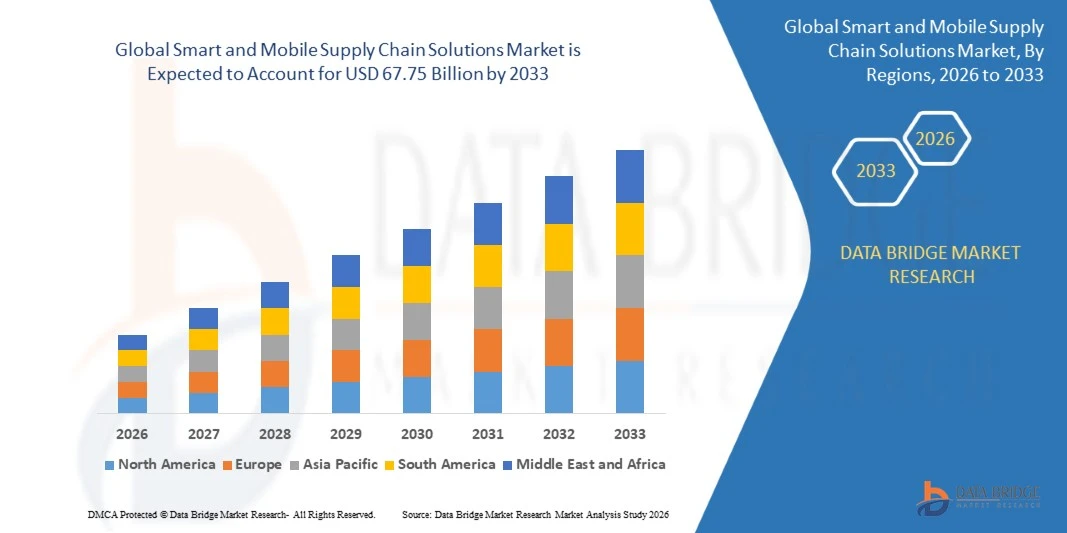
- As per Data Bridge Market Research analysis, the smart and mobile supply chain solutions market was valued at USD 24.56 Billion in 2025 and is projected to reach USD 67.75 Billion by 2033, growing at a CAGR of 13.52% from 2026 to 2033.
- The market is experiencing consistent growth driven by rising demand for real-time shipment and inventory visibility, increasing adoption of AI-enabled planning and execution tools, and expanding use of mobile devices across retail, manufacturing, logistics, healthcare, and food and beverage supply networks.
- The increasing shift toward connected supply networks, mobile-first workforce tools, and autonomous exception handling, combined with growing integration of IoT sensors, cloud platforms, and analytics, is supporting market adoption. Smart and mobile supply chain solutions are being applied across supply chain management, artificial intelligence driven planning, and warehouse management, offering users greater visibility and faster decisions from the warehouse floor to the delivery vehicle.
Market Size & Forecast
- Global Market Value (2025): USD 24.56 Billion
- Expected Market Value (2033): USD 67.75 Billion
- Forecast CAGR (2026–2033): 13.52%
- Leading Region in 2025: North America
- Fastest Growing Region: Asia-Pacific
What are the Major Takeaways of the Smart and Mobile Supply Chain Solutions Market?
- North America dominated the smart and mobile supply chain solutions market with the largest revenue share of 37.80% in 2025, supported by early adoption of cloud supply chain platforms, a large retail and e-commerce base, and the presence of leading software and logistics technology providers.
- Asia-Pacific is expected to be the fastest-growing region at a CAGR of 16.20% from 2026 to 2033, fueled by rapid e-commerce expansion, growing cross-border trade, and rising investment in logistics digitization.
- The software segment led the component category with a 46.30% share in 2025, driven by increasing adoption of visibility, planning, and execution platforms.
- Services are the fastest-growing component, projected to register a CAGR of 15.10%, reflecting rising demand for implementation, integration, managed visibility, and AI deployment support.
- The cloud segment dominated the deployment category with a 57.90% revenue share in 2025, led by the ease of scaling, rapid updates, and multi-party data sharing.
- Fleet and transportation management accounted for 34.10% of the market share in 2025, preferred for real-time tracking, route optimization, and delivery exception management.
- Inventory and asset tracking is the fastest-growing application category, with a CAGR of 15.60%, driven by increasing demand for item-level and returnable-asset visibility.
Report Scope and Smart and Mobile Supply Chain Solutions Market Segmentation
|
Attributes |
Smart and Mobile Supply Chain Solutions Key Market Insights |
|
Segments Covered |
|
|
Countries Covered |
North America
Europe
Asia-Pacific
Middle East and Africa
South America
|
|
Key Market Players |
|
|
Market Opportunities |
|
|
Value Added Data Infosets |
In addition to the market insights such as market value, growth rate, market segments, geographical coverage, market players, and market scenario, the market report curated by the Data Bridge Market Research team includes in-depth expert analysis, import/export analysis, pricing analysis, production consumption analysis, and pestle analysis. |
What is the Key Trend in the Smart and Mobile Supply Chain Solutions Market?
- Smart and mobile supply chain solutions are evolving from tracking and reporting tools into autonomous decision platforms, combining real-time data networks, mobile access, and AI agents that detect and resolve disruptions with limited human input.
- For instance, in February 2026, according to project44, its platform deployed AI agents that autonomously detect and resolve supply chain exceptions and visibility gaps, and its stakeholder workflows shortened time to resolution by more than 40% and saved an estimated 10 hours of manual effort per team member each week.
- Mobile-first design is becoming standard, as supply chain teams increasingly work on warehouse floors, loading docks, and in vehicles rather than at desktops, and need alerts and approvals delivered on the device in hand.
- For instance, in February 2026, according to Surgere, the next evolution of its Interius platform became fully responsive across desktops, tablets, and mobile devices, added agentic AI access, and announced over-the-road asset tracking planned for later in 2026 to complete an end-to-end visibility loop.
- As IoT sensors, cloud data networks, agentic AI, and mobile access continue to advance, smart and mobile supply chain solutions are expected to move beyond visibility into autonomous planning, execution, and exception resolution across the full supply network.
What are the Key Drivers of the Smart and Mobile Supply Chain Solutions Market?
- The need to protect delivery performance and working capital in volatile trade conditions has significantly increased demand for platforms that give real-time visibility and let teams act on disruptions the same day.
- For instance, in August 2026, according to the U.S. Census Bureau, U.S. retail e-commerce sales reached USD 340.2 billion in the second quarter of 2026, up 12.2% from a year earlier and equal to 17.1% of total retail sales, increasing the volume of orders and parcels that supply networks must track and fulfil.
- Retailers, manufacturers, third-party logistics providers, and healthcare distributors are increasingly deploying connected platforms to reduce manual follow-up, prevent stockouts, and improve the accuracy of inventory and shipment data.
- For instance, in October 2026, according to the World Trade Organization, world merchandise trade volume is forecast to grow 3.9% in 2026, up from a March forecast of 1.9%, with AI-enabling goods such as semiconductors and servers accounting for 47% of merchandise trade growth in the first half of 2026.
- With organizations demanding faster decisions and fewer manual touchpoints, smart and mobile supply chain solutions can support higher service levels, lower inventory buffers, and quicker response across the supply network.
What Factors Are Challenging the Growth of the Smart and Mobile Supply Chain Solutions Market?
- Smart and mobile supply chain solutions depend on connected devices, cloud platforms, carrier integrations, and shared data, which increases exposure to cyberattacks and third-party failures across the supply network.
- For instance, in October 2025, according to the European Union Agency for Cybersecurity (ENISA), its Threat Landscape 2025 report analysed 4,875 incidents between July 2024 and June 2025 and found that the transport sector accounted for 7.5% of them, with supply chain compromise among the techniques used against logistics networks.
- These risks, together with integration with legacy systems, data quality gaps between partners, and the cost of rolling out devices and training, can slow deployment and extend payback periods.
- The concentration of data and operations within a few logistics providers and software vendors can also turn a single incident into a multi-sector disruption.
- For instance, in August 2026, according to IT Brief citing NCC Group, a cyberattack on Ceva Logistics became a wider supply chain incident affecting several organizations, with NCC Group noting that attackers can create widespread disruption by breaching one trusted supplier.
- The combination of cybersecurity exposure, legacy integration complexity, and implementation cost can constrain adoption among smaller organizations and in regions with limited digital infrastructure.
How is the Smart and Mobile Supply Chain Solutions Market Segmented?
The smart and mobile supply chain solutions market is segmented on the basis of component, deployment, application, and end user.
- By Component
On the basis of component, the smart and mobile supply chain solutions market is segmented into software, hardware, and services. The software segment dominated the market with 46.30% share in 2025, supported by increasing adoption of visibility, planning, execution, and analytics platforms. Software enables organizations to unify data from carriers, warehouses, suppliers, and sensors in a single view. Subscription models lower upfront cost and speed up deployment. Regular releases bring new analytics and AI features without major rework. Open interfaces make it easier to connect enterprise resource planning and transportation systems.
The services segment is projected to register the fastest growth at a CAGR of 15.10% from 2026 to 2033, driven by growing demand for implementation, systems integration, managed visibility, and AI deployment support. Companies often lack in-house skills to connect legacy systems, clean master data, and redesign workflows around new tools. Managed services allow providers to monitor exceptions and run control towers on behalf of customers. Training and change management are becoming important as mobile and agent-based tools reach frontline staff. Continuous optimization contracts create recurring revenue for service providers.
- By Deployment
On the basis of deployment, the smart and mobile supply chain solutions market is segmented into on-premise, cloud, and hybrid. The cloud segment dominated the market with 57.90% share in 2025, supported by ease of scaling, rapid updates, and the ability to share data across multiple trading partners. Cloud platforms support mobile access without custom infrastructure. They allow carriers, suppliers, and customers to connect to a common network. Pay-as-you-grow pricing suits organizations with seasonal volume swings. Faster rollout across sites and countries further strengthens adoption.
The hybrid segment is projected to register the fastest growth at a CAGR of 16.40% from 2026 to 2033, driven by organizations that need to keep latency-sensitive warehouse and plant systems local while using the cloud for planning and analytics. Hybrid models also help meet data residency and security requirements in regulated industries. They allow gradual migration from legacy systems without disrupting operations. Edge processing at warehouses and vehicles supports continued operation during connectivity gaps. Vendors are increasingly offering flexible architectures to serve these needs.
- By Application
On the basis of application, the smart and mobile supply chain solutions market is segmented into fleet and transportation management, inventory and asset tracking, warehouse management, order management, and others. The fleet and transportation management segment dominated the application category with 34.10% share in 2025, supported by demand for real-time shipment tracking, route optimization, and delivery exception management. Mobile apps give drivers and dispatchers instant updates and proof of delivery. Predictive arrival estimates reduce idle time at docks. Carrier integrations allow shippers to see multimodal movements in one place. Rising customer expectations for delivery transparency add further demand.
The inventory and asset tracking segment is projected to register the fastest growth at a CAGR of 15.60% from 2026 to 2033, driven by increasing demand for item-level, pallet-level, and returnable-asset visibility. Low-cost tags and sensors make it practical to track more items at lower cost. Accurate location and condition data helps reduce shrinkage, loss of reusable packaging, and stockouts. Integration with warehouse and production systems allows automated replenishment decisions. Growth in cold-chain and regulated goods monitoring is creating additional opportunities.
- By End User
On the basis of end user, the smart and mobile supply chain solutions market is segmented into retail and e-commerce, manufacturing, transportation and logistics, healthcare and life sciences, food and beverage, and others. The retail and e-commerce segment dominated the end-user category with 28.70% share in 2025, supported by omnichannel fulfillment, fast delivery expectations, and high order volumes. Retailers use mobile tools for store replenishment, click-and-collect, and returns. Real-time inventory accuracy across stores and warehouses reduces lost sales. Platforms that predict delays help protect delivery promises during peak seasons.
The healthcare and life sciences segment is projected to register the fastest growth at a CAGR of 15.90% from 2026 to 2033, driven by serialization requirements, temperature-controlled logistics, and the need for end-to-end traceability of medicines and medical products. Network-based platforms allow manufacturers, distributors, and dispensers to exchange verified data. Automated exception handling reduces the risk of product loss and compliance gaps. Mobile scanning at hospitals and pharmacies improves accuracy. Growing complexity of biologics and cell therapy logistics is creating additional demand.
Which Region Holds the Largest Share of the Smart and Mobile Supply Chain Solutions Market?
- North America dominated the smart and mobile supply chain solutions market with the largest revenue share of 37.80% in 2025, supported by early adoption of cloud supply chain platforms, a large retail and e-commerce sector, and strong demand for visibility across long-distance freight networks.
- The region also benefits from the presence of leading software and logistics technology providers, high smartphone and tablet penetration among frontline workers, and strong investment in warehouse and fleet technology. Increasing use of AI-enabled visibility and execution tools continues to strengthen North America’s position in the global market.
U.S. Smart and Mobile Supply Chain Solutions Market Insight
The U.S. smart and mobile supply chain solutions market is witnessing strong growth due to rising adoption of AI-enabled visibility, mobile workforce tools, and connected asset tracking across retail, manufacturing, healthcare, and logistics. The country’s large freight network, concentration of technology providers, and strong investment in warehouse and fleet technology are driving demand for advanced platforms. In addition, growing focus on cybersecurity, delivery speed, and inventory accuracy is accelerating adoption of smart supply chain solutions across commercial and industrial operations.
Asia-Pacific Smart and Mobile Supply Chain Solutions Market Insight
The Asia-Pacific smart and mobile supply chain solutions market is expected to witness rapid growth, driven by expanding e-commerce, rising cross-border trade, and increasing investments in logistics digitization across countries such as China, India, and Japan. Growing demand for parcel tracking, multimodal visibility, and mobile-based fleet management is supporting regional market expansion. In addition, the region’s manufacturing base and large logistics workforce are accelerating demand for platforms that coordinate carriers, warehouses, and customs across multiple countries.
Japan Smart and Mobile Supply Chain Solutions Market Insight
The Japan smart and mobile supply chain solutions market is witnessing consistent growth due to labor shortages in logistics, demand for precise delivery, and investments in warehouse automation. Retailers, manufacturers, and logistics firms are increasingly adopting digital tools to improve driver productivity, route planning, and inventory accuracy. Moreover, strong demand for reliability, cold-chain monitoring, and advanced digital workflows is further contributing to market growth in Japan.
China Smart and Mobile Supply Chain Solutions Market Insight
The China smart and mobile supply chain solutions market is growing rapidly, driven by massive e-commerce volumes, an extensive express delivery network, and large-scale manufacturing. Growing use of mobile platforms by couriers, warehouse staff, and merchants is significantly boosting demand for real-time tracking and coordination tools. In addition, strong domestic technology providers and rapid adoption of AI-based demand forecasting and routing are positioning China as a key growth market for smart supply chain solutions across Asia-Pacific.
U.K. Smart and Mobile Supply Chain Solutions Market Insight
The U.K. smart and mobile supply chain solutions market is experiencing steady growth, supported by growth in online retail, post-Brexit trade documentation needs, and the adoption of digital tools across ports and logistics providers. Retailers, hauliers, and contract logistics firms are increasingly utilizing mobile and cloud platforms to improve visibility and delivery performance. Furthermore, rising attention to supply chain cyber resilience, following incidents affecting logistics providers, is supporting investment in secure, well-integrated platforms in the U.K.
Germany Smart and Mobile Supply Chain Solutions Market Insight
The Germany smart and mobile supply chain solutions market is expanding steadily due to the country’s strong manufacturing base, central position in European freight networks, and presence of leading enterprise software and supply chain planning vendors. Manufacturers, automotive suppliers, and logistics operators are increasingly utilizing connected platforms for just-in-time deliveries, returnable asset management, and transport visibility. Continuous advancements in industrial IoT and AI, along with Germany’s emphasis on data protection and reliability, are further driving market growth in the country.
Which are the Top Companies in Smart and Mobile Supply Chain Solutions Market?
The smart and mobile supply chain solutions industry is primarily led by well-established companies, including:
- SAP SE (Germany)
- Oracle Corporation (U.S.)
- Manhattan Associates, Inc. (U.S.)
- Blue Yonder Group, Inc. (U.S.)
- project44, Inc. (U.S.)
- Descartes Systems Group Inc. (Canada)
- Zebra Technologies Corporation (U.S.)
- Kinaxis Inc. (Canada)
- Körber Supply Chain Software (Germany)
- Infor, Inc. (U.S.)
- E2open Parent Holdings, Inc. (U.S.)
- Trimble Inc. (U.S.)
- Samsara Inc. (U.S.)
- FourKites, Inc. (U.S.)
- Honeywell International Inc. (U.S.)
- Coupa Software Inc. (U.S.)
- GEP Worldwide (U.S.)
- Epicor Software Corporation (U.S.)
- TraceLink, Inc. (U.S.)
- Surgere, Inc. (U.S.)
What are Latest Developments in Smart and Mobile Supply Chain Solutions Market?
- In April 2026, Descartes Systems Group introduced its Fleet Data Intelligence platform on the Descartes Global Logistics Network, combining an AI agent named René with machine learning to improve on-time delivery and reduce cost per delivery, and reported route density gains of up to 30% in early deployments.
- In April 2026, Zebra Technologies showcased its WS501-R hands-free RFID wearable computer and the AI-optimized TC501 and TC701 mobile computers at MODEX 2026 in Atlanta, positioning mobile devices as computer vision endpoints able to run frontline AI agents.
- In April 2026, project44 announced a portfolio of AI agents covering freight procurement, disruption response, and carrier onboarding, supported by a network connecting more than 259,000 carriers across 186 countries and territories and processing over 700 million logistics events daily.
- In March 2026, Blue Yonder announced an expanded set of AI agents and role-specific mobile applications for its planning and execution solutions, including an Orchestrator mobile application that gives teams direct access to its agentic AI from anywhere.
- In January 2026, Manhattan Associates announced commercial availability of AI agents embedded across its Manhattan Active platform, including a Labour Agent for workforce deployment, with agents built in Manhattan Agent Foundry compatible with A2A and MCP communication standards.
- Interactive Data Analysis Dashboard
- Company Analysis Dashboard for high growth potential opportunities
- Research Analyst Access for customization & queries
- Competitor Analysis with Interactive dashboard
- Latest News, Updates & Trend analysis
- Harness the Power of Benchmark Analysis for Comprehensive Competitor Tracking
Data collection and base year analysis are done using data collection modules with large sample sizes. The stage includes obtaining market information or related data through various sources and strategies. It includes examining and planning all the data acquired from the past in advance. It likewise envelops the examination of information inconsistencies seen across different information sources. The market data is analysed and estimated using market statistical and coherent models. Also, market share analysis and key trend analysis are the major success factors in the market report. To know more, please request an analyst call or drop down your inquiry.
The key research methodology used by DBMR research team is data triangulation which involves data mining, analysis of the impact of data variables on the market and primary (industry expert) validation. Data models include Vendor Positioning Grid, Market Time Line Analysis, Market Overview and Guide, Company Positioning Grid, Patent Analysis, Pricing Analysis, Company Market Share Analysis, Standards of Measurement, Global versus Regional and Vendor Share Analysis. To know more about the research methodology, drop in an inquiry to speak to our industry experts.
Data Bridge Market Research is a leader in advanced formative research. We take pride in servicing our existing and new customers with data and analysis that match and suits their goal. The report can be customized to include price trend analysis of target brands understanding the market for additional countries (ask for the list of countries), clinical trial results data, literature review, refurbished market and product base analysis. Market analysis of target competitors can be analyzed from technology-based analysis to market portfolio strategies. We can add as many competitors that you require data about in the format and data style you are looking for. Our team of analysts can also provide you data in crude raw excel files pivot tables (Fact book) or can assist you in creating presentations from the data sets available in the report.